Prof. Senthold Asseng is a Professor of Digital Agriculture at the Technical University of Munich (TUM), leading the Hans Eisenmann Forum for Agricultural Sciences since 2021. His research focuses on climate-plant-soil systems modeling, addressing global food security, sustainable agriculture, and digital technologies like vertical farming and autonomous robotics. He holds a PhD from Humboldt University Berlin and habilitation from TUM, with prior roles at CSIRO Australia and the University of Florida (as Full Professor and Director of the Florida Climate Institute). His honors include AAAS Fellow, Web of Science Highly Cited Researcher, and multiple teaching/mentorship awards. Education: BSc/MSc in Agronomy & Horticulture, Humboldt University Berlin (1989-1990) PhD in Agronomy, Humboldt University Berlin (1994) Habilitation in Agronomy, TUM (2004) Research Interests: Climate change impacts on crops, digital agriculture technologies, systems analysis for autonomous farming, and vertical farming sustainability. His work integrates modeling, robotics, and environmental control to enhance agricultural resilience and productivity. Awards: AAAS Fellow (2019) Highly Cited Researcher (2019) UF Research Foundation Professor (2016-2019) Grants & Leadership: Led interdisciplinary projects like AgMIP-Wheat, SECC, and FAO advisory roles. Active in editorial roles for journals like Global Change Biology and Environmental Research Letters . Labs/Teams: Chair of Digital Agriculture at TUM, collaborating on projects like Smartfield and Proteins4Singapore , focusing on automation, controlled environment agriculture, and climate-smart solutions.
Prof. Dr. Johannes Sauer is a Professor at the Technical University of Munich (TUM), holding dual affiliations with the TUM School of Management and the TUM School of Life Sciences . His academic focus is on production and resource economics, with expertise in agricultural sustainability, policy evaluation, and circular economy strategies in Asia-Pacific and Latin America. Education: Bachelor’s/Master’s in Agricultural Economics from Universities of Tübingen, Hamburg, and Imperial College London. Doctorate (summa cum laude) in Agricultural Economics from the University of Bonn (2004). Research Interests: Prof. Sauer’s work spans productivity and resilience in agricultural systems, adoption of sustainable technologies, water resource valuation, and bioeconomic trends. He emphasizes smart technologies and circular economy applications in developing regions. His research employs econometric methods to analyze policy impacts and environmental-economic trade-offs. Key Trends in Publications: Recent articles highlight climate-smart agriculture, ICT adoption in rural China, and agroforestry’s role in reducing ecological-economic trade-offs. He explores behavioral drivers of policy participation and innovative tools like the IoFarm decision support system. Awards: 2021 Honorary Professorship at ANU OECD Fellow Awards (2010, 2016) Best Paper Awards (2008–2015) Consulting & Roles: OECD and Asian Development Bank consultant, ESRC Peer Review College member, and liaison lecturer for the German National Academic Foundation. He advises on agri-environmental policies and international development. Labs/Teams: Active in collaborative projects such as PONDERFUL Framework and IPM Popilia , focusing on nexus research and pest management strategies.
Thomas Berger is a Professor at the University of Hohenheim , affiliated with the Faculty of Agricultural Sciences and leading the Department of Economics of Land Use . He also contributes to the Computational Science Hub and Hohenheim Tropics initiatives. Focus Areas: Climate change adaptation, land-use modeling, biodiversity-productivity trade-offs, agent-based simulation, and machine learning in agricultural systems. Key Projects: Simulation frameworks for smallholder resilience in Ethiopia, bioeconomic modeling in the Amazon, and hybrid intelligence applications in European agricultural policy. Recent Publications: 2025 study on climate change effects on insecticide reduction in Germany, 2024 work on reconciling biodiversity with productivity via hybrid models, and 2023 methodological contributions to surrogate modeling and seasonal forecast integration. Research Trends: Interdisciplinary integration of climate science, agricultural economics, and computational modeling, with increasing emphasis on AI-assisted decision support systems and sustainability policy validation. Teaching & Outreach: Offers Agricultural Economics seminars and Hohenheim Tropics discussions, requiring advance email registration for office hours.
Eugene Rogan is Professor of Modern Middle Eastern History at the University of Oxford and a Fellow of St Antony's College, where he also serves as Director of the Middle East Centre. He is affiliated with the Faculty of Asian and Middle Eastern Studies, a leading center for area studies in the UK. His research focuses on the modern history of the Arab world, particularly during the 18th to 20th centuries. Key areas include the Arab provinces of the Ottoman Empire, the First World War in the Middle East, and the 1948 Palestine War. His current project re-examines the 1860 massacres in Damascus as a case of sectarian conflict and state reconstruction. Rogan’s publications have significantly shaped the historiography of the modern Middle East. His recent books, such as The Arabs: A History and The Fall of the Ottomans , reflect a consistent engagement with themes of empire, resistance, and national identity. The articles and books listed demonstrate a strong emphasis on military, political, and social transformations in the region, with recurring attention to colonialism, state formation, and collective memory. Fellow of the British Academy (2017) He teaches undergraduate and postgraduate courses, including The Middle East in the Age of Empire, 1830–1971 and The History of the Middle East, 1860–1970 . While no students or grants are explicitly listed, his leadership of the Middle East Centre indicates active mentorship and research direction. He is involved in public-facing scholarship, regularly participating in lectures and media engagements. Rogan leads the Middle East Centre at St Antony's College, a hub for interdisciplinary research, conferences, and publications on the region. The center fosters collaboration among scholars, policymakers, and public intellectuals, amplifying the impact of his academic work.
Helmholtz Centre for Environmental ResearchGermany
Prof. Dr. Ralf Merz serves as Head of the Department of Catchment Hydrology at the Helmholtz Centre for Environmental Research (UFZ) and holds a Full Professorship in Catchment Hydrology at Martin-Luther University Halle-Wittenberg since 2011. His career bridges hydrological modeling, flood risk assessment, and water quality analysis across diverse climates from Central Asia to Europe. MSc in Civil Engineering (Technical University of Karlsruhe, 1997) PhD in Hydrology (Vienna University of Technology, 2002) Habilitation in Hydrology (Vienna University of Technology, 2009) Research Interests span comparative hydrology, flood generation mechanisms, climate change impacts on water resources, and nitrate dynamics in river systems. His work emphasizes process-based understanding of runoff events and regional flood modeling through innovative approaches like the PHEV distribution framework. Scientific Contributions include over 100 publications (2003-2025) on: Flood frequency analysis in changing climates Groundwater recharge in arid regions Hydrochemical response to droughts Remote sensing applications for groundwater studies Multi-response calibration of hydrological models Key projects involve MOSES observatory development, TRACER research school, and Pamir Mountains glaciological studies. Recognitions : APART research grant (Austrian Academy of Sciences, 2006) Leadership extends to directing the Catchment Hydrology department and participating in European hydrological networks like the Bode Hydrological Observatory and TERENO infrastructure. His methodological advancements include flood time-scale analysis and event runoff coefficient regionalization.
Leibniz Institute for Agricultural Engineering and BioeconomyGermany
Ahmed Elbeltagi is an Assistant Professor in the Agricultural Engineering Department at Mansoura University's Faculty of Agriculture. His work focuses on hydrology, agricultural water management, and climate change adaptation. Specializes in data-driven modeling for water resource optimization Integrates machine learning with traditional hydrological models Active in climate change impact assessments on agricultural systems Recent research trends include: Developing open-source tools like Aqua-MC for irrigation simulation Applying hybrid deep learning models for evaporation prediction Advancing water quality assessment through multivariate analysis Exploring economic applications of wetlands in arid regions He collaborates with institutions across Egypt, India, China, and Saudi Arabia, with a focus on sustainable water management solutions.
Helmholtz Centre for Environmental ResearchGermany
Prof. Dr. Bernd Klauer serves as Deputy Head of the Department of Economics at the Helmholtz Centre for Environmental Research (UFZ) since 2017 and holds an Honorary Professorship for Sustainability and Water Resources Management at the University of Leipzig since 2015. He leads the Working Group on Social Science Water Research and contributes to interdisciplinary projects spanning Germany, EU, Jordan, and India. Doctorate in Economics (1997), University of Heidelberg Diplom-Mathematiker (1992), University of Heidelberg His research integrates water economics with ecological economics and governance frameworks, focusing on hydro-economic modeling, water resource governance, decision support systems, and multi-criteria evaluation. Key application areas include Food-Water-Energy Nexus, Integrated Water Resource Management, and EU Water Framework Directive implementation. The 15 most recent publications reveal a strong emphasis on coupled human-natural systems modeling, climate change adaptation in agriculture, water scarcity governance, and socioeconomic analysis of informal water markets. His work consistently bridges technical hydrological models with economic decision-making frameworks across diverse geographic contexts. Current projects include FUSE (Food-Water-Energy Nexus) and NexusFootprints, while completed initiatives like the Jordan Water Project demonstrate his commitment to transboundary water challenges. He collaborates extensively with hydrologists, ecologists, and policy experts.
Michael Fink is a researcher at the Chair of Automatic Control Engineering , Technical University of Munich . He holds an M.Sc. in Electrical Engineering and Information Technology (2020) and a B.Eng. in the same field from Technical University Munich and University of Applied Sciences Landshut (2018), respectively. Research Interests : Model Predictive Control (MPC) with focus on stochastic and robust variants Optimal control strategies for autonomous driving and vertical farming Constraint violation probability minimization in dynamic systems Publications span topics in: Time-optimal MPC for linear systems Stochastic and robust MPC frameworks Learning-based control for greenhouse climate systems Vertical farming optimization Contact: michael.fink@tum.de
Professor Stefan Siebert is Head of the Department of Crop Sciences at the Agricultural Faculty of the University of Göttingen, a position he has held since October 2017. His academic career spans multiple prestigious institutions including the University of Bonn, University of Frankfurt, and University of Kassel, where he completed his doctoral studies. University of Göttingen (2017-present): Professor and Head of Crop Science/Agronomy University of Bonn (2016-2017): Temporary Head of Chair Crop Science University of Bonn (2009-2015): Habilitation in Crop Science and Resource Conservation University of Frankfurt (2004-2009): Postdoctoral Scientist University of Kassel (2002-2005): Ph.D. Student and Scientist Professor Siebert's research focuses on sustainable resource use in crop production, climate change impacts on plant growth, plant growth modeling, and drought risk assessment. His work integrates large-scale data analysis with modeling approaches to understand the complex interactions between resource use, crop management, and productivity. He has developed comprehensive datasets on water, soil, and nutrient use in agriculture and pioneered methods for analyzing irrigation systems globally. His recent publication trends reveal a strong emphasis on irrigation systems, climate change impacts on agriculture, and advanced crop modeling techniques. The analysis of his 15 most recent articles shows consistent focus on water resource management, spatial analysis of agricultural systems, and the effects of climate variability on crop production. His work frequently combines remote sensing data with ground-based measurements to create high-resolution datasets for agricultural decision-making. Professor Siebert leads several significant research projects including ZERN (Future of Nutrition in Lower Saxony, 2024-2029), Collaborative Research Center 1502 on Regional Climate Change (2022-2025), and OUTLAST (Development of a global drought hazard forecasting system, 2022-2025). He has been continuously developing and maintaining a global dataset on irrigated areas since 1997, establishing himself as a leading authority in agricultural water management. His teaching portfolio is extensive, covering scientific writing, field production exercises, general crop production, methodical work, plant biology, crop production and breeding, sustainability of production systems, and applications of data analysis to agronomy. Professor Siebert's work bridges theoretical research with practical applications in sustainable agriculture, making significant contributions to our understanding of how to maintain food security in the face of climate change.
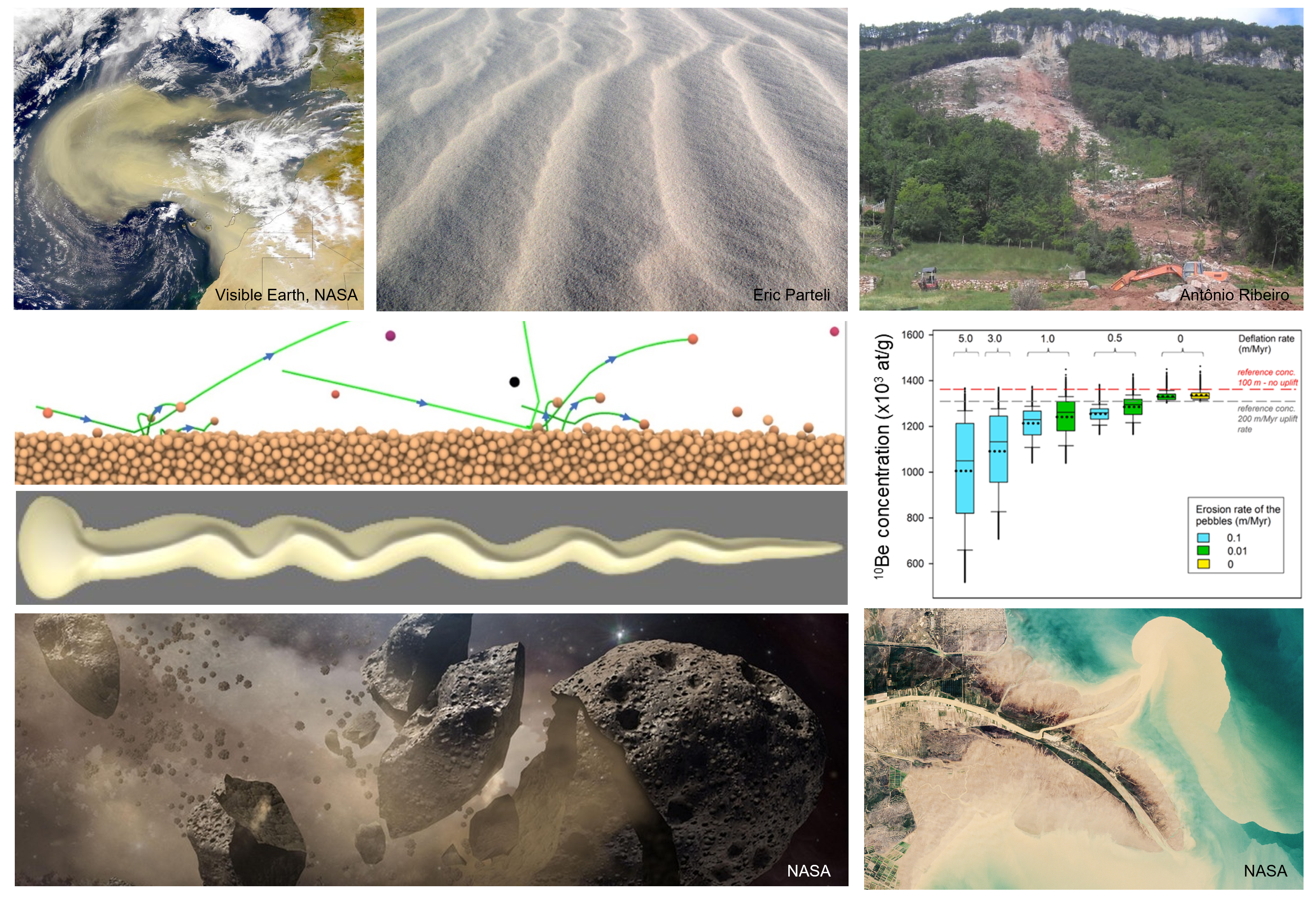
Dr. Eric Parteli is a Heisenberg Group Leader at the Faculty of Physics, University of Duisburg-Essen , with affiliations to the University of Cologne (Computational Geosciences) and The University of Alabama . He leads research on Earth surface particulate materials and their dynamics under wind, fluvial processes, and gravitational forces. Current and former students include PhD candidates, Master/Bachelor candidates, and research assistants like Cong Jiang , Maria Determann , Mateusz Kryger , and Joel Jankowiak . His group develops computational tools to model particle interactions and feedbacks with geomorphology, biosphere, and atmosphere across scales, with applications in climate science, planetary geophysics, and natural hazard risk assessment. Key research themes include aeolian processes , hydrological modeling , granular material behavior , and coupled Earth surface systems . No scientific awards are explicitly mentioned in the provided texts. His lab operates from Room MG 364 at the University of Duisburg-Essen and collaborates with the Computational Geosciences department at the University of Cologne. Recent publications highlight anomalous scaling in sand transport , angle of repose modeling , and regional hydrological systems in arid environments.
Helmholtz Centre for Environmental ResearchGermany
Prof. Dr. Roland A. Müller serves as Department Head of Systemic Environmental Biotechnology at the Helmholtz Centre for Environmental Research - UFZ in Leipzig, Germany, and holds an Honorary Professorship for Integrated Wastewater Resource Management at Leipzig University of Applied Sciences (HTWK) since 2016. With over three decades of experience at UFZ, he has held progressively senior positions including Head of Department SUBT since 2013, Speaker of the Department from 2010-2012, and Head of Infrastructure Unit from 1996-2010. His educational foundation includes university studies in Technical Microbiology at the Carolo-Wilhelmina Technical University of Braunschweig (1984-1990). This technical microbiology background has informed his interdisciplinary approach to environmental biotechnology. Prof. Müller's research pioneers the integration of ecological principles into urban water management systems, particularly focusing on Multifunctional BlueGreen Water Infrastructures for Water Sensitive Cities. His work spans Decentralized Rainwater & Wastewater Treatment, Ecological Engineering, and Resource-efficient Wastewater Treatment systems, with special attention to applications in water-scarce regions like Jordan. He has developed innovative approaches for implementing nature-based solutions that simultaneously address urban flooding, water scarcity, and climate adaptation challenges. His research combines engineering, ecology, and urban planning to create resilient water systems that enhance urban sustainability. Analysis of his recent publications reveals a consistent focus on implementing the 'Leipziger Modell Blau-Grün' - a comprehensive approach to integrated blue-green infrastructure in urban settings. His work demonstrates how nature-based solutions can simultaneously address stormwater management, irrigation needs, and urban greening. A significant portion of his research examines decentralized wastewater treatment systems, with particular attention to their application in arid and semi-arid regions where water resources are constrained. His publications increasingly emphasize participatory planning approaches involving municipal authorities, housing associations, and research institutions to co-design water-sensitive urban developments. 2018: German Environmental Award for solving a central water problem in a decentralized manner in Jordan 2016: Winner of UFZ Knowledge Transfer Award for contributions to Jordanian wastewater policy framework 2014: UFZ Technology Transfer Award for development of vertical filter systems for groundwater purification 2014: Finalist for Hugo Junkers Prize for innovative groundwater purification research Prof. Müller has been instrumental in advising on water policy frameworks, particularly in Jordan where he served as the German representative in the National Implementation Committee for decentralized Wastewater treatment. His work directly influenced the development of national certification standards for wastewater treatment systems with capacities up to 5,000 PE in Jordan. He leads the 'Leipziger BlauGrün' project, a German model city initiative for resource-efficient urban districts that demonstrates practical implementation of his research concepts. His department collaborates with international partners on projects addressing water challenges across diverse climatic conditions. As head of the Systemic Environmental Biotechnology department at UFZ, Prof. Müller oversees research at the intersection of environmental engineering, microbiology, and urban planning. His department is actively involved in the Technical Biogeochemistry Integration Platform, which focuses on 'Tapping Nature's Potential' for sustainable water management solutions. The department maintains strong international partnerships, particularly with institutions in water-stressed regions, to develop and implement decentralized wastewater management concepts that are both scientifically sound and practically implementable in resource-constrained settings.
Potsdam Institute for Climate Impact ResearchGermany
Dr. Christoph Müller is a leading scientist at the Potsdam Institute for Climate Impact Research (PIK), Germany, where he has served as working-group leader of the Land Biosphere Dynamics group since 2012. He also co-leads the Global Biosphere and Water Modeling team and acts as the scientist-in-charge for the internationally renowned LPJmL global vegetation and crop model. Additionally, he is Co-lead of the Ag-GRID initiative within the Agricultural Model Intercomparison and Improvement Project (AgMIP) and serves as Topical Editor for Geoscientific Model Development . Education Diploma in Geoecology, University of Potsdam (2002) PhD in Geoecology, University of Potsdam & International Max Planck Research School (IMPRS) (2007) Research Interests Dr. Müller’s research centres on understanding and modelling the interactions between climate, land use, and the biosphere to support sustainable food-system transformations. His work integrates global-scale vegetation and crop models with climate projections, socio-economic scenarios, and observational data to assess: Impacts of climate change and extreme events on crop yields and food security Carbon, nitrogen, and water cycles in managed and natural ecosystems Land-based climate-mitigation strategies and their co-benefits or trade-offs Adaptation options for agriculture under global change He promotes open science and reproducible modelling workflows, exemplified by the LPJmL open-source ecosystem model and associated toolkits. Publication Profile & Trends Since 2014 he has authored or co-authored more than 200 peer-reviewed articles. Recent work (2024-2025) highlights three dominant themes: (1) quantifying underestimated negative impacts of climate extremes on crop yields, (2) assessing the sustainability of large-scale land-based mitigation measures, and (3) advancing model intercomparison frameworks (e.g., AgMIP, ISIMIP) to reduce uncertainty in global yield projections. His studies increasingly integrate economic and health perspectives, examining how dietary shifts and food-system transformations can achieve climate, environmental, and social co-benefits. Scientific Awards & Recognition While no formal awards are explicitly listed, several publications have received notable recognition: “Soil quality both increases crop production and improves resilience to climate change” (Nature Climate Change, 2022) – listed among China’s top ten major advances in agricultural science in 2023. “Large potential for crop production adaptation depends on available future varieties” (Global Change Biology, 2021) – top-downloaded article. “Climate change impacts on global agriculture emerge earlier in new generation of climate and crop models” (Nature Food, 2021) – widely cited in IPCC AR6. Leadership, Grants & Collaboration Dr. Müller leads or co-leads multiple international projects and working groups: Working Group Leader – Land Biosphere Dynamics, PIK Research Department 2 Co-Lead – Ag-GRID, Agricultural Model Intercomparison and Improvement Project (AgMIP) Scientist-in-Charge – LPJmL model development and application Topical Editor – Geoscientific Model Development journal These roles involve coordinating multi-institutional consortia, securing competitive grants, and mentoring early-career researchers. Laboratory & Data Resources Dr. Müller’s “team” is essentially the LPJmL modelling group at PIK, comprising post-docs, doctoral researchers, and software engineers who maintain and extend the LPJmL code-base, develop satellite-data fusion products, and provide model-driven policy support to governments and international organisations such as the IPCC, FAO, and World Bank.
Laura Dierksmeier is a Research Fellow at the Department of History, Faculty of Humanities, University of Tübingen. As a member of Collaborative Research Center 1070 'ResourceCultures', she specializes in comparative island studies and environmental history through projects like Inselökonomien – Eine vergleichende Studie von Insel-Gesellschaften im späten Mittelalter und in der Frühen Neuzeit . Her work bridges early modern Spain's colonial practices with contemporary resource management debates. University of Tübingen (PhD, MA, BA) Stonehill College & Simmons College (USA) Research focuses on confraternity networks in colonial Mexico, indigenous knowledge transmission under Spanish rule, and preindustrial water management strategies in island societies. She examines how fluid cultural boundaries shaped religious autonomy and economic structures through comparative analysis of Caribbean and Canary Islands. Recent publications analyze missionary science in Latin America, indigenous medical practices under Catholic frameworks, and historical water scarcity in volcanic island ecosystems. Her edited volume European Islands Between Isolated and Interconnected Life Worlds (2021) established interdisciplinary paradigms for island studies. Albert C. Outler Prize (2022) for best book on global Christianity Förderpreis für Medizingeschichte (2021) Bartolomé de las Casas Dissertation Prize (2017) Teaching includes graduate seminars on colonial Latin American history , history of cartography , and missionary knowledge networks . She co-founded the Insularitäten research group (2017) and directs the DFG Island Studies Network (2021).
PD Dr. habil. Thomas Wöhling serves as a Senior Research Scientist and Team Leader for Stochastic Modelling of Hydrosystems at the Chair of Hydrology, Dresden University of Technology's Faculty of Environmental Sciences. His research spans integrated environmental systems modeling with particular expertise in surface water-groundwater interactions, braided river systems, and vadose zone processes. Previously, he held research positions at Water and Earth System Sciences Competence Cluster in Tübingen (2010-2015) and Lincoln Environmental Research in New Zealand (2006-2010). Dr. Wöhling completed his Dipl.-Hydrol. (1999) and PhD in Hydrology (2005) at Dresden University of Technology, followed by habilitation in Stochastic Hydrology (2021). His educational background includes extensive research at the Institute of Hydrology and Meteorology at TU Dresden (1999-2005) where he developed foundational expertise in hydrological modeling. Wöhling's research focuses on integrated modeling of coupled environmental systems , particularly flow and contaminant transport in surface water-groundwater systems, nutrient and energy fluxes in soil-plant-atmosphere systems, and distributed hydrological modeling. His work emphasizes stochastic modeling and uncertainty analysis , with significant contributions to inverse modeling, model calibration, multiobjective optimization, and Bayesian model averaging techniques. He has pioneered methods for evaluating monitoring network worth and data utility for environmental models. His publication record demonstrates consistent contributions to hydrological science, with recent work (2023-2025) focusing on machine learning applications in hydrology, advanced statistical inversion techniques, and complex karst system modeling. Key trends include integration of physics-based and data-driven approaches, improved uncertainty quantification methods, and applications to climate change impacts on water resources. His work bridges theoretical advances with practical applications in New Zealand's braided rivers and European hydrological systems. STAHY Best Paper Award (2018) ASCE Journal of Irrigation and Drainage Engineering Best Reviewer Awards (2008, 2010, 2011, 2015, 2018) ASCE Journal of Irrigation and Drainage Engineering Best Paper Awards (2008, 2009) Dr. Wöhling leads the Stochastic Modelling of Hydrosystems team and has secured funding for numerous projects including Klimakonform, ISOSIM, VAMOS II, and the International Research Training Group 'Integrated Hydrosystem Modelling.' His work combines novel monitoring techniques with modeling and optimal sensor placement to improve prediction reliability for river-groundwater exchange fluxes. He collaborates extensively with international partners, particularly in New Zealand through the Lincoln Agritech's Braided Rivers program. His laboratory work focuses on combining traditional hydrological measurements with advanced computational techniques, including deep learning applications for soil surface hydrology and time-windowed Bayesian analysis for predictive modeling. The team maintains strong connections with field sites in Germany's Saxon region and New Zealand's Canterbury Plains, facilitating integrated theoretical and empirical research approaches.
Prof. Dr. Johannes Max is a Professor at the Department of Horticulture and Food Technology, Faculty of Horticulture and Food Technology, Hochschule Weihenstepfan-Triesdorf (HSWT), located in Freising, Germany. His primary research focus is on plant nutrition, particularly optimizing nutrient cycling and sustainable agricultural practices. He leads projects on phosphorus recovery from wastewater, precision irrigation systems, and greenhouse climate management. Research Interests: Plant nutrition dynamics, recycled fertilizer efficiency, greenhouse hydroponics, water use optimization, and tropical crop adaptation. His work emphasizes bridging gaps between environmental sustainability and agricultural productivity through innovative technologies like porous pipe irrigation and circular economy concepts. Key Projects: Leading initiatives such as 'Sustainable Tunisian Tomato Production via Soilless Systems' and 'Industrial Waste Heat Utilization Guidelines.' Collaborates on research into phosphorus availability in recycled fertilizers, demonstrating how grain size impacts plant uptake. Grants & Advising: Oversees major grants focused on nutrient recycling and tropical greenhouse systems. Actively involved in international collaborations, including projects in Thailand and Greece. Advises on innovative irrigation and crop management strategies. Labs/Teams: Coordinates interdisciplinary teams in agrotechnology and resource efficiency. Works closely with industry partners to translate research into scalable solutions for sustainable agriculture.