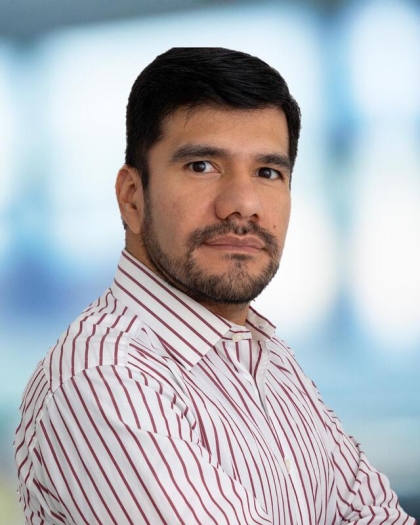
Hugo Jose Herrera de Leon is a Research Fellow at the Department of Geography, University of Bergen. His work focuses on socio-ecological resilience, system dynamics modeling, and policy planning for climate change adaptation. He is affiliated with the System Dynamics research group and has presented at major international conferences like the European Conference on Operational Research and the International System Dynamics Conference. His research explores bioeconomy transitions in Norwegian agriculture, resilience in farming systems, and participatory policy design. He has been funded by the Research Council of Norway (2021-2025) for projects investigating sustainable transitions in rural systems. Notable contributions include developing frameworks for assessing resilience through hybrid simulations and collaborative modeling approaches. Publications span topics like microworld simulations for policymaking, organizational impacts of group model-building, and system dynamics applications in food security. His doctoral thesis (2018) addressed public policy strategies for enhancing resilience in socio-ecological systems under climate change.
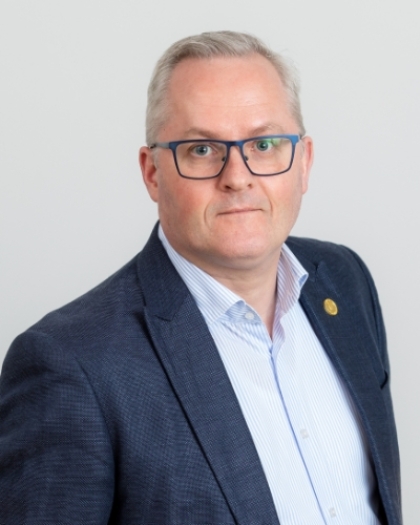
Adam Zylbersztejn is an Assistant Professor (Maître de conférences HDR) at Université Lumière Lyon 2 and affiliated with GATE Lyon Saint-Etienne, a research group in economics. He holds a PhD from the Paris School of Economics (2013) and previously conducted postdoctoral research at WU Wien (Vienna University of Economics and Business). His research focuses on behavioral economics using experimental methods to study individual and interactive decision processes, particularly in contexts involving trust, strategic uncertainty, and cultural variability. Key research areas include behavioral game theory, experimental finance, and the impact of nonverbal communication in economic interactions. His work has been published in top journals such as Journal of Economic Psychology , Games and Economic Behavior , and Experimental Economics . Recent studies examine topics like anonymity effects in charitable giving, trust in market exchanges under oath, and cognitive processes in asset markets using eye-tracking technology. His ongoing projects include research on risk-incentive tradeoffs and ambiguity framing in decision-making. While no formal academic awards are listed, his work has received press coverage in outlets like Le Monde and CORTEX Mag . He collaborates widely with institutions such as GATE-LSE and the Paris School of Economics, contributing to both theoretical and applied economic inquiry.
Johan Gustav Bellika is a Professor at the Department of Clinical Medicine, UiT The Arctic University of Norway, based in Tromsø. His work bridges clinical medicine with health informatics, focusing on practical applications that improve healthcare delivery and patient outcomes. Current Position: Professor, Department of Clinical Medicine Institution: UiT The Arctic University of Norway Location: Tromsø, Norway Contact: johan.gustav.bellika@uit.no Professor Bellika's research spans several critical areas in modern healthcare. His primary focus is on health informatics with particular emphasis on medical data privacy, electronic health records, and the application of artificial intelligence in clinical settings. He has made significant contributions to understanding chronic pain management through technology, primary care research networks, and patient-centered care models. His work often involves large population studies such as the Tromsø Study, examining how digital health tools impact healthcare utilization and patient outcomes. His research demonstrates a consistent thread connecting technological innovation with practical clinical applications. Bellika has been instrumental in developing privacy-preserving architectures for healthcare data analysis, which enable researchers to gain insights from sensitive health information without compromising patient privacy. His work on federated learning frameworks represents cutting-edge approaches to analyzing medical data while maintaining strict privacy controls. Health Informatics and Medical Data Privacy Chronic Pain Management through Technology Primary Care Research Networks (PraksisNett) Electronic Health Records and Clinical Decision Support Patient-Centered Digital Health Solutions Federated Learning Applications in Healthcare Professor Bellika's publication record shows a strong trend toward interdisciplinary research that combines clinical medicine, computer science, and public health. His recent work increasingly focuses on the intersection of artificial intelligence and healthcare, particularly how machine learning can be applied to chronic conditions while maintaining rigorous privacy standards. The geographical scope of his research extends across Norway with particular emphasis on Northern Norwegian populations, providing valuable insights into healthcare delivery in Arctic and remote regions. His collaborative approach is evident through numerous co-authored publications with researchers across multiple institutions and disciplines. While specific awards aren't detailed in the available information, his extensive publication record in reputable journals suggests recognition within his field. Professor Bellika has been actively involved in several major research initiatives including the Tromsø Study and PraksisNett, Norway's nationwide practice-based research network. His work on privacy-preserving architectures for healthcare data has significant implications for how medical research can be conducted while respecting patient confidentiality. He appears to be particularly focused on translating research findings into practical tools for clinicians, as evidenced by his work on audit and feedback systems for antibiotic prescribing.
Maren Toft is a Professor in the Department of Sociology and Human Geography at the University of Oslo's Faculty of Social Sciences. Her academic career has progressed from Research Assistant (2013-2014) to PhD Candidate (2014-2018), Postdoctoral Fellow (2018-2022), Associate Professor (2022), and now Professor. Her research focuses on: Class theory and theory of elites Social mobility and class structuration Segregation and urban inequality Social capital and networks of power Advanced quantitative methods including social sequence analysis and correspondence analysis Toft's publication record shows a consistent focus on elite formation, wealth accumulation, and class reproduction. Her work frequently employs longitudinal approaches to examine how social origins influence life trajectories, particularly among the upper classes. She has made significant contributions to understanding how class structures persist in Scandinavian welfare states, challenging assumptions about equality in these societies. Her major scientific awards include: His Majesty the King's Gold Medal for her 2018 PhD dissertation 'Biographies of privilege' Norwegian sociological association's award for best international publication in 2020/2021 Norwegian sociological association's award for best international publication in 2017 Kunnskap Oslo's award for best Oslo-related Research in 2015 Norwegian sociological association's award for research dissemination in 2018 Toft actively supervises PhD students including Iselin Hewitt (studying urban planning and gentrification), Marte Lund Saga (examining business-politics networks), and Stian Uvaag (researching sibling similarities in mobility). She serves on the board of both the Department of Sociology and Human Geography and the Norwegian Sociological Association. She is involved in several major research projects including HISTCLASS, The Oslo Register Data Classification (ORDC), The Salmon Elite (SALELITE), and Weaving the fabric of Elite Bonds (WEB), which collectively examine various dimensions of elite formation, power structures, and social inequality in Norway and internationally.
Cecilie Schou Andreassen is a Professor at the Department of Clinical Psychology, University of Bergen . She specializes in behavioral addictions , including workaholism, social media addiction, and substance use interactions. Email: cecilie.andreassen@uib.no Visitor Address: Alrek Health Cluster, Årstadveien 17, 5009 Bergen Research Focus: Andreassen's work examines the psychosocial antecedents of addictive behaviors, with emphasis on personality traits , workplace dynamics , and digital platform interactions . Her research spans cross-cultural validation studies and longitudinal health outcomes related to technology and substance misuse. Article Trends (2017-2022): Analyzing 15 recent publications reveals a consistent focus on addiction scale validation , social media epidemiology , and workaholism's health impacts . Key themes include measurement invariance , digital-chemical addiction comorbidity , and psychological withdrawal mechanisms . Scientific Contributions: Co-developer of Bergen Work Addiction Scale Creator of Bergen-Yale Sex Addiction Scale Leadership in behavioral addiction epidemiology Recipient of Norwegian Research Council grants Advising & Collaborations: While no direct advisees are listed, Andreassen collaborates extensively with international researchers in work psychology , social media studies , and public health . Her work involves partnerships with Nottingham Trent University , Yale University , and National Competence Service for Sleep Disorders . Labs & Teams: Affiliated with the Department of Clinical Psychology and previously with the Department of Social Psychology at University of Bergen, she contributes to national health registry studies and cross-occupational research on addiction patterns.
Anna Chalachanova is an Associate Professor in the Department of Health at VID University College, Norway. Her academic work centers on disability research, inclusive methodologies, and citizenship studies, with a primary focus on people with intellectual disabilities across Norway, Slovakia, and Great Britain. Her research spans inclusive research practices, citizenship frameworks for people with intellectual disabilities, higher education accessibility, sexual citizenship, religious inclusion, and protective care. She investigates how intellectual disabilities intersect with everyday citizenship experiences, voting rights, educational participation, and personal assistance services through participatory and co-creative methodologies that prioritize disabled voices. Analysis of her 15 most recent publications (2019-2025) reveals consistent thematic focus on citizenship and inclusion, with methodological emphasis on participatory research. Key trends include comparative studies between Norway and Slovakia, sexual citizenship barriers within personal assistance systems, and higher education experiences for intellectually disabled students. Her work demonstrates strong commitment to amplifying marginalized perspectives through narrative and co-created research approaches. Chalachanova actively contributes to multiple research initiatives including the ongoing PATHWAYS project (Faculty of Social Sciences) examining vulnerable institutional pathways for youth, and "To allow in" focused on barrier reduction for people with intellectual disabilities. Completed projects include "Higher education for people with intellectual disabilities" and "My vote counts too!" which evaluated voting participation mechanisms. These projects involve collaborations across Norwegian institutions, Slovakia, and Great Britain. Based in VID University College's Department of Health, she operates within interdisciplinary teams addressing disability inclusion through international partnerships. Her work connects Norwegian higher education contexts with Slovakian comparative frameworks, driving initiatives that transform citizenship practices and educational access for people with intellectual disabilities through evidence-based interventions.
Habib Ullah is an Associate Professor in Data Science at the Norwegian University of Life Sciences (NMBU), Norway, where he conducts research at the intersection of computer vision and machine learning. He is affiliated with the Institute of Data Science under the Faculty of Science and Technology. He has previously held academic positions at COMSATS University Islamabad, Pakistan, and the University of Ha'il, Saudi Arabia, and served as a postdoctoral researcher at The Arctic University of Norway. Educational Background: PhD in Information and Communication Technology (Computer Vision), University of Trento, Italy (2011–2015) MSc in Electronics and Computer Engineering, Hanyang University, South Korea (2007–2009) BSc in Computer Systems Engineering, NWFP University of Engineering and Technology, Pakistan (2002–2006) Habib Ullah's research is primarily focused on computer vision and machine learning, with applications in aquaculture, agriculture, and human behavior analysis. He investigates underwater fish feeding sounds using audio classification, develops zero-shot learning models for recognizing unseen classes, and applies deep learning to detect stress in salmon via skin dot patterns. He also explores AI-driven controlled environment agriculture, leveraging sensors and automation for optimal crop growth. His work emphasizes practical AI solutions for real-world challenges in environmental and biological domains. The recent publications highlight a strong trend in leveraging deep learning for zero-shot and semi-supervised learning, particularly in computer vision tasks such as sea ice classification, crowd anomaly detection, and agricultural monitoring. His research spans remote sensing, biomedical signal processing, and human activity recognition, demonstrating interdisciplinary versatility. The keywords reflect a focus on robust feature representation, knowledge transfer, and model generalization. Scientific Awards and Funding: Industrial PhD grant 'Advancing Controlled Environment Agriculture AI' from The Research Council of Norway (Project number 354125, 2 million NOK, 2024) Team member (Coordinator-Participant) in the Battery Cell Assembly Twin (BatCAT) project funded by Horizon Europe (7 mEuro, 2023–2027) Development of an AI-Based Image Analysis System for Monitoring Plant Status (Funding: 1.8 mNOK, starting 2025) Habib Ullah actively supervises PhD projects and contributes to academic service through editorial and organizational roles. He has served as an Associate Editor for IEEE Access, Guest Editor for MDPI Remote Sensing, and Editor of the Springer book Machine Learning Techniques and Sensor Applications for Human Emotion, Activity Recognition, and Support (ML-SHEARS) . He has also been a Track Chair and Program Committee Member for several international conferences, reflecting his leadership in the academic community. His research is supported by significant grants and collaborative projects, indicating strong institutional and international engagement. He is involved in multiple research teams and projects, including the BatCAT project on battery manufacturing and AI applications in controlled environment agriculture with RIFT LABS AS. His lab work integrates deep learning, sensor fusion, and data analytics for environmental and biological monitoring systems.
Vasileios Mavroeidis is an Associate Professor in Digital Security at the Department of Informatics, University of Oslo (UiO). He specializes in security automation and orchestration (SOAR) and cyber threat intelligence (CTI) representation, reasoning, and sharing. He actively contributes to European cybersecurity initiatives, including Horizon Europe, Connecting Europe Facility, and the European Defense Fund, and serves as the primary representative of UiO at the OASIS standards development organization since 2017. Role : Associate Professor Department : Digital Security (SEC), University of Oslo Standardization Involvement : Chairman of OASIS Threat Actor Context (TAC), Leading Contributor to CACAO and OpenC2 Projects : Concordia, CyberHunt, JCOP (Joint Cyber Security Operations Platform), Oslo Analytics, P4C (Partnership for Cybersecurity) His research focuses on cyber threat intelligence (CTI), exploring its taxonomies, sharing standards (STIX, CACAO), and ontologies, with contributions to the European Union Agency for Cybersecurity (ENISA) Cybersecurity Playbooks task force. He analyzes quantum computing's impact on cryptography, develops automated threat detection systems using machine learning (e.g., recurrent neural networks for malware-generated domains), and investigates privacy issues under GDPR. Recent publications highlight his work on LLMs for code stylometry , neurosymbolic AI for cyber defense , and knowledge management systems for CACAO playbooks . His articles span 2017–2025, emphasizing formal verification, biometric data protection, and incident response automation. He collaborates with organizations like OASIS (Threat Actor Context, CACAO, OpenC2) and FIRST (Traffic Light Protocol), and participates in European research projects. His work includes standardization efforts in cybersecurity playbooks , MITRE ATT&CK representation, and quantum-resistant cryptography .
Jon Atle Gulla is a Professor at NTNU and Director of the Norwegian Research Centre for AI Innovation (NorwAI). He holds academic leadership roles, including former Head of the Department of Computer Science and Informatics at NTNU. His expertise spans Semantics, Language Technology, Recommender Systems, and AI-driven innovation. He has nearly 150 international publications and advised over 100 students across MSc, PhD, and postdoctoral levels. Education: MSc in Computer Science (1988), PhD in Computer Science (1993) from Norwegian Institute of Technology (NTH) MSc in Linguistics (1995), University of Trondheim MSc in Management (Sloan fellowship, 2003), London Business School Research interests focus on Semantics and Language Technology applied to Recommender Systems, Information Retrieval, and Text Analysis. He explores AI-based innovations in digitalization and entrepreneurship, advising industry on AI adoption and commercialization. Notable projects include Big Data collaborations with DNB, RecTech for news recommendation, and Trondheim Analytica analyzing political texts/social media. Publications emphasize AI applications in news recommendation, political text analysis, and Scandinavian language models. His work addresses ethical AI, copyright implications, and cross-lingual NLP challenges. Awards: Member of the Royal Norwegian Society of Arts and Sciences. Advising/grants: Supervised 30 PhD students and 70 MSc students. Involved in startups like Fast Search & Transfer (acquired by Microsoft) and Mito.ai/Strise.ai. Active in reviewing for journals like Data & Knowledge Engineering and conferences like ACL. Labs/teams: Leads NorwAI, co-founder of INRA and NOBIDS workshops. Collaborates with industry and academia on AI-driven solutions.
Erik Velldal is a Professor in the Language Technology Group (LTG) at the Section for Machine Learning , Department of Informatics, University of Oslo . With over 25 years of experience in machine learning and natural language processing (NLP), he leads the SANT project focused on sentiment analysis and contributes to major research initiatives including MediaFutures , NorwAI , and Integreat (Norwegian Center for AI Research). His work bridges linguistic theory and computational methods, emphasizing semantic modeling and uncertainty detection. Research interests include sentiment analysis , language modeling , event extraction , and machine learning applications to NLP. Recent publications address cross-domain sentiment classification , generative event analysis , and multilingual model adaptation . He co-developed the Norwegian Review Corpus (NoReC) and Norwegian Anaphora Resolution Corpus (NARC) , foundational resources for Norwegian NLP. His projects often involve collaboration with international institutions, reflected in publications at venues like ACL, COLING, and EMNLP. Current efforts focus on entity-level sentiment analysis , diagnostic datasets for Norwegian , and evaluating compositional generalization in language models. No public record of scientific awards or part-time appointments exists.
Sveinung Sandberg is a Professor at the Department of Criminology and Sociology of Law, University of Oslo. His research spans marginalization, illegal drug markets, radicalization, and narrative criminology, combining theoretical frameworks from Bourdieu and narrative analysis. Academic Interests: Marginalisation, Legal & Illegal Drugs, Violence, Radicalization, Bourdieusian Criminology, Narrative Criminology, Latin American Studies, Social Movements Education: PhD from University of Bergen Research Focus includes: Street capital theory in criminology Drug market cultural dynamics Narrative approaches to extremism Latin American criminal trajectories Recent Publications examine pandemic-related crime shifts, gendered drug use patterns, and narrative mechanisms in criminal justice. His 2021-2025 projects Radicalization and Resistance and Crime in Latin America (CRIMLA) involve cross-country life-story analyses. Scientific Awards: Fridtjof Nansen's Award for Young Researchers (2011) The Meltzer Prize for Young Researchers (2010) Editorial Roles include board memberships at Theoretical Criminology , Deviant Behavior , and International Criminal Justice Review . He has conducted fieldwork in Mexico and held visiting positions at institutions including CIDE (Mexico City) and European Monitoring Centre for Drugs and Drug Addiction (Lisbon).
Jan Oskar Engene is an Associate Professor in the Department of Comparative Politics at the University of Bergen, Norway. His academic career spans several decades with significant contributions to both terrorism studies and heraldry research. Engene's research interests have evolved significantly over time, beginning with a strong focus on terrorism, political violence, and European security. His early work centered on the TWEED (Terrorism in Western Europe: Explaining the Trends) dataset, which documented terrorist incidents across Western Europe from 1950 onward. Over the years, his research expanded to include political symbolism, heraldry, and flag history, particularly regarding Norwegian political symbols and their evolution. His work demonstrates a unique interdisciplinary approach, bridging political science with historical and symbolic analysis. Analysis of Engene's publication trends reveals a clear evolution from predominantly terrorism-focused research in the 1990s and early 2000s toward increasing engagement with heraldry, political symbolism, and Norwegian historical identity markers in recent years. The earlier works focus on quantitative terrorism analysis, counterterrorism policy, and European security frameworks, while more recent publications examine municipal heraldry, county coats of arms, and historical political symbols. This shift demonstrates Engene's ability to apply political science methodologies to diverse research areas while maintaining a consistent focus on political symbolism and identity. Engene has supervised numerous Master's theses at the University of Bergen, primarily in the areas of terrorism studies, European politics, and political identity. His supervision record includes students researching topics such as state responses to terrorism in Italy, Nordic political systems, and regional identity in Western Europe. While specific grant information isn't detailed in the available materials, his TWEED project represents a significant research undertaking that likely involved external funding. Engene maintains active engagement with public discourse through media appearances, having participated in numerous television and radio programs discussing terrorism, security policy, and political symbolism. His work with the TWEED project established him as a leading expert on European terrorism patterns, while his more recent heraldry research has positioned him as a specialist in Norwegian political symbolism and historical iconography.
Olof Mikael Lindgren is a Professor of Physics at the Norwegian University of Science and Technology (NTNU) , Department of Physics, Faculty of Natural Sciences. Since 2003, he has led research at the Applied Optics group and Biophysics group , focusing on advanced optical spectroscopy and imaging for biomedical applications. His research spans laser-based spectroscopy, time-resolved optical techniques, and nonlinear optics. He applies these methods to study biomolecular systems, particularly in the context of amyloid diseases like Parkinson’s and Alzheimer’s, and to develop photo-dynamic therapy approaches. He also investigates hybrid organic-inorganic nanomaterials and triplet state dynamics. Recent publications highlight his work on oligothiophenes for amyloid fibril detection, BODIPY-based photosensitizers for cancer therapy, and multimodal fluorescence microscopy of protein aggregates. These studies collectively advance optical diagnostics and therapeutic strategies in life sciences. He teaches the course TFY4195 - Optics and is actively involved in outreach and academic service. His contact email is mikael.lindgren@ntnu.no , and his office is located at Realfagbygget, D4-190, Gløshaugen .
Hans Christopher Bernstein is a Professor at the Norwegian Fisheries College, UiT The Arctic University of Norway, and affiliated with the Arctic Centre for Sustainable Energy (ARC). His research focuses on biotechnology, microbial ecology, synthetic biology, and microalgal carbon capture and utilization. University: UiT The Arctic University of Norway School: Norwegian Fisheries College Research Group: Microalgae & Microbiomes Research Centers: Arctic Centre for Sustainable Energy (ARC) Bernstein’s work explores the intersection of biotechnology and microbial ecology, particularly in synthetic biology applications for carbon capture. His research includes modeling microbial processes, studying lipidome plasticity in Arctic diatoms, and developing engineered genetic circuits for microbial consortia. Key trends in his publications involve marine microbiome dynamics, cold seep ecosystems, and daylight-driven carbon exchange in structured microbial communities. Recent articles highlight advancements in microalgal biotechnology for industrial carbon capture, synthetic genetic circuits, and spatiotemporal metabolic network models. His work spans both theoretical modeling (e.g., neighbor-dependent interaction inference) and applied biotechnological solutions (e.g., EcoFABS fabricated ecosystems).
Knut Tore Alfredsen is a Professor in the Department of Civil and Environmental Engineering at NTNU. His research focuses on cold climate hydrology, environmental impacts of hydropower, river ice dynamics, and water resource management. He leads projects like Trygg Elv (flood detection tools) and Hydro Connect (climate change mitigation in hydropower). He supervises numerous PhD and master’s students and teaches courses in hydrology, hydropower engineering, and environmental design. His work combines field measurements, data analysis, and advanced modelling, often using LiDAR and remote sensing technologies. Key projects include Sagelva research catchment studies and evaluations of environmental impacts from hydropeaking and reservoir operations. He is an active contributor to international conferences and collaborates with organizations like NVE and the IAHR. Education: Not explicitly stated in the provided text. Affiliations: HydroCen, Center for Renewable Energy (FME), NTNU’s Civil and Environmental Engineering Department. Grants: Involved in projects like HydroFlex (turbine development) and Klima 2050 (runoff estimation). Awards: None explicitly mentioned. Labs/Teams: Leads research groups in ecohydraulics, river modelling, and cold climate hydrology. Research Highlights: Focuses on ice-jam flood hazards, hydropeaking effects on fish, and sustainable hydropower practices. Recent work includes LiDAR-based river bathymetry and historical river development analysis using AI.