Stefanos Zenios is Professor at Stanford Graduate School of Business with dual appointments in Entrepreneurship and Operations, Information & Technology . He directs Stanford GSB’s Center for Entrepreneurial Studies and co-directs the Doerr School of Sustainability ’s Program in Ecopreneurship. His Startup Garage course has launched companies like DoorDash while alumni have raised over $3B in venture capital. He co-authored the foundational Biodesign textbook and previously served as Editor-in-Chief of Operations Research . PhD, MIT Operations Research (1996) MA, University of Cambridge (1996) BA, University of Cambridge (1992) Research Focus Dr. Zenios’ work bridges operations research and innovation management , with significant contributions to: Healthcare operations : Administrative cost reduction, organ allocation optimization, and clinical workflow improvements Entrepreneurship : Venture creation frameworks and experiential education Ecopreneurship : Sustainable business model innovation His Precedents Thinking framework (HBR 2025) has gained global recognition for solving systemic inefficiencies. Current research includes the biennial Search Fund Study with Peter Kelly. Scientific Recognition INFORMS Fellow Multiple Best Paper Awards, INFORMS CAREER Award, National Science Foundation (2000) Dhirubhai Ambani Faculty Fellow (2017–2020) George E. Nicholson Award (1997) He has received extensive media coverage in Fast Company , Time Magazine , and Stanford Business . His research has been featured in over 150 press mentions including JAMA , Harvard Business Review , and Health Affairs .
Joel Goh is Associate Professor at the Department of Analytics and Operations, NUS Business School, National University of Singapore. He serves as Director of the J.Y. Pillay Comparative Asia Research Centre (under NUS Global Asia Institute) and PhD Program Director at the Institute of Operations Research and Analytics (IORA). Previously, he was Assistant Professor at Harvard Business School (2014-2017) and Visiting Scholar (2017-2022). BSc, MSc, PhD in Operations, Information, and Technology from Stanford University His research focuses on healthcare analytics (preventing health conditions, hospital operations, frailty assessment), supply chain analytics (digital business models, platform leakage), and service platform operations (hospital-at-home programs, incentive design). He co-created the Robust Optimization Made Easy (ROME) software. Recent publications analyze workplace psychological safety (2024), hospital-at-home models (2024), and platform leakage dynamics (2023). His work spans 18+ journals with 740+ citations for burnout cost studies (2022) and 606+ citations for physician well-being research (2017). Teaching Honors : 2023: Best MBA Teaching & Skinner Innovation Award 2021: NUS Annual Teaching Excellence Award 2020: Early Career Research Excellence Award & 40 Under 40 Best MBA Professors Advising & Grants : Served as PhD Program Director. Received NUS Start-Up Grant R-314-000-110-133 (2021) and Humanities & Social Sciences Fellowship (2021). Editorial roles include Associate Editor at Management Science , Manufacturing & Service Operations Management , and Senior Editor at Production and Operations Management .
Michael Jong Kim is an Associate Professor at the Sauder School of Business, University of British Columbia, specializing in the Division of Operations and Logistics. His research focuses on dynamic programming, statistical learning, robust optimization, and the exploration vs exploitation trade-offs in sequential decision-making processes. BASc, M.Math, and PhD from the University of Toronto His work spans topics in stochastic optimization, supply chain dynamics, and information dissemination in uncertain environments. Publications highlight contributions to Bayesian inventory control, semi-Markovian system control, and variance regularization in optimization models. Dr. Kim teaches advanced business analytics courses, including Descriptive and Predictive Business Analytics and Advanced Predictive Business Analytics (MBAN) during the 2024-2025 academic year. He can be reached at mike.kim@sauder.ubc.ca or by phone at +1 604.822.8682.
Prof. Dr. Gonzalo Guillén Gosálbez is a Full Professor at the Department of Chemistry and Applied Biosciences , ETH Zürich. He holds a PhD in Process Systems Engineering (UPC, 2005) and has held academic positions at Imperial College London (Reader), University of Manchester (Senior Lecturer), and Universitat Rovira i Virgili (Assistant/Associate Professor). His research focuses on Sustainable Chemical Processes , integrating life cycle assessment, optimization techniques, and planetary boundary analysis to evaluate and design low-carbon technologies. Current position: Full Professor, ETH Zürich (2019–present) Prior roles: Imperial College London (2016–2019), University of Manchester (2014–2016), URV Spain (2008–2014) Education: PhD (UPC, 2005), MEng/BEng (University of Murcia) His research explores CO2 valorization , green methanol synthesis , circular marine fuels , and planetary boundary compliance in energy and chemical systems. Recent work emphasizes machine learning for process modeling, single-atom catalysis , and decentralized ammonia production . Scientific contributions include 15+ peer-reviewed articles (2023–2025) in journals like Nature Chemical Engineering , ACS Sustainable Chemistry & Engineering , and Energy & Environmental Science . Key themes: Optimization of hybrid fossil/renewable carbon systems Environmental impacts of energy transitions Catalyst design for sustainable chemistry Life cycle assessment of emerging technologies Awarded UPC Top Doctoral Student Award and Top National Student Award , he combines process systems engineering with sustainability metrics to address global challenges in chemical and energy systems.
Michael Baldea is an Associate Professor in the Department of Chemical Engineering at the University of Texas at Austin . He holds a Ph.D. in Chemical Engineering from the University of Minnesota (2006), with prior degrees from 'Babeş-Bolyai' University in Romania (M.Sc. 2001, Diploma 2000). His research group develops theoretical and computational methods for Process and Energy Systems Engineering , focusing on integrated decision-making, performance optimization, and process intensification with industrial validation. Education: Ph.D., Chemical Engineering, University of Minnesota (2006) M.Sc., Interface Process Engineering, 'Babeş-Bolyai' University (2001) Diploma, Chemical Engineering, 'Babeş-Bolyai' University (2000) Research Thrusts: Integrated decision-making in chemical/energy supply chains Process performance monitoring and optimization Process integration and intensification Key applications include grid-responsive chemical plants, intensified distillation/column designs, and renewable energy integration for building systems. Scientific Awards: Frank A. Liddell, Jr. Fellowship NSF CAREER Award (2015-2020) Moncrief Grand Challenges Faculty Award (2014) AIChE Outstanding Young Researcher Award (2017) Implementation : His group has translated research into commercial tools through partnerships with industrial test beds and is working to integrate methods into commercial simulators. They explore predictive approaches for building energy management and strategic capital investment analysis in next-generation energy systems.
Professor Nagi Gebraeel serves as the Georgia Power Early Career Professor in the H. Milton Stewart School of Industrial and Systems Engineering at Georgia Institute of Technology, where his research integrates predictive analytics, machine learning, and optimization for industrial IoT applications. His work focuses on real-time equipment diagnostics, prognostics, and operational decision-making in critical infrastructure systems. Education: Ph.D. in Industrial Engineering (2003), Purdue University M.S. in Industrial Engineering (1998), Purdue University Research Focus: Dr. Gebraeel develops statistical learning algorithms for IoT-enabled maintenance, repair, and operations (MRO), with emphasis on federated learning frameworks for distributed fault diagnosis and cybersecurity protection against Industrial Control System (ICS) attacks. His research spans manufacturing, power generation, and deep space habitats through NASA's HOME Space Technology Research Institute, where he pioneers self-aware habitat systems. Recent work addresses data heterogeneity in high-consequence industrial environments using causal-informed analytics. Publication Trends: His 2024-2025 publications demonstrate a strong trajectory toward distributionally robust optimization for maintenance logistics, federated learning architectures for distributed fault diagnosis, and prognostics for complex systems like offshore wind farms and industrial robots. Key themes include handling imbalanced data in fault diagnosis, state-space representations for interdependent systems, and cybersecurity integration in manufacturing networks. Awards and Recognition: NSF CAREER Award (2007) SAE Aircraft Electrical Power System Recognition Award (2008) SAE Materials Modeling and Testing Recognition Award (2006) IEEE-AUTOTESTCON Certificate (2006) Fellow of the Institute of Industrial and Systems Engineers Advising and Funding: Dr. Gebraeel mentors doctoral students including Michael Ibrahim (2025 IISE Best Student Paper winner), Heraldo Rozas (now Assistant Professor at University of Chile), Ayush Mohanty, and Nazal Mohamed. He secured a $500,000 NSF grant in August 2025 for AI-driven cybersecurity in distributed manufacturing networks and leads NASA-funded research on deep space habitat systems. His work bridges academic research with industry applications through Georgia Tech's Strategic Energy Institute collaborations. Research Infrastructure: He directs the Analytics and Prognostics Systems laboratory at Georgia Tech's Manufacturing Institute and leads the Predictive Analytics and Intelligent Systems (PAIS) research group. Previously, he served as associate director of Georgia Tech's Strategic Energy Institute (2014-2019), fostering data science applications in energy systems.
Allan Larsen is a Professor and Deputy Head of Division at the Department of Technology, Management and Economics (DTU Management) at the Technical University of Denmark. He heads the Operations and Supply Chain Management Section. His academic background includes an MSc in Applied Mathematics and a PhD in Operations Research, both from DTU. He teaches courses in Operations Management and Simulation at both undergraduate and graduate levels. Research Focus: His work applies operations research methodologies to complex planning problems in supply chain management, logistics, healthcare operations, and public transport. Key areas include urban freight transport, healthcare supply chains, and optimization of public transport resources like crew and fleets. Collaborations with industries, especially in freight transport, have been extensive. He previously co-directed the Transport DTU research center and co-chaired Denmark’s Transport Innovation Network. Education: MSc in Applied Mathematics (1989–1995), PhD in Operations Research (1997–1999), both from DTU. Recognition: Recipient of the Hedorf’s transportpris award in 2022 for contributions to transport research. Research Projects: Supervises multiple PhD students (e.g., on electric freight transport, healthcare resource optimization, and Industry 4.0 applications). Active in projects like 'Pioneering Electric Heavy-Duty Freight Transport' and 'Resource optimization in healthcare.' Labs/Teams: Leads the Operations and Supply Chain Management research group and collaborates in initiatives like the Transport Innovation Network, focusing on sustainable transport solutions.
Dr. Kenan Arifoglu is an Associate Professor at the UCL School of Management. He previously held a postdoctoral position at the Ross Business School, University of Michigan (2008–2012). His education includes a PhD in Industrial Engineering and Management Sciences from Northwestern University (2012), two MSc degrees from Northwestern University (2008) and Koç University (2007), and a BSc from Koç University (2005). His research focuses on behavioral motivations in healthcare, supply chains, pricing, and entrepreneurial operations. Key projects include analyzing inefficiencies in flu vaccine supply chains and developing frameworks for high-growth startups. His work bridges operations management with practical challenges in healthcare, retail, and entrepreneurship. Recent publications address topics such as luxury brand licensing dynamics, incentive programs in healthcare systems, and the theoretical foundations of lean startup methodologies. These contributions span disciplines like marketing, operations research, and public health, emphasizing cross-sectoral applications. Dr. Arifoglu’s advising and grant activities are not detailed here. He is affiliated with the UCL School of Management and actively contributes to academic discourse through his research and teaching roles.
Daniel Adelman is the Charles I. Clough, Jr. Professor of Operations Management at the University of Chicago Booth School of Business. He joined the faculty in 1997 after completing his PhD in industrial engineering and operations research at Georgia Tech. Adelman is a leading expert in Business Analytics and Management Analytics, helping companies deploy data and decision analysis to build world-class strategic and tactical management capabilities. Adelman received his PhD in industrial engineering and operations research in 1997, along with a bachelor's degree in industrial engineering and a master's degree in operations research, all from the School of Industrial and Systems Engineering at the Georgia Institute of Technology. Daniel Adelman's research focuses on applying analytical models to solve complex business problems across multiple industries. He has worked with firms from diverse sectors including internet services, chemical distribution, airlines, third party logistics, fiber-optics manufacturing, semiconductor manufacturing, oil, and healthcare. His research integrates real-world data with analytical models to bring structure and discipline to decision and control processes, enabling firms to achieve higher profits with lower risk. Adelman's recent work has concentrated heavily on healthcare analytics, where he leads the Healthcare Analytics Laboratory at Chicago Booth. This lab works with teams of doctoral and MBA students on projects with major healthcare institutions to optimize clinical, operational, and financial outcomes. His research spans foundational operations research including approximate dynamic programming, inventory theory/supply chain management, and revenue management/pricing optimization, as well as examining the linkage between operational performance metrics and financial performance of firms. Adelman's publications show a clear trend toward increasing focus on healthcare applications while maintaining strong theoretical foundations in operations research. His earlier work focused more on general operations management problems like inventory control and supply chain optimization, while his recent publications demonstrate a strategic shift toward healthcare analytics, particularly examining surgical team dynamics, hospital performance metrics, and resource allocation during public health emergencies like the COVID-19 pandemic. George B. Dantzig Prize (1998) for the best dissertation in operations research and management sciences that is innovative and relevant to practice Adelman regularly advises doctoral and MBA students through the Healthcare Analytics Laboratory at Chicago Booth. He has served as Associate Editor for Management Science, currently serves as Associate Editor for Manufacturing and Service Operations Management, and is the Area Editor for Operations and Supply Chain at Operations Research. His industry collaborations include significant projects with Akamai on internet pricing, with GE Global Research Labs on the electricity smart grid, with BP on gasoline supply contract portfolio optimization, and with Symantec on software release planning. Adelman leads the Healthcare Analytics Laboratory at Chicago Booth, which brings together interdisciplinary teams of doctoral and MBA students to work on a portfolio of projects with major healthcare institutions. The lab focuses on optimizing clinical, operational, and financial outcomes through advanced analytics and decision modeling.
Cong Shi, also known as Alex Shi, is a Professor of Management at the Miami Herbert Business School, University of Miami, since 2025. Previously, he served as Associate Professor at the University of Michigan (2019-2023) and Assistant Professor there (2012-2019). His academic journey began with a B.Sc. in Mathematics (First Class Honors) from the National University of Singapore (2007) and a Ph.D. in Operations Research from MIT (2012) under Professor Retsef Levi. Education : MIT (Ph.D.), NUS (B.Sc.) Current Role : Professor, Management, Miami Herbert Business School Prior Roles : Associate Professor (Tenured), University of Michigan; Assistant Professor, University of Michigan His research spans Revenue Management, Supply Chain Management, Healthcare Operations, Human-Robot Interaction, and Data-Driven Optimization. Recent publications focus on fairness-constrained inventory, sequential pricing, and trust-aware robotics. He has received prestigious awards including the Senior Research Award (2025) and Amazon Research Award (2021), alongside multiple INFORMS recognitions. The 15 most recent articles highlight advancements in inventory control with fairness constraints, sequential pricing algorithms, and trust propagation models in robotics. His work bridges theoretical rigor with practical applications in supply chains and human-robot collaboration. Scientific Awards : Senior Research Award, Miami Herbert Business School, 2025 Amazon Research Award, 2021 INFORMS Meritorious Service Awards (2018, 2019, 2021, 2023) IOE Graduate Course Professor of the Year, University of Michigan, 2019 He has advised 10 PhD students, many now in academia (e.g., UC Berkeley, Penn State) or tech roles (Meta, Amazon). Grants include NSF funding as PI and Co-PI.
Francesco Pilati is an Associate Professor at the Department of Industrial Engineering, University of Trento, where he serves as local coordinator for the scientific field ING-IND/17 (Industrial Plants and Logistic Systems). He chairs the research group on Industrial Plants, Production Systems, and Logistics, and teaches courses in Industrial Plants and Design of Digital Production and Assembly Systems. As coordinator of the Master's program in Management and Industrial Systems Engineering and University Coordinator for the EIT double degree in Zero-Defect Manufacture, Pilati bridges academic leadership with advanced manufacturing research. He has also served as Invited Lecturer at universities in Vienna and Göttingen. His research focuses on integrating environmental sustainability with technical-economic criteria through multi-objective optimization and impact assessment. Key areas include: Distribution networks and warehousing systems Manufacturing and assembly line design Hybrid energy production systems Digitization of manual production processes using depth cameras Recent publications highlight applications of Industry 4.0 technologies to pandemic safety, logistics optimization, and smart manufacturing. Pilati has received significant recognition including the Philip Morris Italia Empowering Research Award (2016) and Autostrade per l'Italia academic recognition. His editorial contributions include guest editing special issues on Digital Twins and Smart Factories in Q1 journals.
Georgia Perakis is the John C Head III Interim Dean of MIT Sloan School of Management and a Professor of Operations Management and Operations Research & Statistics. She has been on MIT Sloan's faculty since 1998, contributing extensively to research in analytics/AI, optimization, and machine learning applications in pricing, supply chains, healthcare, and energy. Recognized as a leading academic, she has won numerous awards, including the INFORMS Fellow and Distinguished MSOM Fellow, along with multiple best paper awards. Perakis has supervised 30 PhD and 59 master's students, fostering lifelong academic relationships. Her administrative roles include co-director of the Operations Research Center and Associate Dean for Social and Ethical Responsibilities of Computing. She currently serves as Editor-in-Chief of M&SOM and has held editorial leadership roles in top journals like Operations Research and Management Science. Her education includes a BS in Mathematics from the University of Athens and advanced degrees in applied mathematics from Brown University. Research Interests : Perakis focuses on solving complex problems at the intersection of optimization and machine learning, with applications in retail promotions, healthcare operations (e.g., emergency department management), and energy systems. Her work emphasizes practical solutions to real-world challenges, leveraging data-driven analytics and prescriptive models. Recent projects include optimizing patient placement in emergency departments and modeling demand for new products in retail. Grants & Awards : Her accolades include the NSF CAREER Award, PECASE Award, and over a dozen best-paper recognitions. Notable contributions include a finalist position in the JD.com Competition (2019) and winning first place for Johnson & Johnson’s demand-prediction work (2018). She has also pioneered methodologies for equitable resource allocation in healthcare. Education & Leadership : Perakis holds leadership roles in interdisciplinary initiatives like the MIT Initiative on the Digital Economy and the Food Supply Chain Analytics and Sensing Initiative. Her teaching excellence is underscored by awards such as the Jamieson Prize and Teacher of the Year (MIT Sloan). She has directed major programs like the MIT Leaders for Global Operations and the Executive MBA program. Labs & Teams : She is affiliated with the Operations Research Center (an interdepartmental PhD program) and collaborates with institutions like UMass Memorial Hospital on healthcare optimization projects. Her work integrates ethics into AI development, emphasizing fairness, bias mitigation, and societal impact.
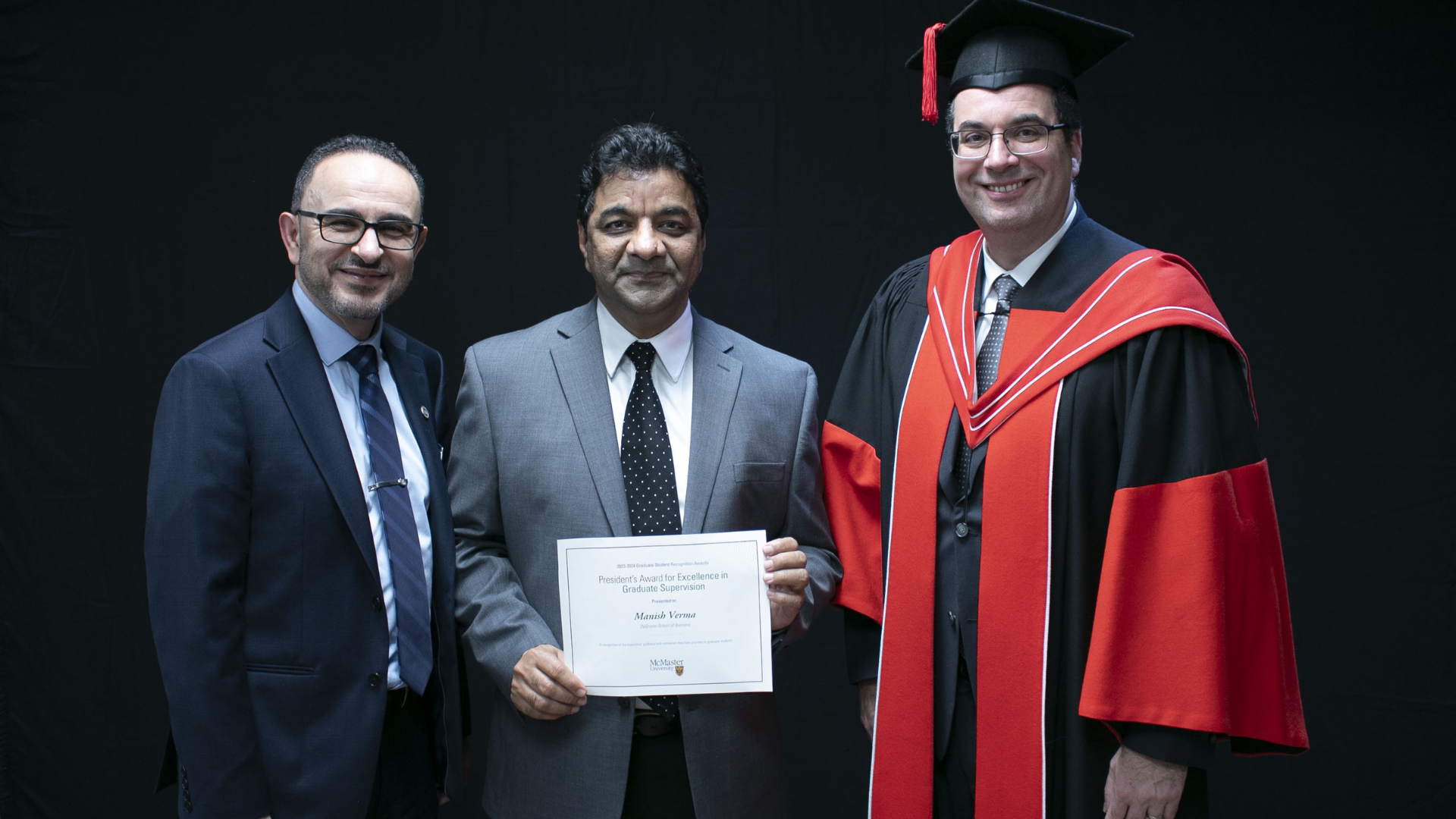
Manish Verma is Professor of Operations Management and Associate Dean, Graduate Studies at the DeGroote School of Business, McMaster University. His academic journey began with an MBA and PhD in Business Administration with Operations Management/Management Science specialization from Desautels Faculty of Management at McGill University. Dr. Verma's research focuses on multimodal transportation of dangerous goods, risk assessment, network design and planning in transportation, humanitarian logistics, green supply chain management, and disruption/resilience in transportation systems. His current research engagements center on safety and security issues in freight transportation and humanitarian logistics, funded by NSERC and SSHRC grants. He has been frequently approached by media to comment on railroad accidents involving dangerous goods. An analysis of his recent publications reveals a strong emphasis on hazardous materials transportation risk management, with significant contributions to rail-truck intermodal systems, hazmat risk modeling using value-at-risk methodologies, and emergency response planning for transportation networks. His work bridges theoretical operations research with practical transportation safety applications. $245K research grant for rail safety research from Government of Canada As an educator, Dr. Verma has taught courses including Predictive Analytics for Managers, Network Design Issues in Freight Transportation, and Management Science Research Issues. His scholarly impact is evidenced by publications in leading journals such as Transportation Research Part E, European Journal of Operational Research, and Safety Science. He actively contributes to real-world transportation safety through media commentary and research that informs policy decisions regarding dangerous goods transportation.
Tim Huh is a Professor and Chair of the Operations and Logistics Division at the University of British Columbia's Faculty of Commerce and Business Administration. He specializes in inventory control, supply chain management, and operations research, with a focus on dynamic decision-making under uncertainty. B.A., B.Math, M.Math from University of Waterloo M.A. from Regent College M.S., Ph.D. from Cornell University His research spans theoretical and applied topics including renewable energy systems, healthcare operations, and digital learning analytics. Recent work explores wind power storage optimization, asynchronous video usage in education, and multi-echelon inventory solutions. Scientific recognition includes the Canada Research Chair in Operations Excellence and Business Analytics He teaches core business analytics and operations management courses at both undergraduate and graduate levels, emphasizing quantitative decision-making and process fundamentals.
Christopher S. Tang is a UCLA Distinguished Professor and Edward W. Carter Chair in Business Administration at the Anderson School of Management , where he researches global supply chain management with a focus on social innovation in developing countries . He also serves as Senior Associate Dean for Global Initiatives and Faculty Director of the Center for Global Management . Education: Ph.D. in Management Science (1985, Yale University) M.Phil. in Administrative Science (1983, Yale University) M.A. in Statistics (1983, Yale University) B.Sc. in Mathematics (First Class Honors, 1981, King’s College, University of London) His research explores the intersection of corporate responsibility and supply chain innovation , addressing topics like microfinancing , mobile platforms for developing economies , direct agricultural procurement , and disaster response logistics . He emphasizes visibility, integrity, and agility in uncertain environments. Recent work highlights AI adoption benefits for supply chains , strategies to reduce forced labor risks , and policy impacts on ride-sharing platforms . His research bridges operations management and social justice , advocating for environmental stewardship alongside business growth. Scientific Awards: Salzberg Medallion (2017) Lifetime Fellow, INFORMS (2011) Responsible Research in Management Award (2017) Teaching Excellence Award (multiple years, UCLA-NUS) Dean’s Excellent Service Award (2014) As an influential adviser and consultant , Tang has worked with Amazon, HP, IBM, Nestlé, GKN , and Accenture . He has taught at Stanford University, UC Berkeley, Hong Kong University of Science and Technology , and served as visiting professor at Cambridge University and the Institute of Advanced Study at HKUST .