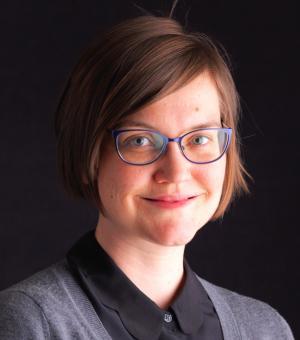
Kathryn Ciancia is Associate Professor of History and Director of Undergraduate Studies at University of Wisconsin-Madison. Her work examines modern Poland, citizenship, and borderlands. Award-winning book 'On Civilization’s Edge' explores modernization in interwar Poland. Current project 'Sites of Sovereignty' analyzes Polish statehood during WWII exile.
Prof. Dr. Olena Palko is a historian specializing in Eastern Europe, the Soviet Union, and Ukraine. She holds the SNSF Professorship at the University of Basel's Department of History, focusing on East European History. Her research emphasizes Soviet minority policies, cultural politics, and national identity formation in interwar Ukraine. She is a leading scholar with notable works including Making Ukraine Soviet (2021), awarded the 2023 Alexander Nove Prize. Her current SNF-funded project, Red Tower of Babel , examines Soviet minority experiments in Ukraine. Education: PhD from University of East Anglia (2017); Kandydat nauk from National Academy of Sciences of Ukraine (2013). Research Interests: Soviet nationality policy, minority history, Ukrainian twentieth-century history, transnational border dynamics. Her work bridges archival analysis with transnational perspectives, addressing contested borderlands between Poland and the USSR. Key publications include co-edited volumes like Making Ukraine (2022) and Ukraine's Many Faces (2023). She actively contributes to academic governance roles, including co-convening the BASEES Study Group for Minority History and serving on the Scientific Advisory Council of the Council of Europe's history observatory.
Dr. Sebastian Rimestad is a Research Fellow at the Institute for the Study of Religions , University of Leipzig. His work focuses on Orthodox Christianity, religious history of Eastern and Northern Europe, religious conversion, religion and politics in modern societies, and religious minorities in Europe. Current affiliation: University of Leipzig Education: Habilitation (2019), PhD (2011), MA in Religious Studies (2007) and Politics & IR (2004) Research interests include confessional identity formation in 18th-century Poland-Lithuania, religious conversion as political statement, and Russian Orthodox concepts of secularity. His work analyzes how religious identities have been shaped by external authorities and critiques of religious modernity. His scientific awards include the DFG Heisenberg Fellowship and Liselotte Kirchner Scholarship. He has taught courses on religious conversion and published extensively on Orthodox Christianity in Eastern Europe, Baltic states, and global contexts.
Jack Bowman is a Teaching Fellow in Modern History at the University of Warwick, School of Arts, Department of History. He teaches modules such as "Britain in the Twentieth Century" and "Race, Racism, and Resistance in Modern Britain," and serves as an Academic Writing Adviser and Teaching Representative for the Social Inclusion and Diversity Committee. PhD in History, University of Warwick (2019–2023) MA in Modern History, University of Warwick (2018–2019) BA (Hons) in History, University of Warwick (2015–2018) His research focuses on anti-colonial print cultures, particularly within the British Empire and the Pan-African movement. He specializes in book history, global histories of empire, queer histories, and visual media. His work explores the role of political publishing in anti-colonial activism and the intellectual networks of figures like V. K. Krishna Menon and Ras T. Makonnen. The recent publications and presentations reflect a strong engagement with transnational anti-colonial movements, Black radicalism, and the material culture of print. His work spans historical biography, archival research, and critical reviews of scholarship in visual culture, decolonization, and global knowledge systems. He frequently contributes to public history through outreach and digital media. University of Warwick, History Department Doctoral Scholarship (2019–2023) Jack Bowman advises undergraduate students and contributes to academic governance through committee roles. He is also involved in public engagement, including outreach to school children as the historian for George Padmore and creating educational resources for GCSE and A-Level students. He is a Convenor of the Modern British History Reading Group and a member of the Global History and Culture Centre and Manuscript and Print Cultures Research Group at Warwick. He is currently working on a new book project on the League Against Imperialism and maintains an active public presence through Twitter (@DrJackBowman) and podcast contributions, such as with Shoga Films on the Harlem Renaissance.
Monika Gabryś-Sławińska is a Professor at the Department of Polish Literary History , part of the Faculty of Languages, Literatures and Cultures at the University of Maria Curie-Skłodowska (UMCS). Her research spans 19th- and 20th-century Polish literature , focusing on Stefan Żeromski , historical journalism , text editing , voice emission , and museology . MA in Polish Philology (1998, UMCS) PhD in Literary Studies (2007, UMCS) Habilitation in Literary Studies (2016, UMCS) Her research interests include political commentary in historical press , media's role in cultural identity , and sociolinguistic trends . She has edited over 29 academic volumes and authored 5 monographs. Scientific awards: Bronze Cross of Merit KEN Medals (Bronze, Silver) 8 Rector's Awards (UMCS) Lublin Mayor's Medal (2019) She has participated in 5 research grants , organized 35 academic conferences , and contributed extensively to Annales UMCS as a scientific editor.
Kamila Kociałkowska is an Assistant Professor in the Department of History of Art at the University of Warwick, Faculty of Arts. She joined the department in 2024 after holding postdoctoral fellowships at the Metropolitan Museum of Art, the Getty/ACLS, and Harvard University’s Davis Center. Education: PhD in History of Art, University of Cambridge MA in History of Art, Courtauld Institute of Art MA in Fine Art, University of Edinburgh Her research centers on modernism in Eastern Europe, especially the interplay between artistic production and systems of censorship and surveillance in the Soviet Empire and its peripheries. She employs new materialist approaches to analyze redacted and fragmented visual and textual sources, rethinking the origins of abstraction beyond traditional resistance narratives. Her work also explores the cryptographic imagination and the impact of surveillance technologies on interwar avant-garde aesthetics. Her recent publications span topics such as Suprematist resistance, undead imagery in Stalinist propaganda, and explosive futurist texts, reflecting a deep engagement with avant-garde experimentation under repression. These works reveal recurring themes: the materiality of censorship, subversive semiotics, and the transformation of political constraint into aesthetic innovation. Scientific Awards and Fellowships: Leonard A. Lauder Postdoctoral Fellow, Metropolitan Museum of Art Getty/ACLS Postdoctoral Fellow in the History of Art Visiting Scholar, Davis Center, Harvard University She is currently completing her first book, The Black Square and the Blue Pencil: Censorship and the Stimulation of Modernist Style , which charts how censorship shaped avant-garde aesthetics in Russia, Georgia, Ukraine, and Azerbaijan. Her second project, Coding Modernity: The Cryptographic Imagination and the Interwar Avant-Garde , investigates the cultural history of spying and secret policing in interwar Europe. She does not currently have any listed advisees or research grants in the provided text.
Professor Agnieszka Zabłocka-Kos is a faculty member at the Institute of Art History, University of Wrocław, specializing in Central European architectural history and urbanism. Her work focuses on 19th-20th century architecture, with particular emphasis on Wrocław/Breslau, including post-war reconstruction, national identity construction, and sacred space design. Professor, University of Wrocław Specialist in 19th-20th century Central European architecture Director of postdoctoral internships (NCN FUGA III) Recipient of multiple Rector's awards for research and teaching Research Themes: Urban development in Central Europe, political architecture in Poland/Germany, sacred architecture of the 19th century, post-war modernism, industrial architecture revitalization. Her students have produced award-winning theses on topics like Wrocław urban blocks, Silesian architects, and post-industrial adaptations. Scientific Contributions: Notable works include the edited volume Architecture in the 'long' 19th century (2019), multiple articles on Breslau's architectural conflicts, and international projects on Central European sacred architecture. She has supervised 33 master's and 5 doctoral theses, with several student works published as books. Dettloff Prize for dissertation (1992) Rector's awards for research and didactic achievements International projects with universities in Berlin, Freiburg, and Leipzig Advisor for Wrocław's Monument Office and City Development Bureau Her teaching integrates interdisciplinary approaches, linking art history with political, economic, and social contexts. She promotes student research popularization through conferences, exhibitions, and publications.
Lena Berggren serves as an Associate Professor in the Department of Historical, Philosophical and Religious Studies at Umeå University, Sweden, with her office located in Humanisthuset (HUM.H.125), Umeå. She holds the title of Docent and has been honored as a Distinguished university teacher for exceptional pedagogical contributions. Her academic qualifications include the Swedish Docent credential (a post-doctoral habilitation) and recognition as a Distinguished university teacher, reflecting dual expertise in research and education. Berggren's research centers on Swedish fascism, antisemitism, and ultra-nationalism during the interwar period, with specific focus on clerical fascism intersections with Lutheranism and völkisch thought. She simultaneously advances university pedagogy through investigations into scientific methodology development and assessment strategies for students, creating a unique bridge between historical scholarship and educational innovation. Analysis of her publication trajectory reveals persistent examination of extremist ideologies' historical roots and modern manifestations, culminating in her 2024 co-authored book '100 år av svensk nazism' which directly addresses contemporary far-right movements in Sweden. Her scientific recognition includes: Distinguished university teacher award Berggren secured research funding for the project 'Swedish fascism 1920-1950' (2007-2008), demonstrating sustained investigative focus. While no formal advisee list is documented, her pedagogical publications indicate active mentorship in historical methodology and academic writing development.
Prof. Stefan Rohdewald is a Professor of East and South-Eastern European History at the University of Leipzig since 2020. Previously, he held positions at Justus Liebig University Giessen (2013-2020), University of Passau (2003-2012), and University of Zurich (1998-2001). His research focuses on transregional histories, religious memory, and intercultural communication in Eastern Europe and the Ottoman sphere. Key roles include coordinating DFG’s Transottomanica program and leading the GiZo partnership with University of Zagreb. Education: PhD (2004, University of Zurich), Habilitation (2012, University of Passau). Research interests span memorial discourses, Ottoman-Europe relations, and sport history. Major projects include studies on Serbo-Bulgarian religious figures and transottoman mobility dynamics. He chairs conferences on minority politics and Ottoman Europe, contributing to over 70 peer-reviewed publications. Award-winning publications include Götter der Nationen (2014) and Vlad der Pfähler (2017). His work bridges Eastern European, Ottoman, and transnational histories through innovative methodological frameworks.
Cathryn Carson is a Professor in the Department of History at the University of California, Berkeley. Her work bridges the philosophical, cultural, and political dimensions of 20th-century science, with a focus on theoretical physics, nuclear history, and the integration of social sciences and humanities into engineering education. Education: AB in History and Philosophy of Science from University of Chicago (1990) AM in Physics from Harvard University (1993) PhD in History of Science from Harvard University (1995) Her research explores the interplay between science and philosophy, particularly in Germany and the U.S., alongside the institutionalization of data science. She teaches graduate and undergraduate courses, including Berkeley’s Data Science major’s Human Contexts and Ethics of Data course. Scientific Awards: Berkeley Collegium Award for Excellence in Undergraduate Education (2017) Distinguished Service Award, Division of Social Sciences (2014) Carol D. Soc Distinguished Graduate Student Mentoring Award (2014) Fellow of the American Association for the Advancement of Science Fellow of the American Physical Society Mellon New Directions Fellowship NSF CAREER Award Alexander von Humboldt Foundation Research Fellowship Member, Institute for Advanced Study, Princeton Carson has served in multiple leadership roles, including Associate Dean of Social Sciences, founding Interim Director of the D-Lab (Social Science Data Laboratory), and Faculty Lead of Berkeley’s Data Science Education Program. She is currently accepting students for advising and contributes to campus governance through roles in the Academic Senate.
Claire Battershill is an Assistant Professor jointly appointed in the Faculty of Information and the Department of English at the University of Toronto. She holds a PhD from the University of Toronto and a BA (Hons) from the University of Oxford. Her research focuses on the history and future of the book, with a particular emphasis on feminist experimental publishing, literary aesthetics, and 20th/21st-century publishing practices. She is Co-Director of the Modernist Archives Publishing Project (MAPP), a critical digital archive of early 20th-century publishers’ records, and Co-Creator of the SSHRC-funded 'Make Believe' research-creation project. Her publications include Women and Letterpress Printing: Gendered Impressions (2022) and Using Digital Humanities in the Classroom (2022). Dr. Battershill has held prestigious roles such as Wendy M. Cecil Professor in VicOne at Victoria College and Fellow of the Royal Historical Society. She has secured grants including the SSHRC Impact Award (2017) and funding from the Canada Council for the Arts. Her teaching spans courses like INF2228H (The Future of Things: Digitization and Remediation) and BKS1002H (Book History in Practice), blending theory with hands-on engagement in digital humanities and book studies. Her research interests span digital humanities pedagogy, collaborative publishing projects, and the intersection of feminist theory with material book culture. She actively contributes to interdisciplinary initiatives like the Critical Digital Humanities Initiative (CDHI) at the University of Toronto.
Dr. Mary Elisabeth Cox holds dual academic appointments. She is a Research Associate at the Oxford Centre for Economic and Social History and the Global History of Capitalism Project at the University of Oxford, and an Assistant Professor in International Relations at the Central European University in Vienna, Austria. Her work bridges historical analysis with contemporary policy considerations, particularly regarding civilian suffering during conflicts. Education: Doctor of Philosophy (DPhil) in History from the University of Oxford Research interests center on the socio-economic and health impacts of war on civilians, focusing on gender and social inequality. She investigates food security, international aid institutions, anthropometric data applications, and 20th-century warfare. Her approach combines quantitative methods with traditional qualitative sources to explore deprivation timelines and recovery patterns across social groups. Her scholarly work analyses wartime blockades' nutritional consequences on German civilians, highlighted in her award-winning 2015 article and 2019 monograph. These studies demonstrate the interdisciplinary potential of blending anthropometric data with institutional reports, personal letters, and other sources. Awards include the Dev Book Prize for her groundbreaking DPhil dissertation and the 2016 Alexander Prize for the aforementioned 2015 article. She is also a shortlisted candidate for the Economic History Society's best doctoral dissertation. In advising and grants, she supervises Masters students at Brasenose College, Oxford, and leads the Leverhulme Trust-funded ‘Hunger Draws the Map’ project . This initiative traces hunger’s geopolitical dimensions across Europe and the Ottoman Empire during 1914–1922, culminating in a co-edited monograph expected in 2020. Collaboration with Dr. Claire Morelon and Sir Hew Strachan is central to this work. Labs/teams: She co-leads the ‘Hunger Draws the Map’ international network, which includes workshops at institutions like the Hoover Institution and partnerships with scholars worldwide. Her research also draws on lived experiences from her childhood in the South Pacific and Scandinavia, informing her cultural and regional perspectives.
Dr. Mirosława Podhajecka is an Associate Professor of Linguistics at the University of Opole's Institute of Linguistics. Her research focuses on lexicography (especially its historical dimensions), contact linguistics, corpus linguistics, translation studies, and biographical linguistic research. Current projects include a book on English language teaching in Lviv and a comparative study of post-war Polish-English/English-Polish lexicography. She has published extensively on historical dictionaries, bilingual lexicons, and lexical borrowing phenomena, with over 117 documented publications. Her work spans interdisciplinary approaches, utilizing digital corpora (e.g., Google Books) and archival materials to trace linguistic developments. Notable research areas include analysis of Russian loanwords in English, methodology of historical lexicography, and comparative studies of 19th-20th century bilingual dictionaries. She actively engages in lexicographic theory and practice, bridging historical and contemporary linguistic studies.
Victoria Kahn is a Professor and Katharine Bixby Hotchkis Chair in English at the University of California, Berkeley. She specializes in Renaissance and Early Modern literature, Critical Theory, and political thought. Her research explores the intersections of literature, philosophy, and political theology, with a focus on figures like Machiavelli, Hobbes, and Milton. She has held academic roles at Princeton University and UC Irvine before joining Berkeley in 1997. Her key publications include The Trouble with Literature (2020), The Future of Illusion (2014), and Wayward Contracts (2004). These works analyze early modern texts and their impact on modern political and philosophical discourse. She also contributes to comparative literature, examining continental Renaissance texts and literary theory. Education: Ph.D. in English Literature (implied by career path but not explicitly stated) Research Interests: Contract theory, political obligation, Machiavelli’s legacy, and the role of literature in shaping political thought. Her scholarly contributions include interdisciplinary analyses of early modern political theology, rhetoric, and aesthetics. Kahn’s work bridges literary studies with political philosophy, emphasizing the enduring relevance of Renaissance texts. Grants and advising details are not explicitly mentioned, but her extensive publication record reflects sustained academic engagement. She is affiliated with the Department of English and Comparative Literature programs at Berkeley.
Zaur Gasimov is a Lecturer at Johannes Gutenberg University Mainz and currently serves as DAAD Departmental Coordinator and Co-Head at the Faculty of Economics and Administrative Sciences, Turkish-German University. He holds a habilitation in Modern History and Eastern European History, with a focus on Eastern European History, political science, and sociology. Education : B.A. in International Relations from Baku State University; M.A. from Catholic University of Eichstätt-Ingolstadt; Doctorate in Eastern European history Research : Concentrates on Russian-Turkish relations, nationalism in Eastern Europe, cultural transfer processes, and historical narratives. His habilitation thesis analyzed Polish-Turkish anti-Soviet alliances. Publications : Authored monographs on Prometheism, Azerbaijani historiography, and Russification policies. Collaborated on comparative studies of cultural transfer and Ottoman-Russian entanglements.