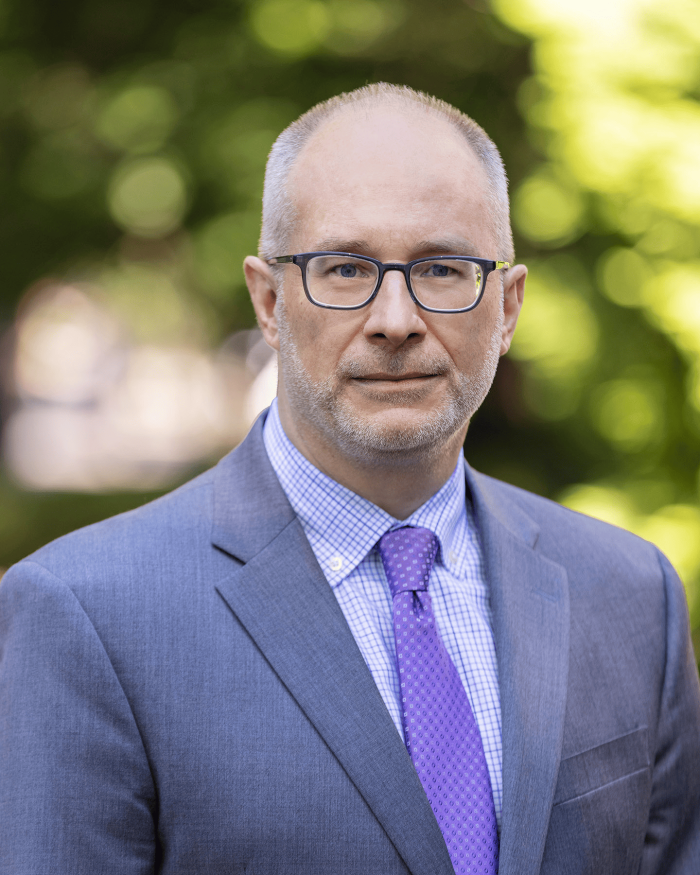
Alexander B. Downes is a Professor of Political Science and International Affairs at The George Washington University, serving as Director of the Institute for Security and Conflict Studies within the Elliott School of International Affairs. He holds a Ph.D. in Political Science from the University of Chicago. His research focuses on international security with expertise in civilian victimization during war, foreign-imposed regime change, military effectiveness, coercion, nuclear weapons, and civil war. He has authored two influential books: Targeting Civilians in War (2008) and Catastrophic Success: Why Foreign-Imposed Regime Change Goes Wrong (2021). Downes has received major recognition including the Joseph Lepgold Prize (2008), Emerging Scholar Award (2016), Michael E. Brown Research Prize (2022), and Harry Harding Teaching Prize (2020). His work has been funded by the Department of Defense Minerva Initiative, Carnegie Corporation, and others. He has held fellowships at Harvard's Belfer Center and Stanford's CISAC. Teaching responsibilities include courses on international security, modern warfare theory, and coercion strategies. His research emphasizes policy-relevant analysis of global security challenges, combining historical case studies with contemporary strategic dilemmas.
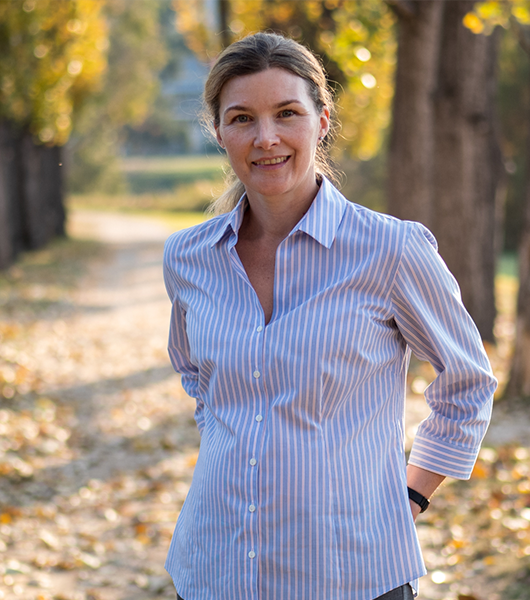
Paul Huth is a Professor and Director of the Center for International Development and Conflict Management (CIDCM) at the University of Maryland, where he also serves as Editor of the Journal of Conflict Resolution. He earned his PhD in Political Science from Yale University in 1986. His research spans international relations with concentrated expertise in interstate armed conflict, territorial disputes, international law applications, deterrence theory, civil war dynamics, civilian impacts of warfare, and aid-conflict interactions. He employs rigorous statistical methodologies and develops original datasets for large-N empirical analysis, frequently collaborating with graduate students and faculty to advance theoretical frameworks in conflict resolution. Professor Huth actively integrates students into his research projects to bridge academic theory with practical methodology, emphasizing real-world relevance for undergraduates through current event applications while fostering advanced research skills among graduate students.
Dr. Amelia Simpson holds the position of Honorary Associate Professor at the Australian National University (ANU), specializing in constitutional law with a focus on discrimination principles and federalism. She earned her BA Hons and LLB Hons from ANU, followed by an LLM and JSD from Columbia University. She is a practicing Barrister and Solicitor in the High Court of Australia. Her research critically examines constitutional frameworks, particularly regarding state residence discrimination under Section 117 and interstate free trade jurisprudence. Her work has been cited in landmark High Court and Federal Court rulings, solidifying her reputation as a leading scholar in public law. Amelia’s contributions include co-authoring Hanks Australian Constitutional Law: Materials and Commentary (2016) and contributing to the Oxford Handbook of Australian Constitutional Law (2018). Her research on social equality and functionalist approaches to non-discrimination has advanced scholarly discourse on constitutional values. Notably, her 2017 paper Social Equality in Australia critiques the historical neglect of equality principles in constitutional interpretation. Her publications span constitutional doctrine, class actions reform, and environmental policy, reflecting her interdisciplinary approach. She ranks among Australia’s top 20 most prolific legal scholars in high-impact journals (2000–2010). Her work bridges theoretical analysis with practical legal challenges, influencing both academia and judicial practice.
Sara McLaughlin Mitchell is Professor of Political Science and courtesy Professor at the College of Law at the University of Iowa, where she holds the Collegiate Fellow honor. Her interdisciplinary work bridges international relations, political methodology, and gender dynamics in academia. Her educational background: PhD in Political Science, Michigan State University, 1997 BS in Economics and Political Science, Iowa State University, 1991 Professor Mitchell's research centers on international conflict with deep expertise in maritime disputes, identity claims, and climate-conflict linkages. She pioneers political methodology through large-scale datasets like the Issue Correlates of War (ICOW) project, while her groundbreaking work on gender in academia examines citation patterns and career advancement barriers for women scholars. Her analytical rigor spans quantitative conflict modeling and qualitative institutional analysis. Recent publications reveal three dominant trajectories: environmental security (climate volatility impacts on human rights and disasters), geopolitical conflict (Russia-Ukraine War analysis, maritime/river disputes), and gender equity (academic networks, citation practices). She consistently integrates methodological innovation with real-world policy relevance, particularly in disaster response and international adjudication. Her major scientific awards include: Collegiate Fellow, University of Iowa Quincy Wright Distinguished Scholar Award (2015) Foreign Policy Analysis Distinguished Scholar Award (2023) Conflict Processes Lifetime Achievement Award (2023) Distinguished alumni award from Iowa State University A dedicated mentor, Mitchell co-founded the Journeys in World Politics workshop for junior women in international relations, earning university mentoring awards. Her research program is sustained by substantial grants from: Department of Defense National Science Foundation United States Agency for International Development She leads the Issue Correlates of War project and collaborates extensively through the Peace Science Society (where she served as President), driving interdisciplinary research on conflict management regimes and gender equity initiatives across academic networks.
Dr. Patrick Gill-Tiney is an LSE Fellow in the Department of International Relations at the London School of Economics and Political Science. His work focuses on international order, major power relations, and the role of international institutions like the United Nations. He holds a DPhil from Oxford University, an MSc from UCL, and degrees from Oxford and the University of Maryland. His research explores the decline of interstate violence linked to liberal norms, the impact of subordinate monopolization on major power wars, and evolving UN peacekeeping norms. Previously, he was a Fixed-Term Lecturer at St John’s College, Oxford. He is a Fellow of the Higher Education Academy. Key research interests include international security, regime type effects on peace, and the functional role of international organizations. His work has been published in the Journal of Conflict Resolution.
Douglas Lemke is a Professor of Political Science and Director of Graduate Studies at the University of Pennsylvania State (Penn State) within the College of the Liberal Arts. His primary affiliation is with the Department of Political Science. Professor Lemke has been at Penn State since 2004, previously teaching at the University of Michigan and Florida State University. He earned his Ph.D. from Vanderbilt University in 1993. His research focuses on conflict studies, encompassing both interstate and intrastate conflicts, with a particular emphasis on how international relations theories can explain domestic conflicts and inform state-making processes. Key areas include territorial non-state actors, state failure, power transitions, and regional security dynamics. His work has appeared in leading journals such as the American Journal of Political Science and International Studies Quarterly, and he authored the influential book Regions of War and Peace (Cambridge University Press, 2002). Professor Lemke’s recent publications (2023–2013) highlight themes like the influence of international norms on non-state actors, historical legacies of state formation, and regional power dynamics. His scholarship bridges theoretical frameworks from international relations and comparative politics, offering insights into the interplay between global and domestic conflict drivers. He currently holds no listed scientific awards but maintains an active research agenda supported by his academic roles. His advising and grants focus on graduate student mentorship and institutional contributions as Director of Graduate Studies. Lemke’s professional website is https://sites.psu.edu/territorialcontenders/ .
Joshua D. Kertzer is the John Zwaanstra Professor of International Studies and Government at Harvard University, where he also serves as Director of Graduate Studies. His research integrates international security, political psychology, and foreign policy analysis. His work examines public opinion formation, elite decision-making, and experimental approaches to international relations. Recent studies focus on how observers assess resolve in international conflicts, partisan influences on foreign policy attitudes, and the psychological foundations of reputation costs. Publications demonstrate methodological innovation in combining survey experiments with archival research, exploring topics from democratic credibility to signaling in crisis diplomacy. His award-winning research has been recognized by the International Studies Association and American Political Science Association.
Yuleng Zeng is an Assistant Professor of International Political Economy at the Faculty of Arts, University of Groningen. He is affiliated with the Center for International Relations Research (CIRR). His work focuses on the security implications of economic interdependence, tools of economic statecraft, major power competition, and contemporary Chinese foreign policy. He holds an associate editor position at Political Research Exchange . Research interests include international relations, security studies, and the intersection of economic policies with geopolitical strategies. His studies analyze how trade dynamics influence state power and interstate relations, including topics like sanctions, trade networks, and Chinese investment patterns. Publications span journals such as Journal of Law and Courts , Conflict Management and Peace Science , and Journal of Contemporary China . Recent work examines U.S. sanctions impacts, judicial independence models, and EU-China trade dynamics. No scientific awards are explicitly mentioned in the provided texts. Advising and grants information is not detailed here. Zeng contributes to academic networks through editorial roles and research collaborations, focusing on advancing theoretical frameworks in international political economy.
Jenny Kehl is a Visiting Associate Professor in the Department of Political Science at McMaster University's Faculty of Social Sciences. Her academic work focuses on the intersection of political science, international relations, and environmental policy, with particular emphasis on resource politics and governance. Dr. Kehl's research interests span several critical areas of contemporary political science: International water security and transboundary water management Political economy of natural resources, particularly oil and water Human rights and environmental justice in the context of climate change Foreign investment and development strategies in emerging economies Theoretical frameworks addressing the resource curse phenomenon Her scholarly work demonstrates a clear trajectory examining how states and international actors manage critical resources, particularly in contexts of conflict and cooperation. Recent publications show an increasing focus on water security issues, environmental justice, and the intersection of climate change with social practice. Her research bridges theoretical political science with practical policy implications, particularly in the areas of resource governance and international cooperation. Dr. Kehl has received recognition for her work, with publications referenced in Wikipedia pages and picked up by news outlets. Her research has been shared among academic communities, with readers on platforms like Mendeley. Her teaching and scholarly activities include contributions to political science education, as evidenced by publications on teaching and learning in political science. She has been involved in initiatives for preparing future faculty, demonstrating commitment to academic development beyond her research interests.
Carl Müller-Crepon is an Assistant Professor at the Department of Government, London School of Economics and Political Science (LSE) . His research focuses on state-building, political ethnicity, conflict, and geographic analysis, particularly in Africa and Europe. He previously held roles at the University of Oxford and ETH Zurich, and has affiliations with Harvard University. His work combines computational methods with geospatial data to study historical and modern dynamics of ethnicity, state capacity, and political violence. Education: PhD in Political Science, ETH Zurich (2019) MA in Political Science, ETH Zurich (2015) BA in International Affairs and Economics, University of St. Gallen (2013) Research Interests: His work explores how administrative borders shape ethnic identities, the impact of colonial policies on development, and the role of nationalism in territorial disputes. He innovates in geospatial data analysis and machine learning, publishing in top journals like the American Political Science Review and International Organization . Key Contributions: Developed the SIDE dataset for fine-grained ethnic demography analysis. Studied the reciprocal relationship between ethnic geographies and political borders since the 19th century. Explored state capacity in Africa using travel time metrics and road networks. Grants & Labs: Leading projects on colonial administrative design and ethnic persistence. Collaborations with institutions like ETH Zurich’s International Conflict Research Group.
Beatrice de Graaf is a Professor of History of International Relations & Global Governance at Utrecht University's Department of History and Art History, within the Faculty of Humanities. She serves as Scientific Director of the Adapt! Academy (2025–2035), a consortium funded by a NWO Gravitation grant, focusing on societal crisis resilience. Her roles include core editorships of Terrorism and Political Violence and Journal of Modern European History , and membership in the Netherlands Academy of Sciences (KNAW) and Academia Europaea. She is also a Visiting Fellow at the University of Cambridge and holds fellowships at the Center for Advanced Security Studies in Bonn and George Washington University's Extremism Project. Education: She earned her PhD from Utrecht University (2004) on GDR, Dutch churches, and the peace movement, awarded the Max van der Stoel Human Rights Award. She holds a master's in Modern History and German from Utrecht and Bonn universities. Notable achievements include the NWO Stevin Prize (2018), Arenberg European Prize (2022), Comenius Prize (2022), and Brouwer Trust Prize (2023). Research focuses on security state evolution, counterterrorism, crisis management, and their impacts on democratic values. Key projects include TerInfo (classroom terrorism education), Security History Network, and JISRA’s 'Reimagining Religion, Security and Social Transformation' (2022–2025). Her work bridges historical analysis with contemporary policy, emphasizing resilience and interdisciplinary collaboration. Media engagement includes columns in NRC Handelsblad , international TV/radio appearances, and the Huizinga Lecture (2024).
Virginia Page Fortna is the Harold Brown Professor of U.S. Foreign and Security Policy and Chair of the Department of Political Science at Columbia University. She is a leading scholar in international relations with expertise in conflict resolution, peacekeeping operations, and civil war dynamics. Professor Fortna earned her BA from Wesleyan University and completed her Ph.D. at Harvard University in 1998. Her academic career has been centered at Columbia where she has established herself as a prominent figure in international security studies through rigorous research and scholarly leadership. Fortna's research focuses on terrorism in civil conflicts, international climate politics, peace durability after wars, and war termination processes. Her work integrates quantitative and qualitative methodologies while addressing policy-relevant questions. She is particularly renowned for her groundbreaking studies on peacekeeping effectiveness that have reshaped academic understanding of post-conflict stabilization. Her scholarship consistently challenges conventional wisdom, as evidenced by recent work questioning whether terrorism is truly 'a weapon of the weak.' Her publication record shows an evolution from foundational work on peace agreements and ceasefire durability to more recent investigations of terrorist tactics in civil wars. Throughout her career, Fortna has maintained methodological innovation, often developing new datasets to address critical questions in international security. Her research combines theoretical diversity with empirical rigor, making significant contributions to both academic debates and policy discussions. Elected to the American Academy of Arts and Sciences (2021) Lenfest Distinguished Columbia Faculty Award (2014) Karl Deutsch Award from International Studies Association (2010) Fellowships at multiple prestigious research institutions Professor Fortna mentors graduate students through Columbia's Ph.D. program and teaches courses on international politics, climate change, war termination, terrorism, cooperation and security, and research methods. Her research has received substantial support through fellowships from leading academic institutions, reflecting the significance and policy relevance of her work in international relations. Based in New York with connections to Portland, Oregon, Fortna continues active research on terrorism in civil wars and international power dynamics in the anthropocene. Her scholarship remains highly influential in both academic and policy circles, particularly regarding effective conflict resolution strategies and international security frameworks.
Jared F. Edgerton is an Assistant Professor at the University of Texas at Dallas, affiliated with the School of Economic, Political and Policy Sciences. His research focuses on how social relations and networks influence conflict dynamics, employing methodologies from network science and machine learning. He holds a Ph.D. (2021) and M.A. (2018) in Political Science from The Ohio State University. Key research interests include terrorism, international security, civil war, and data-driven approaches to conflict analysis. His work spans topics like media effects on violence (e.g., Rwanda's radio impact), extremist recruitment networks (Islamic State), and elite polarization in crises like the COVID-19 pandemic. Methodologically, he combines experimental designs, bipartite network analysis, and geospatial techniques. Notable contributions include analyzing genocide participation in Rwanda, resilience in cooperative state networks, and the socio-technical dimensions of conflict mobilization. His interdisciplinary approach bridges political science, computer science, and security studies. While no scientific awards are explicitly listed, his prolific output reflects sustained scholarly impact. Edgerton has advised no listed students but has engaged in quasi-experimental policy evaluations (e.g., prisoner recidivism programs) and applied geospatial analysis to post-conflict land safety in Cambodia. His research portfolio demonstrates a commitment to both theoretical innovation and real-world conflict mitigation strategies.
Catherine M. Brooks is a Professor at Creighton University School of Law, where she has served since joining the faculty in 1990 as an Associate Professor and earning tenure and promotion to full Professor by 1995. She designs and develops family law courses and innovative skills curricula for child advocacy, client counseling, and cultural competence, directing the certificate program in family law studies while coaching student teams to regional and national finalist positions in legal competitions. Her commitment extends beyond graduation as law alumni routinely consult her on complex family law matters including adoption, juvenile delinquency, and custody disputes. Her academic credentials include a BA ( in cursu honorum , summa cum laude ) and MA from Fordham University (1977), and a JD from the University of Virginia (1980). She holds membership in prestigious honor societies Phi Beta Kappa, Alpha Sigma Nu, and Phi Delta Phi, and is licensed by the American Bar Association, Pennsylvania Bar (state and federal), and Omaha Bar Association. Brooks' research centers on the legal treatment of vulnerable populations, with rigorous scholarship addressing justice rights of Native American children, equal access rights for children of LGBTQ+ parents, dignity rights of maltreated minors, and minors' refusal of medical treatment. She integrates social justice frameworks into legal pedagogy, emphasizing culturally competent lawyering and systemic reform for marginalized groups. Her work bridges theoretical analysis with practical application, notably through mediation advocacy and child welfare policy critiques. Publication trends reveal sustained focus on family law and children's rights since the 1990s, evolving from foundational juvenile court manuals to contemporary analyses of bankruptcy practice and bioethics. Recurring themes include inter-jurisdictional adoption conflicts, child sexual abuse in custody cases, and due process in institutional governance. Recent works prioritize skill-building resources for practitioners, reflecting her dedication to translating academic rigor into real-world legal solutions. Her accolades encompass professional recognition and academic honors: Ten Outstanding Young Omahans (1994) Phi Beta Kappa membership Alpha Sigma Nu membership Phi Delta Phi membership Brooks actively mentors students through skills competitions and alumnus consultations while securing nearly $500,000 in federal grants for a legal clinic and African American law student scholarships. She provides pro bono support to child welfare agencies and serves on the Creighton Inn of Court to guide new lawyers. Her grant work specifically targets equity in legal education and clinic-based child advocacy. She leads critical institutional initiatives as Chair of the University Committee on Rank & Tenure, creating comprehensive web resources (https://www.creighton.edu/provost/tenure-and-promotion), workshops for evaluators, and revisions to the Faculty Handbook. Previously, she created the Children's Rights Clinic at Seton Hall Law School and served as Assistant Deputy Public Defender in New Jersey, representing children in abuse cases for the Law Guardian Program.
Michael R. Moore was a Professor of Environmental Economics at the University of Michigan’s School for Environment and Sustainability (SEAS). His research focused on water resource economics, climate change adaptation, and environmental policy, with notable contributions to valuing water quality, analyzing agricultural adaptations to weather risks, and evaluating renewable energy policies. He held leadership roles in NSF-funded projects addressing Great Lakes water quality and offshore wind energy siting. Education: PhD, Natural Resource Economics, University of Michigan BA, Economics, University of Colorado Research Interests: His work integrated ecological and economic systems, emphasizing: Environmental valuation using hedonic pricing Climate change impacts on land use and farming Policy design for emissions trading and renewable energy markets Great Lakes ecosystem restoration and economic outcomes Grants & Leadership: Key grants included $5M NSF funding to study Great Lakes algal blooms and $224K for analyzing Great Lakes restoration’s economic impacts. He co-led multi-institution studies on offshore wind energy siting and green electricity market mechanisms. Media Impact: His research on Great Lakes pollution remediation’s effect on property values garnered national media attention, including features in Michigan Radio and Wisconsin Public Radio . He also advised on Colorado River water agreements and African freshwater science initiatives.