Mark W. Newman is an Associate Professor in the School of Information at the University of Michigan, with a joint appointment in the EECS Department. His research focuses on human-computer interaction, ubiquitous computing, and health informatics, emphasizing the design of technologies that integrate seamlessly into everyday life. He teaches courses on user experience research, programming, and application development, contributing to curriculum design efforts such as the User Experience Design track and programming curricula for undergraduate and graduate programs. His work spans smart home technologies, mobile health interventions, and collaborative health management systems. Notably, he collaborates across disciplines to address challenges in healthcare technology, including patient-generated data integration and sustainable energy solutions. Newman actively mentors students and leads design projects that prioritize user-centered approaches, such as the UX Research & Design Specialization on Coursera. His recent scholarship explores adaptive mHealth interventions, context-aware systems, and participatory design methods to enhance health equity.
Andy Hargreaves is an internationally recognized scholar and advisor in education, holding dual roles as Adjunct Professor at Boston College and Visiting Professor at the University of Ottawa. He advises governments including Ontario, Scotland, and New Brunswick on educational policy and system reform. His work focuses on leadership, well-being, student engagement, and systemic educational change. Hargreaves co-leads the ARC Education Project and founded CHENINE, a Canadian research initiative advancing pedagogical innovation. Research Interests: Leadership from the Middle Teacher Well-Being and Professional Capital Identity Development in Schools Play-Based Learning Crisis Management in Education Awards: 2023 Canadian EdTech Awards Educator of the Year 2023 RHSU Edu-Scholar #16 2022 National Academy of Education Member 2015 Grawemeyer Award Key Projects: ARC Education Project (7 nations collaboration) CHENINE (Canadian educational innovation hub) Canadian Playful Schools Network Labs/Teams: Directs CHENINE, collaborates through ARC networks, and leads research on global educational transformation.
Jana Cason, DHSc, OTR/L is a Professor in the Department of Occupational Therapy at the Graduate College of Health Sciences, Hawai'i Pacific University. With a career spanning diverse practice settings—including hand therapy, outpatient rehabilitation, and telehealth—she has significantly advanced the use of telehealth in occupational therapy through research, policy development, and international collaboration. Doctorate in Health Science (DHSc) from the University of Indianapolis MHS and BS in Occupational Therapy from the University of Indianapolis and University of Alabama at Birmingham Her research focuses on telehealth implementation, compassionate care, and early intervention. She has authored peer-reviewed articles, book chapters, and standards for telehealth practice, and serves as Senior Associate Editor for the International Journal of Telerehabilitation . Dr. Cason has presented globally and contributed to resolving licensure portability challenges for telerehabilitation professionals. Fellow of the American Occupational Therapy Association (FAOTA) Developer of telehealth protocols and frameworks Advocate for uniform state licensure requirements She integrates clinical practice, research, and education, emphasizing cultural competence in Hawaiian and Pacific Asian contexts while maintaining three rescue dogs and cats with her family.
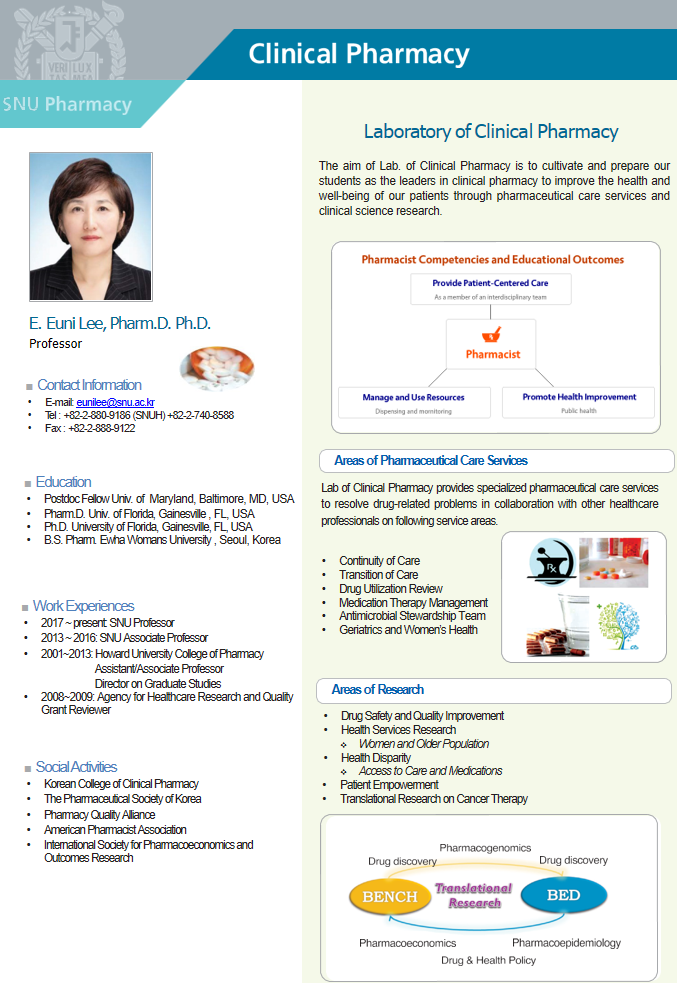
Professor Kim Eun-kyung is a full-time Professor at the College of Pharmacy , Seoul National University , South Korea. She directs patient-oriented research at the intersection of pharmacy, public health and clinical epidemiology, leading projects that range from nationwide pharmaco-epidemiologic cohort analyses to qualitative investigations of pharmacist-led care models. Education Ph.D. & Pharm.D., University of Florida, USA Research Interests Professor Kim’s research program is built on five mutually reinforcing pillars: Population-based patient care research – leveraging large national databases to understand medication utilization and outcomes in real-world settings. Drug safety and patient empowerment – identifying adverse drug reactions and developing interventions that enable consumers and clinicians to report and prevent harm. Access to care and medications in underserved and special populations – examining barriers faced by the elderly, rural residents, patients with rare diseases, and those undergoing high-cost procedures such as hematopoietic stem-cell transplantation. Disease prevention and appropriateness of therapy – evaluating preventive pharmacotherapy (e.g., anti-osteoporosis drugs, vitamin D) and ensuring evidence-based prescribing. Quality improvement in health-care delivery – designing multidisciplinary models that integrate pharmacists into care teams to optimize medication therapy and reduce drug-related problems. Publication Trends Across 2017–2020, Professor Kim has published extensively in International Journal of Environmental Research and Public Health , Clinical Nutrition , Medicina , BMC Public Health , Blood Research , Neuroepidemiology and other peer-reviewed journals. Her work characteristically combines rigorous secondary-data analyses of Korean or US national health surveys with systematic reviews/meta-analyses focusing on drug safety endpoints. Themes include neurological adverse events (trimetazidine-induced parkinsonism), hematologic toxicities (linezolid-induced thrombocytopenia), nutritional and metabolic complications in critical care, and access/utilization of medications in vulnerable populations. Scientific Awards & Honors (None listed in the provided texts) Grants & Research Support While specific grant identifiers are not detailed in the supplied pages, the breadth of large-scale database studies and multi-institutional collaborative projects implies sustained funding from national agencies such as the Korea Health Industry Development Institute (KHIDI) or the Ministry of Health & Welfare. Laboratory & Team Professor Kim leads an active research group located in Yeongeon Campus 17-201. The team integrates graduate students, post-doctoral researchers, pharmacists and biostatisticians working together on pharmacoepidemiology, patient-reported outcomes and health-services research.
Ying MacNab is an Associate Professor in the Department of Statistics at the University of British Columbia (UBC), Vancouver Campus. She holds an additional affiliation as an Associate Member in the School of Population and Public Health (SPPH). Her research focuses on Bayesian hierarchical modeling, spatial epidemiology, and disease mapping with applications to public health surveillance and aging populations. She has contributed extensively to methodological advancements in Gaussian Markov random fields and spatiotemporal modeling frameworks. Her work bridges statistical theory and practical health challenges, including pandemic-related stress in older adults, opioid treatment outcomes, and infectious disease forecasting. MacNab has collaborated on projects involving mental health assessments (e.g., sleep dysfunction, anxiety/depression in iOAT patients) and has developed novel statistical tools for analyzing spatially and temporally correlated health data. Her research also addresses methodological gaps in coregionalized multivariate models and constrained Bayesian estimation. MacNab's publications reflect a multidisciplinary approach, integrating epidemiological theory with advanced computational methods. Recent trends in her work emphasize dynamic modeling of infection risks, mediation analysis in aging populations, and validation of psychometric scales for health-related stress. She has maintained an active research agenda since the early 2000s, with notable contributions to neonatal health outcomes, injury surveillance, and healthcare quality improvement.
Professor James Barlow is Co-Director of Imperial College London's Centre for Sectoral Economic Performance and holds a Professorship in the Department of Economics and Public Policy at the Imperial College Business School. He also serves as Academic Director for the MBA programme and Visiting Professor at Halmstad University (Sweden) and Honorary Professor at UCL Bartlett Real Estate Institute. His research focuses on structural challenges in healthcare innovation, housing, and construction sectors, with a particular emphasis on embedding innovations into healthcare systems. Barlow's education includes a background in geography and economics from the London School of Economics. He has held previous roles at the University of Westminster and Policy Studies Institute. His advisory work spans governments, healthcare organizations, and industries including medical technology and pharmaceuticals. He contributes to major initiatives like AGE-WELL (Canada) and the Industry Commons Foundation (Sweden). Research interests include healthcare innovation ecosystems, institutional logics, and frugal innovation. His recent book *Managing Innovation in Healthcare* synthesizes his work. He collaborates across disciplines, addressing challenges in telehealth, AI integration, and regulatory frameworks post-Brexit. Key affiliations include the Centre for Health Economics and Policy Innovation, Policy Innovation Research Unit (PIRU), and the NIHR Health Tech Research Centre. His work bridges academic research with practical policy and industry solutions, emphasizing scalable and sustainable business models.
Dr. Angelique Jenney is an Associate Professor and the Wood’s Homes Research Chair in Children’s Mental Health at the Faculty of Social Work, University of Calgary. With over 25 years of experience in gender-based violence, child protection, and children’s mental health sectors, she specializes in trauma-informed approaches and simulation-based learning methodologies. Doctor of Philosophy (PhD), Social Work – University of Toronto (2011) Master of Social Work (MSW) – Wilfrid Laurier University (1998) Bachelor of Arts (BA), Psychology Co-op Program – University of Guelph (1995) Her research focuses on child mental health , gender-based violence , trauma across the lifespan , and simulation-based learning . She develops tools to enhance clinical competencies through experiential training, addressing gaps in child protection responses to violence and trauma. Dr. Jenney’s publications highlight innovative practices such as virtual simulations for interdisciplinary education, narrative shelter models for resilience, and trauma-informed interventions with perpetrators. Her work bridges academic research and frontline practice, emphasizing practical knowledge dissemination to parents and policymakers. Faculty Publication Award (2017–2022) Faculty of Social Work Early Career Researcher Award (2021) Teaching Experiential Learning Initiatives Teaching Award (2023) She collaborates with agencies like the Hotchkiss Brain Institute and Mathison Centre for Mental Health Research and Education, contributing to policy development and training frameworks in child welfare.
Ulla-Mari Kinnunen is a Professor of Health and Human Services Informatics at the University of Eastern Finland's Department of Health and Social Management, within the Faculty of Social Sciences and Business Studies. She also holds the title of Adjunct Professor in Evidence-Based Research and Development. Her research focuses on health informatics, digitalization in healthcare and social services, evidence-based practices, and informatics competencies for professionals and citizens. She chairs the Finnish nursing terminology (FinCC) and serves on the IMIA Nursing Informatics Board and the Finnish Centre for Evidence-Based Health Care. She supervises 16 doctoral students and coordinates the Health and Human Services Informatics (HHSI) Master’s program. She is a member of the Finnish Publication Forum (Panel 14) and the Editorial Board of JMIR Nursing. In 2021, she was awarded the IMIA fellowship as a Fellow of the International Academy of Health Sciences Informatics. Her research interests include structured data systems, classifications in electronic health records (EHR), and organizational factors influencing digitalization. Key projects include the 'FinCC' research group for nursing terminology and the 'House of Effectiveness' initiative. Her work emphasizes improving healthcare quality through informatics and evidence-based practices. Recent publications highlight studies on information systems implementation, digitalization challenges, and the role of informatics in interprofessional collaboration. She actively contributes to international health informatics education and policy, including the European Summer School in Health Informatics and the TIGER Initiative for workforce development. Grants and Projects: Research Project on Data Resources for Fire Investigation (2023–2025), IMIA Fellowship, and EU-funded initiatives like eHealth4all@eu. Labs/Teams: Health and Human Services Informatics Research Group, FinCC Research Group, and the Finnish Centre for Evidence-Based Health Care.
Niall Winters is a Visiting Fellow at the University of Oxford's Department of Education, previously serving as Professor of Education and Technology and an Official Fellow. His research focuses on socially-just technology innovations, particularly in healthcare and education, supported by over €7 million in funding. He holds a PhD in Computer Science from Trinity College Dublin. Key roles include co-convenor of the Critical Digital Education Research Group, director of the MSc Education (Digital and Social Change), and mentor to Kellogg students. Prior to Oxford, he was a Reader in Learning Technologies at UCL Institute of Education and Deputy Head of the Department of Culture, Communication and Media. His research integrates global health challenges with digital solutions, emphasizing community health workers' training in low-resource settings. Collaborations include the Global Centre on Healthcare and Urbanisation at Kellogg and projects with UNESCO, WHO, and the NHS. He has held fellowships at institutions like Sciences Po and MIT Media Lab Europe. Publications span mobile health technologies, gamification in medical education, and policy frameworks for digital equity. His work bridges theory and practice, advocating for ethical technology design that addresses systemic inequalities in education and healthcare systems.
Reza Taheri is a Professor and Senior Associate Dean of Pharmacy Education at Chapman University School of Pharmacy. His expertise spans leadership development, curriculum design, strategic planning, and programmatic accreditation in pharmacy education. Previously, he served as Chief Strategy Officer at RxPrep Inc., founding Associate Dean at West Coast University, and held faculty and leadership roles at Western University of Health Sciences and Loma Linda University School of Pharmacy. Education: Doctor of Pharmacy (University of Minnesota), Executive MBA (University of Southern California) Current Role: Department of Pharmacy Practice, Chapman University His research focuses on pharmacy education , emphasizing emotional intelligence coaching , interprofessional collaboration , and virtual learning modalities . Recent studies examine mock-trial simulations for teaching-assessment, supplemental instruction efficacy, and interprofessional virtual simulations for leadership and patient advocacy. Publications highlight technology integration in pharmacy curricula and resilience measurement in educational contexts. Taheri collaborates extensively on interprofessional education (IPE) interventions, analyzing their impact on patient outcomes like length of stay , medical errors , and mortality . He is a certified Emotional Intelligence Coach and trainer with Crucial Learning and The Table Group.
Dr. Payam Sheikhattari is a tenured Professor of Public Health in the School of Community Health & Policy at Morgan State University with nearly two decades of experience in community-based participatory research. He is the founder of the Morgan CARES network and former director of the Prevention Sciences Research Center, fostering sustainable collaborations between academia and community organizations to address health disparities in underserved communities. His educational background includes a Post-Doctoral Fellowship from Johns Hopkins Bloomberg School of Public Health, an MD from Uromia University of Medical Sciences in Iran, and an MPH from Tehran University of Medical Sciences. This diverse training informs his approach to public health research and practice. Dr. Sheikhattari's research focuses on advancing health equity through community engagement, with particular emphasis on tobacco cessation programs, health disparities in marginalized populations, and innovative community-academic partnerships. His work consistently centers on community-based participatory research methods that empower communities to be active partners in the research process. His publication portfolio demonstrates expertise across tobacco control, health disparities, and community engagement, with recent work examining gender differences in quit rates, electronic cigarette use among youth, and intersectional approaches to tobacco advertising exposure. His 2022 book "Practitioner Research for Social Work, Nursing, and the Health Professions" represents a significant contribution to methodological approaches in community health. $41 million (over 10 years) NIH U54 award for ASCEND Training Model $18 million (over 5 years) NIH U54 award for RCMI@Morgan $749k (over 4 years) AHA funding for IMPACT project $226k (over 2 years) Morgan State University funding for Community & Stakeholder Engagement Certificate Program As a dedicated mentor, Dr. Sheikhattari has supervised numerous undergraduate research students through programs like ASCEND and has been instrumental in developing training models to enhance biomedical research opportunities for underrepresented minorities. His leadership extends to establishing physical infrastructure for community engagement through the Morgan CARES initiative, which has become a model for academic-community partnerships in public health research.
Anna Mayo is the Anna Loomis McCandless Assistant Professor of Organizational Behavior at Carnegie Mellon University’s Heinz College. Her research focuses on dynamic teamwork in modern organizations, particularly in healthcare and cross-sector settings. She investigates how teams adapt to fluid participation, technology integration, and volatile environments to enhance productivity and collaboration. Education: Ph.D. & M.S. in Organizational Behavior & Theory, Carnegie Mellon Tepper School of Business B.A. in Psychology, Denison University Research Interests: Mayo explores team coordination, cognitive versatility, and the impact of organizational structures on teamwork efficacy. She combines lab and field studies (e.g., healthcare, sales teams) to address challenges like rapid team formation/dissolution and distributed member roles. Her work emphasizes agility while mitigating risks to team outcomes. Publications: Her research appears in top journals such as Administrative Science Quarterly, Academy of Management Annals, and BMJ Leader. Recent studies address pandemic teamwork dynamics, nursing-physician collaboration, and the role of coordinated attention in group performance. Prior Experience: Before joining CMU, Mayo held roles at Johns Hopkins Carey Business School and worked in nonprofit human services. She teaches Organizational Design & Implementation (Course 94-700).
Associate Professor Stephen Carter is an Associate Professor in Pharmacy Practice at the University of Sydney's Sydney Pharmacy School within the Faculty of Medicine and Health. He serves as the Program Director for Undergraduate Pharmacy programs and is a registered pharmacist with clinical specialisation in medication management review. Stephen holds qualifications including BPharm, MSc, PhD, and Grad Cert Edu (Higher Ed). He is a Fellow of the Pharmaceutical Society of Australia (FPS), Fellow of the Higher Education Academy (FHEA), and holds other professional accreditations. His research focuses on optimizing the role of pharmacists in healthcare, particularly examining how consumers and caregivers obtain and use medicines, designing effective pharmacist services, and supporting pharmacists throughout their professional journey. His work spans areas including osteoporosis care, medication adherence, service quality in community pharmacies, and the application of advanced statistical methods like Structural Equation Modelling. Stephen's publications demonstrate a strong focus on practical pharmacy interventions, with significant work on osteoporosis management services, perinatal depression screening in pharmacies, and digital health approaches to improve medication adherence. His research employs diverse methodologies including randomized controlled trials, qualitative studies, and advanced psychometric analyses. Early Career Investigator Award Australasian Pharmaceutical Science Association (APSA) for 2017 Lesmuller Award for Best Oral Communication - Pharmaceutical Care Network Europe Working Conference, Berlin, 2013 Recipient of the 2013 Annual Best Paper Award by Elsevier publication, Research in Social and Administrative Pharmacy Best Poster Presentation Award: International Social Pharmacy Workshop, Boston, USA, 2014 Top reviewer, Research in Social and Administrative Pharmacy (2015, 2016, 2017, 2019) Stephen actively supervises several graduate students including PhD candidates Fatima Rezea, Steven Tran, Veronika Seda, Kingston Leung, and Joel Hillman, as well as MPhil student Linda Krogh. He has secured significant research funding, including co-leading a $2.36 million Randomized Controlled Trial and managing four current competitive grant-funded projects totaling over $6.3 million. His work has particular emphasis on translating research into practical pharmacy services that improve patient outcomes. Stephen is actively involved in major research initiatives including the #STOP trial (Safer medicines To reduce falls and refractures for OsteoPorosis) and the TICTOC trial (Timely post-discharge medication reviews to Improve Continuity – the Transitions Of Care stewardship), both focusing on innovative pharmacist-led interventions to improve medication safety and effectiveness.
Associate Professor Mary Jeanette Ignacio is a faculty member at the Alice Lee Centre for Nursing Studies, Yong Loo Lin School of Medicine, National University of Singapore (NUS), where she has served since 2008. She currently serves as the Undergraduate Programmes Director for Year 1 and specializes in simulation-based pedagogy. Doctor of Philosophy (Health Professions Education), Maastricht University Bachelor of Science (Nursing), St Dominic Savio College, Philippines Doctor of Medicine (MD), University of Santo Tomas, Philippines Bachelor of Science (Psychology), University of the Philippines Diliman Her research focuses on stress management , cognitive integration , collaborative learning , and human factors in healthcare education. She has pioneered simulation-based teaching strategies across undergraduate and postgraduate nursing curricula and developed innovative approaches to link pathophysiology with clinical practice. Recent publications highlight her work in virtual reality simulations , systematic reviews on gender discrimination in nursing , and interprofessional educational interventions . She has received multiple teaching excellence awards and secured grants for simulation-based learning projects. NUS Teaching Excellence Award (Individual) 2023 NUS Long Service Award 2023 National University of Singapore Teaching Excellence Award 2017 Her funded projects include grants from the Centre for Development of Teaching and Learning (NUS), Singapore Millennium Foundation, and Sigma Theta Tau International Honors Society of Nursing Research. She actively contributes to advancing simulation pedagogy , virtual hospital design , and affective fidelity in simulations to improve clinical learning outcomes.
Dr. Brad Nakamura is Professor and Director of the Center for Cognitive Behavioral Therapy (C-CCBT) at the University of Hawai‘i at Mānoa. With over 15 years of continuous service to the university, he focuses on improving youth mental health through integration of scientific research with community practice. His career demonstrates strong commitment to Hawai‘i's youth mental health systems. PhD in Clinical Psychology (2007) MA in Psychology (2004) BA in Psychology (2000) His research program addresses two key areas: 1) dissemination and implementation of evidence-based practices (EBPs) in youth mental health services, and 2) developmental psychopathology of anxiety disorders in children and adolescents. Recent publications focus on strength-based assessment tools like SEEDS, Ohio Scales validation, and implementation strategies for EBPs in public mental health systems. Current research trends show particular attention to: Telehealth adaptation and telepresence optimization Measurement feedback systems in schools Implementation context analysis Strengths-based assessment development Community-academic partnerships Cultural adaptation of mental health tools Dr. Nakamura actively advises trainees and leads multiple funded initiatives including: $582,550 (2024-2025) Hawaii Department of Education contract $1,757,063 (2024-2025) Department of Health grant Long-running Faculty Travel Fund recipient He serves as principal investigator for statewide mental health assessment and training programs, and co-investigator for psychological assessment training initiatives. His lab collaborates with the Center for Cognitive Behavior Therapy to develop practice element frameworks and implementation ontologies that standardize youth mental health care delivery across Hawaii.