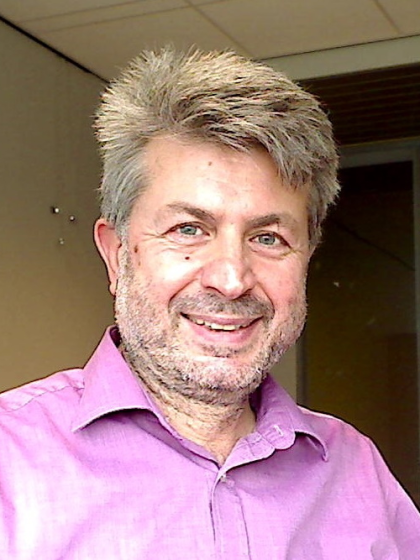
Christos Emmanouilidis is an Associate Professor with Ius Promovendi at the Faculty of Economics and Business, University of Groningen. He holds over 20 years of experience across Industry, Academia, Research, and Innovation. Current roles include Scientific Vice Chair of IFAC TC 5.1 and Chair of the IFAC AMEST Working Group. He is a Senior IEEE Member and Founding Fellow of ISEAM. Education: PhD in Computing and Engineering Technology, University of Sunderland (2002) MSc in Engineering, University of Durham (1997) Dipl-Eng in Electrical Engineering, Aristotle University of Thessaloniki (1992) Research Interests: Industrial Informatics, IoT, and Cyber-Physical Systems Human-Centric AI & Linked Data Maintenance Engineering and Asset Lifecycle Management AI Ethics and Human-Centric Digital Twins Awards: PHM Society Annual Data Challenge Award (2013) Senior IEEE Member Founding Fellow of ISEAM Labs/Teams: Leads projects in Human-AI Interaction (HumAIne EU Project) and Trustworthy AI in Manufacturing (STAR Project). Active in IEEE and IFAC standardization committees (CEN TC319, ISO 251).
Ali Shiri is a Professor in the School of Library and Information Studies and Vice Dean in the Faculty of Graduate & Postdoctoral Studies (GPS) at the University of Alberta. He holds a PhD in Information Science from the University of Strathclyde (2004). His research focuses on digital libraries, cultural heritage preservation, AI ethics, and learning analytics. He leads major funded projects like the Inuvialuit Voices initiative and the D-CRAFT toolkit development. Awards include the University of Alberta’s J. Gordin Kaplan Award for Excellence in Research (2021) and Emerald Literati Award (2023). Shiri’s work emphasizes community-driven design, ethical AI integration, and Indigenous knowledge preservation. Education: PhD in Information Science, University of Strathclyde (2004). Research Interests: Digital libraries, cultural heritage digitization, AI ethics, learning analytics, and Indigenous knowledge systems. His projects often involve collaborations with Northern Canadian communities to develop inclusive digital platforms. Recent work explores generative AI’s impact on education and research paradigms. Grants & Projects: SSHRC-funded projects totaling over $500,000, including Inuvialuit Voices (2019-2024) and Digital Library North (2014-2018). Current initiatives include intergenerational storytelling apps and the D-CRAFT assessment framework. Awards: Outstanding Paper Award, Emerald Literati (2023) J. Gordin Kaplan Award (2021) Faculty of Education Teaching Award (2016) Labs/Teams: Leads the Digital Libraries & Cultural Heritage Lab, collaborating with Inuvialuit communities on storytelling systems and metadata frameworks.
Mehrdad Ghandhari Alavijh is a Full Professor in Electric Power Systems at KTH Royal Institute of Technology. He leads research in power system dynamics, stability, and control, with a focus on FACTS (Flexible AC Transmission Systems), HVDC systems, and advanced control strategies. His work addresses challenges in grid reliability, renewable energy integration, and environmental sustainability. Education: Received M.Sc. (1995) and Ph.D. (2000) in Electrical Engineering from KTH. His research group develops innovative methods for secure, efficient power system operation, leveraging advanced monitoring and communication technologies. Research Interests: Power System Dynamics and Stability Transient Stability Assessment HVDC and FACTS Technologies Renewable Energy Integration Publications: Recent works focus on HVDC systems, battery storage, transient stability algorithms, and frequency control. His studies emphasize real-time monitoring and control strategies to enhance grid resilience against outages. Teaching: Supervises courses in power systems engineering, including degree projects in Electric Power Systems and Energy Innovation. Serves as an examiner and course responsible for multiple graduate programs.
Professor Alistair Barros is Head of School and Academic Program Leader of Service Science at QUT’s School of Information Systems (Faculty of Science). He holds a PhD from the University of Queensland, with extensive ICT experience in academia and industry (e.g., Global Research Leader at SAP AG). His research focuses on enterprise systems design, optimization, and interoperability in cyber-physical environments leveraging cloud, IoT, and blockchain technologies. Key areas include service computing methods (microservices, business process management), model-based systems re-engineering, and distributed service coordination. Education: PhD in Information Systems from the University of Queensland. Research Interests: Enterprise systems modernization, service-oriented architectures, Industry 4.0 applications, and digital transformation in sectors like construction, manufacturing, and supply chains. He has published 180+ peer-reviewed articles (including 6 edited books) and holds 17 US patents. Notable contributions include the BPMN 2.0 standard co-authorship and the 'Workflow Patterns' paper (most cited in BPM). Awards: Test of Time Award (BPM 2015), Wharton Education Award (TeachConnect platform), and impactful industry collaborations (e.g., SAP NetWeaver, Federal Government WPIT project). Grants & Projects: Led ARC, EU FP6, and industry-funded projects. Current focus includes re-engineering legacy systems for microservices, EV charging network design, and adversarial ML in cybersecurity. Labs/Teams: Active in QUT’s Centre for Data Science, focusing on service science and cyber-physical systems integration.
Professor Alexander Moens is a prominent academic in Political Science at Simon Fraser University's Department of Political Science. He holds the rank of Professor and specializes in NATO studies, Canadian-American defense policy, and experiential teaching methods. His research emphasizes great power politics involving the U.S., China, and Russia, with extensive fieldwork in NATO institutions and military organizations. Education: BA (with Distinction), University of Lethbridge MA, McMaster University PhD, University of British Columbia His research focuses on NATO's strategic relevance in contemporary geopolitics, defense policy formulation, and the evolving security architecture in Europe and North America. He pioneered the NATO Field School program, an experiential learning initiative taking students to NATO member countries for simulations and engagement with military/diplomatic officials. Publications analyze NATO's adaptation to emerging challenges, Sino-American competition, and the legacy of post-9/11 security frameworks. His work bridges academic research with practitioner insights through direct engagement with policymakers in Ottawa, Washington, and Rome. Moens has developed influential frameworks for understanding Canada's role in NATO, including the 'Framework Nation' concept and defense policy modernization strategies. He actively contributes to think tanks like the Macdonald-Laurier Institute and collaborates with the NATO Defense College.
Douglas Allaire is an Associate Professor and Sallie and Don Davis '61 Faculty Fellow in the J. Mike Walker ’66 Department of Mechanical Engineering at Texas A&M University, part of the College of Engineering. He leads the Computational Design Laboratory, focusing on computational methods for complex engineered systems. His research spans multidisciplinary design optimization, Bayesian optimization, machine learning, and materials design. Education: Ph.D., Aerospace Engineering, Massachusetts Institute of Technology (2009) M.S., Aerospace Engineering, Massachusetts Institute of Technology (2006) B.S., Aerospace Engineering, Massachusetts Institute of Technology (2004) Research Interests: Bayesian optimization and uncertainty quantification Materials design using machine learning Autonomous experimentation and data fusion Predictive analytics for engineering systems Recent Trends in Publications: His work emphasizes integrating Bayesian methods with materials discovery, autonomous systems, and high-fidelity modeling. Key themes include optimizing multifidelity systems, inverse microstructure design, and real-time decision frameworks. Awards: ASEM Fellow (2024) AIAA Associate Fellow (2023) ASME Young Engineer Award (2018) Advising & Grants: Advised students like Jaylen James (Ph.D. 2022) and Danial Khatamsaz. Active in securing grants for computational design and materials research. Collaborates with institutions like the American Institute of Aeronautics and Astronautics. Labs & Teams: Directs the Computational Design Laboratory, part of the Engineering Systems Design Group. Engages in interdisciplinary projects with Texas A&M’s Multidisciplinary Engineering program.
Mohammed Shafae is an Assistant Professor in the Department of Systems and Industrial Engineering at the University of Arizona, where he has been serving since 2018. He is also a member of the Graduate Faculty, contributing to advanced research and mentorship in engineering disciplines. Education: PhD in Industrial and Systems Engineering, Virginia Tech, Blacksburg, Virginia, United States MS in Industrial and Systems Engineering, Virginia Tech, Blacksburg, Virginia, United States MS in Production Engineering, Alexandria University, Alexandria, Egypt BS in Production Engineering, Alexandria University, Alexandria, Egypt His research centers on cyber-physical systems security , smart manufacturing systems , and data-driven quality control , with a strong emphasis on leveraging manufacturing data for process monitoring, modeling, and securing machining and additive manufacturing systems. His work integrates statistical process monitoring, machine learning, and advanced metrology to enhance manufacturing resilience and efficiency. His recent publications (2022–2025) reflect a clear trend toward securing Industry 4.0 systems, with a focus on digital twin security, attack detection in machining, and anomaly detection in additive manufacturing using photodiode and thermal data. He also explores futuristic applications such as in-situ lunar manufacturing using regolith-based materials. Scientific Awards: First Place in the ASCEND Propel Pitch Competition (AIAA, Fall 2020) Virginia Tech Teaching Excellence Award (Spring 2017) Harold Schneikert Graduate Fellowship (Spring 2016) David H. Burrows Graduate Fellowship (Fall 2015) Best Track Paper Award (IEOM 2012) Prize for Excellence in Senior Design Project (Cairo, 2009) Dr. Shafae actively mentors graduate students, co-authoring numerous publications with advisees in areas such as cybersecurity, additive manufacturing, and process monitoring. While specific grant details are not listed, his research is clearly funded through competitive fellowships and likely external grants given the volume and quality of his outputs. He has no listed labs or teams in the provided text, but his collaborative work suggests active participation in research groups focused on smart manufacturing and cybersecurity.
Sonia Solera Cotanilla is an Assistant Professor at the Universidad Politécnica de Madrid, specializing in cybersecurity, IoT security, and privacy protection in connected devices. She leads the RSTI research group, actively participates in European projects like DESIRE6G, 6Green, and ACROSS, focusing on 5G network security, energy efficiency, and cross-layer provisioning frameworks. Her work integrates hardware-software solutions for emerging technologies such as smart home systems, wearables, and e-voting infrastructure. Key affiliations: RSTI Group, Polytechnic University of Madrid Research areas: Cybersecurity frameworks, threat detection, privacy-preserving architectures Recent contributions include developing the SPEDIA system for insider threat detection, cybersecurity frameworks for FCAS risk assessment, and privacy analysis of wearable devices for minors. She has advised doctoral candidates like Mario Sanz Rodrigo and Carmen Sánchez Zas, both awarded PhDs in Telematic Systems Engineering. Notable awards: ISDEFE Prize for Best Doctoral Thesis (2024) Grants: National Cybersecurity Institute (INCIBE) funding, Horizon 2020 projects Labs/Teams: RSTI Group focuses on advanced cybersituational awareness platforms and secure IoT/IIoT infrastructure development. Current projects include GovTech4Impact, RAMONES, and e-Voting security audits for Minsait.
John Krogstie is a Professor of Information Systems at NTNU’s Department of Computer Science and Informatics (IDI). He has held leadership roles including Head of IDI (2017–2021), Director of NTNU Digital (2022–2023), and Head of the Center for Sustainable ICT (CESICT). He co-founded goforIT (2020) and established the NOKIOS conference in 2007. Krogstie holds a PhD (1995) and master’s (1991) from NTNU, with research spanning information systems development, sustainable digitalization, and neuro-conceptualization. His work emphasizes sustainable smart cities, eGovernment, and AI applications. He has authored over 380 publications, achieving an H-index of 68 (Google Scholar, 2024). Education: PhD in Information Systems, NTNU, 1995 Master’s in Information Systems, NTNU, 1991 Research Interests: Krogstie focuses on sustainable ICT integration, AI-driven urban solutions, and modeling methodologies. He explores neuro-conceptualization techniques using biometric data to enhance model comprehension. His work bridges academia and industry, addressing challenges in digital transformation and environmental sustainability. Publications Trends: Recent articles emphasize AI in smart cities, sustainable design frameworks, and neuro-cognitive modeling. Key themes include energy systems digitalization, ethical AI governance, and interdisciplinary sustainability collaboration. Awards & Recognition: H-index 68 (Google Scholar) reflects his impactful contributions. He has led IFIP committees (e.g., IFIP TC8 Vice-Chair) and chairs international conferences like NOKIOS. Grants & Advising: Open research assistant positions (2025) focus on biometrics in neuro-conceptualization and Active Knowledge Models (AKM). He has supervised numerous initiatives, including the goforIT project and the CESICT sustainability framework. Labs & Teams: Leads the CESICT and collaborates with SINTEF on smart city projects. Engages in international networks like IFIP WG 8.1 and the EU’s Smart Cities initiatives.
Mohammed Alghazwi serves as an external researcher in the Information Systems department within the Faculty of Science and Engineering at the University of Groningen. His institutional affiliation is evidenced through his published research and university email address. His research focuses on the intersection of blockchain technology and genomic data analysis, with particular emphasis on privacy-preserving systems. Key areas include off-chain computation verification, ciphertext security, and genomic dataset management. His work bridges computer science with biomedical applications, addressing critical challenges in healthcare data privacy through cryptographic solutions. Alghazwi's publication record demonstrates specialization in systematic literature reviews and cryptographic implementations for genomics. His research outputs consistently address privacy concerns in genomic data handling, utilizing blockchain frameworks to develop secure off-chain computation methods. The fingerprint analysis of his work reveals strong connections between blockchain mechanisms and genomic data security protocols. His collaborative research approach is evident through co-authorship with multiple researchers across institutions. While no formal advising role is documented, his contributions to systematic reviews and cryptographic implementations indicate significant expertise in emerging healthcare data security paradigms.
Marta Poblet Balcell is an Adjunct Professor at the School of Law, RMIT University (City Campus, Australia). Her work bridges law, technology, and governance, with a focus on blockchain applications, crisis management, and digital democracy. She actively supervises research projects on topics like blockchain governance, pandemic response strategies, and AI regulation in financial markets. Research interests include: LAW & TECHNOLOGY: Blockchain dispute resolution frameworks, digital identity systems, and smart contract governance CROWDSOURCING: Applications in disaster management, public health crises, and innovation ecosystems CRISIS MANAGEMENT: Social media utilization in emergency response, vulnerable community engagement, and policy frameworks for pandemics Notable contributions include analyzing blockchain's role in energy transitions (2022) and exploring digital democracy models during the 2017 Catalan referendum (2018). Her recent work examines post-pandemic resource transformation through crowdsourcing mechanisms (2023). Supervision highlights include projects on: Transnational AI regulation in finance Legal implications of 3D bioprinting Taxation of urban informal economies Engages in collaborative research across disciplines, including partnerships with institutions in Europe and Asia-Pacific regions.
Carlos Cilleruelo Rodríguez is an Associate Professor in the Department of Computer Science at Universidad de Alcalá. He is affiliated with the TIFyC research group ("Information Technologies for Training and Knowledge") and specializes in cybersecurity, healthcare IT security, and authentication systems. His research focuses on dark web analysis, malware detection, and adaptive security frameworks. He earned his Doctorate from Universidad de Alcalá in 2023 with the thesis "A cybersecurity review of healthcare industry 2023" , supervised by Dr. José Javier Martínez Herráiz and Dr. Luis de Marcos Ortega. His work spans ransomware mitigation in manufacturing, continuous authentication architectures (JBCA), and privacy issues in IoT healthcare devices. Recent projects include the ProTego initiative for mobile authentication in eHealth environments. Publications highlight trends in machine learning for behavioral authentication, darknet interconnections, and security in Bring-Your-Own-Device (BYOD) healthcare settings. No scientific awards explicitly mentioned. Labs/teams: Active contributor to the TIFyC group, focusing on cybersecurity education and applied research in critical infrastructure protection.
Carolin Gerlitz is Professor for Digital Media and Methods in the Department of Media Studies at the University of Siegen, Faculty of Arts and Humanities. She is a leading figure in digital methods, platform studies, and the sociology of data, with extensive affiliations including the DFG-funded Collaborative Research Centers Media of Cooperation (SFB 1187) and Transformations of the Popular (SFB 1472). She is Principal Investigator of subproject C01 'Fabricating the People' and co-leader of the Center for Digital Methodologies in Media, Language and Technology Research. She previously served as Assistant Professor in New Media & Digital Culture at the University of Amsterdam and is a member of the Digital Methods Initiative Amsterdam. Her research focuses on the socio-technical dimensions of digital media, including digital methods, platform and app studies, economic sociology, valuation, quantification, metrics, data infrastructures, and sensor media. She is particularly interested in inventive methodologies for interdisciplinary media research and the politics of data practices. The most recent publications reflect a consistent engagement with digital methods, datafication, platform infrastructures, and the epistemology of digital data. Themes include app ecosystems, data literacy, interface methods, and the social life of metrics. Her work bridges media studies, sociology, and science and technology studies (STS), often employing critical and inventive methodological approaches. Scientific Awards and Recognitions: NWO Veni Grant for project 'Numbering Life. Measures and Metrics in Digital Media' Visiting Fellow at the Center for Interdisciplinary Methodologies, University of Warwick (2018) Carolin Gerlitz actively supervises BA and MA theses and leads a dynamic research team within the SFBs. She has secured competitive research grants, including the NWO Veni grant, and contributes to major collaborative projects. She is involved in curriculum development, teaching digital methods at both BA and MA levels, and advancing research through tool development in the Tool Lab. She also serves as Deputy Speaker of the Department of Media Studies. Labs and Research Teams: She leads the 'Digital Methods' team at the University of Siegen, which includes postdoctoral researchers, doctoral candidates, and research associates. The team develops digital methods tools and conducts research within the SFBs, focusing on data practices, platform studies, and inventive methodologies. The group has established a practice-based 'Digital Methods Lab' as part of the BA and MA programs.
Dr. Paul de Vrieze is a Principal Academic in Web Systems and Technologies at Bournemouth University's Faculty of Science and Technology, Department of Computing and Informatics. He is the coordinator of the EU H2020 FIRST project and leads research in enterprise information systems, digital twins, and Industry 4.0. His work contributes to the UN Sustainable Development Goals, particularly Quality Education, Decent Work and Economic Growth, Industry Innovation and Infrastructure, and Reduced Inequalities. Education: PhD in Information Systems, Radboud University Nijmegen, 2006 MSc in Information Systems Management, Tilburg University, 2002 His research focuses on the design and implementation of complex enterprise information systems, especially in supporting and automating business processes, with a strong emphasis on cross-organizational and collaborative systems. He investigates resilience, interoperability, and service-oriented architectures in virtual factories and digital twins. His recent work applies these concepts in industrial contexts, particularly under Industry 4.0. The 15 most recent publications show a strong trend toward digital twin technologies, predictive maintenance, federated simulation, and compliance in collaborative networks. These works are deeply rooted in computer science and industrial engineering, with applications in smart manufacturing, supply chain resilience, and sustainable production. Scientific Awards and Recognitions: Panel Member, Guardian round table on cloud computing, 2012 Dr. de Vrieze has supervised multiple PhD students to completion, including Olaolu Sofela, John-Paul Kasse, Oluwetoyin Fakorede, Go Sang, and Rushan Arshad. He has secured grants from the European Commission (H2020, Horizon Europe), National Natural Science Foundation of China, British Council, and internal Fusion Funding. His current major grant is the Sustainable Production of High Entropy Alloys from Secondary Metals (Horizon Europe MSCA, starting 2026). Labs and Research Teams: He is central to the EU H2020 FIRST project team, which focuses on virtual factories and interoperation supporting business innovation. He collaborates extensively with Prof. Liang Xu and researchers across Europe and China. He is also involved in the Service Computing Research group at Bournemouth University.
Pasquale Lisena is a Research Fellow in the Data Science department at EURECOM, where he contributes to the Data2Knowledge research group. His work bridges academic research with practical applications in knowledge-intensive domains. Education: PhD in Computer Science from EURECOM / Sorbonne University (2019), thesis: "Knowledge-based music recommendation: Models, algorithms and exploratory search" supervised by Raphaël Troncy His research centers on Knowledge Graphs, Knowledge Engineering, and Recommender Systems with strong applications in cultural heritage and music. Key specializations include: Semantic Web technologies for domain-specific knowledge representation Information extraction from multimedia and text sources Development of ontologies for complex cultural domains Music metadata modeling and recommendation systems Recent publications reveal a trajectory from foundational music metadata work (2018-2019) toward cutting-edge applications in olfactory heritage (Odeuropa) and language model-driven recommendation (2025). His research consistently integrates knowledge graphs with machine learning, demonstrating expertise in both classical music informatics and emerging sensory heritage domains. Awards: Best Resource Paper Award (2022) for Odeuropa Data Model publication Funding and Collaboration: ANR JCJC project coordinator for kFLOW (2022-2024) Key contributor to EU H2020 projects including Odeuropa, SILKNOW, and MeMAD Extensive cross-institutional collaboration across European cultural heritage initiatives He operates within EURECOM's Data2Knowledge group, participating in international research consortia focused on knowledge-intensive applications in cultural heritage preservation and digital humanities.