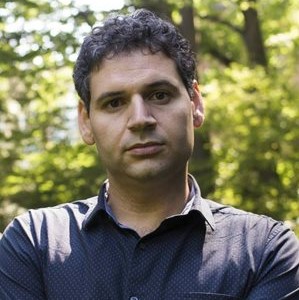
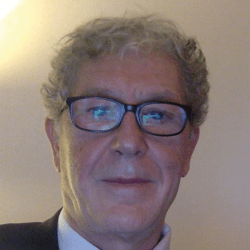
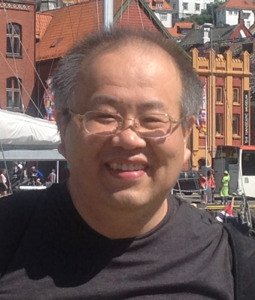
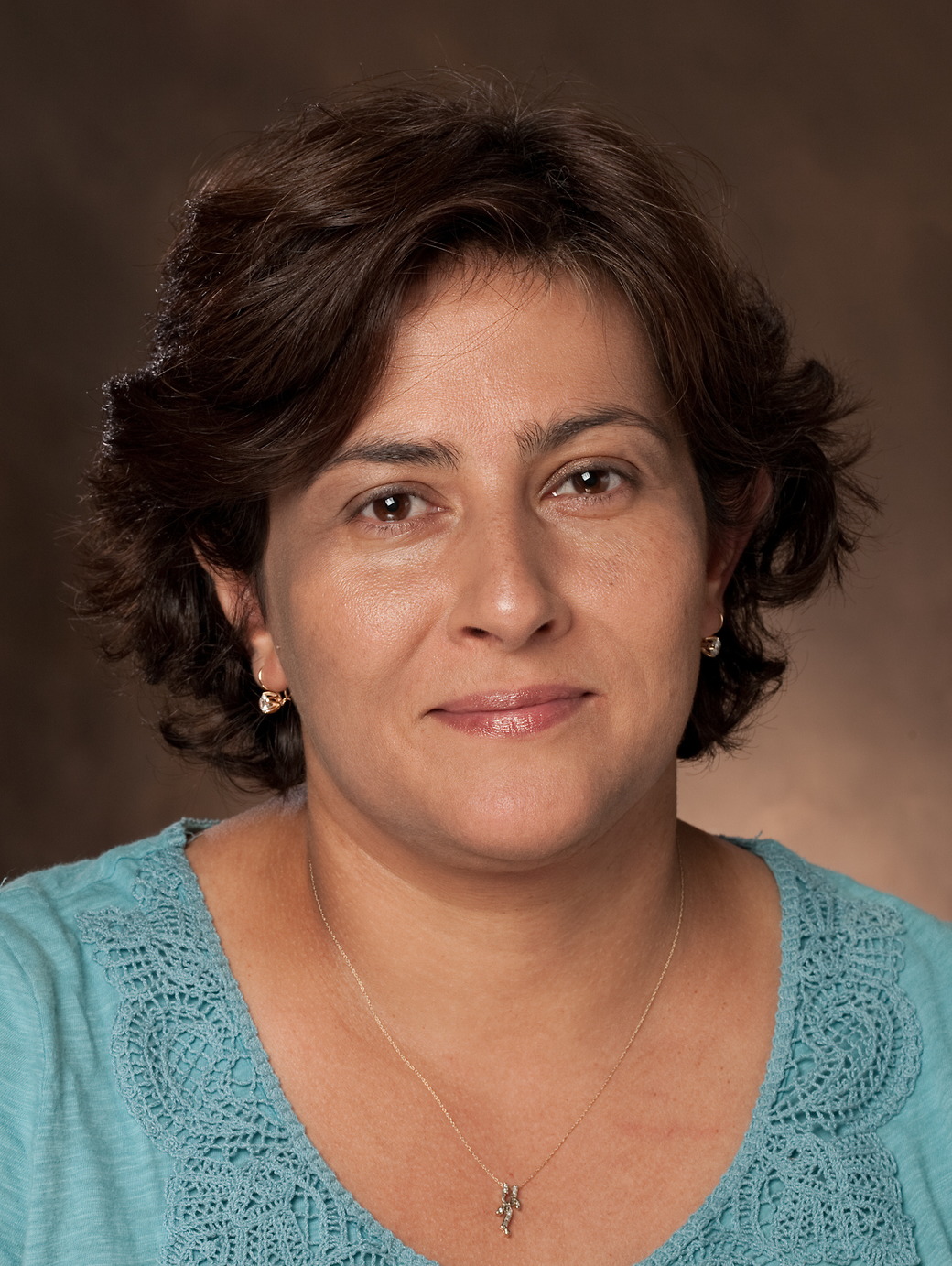
Karam Dana is the Alyson McGregor Distinguished Professor of Excellence and Transformative Research at the University of Washington Bothell's School of Interdisciplinary Arts & Sciences. He holds adjunct professorships in Political Science and Sociology at UW Seattle, and is core faculty in the Interdisciplinary Ph.D. Program in Near and Middle Eastern Studies. His research focuses on transnational political identities, Palestinian politics, and Muslim American communities. Dana has led major surveys including the Muslim American Public Opinion Survey (MAPOS) and the Middle East Public Opinion Project (MEPOP). He has been recognized with UW Bothell's top teaching (2018) and research (2023) awards. Education: B.A. Economics/Political Science (UW Seattle), M.A.I.S. International Studies (UW Seattle), Ph.D. Interdisciplinary Near and Middle Eastern Studies (UW Seattle). Former appointments include Harvard Kennedy School's Dubai Initiative (2010-2012), Tufts University (2010-2011), and Temple University press contributions Led the 2020 Muslim American oversample of the Collaborative Multiracial Post-Election Survey Founder of the American Muslim Research Institute (AMRI) Teaching emphasizes inclusive pedagogy with real-world applications, using case studies and problem-based learning to engage students across differences. Research bridges social science theory with applied public opinion analysis in contentious political environments.
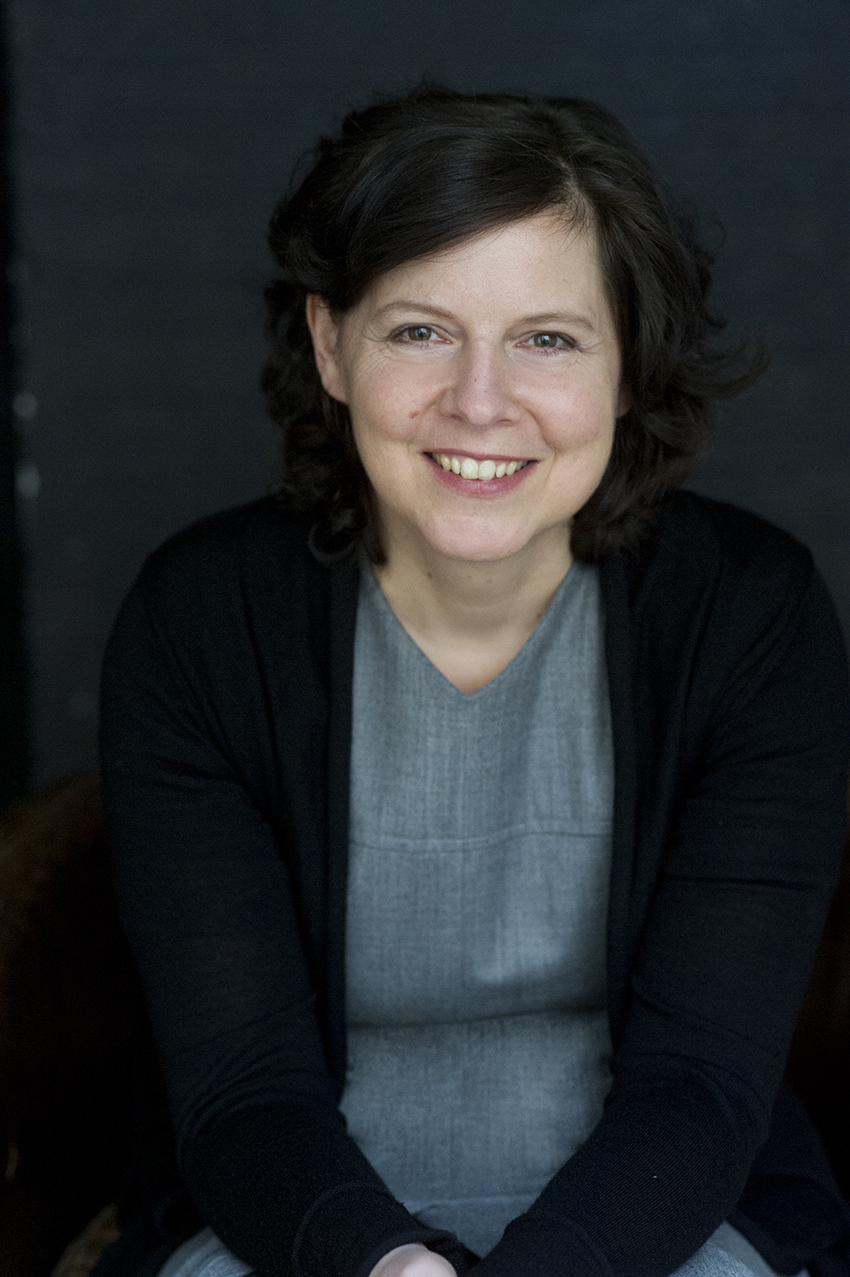
Katalin Farkas is a Professor of Philosophy at the Central European University (CEU), where she has been affiliated since 2000. She previously taught at Eötvös Loránd University in Budapest. Her primary research areas are philosophy of mind and epistemology, with a focus on topics like intentionality, knowledge-wh, and Cartesian philosophy. She is author of The Subject's Point of View (2008) and currently working on The Unity of Knowledge . Dr. Farkas holds a PhD and DSc from the Hungarian Academy of Sciences and an MA in Mathematics and Philosophy from Eötvös Loránd University. She has held visiting positions at institutions including the University of Sydney, the Center for Subjectivity Research in Copenhagen, and Newnham College Cambridge. From 2010–2014, she served as CEU’s Provost and Academic Pro-Rector, and later as Head of the Philosophy Department (2007–2010 and 2020–2024). Her honors include membership in the Academia Europaea (2012) and presidency of the European Society for Analytic Philosophy (2020–2023). Her work explores themes such as extended mind theories, phenomenal consciousness, and the relationship between belief and knowledge, challenging reductionist approaches to knowledge types.
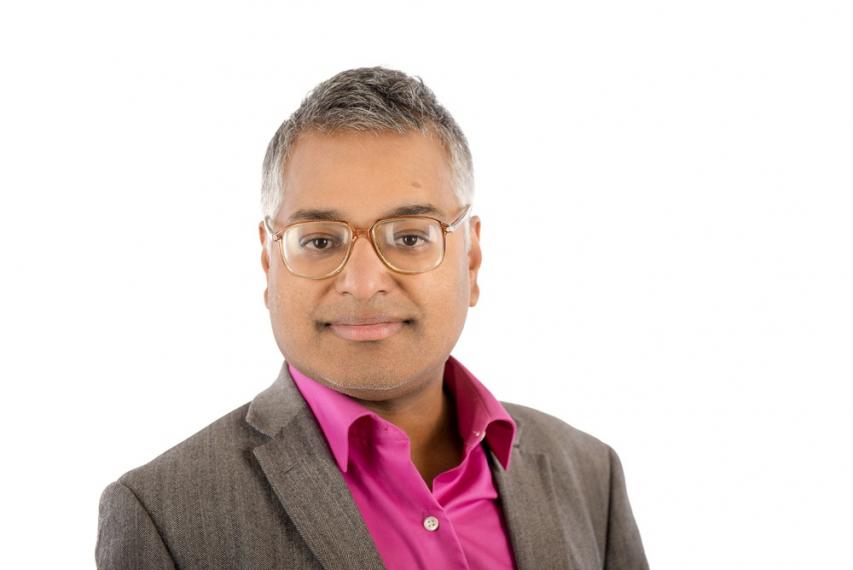
Rajesh Pereira is an Associate Professor and Chair of the Department of Mathematics at the University of Guelph. His research focuses on matrix theory, quantum information, functional analysis, and classical analysis, with significant contributions to problems in polynomial theory and quantum entanglement. Education: B.Sc. in Applied Mathematics, McGill University (1996) M.Sc. in Mathematics, McGill University (1998) Ph.D. in Mathematics, University of Toronto (2003) Rajesh Pereira's research in matrix theory includes work on diagonal matrix scalings, doubly stochastic matrices (solving the Perfect-Mirsky conjecture for n=4), and extending Wielandt's theorem to Banach algebras. In quantum information , he investigates quantum fidelity, entanglement, coherence, and privacy, utilizing tools such as completely positive linear maps and majorization. His early work resolved several conjectures in the analytic theory of polynomials. He has successfully supervised several graduate students, including: George Hutchinson (Ph.D., 2018) Connor Paul-Paddock (M.Sc., 2016) Jeremy Levick (Ph.D., 2015) Preeti Mohindru (Ph.D., 2014) Jeffrey Tsang (Ph.D., 2014) Dustin Styner (M.Sc., 2012) His research has been supported by Natural Sciences and Engineering Research Council of Canada (NSERC) Discovery grants (2005, 2010, 2016). He serves on the editorial board of Linear and Multilinear Algebra (2016-present) and is the Problem Corner editor for IMAGE, the newsletter of the International Linear Algebra Society (2016-present). Additionally, he has organized the William Lowell Putnam competition since 2013.
Eva Hammar Chiriac is a Professor in the Department of Behavioural Sciences and Learning at Linköping University, specializing in the Division of Psychology. Her research focuses on group processes within educational systems, emphasizing cooperative learning, problem-based learning (PBL), and interprofessional problem-based learning (iPBL). She explores how group dynamics influence learning outcomes, particularly in contexts like classrooms and higher education settings. Her work also addresses challenges in assessing knowledge and abilities developed through group collaboration, as well as fostering positive school climates. Her academic journey includes a PhD in Psychology (2003) and becoming a full Professor at Linköping University in 2020. She leads research projects on group work assessment, classroom management, and school climate improvement, often employing qualitative methods like group observations and focus groups. Collaborations include national and international researchers in social psychology, pedagogy, and medical fields. Key research areas include: Assessment strategies in cooperative learning Interprofessional education dynamics Student and teacher perspectives on group work fairness School climate and teacher-student relationships Her teaching includes courses on group psychology, social psychology, and group observation techniques. She actively supervises PhD students, including Johan Forsell, and contributes to academic networks like the International Association for the Study of Cooperation in Education (IASCE).
Kaarina Aitamurto is a scholar of religion specializing in Islam and contemporary Paganism in Russia, affiliated with the Faculty of Arts at the University of Helsinki. She holds a position at the Aleksanteri Institute - Finnish Centre for Russian and East European Studies, focusing on interdisciplinary research blending social sciences and humanities. Her research interests include nationalism, migration, and the governance of religion in Russia, particularly Islam and Slavic Paganism (Rodnoverie). She co-leads projects such as 'Migration, Shadow Economy and Parallel Legal Orders in Russia' and co-edits Aleksanteri Insight . Her work addresses topics like desecularization, religious representation, and the intersection of politics and culture in post-Soviet contexts. Aitamurto has advised doctoral and master's theses, participated in international conferences, and contributed to academic publications. Her recent studies highlight the political alliances within Pagan movements, the social dynamics of Islamic sects in Russia, and the impact of illiberalism on migration. She frequently collaborates with institutions like the University of Bologna and the Free University of Berlin. Labs/Teams: Active in the Aleksanteri Institute, contributing to its research on Eurasia and global migration. Engaged in editorial roles for journals and book series, fostering academic discourse on Russian and East European studies.
Jakob Wagner is a Research Fellow at the Technical University of Munich (TUM), affiliated with the School of Computation, Information and Technology and the Department of Mathematics. He works within the Chair of Optimal Control under Prof. Boris Vexler and serves as an Invited Lecturer at Kutaisi International University in Georgia since 2022. His educational background includes a Master's degree in Mathematics from TUM (2019-2020, grade 1.0) and a Bachelor's degree in Mathematics from TUM (2014-2018, grade 1.2). Wagner's research focuses on Optimal Control of fluid dynamics equations, particularly the Navier-Stokes and Stokes systems. He specializes in Finite Element Methods and rigorous Error Estimates for discretizations of partial differential equations. His work addresses time-dependent problems, state constraints, and boundary control mechanisms in computational fluid dynamics, with significant contributions to stream-function formulations and pressure boundary conditions. Analysis of his publication record reveals a concentrated research trajectory in numerical analysis of incompressible flow control. His work consistently advances theoretical foundations for finite element discretizations, emphasizing fully discrete error analysis and pointwise constraints across Stokes and Navier-Stokes frameworks. Key innovations include novel approaches to blood flow modeling and ocean current reconstruction through coupled ODE systems. Wagner actively mentors students, supervising Master's theses by Alexandro Jedaidi (2025, ocean current reconstruction), Chenhong Lin (2025, Stokes equations), and Hendrik Bruhse (2023, parabolic problems), plus Noah An der Lan's Bachelor thesis (2025, Bayesian experiment design). His teaching portfolio spans Analysis, Optimization, and Numerical Methods courses at TUM and Kutaisi International University. He operates within TUM's Chair of Optimal Control research ecosystem, contributing to international collaborations through conference presentations at GAMM Annual Meetings and specialized symposia, while maintaining active involvement in computational mathematics projects including robotic swarm applications for radio imaging.
Professor Sandra Bucci is a NIHR Research Professor and Clinical Professor of Psychology at The University of Manchester , UK. She holds a Honorary Consultant Clinical Psychologist position at the Greater Manchester Mental Health NHS Foundation Trust and co-directs the Complex Trauma and Resilience Research Unit there. She is also Editor-in-Chief of the Psychology and Psychotherapy: Theory, Research and Practice journal, published by the British Psychological Society . Doctor of Clinical Psychology, University of Newcastle, Australia (2006) Bachelor of Science (Psychology), University of Wollongong, Australia (1998) Bachelor of Science (Exercise Science), University of Wollongong, Australia (1998) Her research focuses on digital care pathways and remote monitoring technologies to enhance detection and treatment of severe mental health issues . She investigates psychological and social mechanisms in psychosis, schizophrenia, bipolar disorder, and trauma. Her work aligns with the UN Sustainable Development Goals , particularly in education and health . Recent publications highlight her expertise in digital mental health and implementation challenges across diverse populations (youth, inpatient settings, acute wards). Key subfields include digital therapeutics , user engagement , wearable sensors , and systematic reviews . Aurora Women in Leadership (2017) Social Economy Award (2016) AXA PPP Health and Tech Awards Finalist (2015) Making a Difference Award - Commendation (2017) Northern Health Science Alliance Honour’s List (2019) She supervises postgraduate research students and collaborates with NHS clinicians and international researchers . Her funded projects include NIHR Manchester Biomedical Research Centre (2022–2027) and iCHARTS (adverse event monitoring in digital platforms).
Mark Hoover is an Associate Research Scientist and Intermittent Lecturer at the University of Michigan's Marsal Family School of Education, Department of Mathematics Education. His work focuses on disrupting systemic educational inequities through mathematics teaching and teacher professionalization, emphasizing social justice and ethical pedagogy. He draws inspiration from civil rights activist Robert Moses and education researcher Deborah Ball, whose collaborations are highlighted in his research. Hoover has held roles in both research and teaching, contributing to the development of practice-based approaches to studying teaching demands and advocating for curricula that promote civic participation. His research bridges mathematics content and pedagogy, exploring how teaching practices can address historical injustices embedded in educational systems. Research Interests: Equity in STEM education, mathematical knowledge for teaching (MKT), teacher professionalization, curriculum development, assessment design, and the intersection of mathematics education with social justice movements. He critiques oppressive educational standards and accountability systems while investigating how teaching can be reimagined to center justice. His work also explores the role of mathematicians in shaping mathematics education and the importance of tasks for assessing teaching proficiency. His scholarly output reflects a sustained engagement with equity and justice, analyzing classroom practices and teacher education through critical frameworks. Recent publications emphasize collaborative research initiatives (e.g., TWG19) and the moral dimensions of pedagogy. Grants: Recipient of the Communicating Mathematically Across Difference in the Work of Teaching Award (2018-2025). Advising: No formal advisees listed in provided materials, but his work supports professional learning communities across disciplines. Hoover is affiliated with the Connected Mathematics Project, contributing to curriculum development and its impact assessment. His contributions span both research and practical teaching, aiming to create inclusive and just educational environments.
Professor Antje Gumz holds a Professorship for Psychosomatics and Psychotherapy with a focus on Depth Psychology-Based Psychotherapy at the Psychologische Hochschule Berlin (PHB). She leads a dedicated working group focused on psychotherapy research and training, with particular emphasis on therapeutic relationship skills, alliance ruptures, and psychodynamic concepts. Her academic work bridges clinical practice and scientific research, contributing significantly to the field of psychotherapy. Dr. Gumz's research interests span multiple dimensions of psychotherapy, with particular focus on measuring and training therapeutic relationship skills, including alliance ruptures, facilitative interpersonal skills, dealing with transference/countertransference, and enactments. She investigates mediators of therapy success and the role of language and voice in psychotherapy, bringing a unique perspective that integrates psychodynamic and systems theory concepts. Her work emphasizes the importance of understanding the therapist's role in therapeutic tensions and crises, and how these can be transformed into opportunities for therapeutic advancement. Professor Gumz has published extensively on psychotherapy techniques and training, with numerous publications in leading journals. Her recent work focuses on the development of assessment tools like the Psychodynamic Intervention List (PIL) and the Mediators of Change in Psychotherapy Inventory (MoCPI). Her research demonstrates how specific verbal techniques relate to session quality and therapeutic outcomes, providing empirical support for clinical practice. Heigl Foundation Research Grant (2019-2025) for therapist interpersonal skills research German Psychoanalytic Society Research Grant (2017-2019) for therapeutic techniques studies Professor Gumz actively supervises numerous doctoral students and research assistants, fostering the next generation of psychotherapy researchers. Her work extends beyond academia through collaborations with multiple psychotherapy training institutes across Germany. She has developed innovative training approaches like the Modified Alliance-Focused Training with Doubling (MAFT-D) to improve therapists' competencies in handling therapeutic tensions. Her research group maintains strong national and international collaborations, contributing to evidence-based psychotherapy training and improved treatment outcomes.
Sonja Wogrin is a University Professor (Univ.-Prof.) at Graz University of Technology (TU Graz), where she has been heading the Institute for Electricity Economics and Energy Innovation since August 2021. She holds a Dipl.-Ing. in Technical Mathematics from TU Graz (2008), a Master of Science in Computation for Design and Optimization from MIT (2008), and a doctorate in Electricity Systems from Universidad Pontificia Comillas (2013). Her educational background includes: Doctorate in Electricity Systems, Universidad Pontificia de Comillas (June 2013) Dipl.-Ing. in Technical Mathematics, Graz University of Technology (October 2008) Master of Science in Computation for Design and Optimization, MIT (June 2008) Professor Wogrin's research focuses on decision support systems in the energy sector, optimization methodologies, and particularly the problem of generation capacity expansion. Her work spans several key areas including bilevel programming, capacity expansion planning, energy storage systems, and time series aggregation for energy system optimization. She has made significant contributions to understanding how to integrate renewable energy sources into power systems while maintaining economic efficiency and grid stability. Her research often addresses the challenges of decarbonizing electricity systems through advanced mathematical modeling and optimization techniques. Her recent publications demonstrate a strong focus on improving the computational efficiency of energy system models while maintaining accuracy, with particular attention to the integration of renewable energy sources, energy storage systems, and the development of resilient energy communities. She has pioneered work on time series aggregation methods that balance computational tractability with model accuracy, which is crucial for long-term energy planning under uncertainty. Professor Wogrin has received several prestigious awards and fellowships including: 4th EASE Student Award for "Co-Optimisation of energy storage technologies in tactical and strategic planning models" (2019) Beca de movilidad para investigadores "NILS Ciencia y Sostenibilidad" (2015) Beca Erasmus "Personal Docente/Investigador" de formación (2016) Beca Iberdrola de ayuda a la investigación en energía y medio ambiente (2020) She leads multiple significant research projects including EU - NetZero-Opt, RINGs, iKlimET, V2G-QUESTS, and CIDEAL, which focus on optimizing energy systems for net-zero emissions, resilient energy networks, climate and energy system modeling, vehicle-to-grid integration, and industrial decarbonization. Her work has substantial practical implications for energy policy and grid operations in Austria and beyond. Professor Wogrin collaborates extensively with industry partners including Austrian Power Grid AG, KELAG, and Netz Niederösterreich, ensuring her research addresses real-world energy challenges. Professor Wogrin leads the research group at the Institute for Electricity Economics and Energy Innovation, which develops advanced optimization models for energy systems. Her team has created the LEGO (Low-carbon Expansion Generation Optimization) model, an open-source tool for energy system optimization that has gained international recognition. The group's work spans from fundamental optimization methods to practical applications in energy system planning and operation, with a strong emphasis on computational efficiency and model accuracy.
Olivier ALLIX is a Professor at the Laboratoire de Mécanique et Technologie (LMT) at École Normale Supérieure de Cachan (ENS-Cachan). His research focuses on computational mechanics, including multiscale modeling of composite materials, structural failure analysis, and non-intrusive coupling strategies. He has held leadership roles such as Head of LMT-Cachan and Vice-president of the International Association for Computational Mechanics (IACM). Expertise: Computational structural mechanics, material failure, inverse problems, and multiscale approaches. Editorial Roles: Associate editor of multiple journals including Computational Mechanics and Computer Methods in Applied Mechanics and Engineering . Awards: IACM Fellow, Euromech Fellow, and recipient of the Gay-Lussac Humboldt Prize (2019). His work integrates experimental mechanics with computational methods, emphasizing big data applications and model validation. He has organized major conferences like the World Congress on Computational Mechanics and co-led international research initiatives such as the IRTG ‘Virtual Material and Structures’ with Hannover University. Teaching includes advanced courses on structural dynamics, composite materials, and computational mechanics at the Master’s level. His research group collaborates with industries like Safran, IFPEN, and DGA on projects involving fatigue analysis, mooring systems, and composite testing.
Elena Panteley is a Research Director at the CNRS and a member of the Laboratoire des Signaux et Systèmes (L2S) at CentraleSupélec. She holds a PhD in Applied Mathematics from Saint Petersburg State University (1997) and has extensive experience in research, including roles at the Institute of Problems in Mechanical Engineering, Russian Academy of Sciences (1986–1998). She co-chairs the International Graduate School of Control at the European Embedded Control Institute (EECI-IGSC) and serves as a Book-reviews Editor for Automatica and Associate Editor for IEEE Control Systems Letters . Education: PhD in Applied Mathematics, Saint Petersburg State University, 1997 MSc/BSc in relevant fields (implied by career progression) Research Interests: Focuses on stability and control of nonlinear dynamical systems, networked systems, multi-agent systems, and their applications. Her work emphasizes robust control, consensus algorithms, synchronization, and distributed control strategies for autonomous systems. She explores theoretical frameworks like Lyapunov methods and adaptive control, with practical applications in robotics and communication networks. Publications: Over 100 peer-reviewed articles in top journals like IEEE Transactions on Automatic Control and Automatica . Recent trends include advancements in consensus algorithms for multi-agent systems, synchronization of nonlinear oscillators, and control under communication delays. Awards: No specific awards mentioned, but contributions to control theory and networked systems are widely recognized. Grants/Advising: Leads research on adaptive control, network synchronization, and robotics. Collaborates internationally and advises on projects involving autonomous vehicles and distributed systems. Labs/Teams: Active in L2S and affiliated with CNRS, contributing to teams like MODESTY, COMEDY, and SYCOMORE. Engaged in transverse research on energy, industry automation, and healthy systems.
Professor Roger Flanagan is a distinguished academic specializing in construction management with over two decades of research contributions. His work primarily focuses on international construction business, risk management, sustainable building practices, and whole life cost appraisal. Affiliated with the Chartered Institute of Building, London, he has authored numerous technical guides and publications that shape construction industry practices globally. Specializes in international construction business dynamics Expert in risk management and sustainable building practices Author of influential technical guides for the construction industry Research spans construction economics and supply chain management Flanagan's research interests center on the complexities of international construction projects, with particular emphasis on risk management, sustainable building practices, and whole life cost considerations. His work examines how contractors navigate international markets, manage project complexity, and implement sustainable practices. Recent publications address materials procurement in MSMEs, pre-construction planning complexity, and the integration of renewable energy in building projects, reflecting evolving industry challenges. Analysis of his 15 most recent publications reveals a consistent focus on construction management challenges with increasing emphasis on sustainability and international business dynamics. His work spans construction economics, risk management, sustainable building practices, and supply chain management, with particular attention to Korean and Middle Eastern construction markets. The research demonstrates methodological diversity, employing panel threshold regression, system dynamics, and empirical case studies to address complex construction industry problems. Professor Flanagan has made significant contributions through his authored guides for the Chartered Institute of Building, including the Guide to Quality Management in Construction (2021), Site Management and Production Guide (2020), and Code of Quality Management (2019). These practical resources translate academic research into industry applications, demonstrating his commitment to bridging theory and practice in construction management. His collaborative research extends across international boundaries, working with academics from institutions in Asia, Europe, and the Middle East. This global perspective enriches his understanding of diverse construction markets and practices, informing his research on international competitiveness, cross-cultural project management, and global supply chain dynamics. Professor Flanagan's work on construction sector futures, particularly his contributions to Vision 2020 initiatives, demonstrates leadership in anticipating industry trends and challenges. His research on information complexity, system dynamics applications, and decision support systems positions him at the forefront of addressing emerging challenges in digital construction and project management.
Hong Wang is a Professor in the Department of Mathematics at the University of South Carolina, part of the McCausland College of Arts and Sciences. He specializes in numerical analysis and differential equations, with a focus on numerical methods for fractional and variable-order equations. His work addresses complex boundary conditions, optimal control, and scientific computing challenges in advection-diffusion systems. Education Ph.D. in Mathematics, University of Wyoming (1992) Research Interests His research emphasizes numerical approximation techniques for differential/integral equations, particularly fractional diffusion-wave equations, variable-order models, and stochastic systems. Key areas include finite element methods, spectral methods, and fast algorithms for solving high-dimensional and time-dependent problems. He explores applications in optimal control, viscoelasticity, and multi-scale modeling. Recent Work Trends Recent publications highlight advancements in fractional calculus applications, including variable-exponent diffusion, distributed-order equations, and stochastic fractional differential equations. His work often combines theoretical analysis with computational efficiency, addressing challenges like nonsmooth parameters and singular density functions. Grants and Advising No specific grants or advisees are listed, but his research collaborations span computational mathematics, applied physics, and engineering systems. Labs/Teams No dedicated lab or team is explicitly mentioned, though his research aligns with computational and applied mathematics groups at the University of South Carolina.
Anna Ghazaryan is a Professor and Department Chair in the Department of Mathematics at Miami University. She holds a Ph.D. in Mathematics from The Ohio State University, with postdoctoral research at the University of North Carolina and the University of Kansas. Her research focuses on applied dynamical systems, nonlinear waves, and reaction-diffusion systems, with applications in ecological models, combustion theory, and fluid dynamics. She has organized international conferences on Dynamical Systems and Applications in 2016, 2019, and 2023, supported by the NSF and Miami University. Her collaborative work includes co-authoring the textbook Introduction to Traveling Waves (2022) and securing grants such as the NSF DMS-1311313 and Simons Foundation Collaboration Grant (2012–2017). Prof. Ghazaryan mentors undergraduate and graduate students in research projects, including studies on disease spread modeling, mussel population dynamics, and malaria transmission. Her research has led to publications in journals like Studies in Applied Mathematics , SIAM Journal on Applied Mathematics , and Physica D . She actively engages in academic leadership, including roles at Miami University’s Undergraduate Research Awards and professional societies such as the Association for Women in Mathematics (AWM). Her work bridges theoretical analysis and applied problems, emphasizing interdisciplinary collaboration.