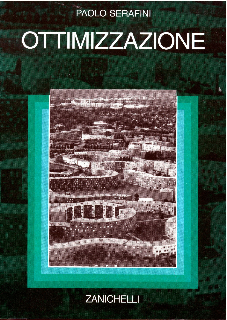
Paolo Serafini is a Professor in the Department of Mathematics and Computer Science. His academic work centers on Operations Research and Mathematical Optimization, with extensive contributions to both theoretical and applied aspects of the field. Position: Professor Department: Department of Mathematics and Computer Science His research spans a broad range of topics within optimization, including linear and integer programming, graph algorithms, duality, and computational methods. He has developed comprehensive educational materials that reflect deep expertise in the discipline. Paolo Serafini authored the textbook Ottimizzazione , covering fundamental and advanced topics in operations research. The book includes structured chapters on complexity, convex analysis, linear and nonlinear programming, network flows, dynamic programming, matroids, polyhedral combinatorics, and heuristic methods. Accompanying this work are exercise solutions and computational models, demonstrating a strong commitment to pedagogy. Scientific awards are not mentioned in the available materials. He has supervised no students listed in the provided content. There is no mention of grants or funding sources. However, his development of teaching resources—including solved exercises, Lingo models, and Excel implementations—shows active engagement in academic instruction and dissemination. There is no information about labs, research teams, or collaborative groups in the provided texts.
Alberto Manuel Tavares Simões is an Assistant Professor in the Department of Mathematics at the University of Beira Interior (UBI), Portugal. He holds a PhD in Mathematics (2011) and a Master's degree in Mathematics (2004) from the University of Aveiro. PhD: Mathematics, University of Beira Interior (2011) Master's: Mathematics (Functional Analysis and Operator Theory specialization), University of Aveiro (2004) Graduation: Applied Mathematics, University of Évora (14.4/20) His research focuses on Hyers-Ulam stability and related methods for integral equations , differential equations , and operator theory . Key areas include fixed-point theorems, convolution operators, and wave diffraction problems with higher-order boundary conditions. The 15 most recent publications highlight his work on stability analysis for Voltterra and Fredholm integral equations , Bessel differential equations , and integro-differential equations . Subfields span boundary conditions , partial differential equations , operator theory , and mathematical physics . He has supervised one Master's dissertation on the teaching of derivatives and has been active in academic roles at UBI since 2000, transitioning from Assistant to Assistant Professor in 2011.
Carla Patrícia Alves Freire Madeira da Cruz is an Associate Professor at the Department of Chemistry, Faculty of Sciences, University of Beira Interior (UBI). She leads the G4Lab at RISE-Health UBI and the Pharmaceutical and Biotechnological Drug Innovation group. Her work integrates drug design, G-quadruplex (G4) aptamer research, and biophysical methods for cancer-targeted therapies. Established independent research since 2015 Coordinates European NMR infrastructure (PTNMR) Supervises 15+ students across post-doc to BSc levels Her research focuses on G-quadruplex structures and aptamer-based diagnostics/therapeutics , with applications in prostate cancer, HPV-related lesions, and SARS-CoV-2 detection. Recent publications highlight: 2025 breakthroughs in miR-155-3p fluorescence detection and AS1411 derivatives 2022-2023 advances in aptamer-functionalized nanocarriers 2020-2021 microfluidic biosensor developments Scientific recognition includes: 17+ national/international projects as Principal Investigator 15+ research awards (2003-2025), including ARRISCA C Innovation Prize (2023) Leadership roles in COST Actions, European infrastructures, and international PhD programs Her outreach spans hospital collaborations, science festivals, and media engagements (Expresso, Antena 1).
Jordi Castro Perez is a Professor at the Department of Statistics and Operations Research within the Faculty of Mathematics and Statistics (FME) at Universitat Politècnica de Catalunya-BarcelonaTech . He leads the GNOM - Grup d'Optimització Numèrica i Modelització research group and contributes to the Institut de Matemàtiques de la UPC-BarcelonaTech . Expertise : Mathematical Optimization, Interior Point Methods, Operations Research, Data Privacy Research Focus : Dr. Castro develops specialized optimization techniques for complex problems in data privacy, machine learning, and large-scale stochastic programming. His recent work includes privacy-preserving dynamic data publishing, microaggregation algorithms, and efficient methods for support vector machines. Scientific Recognition : Spanish Society of Statistics and Operations Research – BBVA Foundation Awards 2024 Advising & Projects : He advised doctoral thesis by De La Lama Zubirán, Paula and leads the R&D project Modelización y Optimización de Problemas Estructurados y Aplicaciones , which includes collaborators like Heredia, Albareda-Sambola, and Gentile.
Zeguan Wu is a NASA Postdoctoral Fellow in the Department of Computer Science at the School of Computing and Information, University of Pittsburgh, collaborating with Professors Juan Jose Mendoza Arenas, Peyman Givi, and Junyu Liu on quantum computing applications for fluid dynamics. Previously, he completed his Ph.D. in Industrial Engineering at Lehigh University under Tamás Terlaky and Xiu Yang. His educational background includes: Ph.D. in Industrial Engineering, Lehigh University (2020-2025) M.S. in Operations Research, Columbia University (2018-2020) B.S. in Material Physics, Nanjing University (2014-2018) Dr. Wu's research centers on quantum algorithm development for optimization and linear algebra problems, with specific focus on adapting interior point methods and tensor-based computations to quantum architectures. His work bridges theoretical quantum computing with practical applications in fluid dynamics simulation and regression analysis, targeting exponential speedups over classical methods through novel preconditioning and inexact solution techniques. His publication trajectory since 2022 reveals concentrated advancement in quantum interior point methodologies across linear and quadratic optimization domains, increasingly incorporating tensor representations and fluid dynamics applications. These contributions appear in leading quantum computing venues including ACM Transactions on Quantum Computing and IEEE workshops, demonstrating rigorous mathematical foundations with practical quantum hardware considerations. His primary scientific recognition is: NASA Postdoctoral Fellowship Funded by the NASA Postdoctoral Program, Dr. Wu contributes to quantum fluid dynamics research while maintaining active professional service. He has not yet served as primary advisor for graduate students but gained teaching experience as a graduate TA at Lehigh University for core engineering courses including Mathematical Optimization and Simulation. At the University of Pittsburgh, he operates within collaborative quantum computing research groups focused on computational fluid dynamics, leveraging institutional expertise in high-performance computing to develop quantum-classical hybrid simulation frameworks for aerospace applications.
Dr. Kai Zhou is a Research Fellow at the Frankfurt Institute for Advanced Studies (FIAS) in the Theoretical Sciences division, where he leads the 'Deepthinkers' research group. Born in China in 1987, he completed his B.Sc. in Physics from Xi'an Jiaotong University in 2009 and earned his PhD with 'Wu You Xun' Honors from Tsinghua University in 2014. After postdoctoral research at Goethe University Frankfurt's Institute for Theoretical Physics, he joined FIAS in August 2017 as a Research Fellow focusing on Deep Learning applications in physics. Frankfurt Institute for Advanced Studies (FIAS), Theoretical Sciences (2017-present) Goethe University Frankfurt, Institute for Theoretical Physics (Postdoc) Tsinghua University, Physics (PhD, 2014) Xi'an Jiaotong University, Physics (B.Sc., 2009) Dr. Zhou's research bridges artificial intelligence and theoretical physics, with a focus on applying machine learning techniques to complex physical systems. His work spans heavy-ion collisions, lattice quantum field theory, seismology, and renewable energy systems. He has developed innovative deep learning approaches to extract physical insights from complex data, including constructing an Equation-Of-State meter for heavy ion collisions. His research demonstrates how physics can inform AI development while AI enhances our understanding of physical phenomena. Analysis of Dr. Zhou's recent publications reveals a strong trend toward integrating physics principles with machine learning architectures. His work increasingly focuses on Bayesian inference methods applied to QCD phase transitions, physics-informed neural networks for solving inverse problems in nuclear physics, and developing specialized architectures that preserve physical symmetries. The interdisciplinary nature of his research is evident in applications spanning from heavy-ion collisions to neutron star physics and industrial process optimization. Wu You Xun Honors (PhD) Third party funding through Samson AG: AI for science BMBF funding within ErUM data program: Deep Learning for CBM computing DAAD exchange program Xidian-FIAS International Joint Research Center: AI for science BMWI: AI for energy Nvidia: GPU Grant Dr. Zhou actively mentors doctoral and master's students, currently advising seven graduate students across multiple institutions. His research group 'Deepthinkers' has secured significant third-party funding from diverse sources including industrial partners (Samson AG), government agencies (BMBF, BMWI), and international collaborations (DAAD, Xidian University). His approach combines theoretical physics with cutting-edge AI techniques to address complex problems in both fundamental science and industrial applications. The 'Deepthinkers' research group operates at the intersection of AI and physics, developing novel methodologies that leverage physical principles to enhance machine learning and vice versa. Their work on applying deep learning to heavy-ion collisions represents a significant advancement in extracting meaningful physical insights from complex collision data. The group maintains strong international collaborations, particularly with Chinese institutions through the Xidian-FIAS International Joint Research Center.
Amanda Keen-Zebert serves as Associate Research Professor and Interim Director of Research Operations at the Desert Research Institute (DRI) in Reno, holding key administrative responsibilities within the Environmental Sciences division. Her academic career bridges advanced geochronological techniques with geomorphological applications across diverse landscapes. Her research focuses on luminescence dating methodologies including OSL and thermoluminescence, applied to critical problems in Quaternary geology , fluvial geomorphology , and paleoclimate reconstruction . Notable expertise includes dating cave sediments, floodplain deposits, volcanic glasses, and river terraces to unravel landscape evolution processes. Current work demonstrates increasing integration of multi-method dating approaches to address complex questions in Earth surface processes. Analysis of her recent publications reveals consistent leadership in applying luminescence dating to fluvial systems, with significant contributions to understanding Lithological controls on river incision Floodplain sediment dynamics Valley evolution in stable cratonic settings Volcanic glass dating innovations Paleoenvironmental reconstruction through sediment archives Her work spans diverse geographical contexts including the Ozark Plateau, South African interior, California basins, and North American archaeological sites. As Interim Director of Research Operations, she oversees critical administrative functions while maintaining active research output. Her methodological publications, particularly the luminescence dating chapter in the Encyclopedia of Scientific Dating Methods, serve as key references in the field. Current projects continue to explore the intersection of dating techniques with landscape evolution questions across multiple continents.
Silvia Katsarska-Filipova is an Associate Professor at the Department of Photogrammetry and Cartography within the Faculty of Geodesy at the University of Architecture, Civil Engineering and Geodesy (UACEG) in Sofia, Bulgaria. She holds a Doctor of Science degree in Photogrammetry and Remote Sensing Methods (2014) and a Master of Science in Geodesy from the same institution (1995-2000). Currently, she teaches courses including Unmanned Aerial Photogrammetry and Transformation and Interpretation of Space Images, and conducts exercises in Digital Photogrammetry, Close-range Photogrammetry and Laser Scanning. Doctor of Science in Photogrammetry and Remote Sensing Methods (2014) Master of Science in Geodesy, University of Architecture, Civil Engineering and Geodesy (1995-2000) Dr. Katsarska-Filipova's research focuses on digital photogrammetry, image processing, 3D modeling of surfaces and volumetric bodies, methods for obtaining and analyzing geospatial information, unmanned aerial systems for image capture and processing, applications of remote sensing, and GIS. Her work bridges theoretical advancements with practical applications in cultural heritage documentation, environmental monitoring, and urban planning. She has developed expertise in using drone technology for precise geospatial measurements and analysis, particularly for volume computations in quarries and other applications. Her recent publications (2022-2024) demonstrate a strong focus on integrating photogrammetry with remote sensing for diverse applications including urban heat island analysis, forest fire monitoring, water body assessment, and photovoltaic park efficiency evaluation. She has increasingly incorporated digital twin technology and multi-sensor approaches in her research, showing a progression from traditional photogrammetric techniques to more integrated, technology-driven solutions that combine close-range photogrammetry, laser scanning, and satellite imagery. Her work frequently involves practical applications in environmental monitoring and cultural heritage preservation. Dr. Katsarska-Filipova has supervised numerous diploma students on topics ranging from photogrammetric documentation of architectural heritage to analysis of burned territories using satellite imagery. She has served as Quality Manager for her department since 2017 and has participated in multiple research projects including 'Information platform for research and monitoring of the environment' (2018-2019), 'Use of multispectral and thermal images in analysis and assessment of energy efficiency' (2021-2022), 'Creation of 3D models of architectural objects based on hybrid technology for laser scanning' (2022-2023), and 'Digital geodetic twins in UACEG' (2023-2024). She is a member of the Union of Geodesists and Land Surveyors in Bulgaria and has received positive assessment from the Commission for the Attestation of the Academic Staff at the Faculty of Geodesy of UACEG (375.9 points) dated January 7, 2020. Her research has been widely cited internationally, particularly her 2016 work on volume computation of stockpiles using UAV measurements, which has become a reference in the field of drone-based surveying applications.
Zhaonan Qu is a Research Fellow at Columbia University's Data Science Institute, working on econometrics, optimization, and machine learning. His research develops methods for causal inference, network analysis, and efficient statistical estimation. Key contributions include optimal preconditioning techniques, robust instrumental variables estimation, and scalable algorithms for large-scale choice modeling. Recent work connects matrix balancing with discrete choice theory and develops network inference methods using iterative proportional fitting. Qu holds a PhD in Economics from Stanford University, where he was advised by Guido Imbens and Yinyu Ye. Current projects address distributionally robust optimization and computational challenges in high-dimensional econometrics.
Christian Müller is a researcher at the German Research Center for Artificial Intelligence (DFKI) in Saarbrücken, affiliated with the Agents and Simulated Reality group. His work focuses on enhancing AI methods for autonomous driving, cybersecurity in vehicular networks, and 3D perception systems. His research interests include: V2X Security and Collaborative Perception Adversarial Training and Consensus Mechanisms Hybrid AI for Trustworthy Human-Machine Interaction Semi-Supervised Learning for 3D Object Detection Flexible Voxel Grid Representations in Autonomous Navigation Behavioral Replication of Human Drivers He contributes to projects like: BERTHA : €7.98 million Horizon Europe project on driver behavioral modeling for autonomous driving. B5GCyberTestV2X : Virtual cybersecurity testing for V2X systems in 5G/Beyond 5G scenarios. MOMENTUM : Robust and explainable AI in complex environments. BSI_SiKI2 : Studying symbolic and hybrid KI methods for AI system security. KAI : AI-assisted interior development tools.
Brian Anderson Bullins is an Assistant Professor in the Department of Computer Science at Purdue University, affiliated with the College of Science. He previously served as a research assistant professor at the Toyota Technological Institute at Chicago (TTIC). His research focuses on optimization for machine learning, including matrix estimation techniques, higher-order methods for convex/nonconvex optimization, and distributed optimization. His work has been recognized with awards such as the Best Paper Award at COLT 2021. Education: PhD in Computer Science from Princeton University (2019), advised by Elad Hazan. B.S. in Computer Science and Mathematics from Duke University as a Benjamin N. Duke Scholar. His research explores theoretical and practical aspects of optimization, with applications in machine learning and distributed systems. Teaching includes courses like CS57100 (Artificial Intelligence) and CS47100 (Introduction to AI), emphasizing foundational methods in search, probabilistic reasoning, reinforcement learning, and ethical AI considerations. He has also contributed to curriculum development for data engineering courses. Awards include the Siebel Scholarship for his doctoral research and the 2018 INFORMS Optimization Society Student Paper Prize. His recent work addresses acceleration techniques for steepest descent, lower bounds in optimization, and robust model immunization strategies.
Robert M. Freund is the Theresa Seley Professor in Management Science at the MIT Sloan School of Management, specializing in Operations Research. His research focuses on nonlinear optimization, computational complexity, and first-order methods with applications in management and engineering. He holds a PhD in Operations Research from Stanford University and has authored influential textbooks like Data, Models, and Decisions: The Fundamentals of Management Science . Education: B.A. in Mathematics (Princeton, 1975), M.S. and Ph.D. in Operations Research (Stanford, 1979–1980). Roles: Faculty Director of MIT Sloan MBA Program, Deputy Dean for Faculty (2008–2011), Co-Director of MIT Program in Computation for Design and Optimization (2004–2008). His research interests span optimization theory, computational science, and applications in machine learning. Notable contributions include advancements in Frank-Wolfe algorithms, interior-point methods, and photonic crystal design. He has received the Longuet-Higgins Prize (2007) and multiple teaching awards. Recent work includes the development of restarted PDHG algorithms, Taylor-approximated gradients for empirical risk minimization, and analysis of first-order methods' computational guarantees. His collaborative efforts with students and researchers like Zikai Xiong and Haihao Lu have produced impactful publications in Mathematical Programming and SIAM Journal on Optimization . Freund has also contributed to educational initiatives, including MIT's Professional Certificate in Data Science and Analytics. His work bridges theoretical optimization advancements with practical applications in engineering and data-driven decision-making.
Dr. Scott Lindstrom is a Lecturer at Curtin University's School of Electrical Engineering, Computing and Mathematical Sciences, within the Faculty of Science and Engineering. He holds an office in the Office of the Provost and is based at the Curtin Perth campus. His research focuses on advanced mathematical optimization, convex analysis, and algorithm design, with applications in numerical methods and feasibility problems. Key research interests include error bounds in optimization, convex programming, and the Douglas-Rachford algorithm. He has contributed to theoretical developments in proximal algorithms, projection methods, and Bregman distances. Lindstrom's work often bridges pure and applied mathematics, addressing challenges in optimization theory and numerical analysis. His publications span journals like Mathematical Programming and SIAM Journal on Optimization , with a focus on algorithmic innovation and rigorous mathematical analysis. Recent work includes studies on log-determinant cones, p-cones, and ADMM applications in signal processing. Lindstrom has also explored historical perspectives on mathematical practices and algorithmic evolution. Notable contributions include developing centering methods for spiraling algorithms and advancing understanding of quasi relative interiors in convex programming. His interdisciplinary approach integrates optimization theory with practical computational techniques, addressing both theoretical and applied challenges.
Andrei Draganescu is an Associate Professor in the Department of Mathematics and Statistics at the University of Maryland, Baltimore County (UMBC). He holds a Ph.D. in Applied Mathematics from the University of Chicago (2004) and a B.Sc. in Mathematics from the University of Bucharest, Romania (1993). Before joining UMBC in 2006, he completed a postdoctoral appointment at Sandia National Laboratories. He currently serves as the Graduate Program Director for the Applied Mathematics program at UMBC. His research focuses on numerical analysis of partial differential equations, particularly multilevel algorithms for PDE-constrained optimization. He has led or co-led multiple grants funded by the National Science Foundation (NSF) and Department of Energy (DOE), including projects on multigrid methods, optimal control of PDEs, and optimization-based domain decomposition. Draganescu has advised several Ph.D. students and postdocs, including Sumaya Alzuhairy (2021), Mona Hajghassem (2017), and Jyoti Saraswat (2014). His publications span topics such as multigrid preconditioning, PDE-constrained optimization, and numerical linear algebra, with contributions to journals like SIAM Journal on Numerical Analysis and Numerical Linear Algebra with Applications . He has organized conferences such as the 2024 Fall Finite Element Circus and the Sayas Numerics Days. His teaching spans graduate and undergraduate courses in numerical analysis, matrix analysis, and differential equations.
Osman Güler is a Professor in the Department of Mathematics & Statistics at the University of Maryland, Baltimore County (UMBC). His research focuses on mathematical programming, operations research, convex analysis, and complexity theory. He holds a B.A. from Yale University and both M.S. and Ph.D. degrees from The University of Chicago. Dr. Güler has authored numerous publications in optimization and computational mathematics, including influential papers on barrier functions, interior point methods, and convex analysis. His work bridges theoretical foundations with algorithmic applications, particularly in convex optimization, linear programming, and complexity analysis. His research explores topics such as extremal ellipsoids, quasi-Newton methods, hyperbolic polynomials, and self-scaled barriers. The trajectory of his publications reflects a deep engagement with core challenges in optimization theory and algorithm design. No scientific awards are explicitly mentioned in the provided texts. His advising and grant activities are not detailed in the data, though his extensive publication record suggests significant academic contributions. He has written a notable book, Foundations of Optimization (2010), published by Springer.