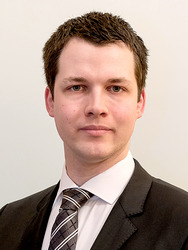
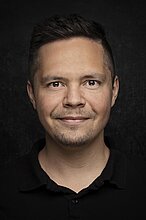
Prof. Dr.-Ing. Guido Kramann is a faculty member at Brandenburg University of Technology in the Department of Technology. His academic work bridges mechatronics and computational music, emphasizing innovative intersections between engineering and artistic practice. Affiliation: Brandenburg University of Technology Department: Technology Location: Engineering Science Center (IWZ), Room 403, Brandenburg an der Havel, Germany Guido's research spans mechatronics, algorithmic music generation, and human-computer interaction. He explores arithmetic-based grammars and evolutionary processes for real-time musical composition, focusing on accessibility for laypeople and phenomenological efficacy in technical systems. His publications reflect a recurring interest in: Ubiquitous music and interactive soundscapes Phenomenological approaches to user interfaces Evolutionary algorithms for creative applications Harmonic unification in computational counterpoint He has contributed to conferences like CMMR, UbiMus, and EvoMUSART, though no scientific awards are documented here.
Abhishek Tiwari is an Associate Professor of Software Engineering at the Maersk Mc-Kinney Moller Institute, University of Southern Denmark, where he was promoted from Assistant Professor in September 2025. His academic journey includes positions as Senior Researcher at Software Institute, USI Lugano (2024), Senior Researcher at University of Passau (2022-2023), and Research Fellow at National University of Singapore (2020-2021). He completed his PhD in Software Engineering at University of Potsdam, Germany in 2019 under supervision of Prof. Dr.-Ing Christian Hammer. His research focuses on the intersection of programming languages and software engineering, with particular expertise in static program analysis, language-based security, information flow control, and automated program repair. His work has significant practical applications in Android security and privacy, addressing critical challenges in information flow analysis, vulnerability detection, and program repair. His research has evolved from foundational work on Android security mechanisms like PendingIntent analysis and anti-theft frameworks to more recent sophisticated approaches for information flow security repair and multilingual program analysis. Trends in his publication record show a consistent focus on Android security challenges, with increasing sophistication in analysis techniques from 2017 through 2025. His work spans theoretical foundations of program analysis while maintaining strong practical relevance to real-world Android security issues. Recent publications demonstrate growing interest in multilingual program analysis and formal specification challenges. ACM SIGSOFT Distinguished Paper Award (MOBILESoft 2023) Dr. Tiwari actively contributes to the academic community through program committee service for major conferences including ASE (2024, 2025), ICSE (2025), and ISSTA (2022-2024). His teaching portfolio includes Advanced Software Engineering Methodologies (2024), Automated Program Repair (2022-2023), and Mobile Security (2022) courses. He has received research funding from prestigious sources including Deutsche Forschungsgemeinschaft (DFG), German Federal Ministry of Education and Research, and EIT Digital for projects related to programming principles for privacy, SmartPriv, and SMAPPER.
Prof. dr. Raf Ramakers is an Associate Professor in Computer Science at Hasselt University in Belgium, affiliated with the research institute Expertise Centre for Digital Media (EDM). His research and teaching focus on Human-Computer Interaction (HCI), particularly novel software and hardware tools for ubiquitous computing devices, physical computing, and digital fabrication. Education highlights include: Ph.D. in Human Computer Interaction from Hasselt University (2016) Master in Computer Science, Human Computer Interaction (Magna Cum Laude) from Hasselt University (2012) Bachelor in Computer Science (Cum Laude) from Hasselt University (2010) His interdisciplinary research spans computer science, electrical engineering, media design, and material science, focusing on creating tools that facilitate making ubiquitous computing devices. Key areas include sensor-based systems, digital fabrication machinery, and physical interface design. Notable scientific awards: FWO IBM Innovation Award (2017) FWO Nokia Bell Scientific Prize (2017) CHI2016 Best Paper Honorable Mention 2nd Place UIST Student Innovation Contest (2013) He actively mentors PhD candidates and students, with research groups focusing on HCI and digital fabrication. His lab develops innovative tools bridging digital and physical interactions, resulting in numerous publications and patents.
Martin Giese is affiliated with the University of Oslo (Department of Informatics) and the University Clinic Tübingen (Department of Cognitive Neurology). He is a researcher with a focus on semantic technologies, ontology-based data access, and visual query systems. Research Themes : Semantic Web, Ontology Engineering, Knowledge Graphs, Geological Informatics, Probabilistic Logic, Automated Reasoning Key Collaborations : Siemens, Statoil, Norwegian Petroleum Directorate, and various European research institutions Technical Contributions : Developed visual query systems (OptiqueVQS), ontology-driven geological modeling (GeoFault), and semantic data integration frameworks for industrial applications. His work spans both theoretical logic and practical implementations in big data environments. Publications : Recent articles focus on fault ontologies, process representation, and semantic embeddings. Earlier work includes foundational research in automated theorem proving and UML formalization.
Frank Piessens is a full professor in the Department of Computer Science at KU Leuven, Belgium, with research spanning both offensive and defensive aspects of software and systems security. His defensive work includes formal verification for C-like languages, information flow security enforcement, memory safety hardening, micro-architectural side-channel mitigation, and embedded security architectures. On the attack front, he has pioneered techniques for transient execution vulnerabilities, memory corruption exploits, and controlled channel attacks. His research interests focus on software security , system security , formal methods , programming languages , and information flow security . Recent publications demonstrate expertise in secure compilation (linear capabilities, control-flow linearization), functional reactive programming for web/IoT systems, and type-theoretic approaches to program equivalence. His work bridges theoretical foundations with practical security implementations across hardware-software boundaries. Professor Piessens maintains active leadership in the academic community through program committee service for top-tier conferences including ACM CCS, Usenix Security, IEEE Security & Privacy, and ACM POPL. He has chaired major events such as POST 2016, IEEE Euro S&P 2018-2019, and IEEE SecDev 2021-2022, while delivering keynotes at SPLASH 2025 and PriSC 2022 on confidential computing and hardware security evidence.
Oliver Baumann serves as Professor of Mathematics and Physics at the Department of Industrial Engineering within the Faculty of Engineering and Computer Science at Hamburg University of Applied Sciences (HAW Hamburg). His office is located in Room 0.17b at Ulmenliet 20, 21033 Hamburg, with office hours held Wednesdays 10:00–11:00 by email appointment. His academic background includes a physics diploma from CAU Kiel, a diploma thesis in applied optics at JGU Mainz, and a doctorate in astronomy from MPIA Heidelberg. Prior to his professorship, he worked as a scientific employee at Carl Zeiss AG in Oberkochen. Baumann's research spans applied and technical optics , experimental physics , and scientific image processing , with emphasis on optical measurement technology and precision mechanical-optical systems. His work bridges theoretical physics with industrial applications in aerospace, medical technology, and optical instrumentation. Key projects include radar system optimization for field mouse detection, fluorescence imaging evaluation in medical contexts, and photovoltaic-heat transport system design. His publications reveal strong focus on optical engineering (75% of works), instrumentation patents (60%), and educational methodologies (20%). Recent trends show increasing specialization in medical optics applications since 2016, alongside consistent contributions to astronomical instrumentation. Graduates' award for particularly dedicated teachers: 'Golden Duck' 2023 Graduates' award for particularly dedicated teachers: 'Golden Duck' 2019 Graduates' award for particularly dedicated teachers: 'Golden Duck' 2018 Graduates' award for particularly dedicated teachers: 'Golden Duck' 2017 Graduates' award for particularly dedicated teachers: 'Golden Duck' 2016 Baumann actively supervises graduate theses while serving as Chairman of the Examination Board for HWI bachelor's and master's programs. He holds multiple institutional roles including BAFöG representative, Deputy member of Faculty Council LS, and DAAD reviewer for Nigeria (PTDF). His professional affiliations include the European Optical Society (EOS), German Society for Applied Optics (DGaO), German Physical Society (DPG), and University Teachers' Association (hlb). His research activities center around precision mechanical-optical systems development, with emphasis on imaging technologies and measurement instrumentation. Current projects focus on optical metrology applications in aerospace and medical technology sectors.
Tomoki Nakamaru is an Assistant Professor at the Department of Multidisciplinary Systems Science, Graduate School of Arts and Sciences, The University of Tokyo. He holds a Ph.D. in Information Science and Engineering from The University of Tokyo, advised by Prof. Shigeru Chiba. Education: PhD (2021), The University of Tokyo M.Sc. (2018), The University of Tokyo B.Eng. (2016), The University of Tokyo His research focuses on Domain-Specific Languages , Mining Software Repositories , and Notebook Programming . He develops tools like Multiverse Notebook and Silverchain to enhance code exploration and API usability. He has published extensively at top venues like OOPSLA and PLDI , covering topics from Fluent Interface Generation to Runtime Monitoring . His 15 most recent works span 2017–2025. Scientific Awards: Yamashita Memorial Research Award (2023) University of Tokyo Business Reform Special Award (2021) JSST Student Encouragement Awards (2019–2020) Distinguished Artifact Award at OOPSLA (2019) Dean's Award, UTokyo (2018) Nakamaru serves on program and artifact committees for conferences like ECOOP , OOPSLA , and ‹Programming› . He teaches courses including Practical Programming and Introduction to Information Systems .
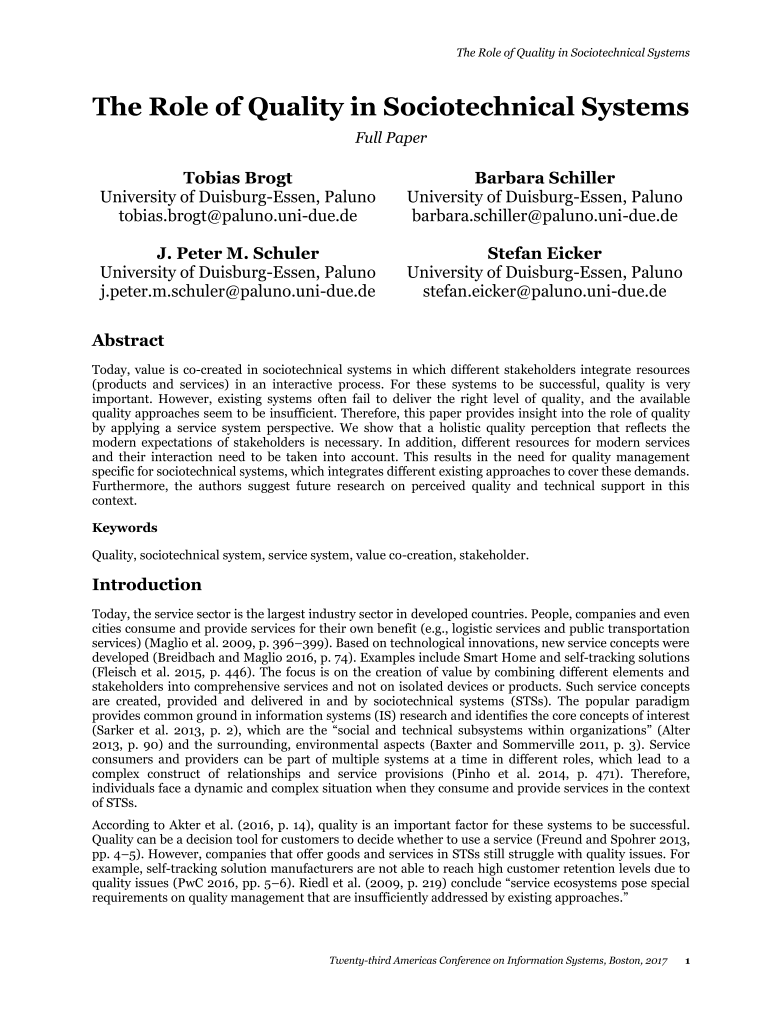
Tobias Brogt is an External Ph.D. Student and Research Assistant at the Chair of Business Information Systems and Software Engineering within the Faculty of Business and Economics at the University of Duisburg-Essen. He combines academic work with practical experience as a Software Engineer at IT-Objects GmbH since 2015. Ph.D. research in Service Systems Engineering and Smart Connected Products Active lecturer in DBIT (Digital Business Innovation and Transformation) and VAWi (Virtual Continuing Education Program) since 2019 and 2016 Published extensively in ECIS , HICSS , and Springer Gabler publications Research Focus includes digital transformation , smart product architectures , and quality management in sociotechnical systems . His work applies service-dominant logic to analyze value creation through resource integration, particularly in IoT-enabled environments. Key Publications Trends reveal expertise in: Smart service system taxonomies Quality factors for self-tracking solutions Hybrid process models combining agile and plan-driven approaches Industry 4.0 transformation strategies Academic Contributions include: Supervision of 54+ Bachelor’s and Master’s theses since 2016 Design of courses like Advanced Programming Concepts and Software Development Paradigms Collaboration on the WIWI-chairT3 web content management solution
Prof. Dr. Jan Hasenauer holds the Hertz Professorship at the University of Bonn since August 2024, with dual affiliations to the Life & Medical Sciences Institute (LIMES) and the Hausdorff Center for Mathematics (HCM) . His work bridges computational biology , systems biology , and mathematical modeling , focusing on methods for integrating heterogeneous biological data , model-based hypothesis testing , and experimental design optimization . Develops computational frameworks for analyzing complex biological systems Active in multi-scale modeling of cellular and organismal processes Key contributor to universal differential equations and Bayesian inference tools Research Trends from 2024-2025 publications show expertise in: Integrating clinical data with multi-omics for disease modeling Designing privacy-preserving analysis tools for clinical trials Developing software standards like PEtab for reproducible modeling Applying machine learning to epidemiological forecasting The group maintains strong connections with the Transdisciplinary Research Area 'Modelling' and collaborates across mathematics , life sciences , and public health . Recent ERC Starting Grant funding (€1.5M) supports their innovative computational approaches.
Julia Brich is a Researcher at Ulm University, affiliated with Prof. Weber's research group. She holds a B.Sc. from the University of Applied Sciences Ulm (2011) and an M.Sc. from Ulm University (2014), both focused on distributed systems. Her research centers on game design, adaptive systems, and human-computer interaction, particularly in serious games and virtual reality environments. She has contributed to projects like 'Serious Games – Skill Advancement Through Adaptive Systems' and 'EffIS – Efficient and Interactive Studying'. Her work spans end-user programming for smart homes, emotion-driven game adaptivity, and VR-based educational tools. Key contributions include the LiverDefense tower defense game framework for research and the Ubidoo multi-user tracking system. Julia has also explored contextual tutorials in VR and integrated questionnaires for maintaining user presence in games. Awards and grants are not explicitly mentioned, but her research has been published in venues like IEEE VR, CHI Play, and Springer. She has collaborated with institutions like EADS Germany and contributed to interdisciplinary projects blending game design with educational and industrial applications.
Florian Nouviale is a researcher specializing in virtual reality (VR), human-computer interaction, and collaborative systems. His work spans applications in medical training, historical reconstruction, and industrial design. He has collaborated extensively with institutions and researchers in France, focusing on projects such as the development of wheelchair simulators for rehabilitation and frameworks for no-code interactive applications. Key contributions include EvoluSon (an interactive music history platform) and Xareus (a no-code VR framework). His research emphasizes usability, user-centered design, and interdisciplinary collaboration. Research Interests: Virtual Reality Applications in Medicine and Rehabilitation Collaborative Systems and Frameworks for Interactive Environments Historical and Cultural Heritage Visualization Non-Verbal Communication and Emotional Expression in VR Publications: Focus on VR frameworks, medical simulators, and interactive systems, with a trend toward user-centered design and accessibility. Recent work explores emotional expression through body postures and no-code development tools.
Leif Bonorden is a Research Associate and Doctoral Student at the Department of Informatics, Faculty of Mathematics, Computer Science and Natural Sciences, University of Hamburg. He works within the Software Engineering and Construction Methods research group led by Professors Matthias Riebisch and André van Hoorn. His academic background includes a B.Sc. and M.Sc. in Mathematics from Technische Universität Berlin (2010-2018), with thesis work in Probability Theory and Functional Analysis. Since 2019, he has been pursuing doctoral research at the University of Hamburg while also studying for an M.A. in Higher Education. 2010-2018: Student, B.Sc. and M.Sc. Mathematics, Technische Universität Berlin 2012-2015: Student Teaching Assistant, Software Engineering group, TU Berlin 2015-2017: Assistant Researcher, FZI Forschungszentrum Informatik 2019-present: Research Associate & Doctoral Student, University of Hamburg 2020-present: M.A. Higher Education student, University of Hamburg Bonorden's research centers on API evolution and deprecation processes, with particular focus on how deprecated web APIs can be detected through tracing techniques. His work bridges theoretical software engineering with practical applications in API design and documentation. He has developed expertise in systematic mapping studies of API deprecation practices and their impact on software maintenance. His publication record demonstrates consistent focus on API-related research, with multiple systematic studies and empirical analyses. He has also contributed significantly to software reengineering knowledge through the SREBOK initiative and explored innovative educational approaches for teaching software engineering concepts through research-based learning. Active member of Software Engineering and Construction Methods research group Contributor to German Informatics Society's software reengineering special interest group Member of ACM, GI (Gesellschaft für Informatik), and DMV professional organizations Bonorden serves on multiple university committees including the Committee for Teaching and Studies, Building Committee, Faculty Council, and various examination boards for computer science programs. His teaching portfolio includes Software Design, Introduction to Software Engineering, and Bachelor Seminars in Software Engineering at both University of Hamburg and TU Berlin.
Florian Kern is a PhD candidate in Human-Computer Interaction at the University of Würzburg, supervised by Prof. Marc Erich Latoschik. He holds an M.Sc. in Computer Science focusing on HCI (2018). His research centers on Extended Reality (XR), particularly text input methods, surface alignment for handwriting/sketching, and VR applications in rehabilitation. Key projects include the Off-The-Shelf Stylus framework for XR interaction and the Reality Stack I/O modular framework for cross-platform XR development. Research Interests: XR Interaction: Handwriting/sketching in VR/AR, physical-virtual surface alignment. Rehabilitation Technology: VR-based gait training (e.g., Homecoming application for MS/stroke patients). Framework Design: Cross-platform tools like Reality Stack I/O, modular animation pipelines. User Experience: Evaluating input techniques, sketching behavior, and usability in immersive systems. Publications emphasize technical innovations (e.g., stylus calibration, surface refinement) and interdisciplinary applications (e.g., healthcare VR). Collaborations span HCI, psychology, and engineering departments.
Steve Riddle is a Research Professor with extensive contributions to software engineering, systems of systems (SoS) modeling, and requirements engineering. His work spans formal methods, traceability frameworks, and safety-critical system design across institutions and projects. Active in software traceability and requirements engineering Key contributor to SoS architectural modeling Collaborator in formal methods education initiatives His research focuses on traceability in software systems , contract-based analysis of SoS , and protective wrapping for off-the-shelf components . He explores how project metrics predict change-proneness and develops frameworks for competency-based computing education. Recent publications analyze team-based capstone projects in computing education and instructor perspectives on software engineering pedagogy. His work bridges theoretical approaches (like VDM++) with industry-aligned problem-solving .
Prof. Dr.-Ing. Yiannos Manoli is the Director of the Fritz Huettinger Chair of Microelectronics at the University of Freiburg, Germany. He holds a Dr.-Ing. from Gerhard Mercator Universität and has held academic positions at the University of Saarland and the Fraunhofer Institute. His research focuses on energy-harvesting electronics, sensor systems, and biomedical applications. He has published over 400 papers and contributed to innovations in low-power mixed-signal CMOS circuits. Education: B.A. (summa cum laude) in Physics and Mathematics, Lawrence University (1978) M.S. in Electrical Engineering and Computer Science, University of California, Berkeley (1980) Dr.-Ing. in Electrical Engineering, Gerhard Mercator Universität (1987) Research Interests: His work spans energy harvesting for IoT and automotive systems, analog-to-digital converters, neural probes, and biomedical applications. Notable contributions include advancements in ultra-low-voltage circuits and sensor read-out systems. Recent projects involve tactile sensors with machine-learning-based processing and neural probe interfaces. Awards & Recognition: Best Paper Award at ESCCIRC (1988) MSE-2007 Award for SpicyVOLTsim Excellence in Teaching Award (2010) IEEE Life Fellow Leadership & Service: Served as Dean of the Faculty of Engineering (2008–2015) and co-director of the Hahn-Schickard-Institut. Contributed to the establishment of the INATECH department. Active in editorial roles for IEEE journals and conferences like ISSCC and IEDM. Labs & Collaborations: Lead the Microelectronics Professorship at IMTEK, collaborated with industry partners like Intel and Motorola, and engaged in international research networks including the Thomas Mann House residency (2018).