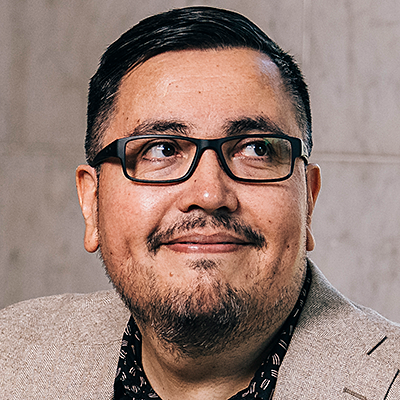
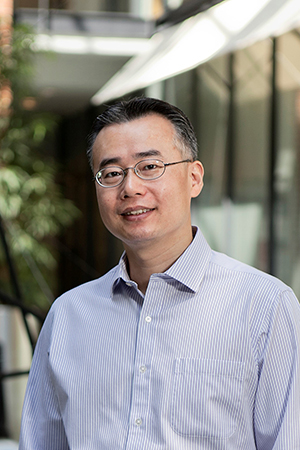
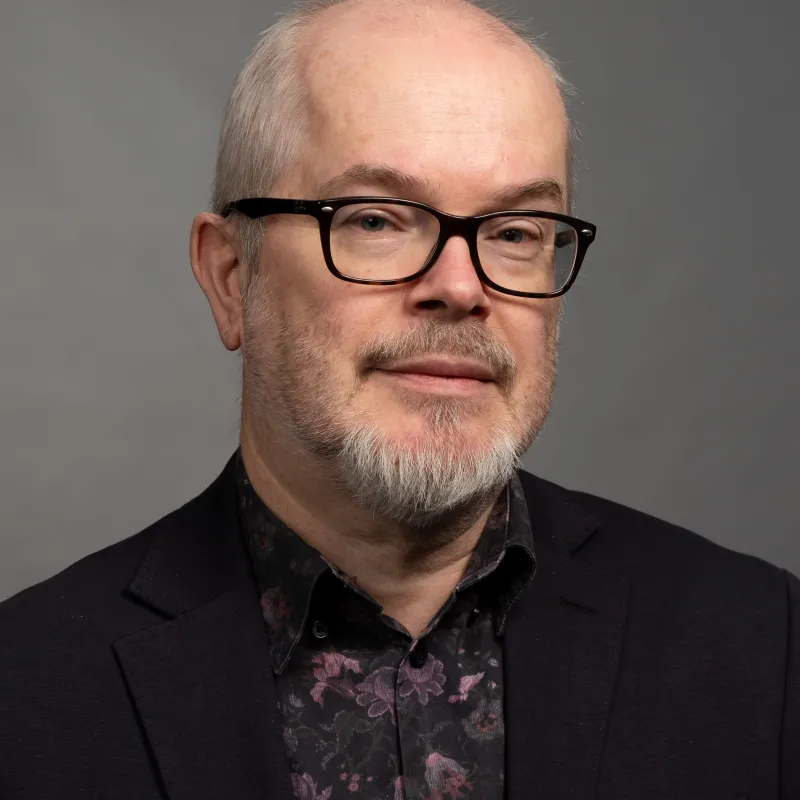
Andres Lucero is Associate Professor of Interaction Design at Aalto University's Department of Art and Media, specializing in human-computer interaction for mobile devices and interactive surfaces. His research integrates human-computer interaction, design methodologies, and playful interfaces. He holds a PhD from Eindhoven University of Technology and has industry experience from Nokia, where he led user-centered design projects as Senior Researcher. Research explores tangible interfaces, social wearables, museum experience design, human-AI collaboration, and cross-cultural co-design approaches. Recent projects investigate conversational agents in design processes, persona generation workflows, and freeform interactive devices. Dr. Lucero received the Honourable Mention Award at MUM 2020 for innovative interaction research. His work advances design methods through first-person perspectives, AI integration, and novel interaction paradigms.
Petri Myllymäki serves as Director of multiple prominent research entities at Aalto University's School of Science, including the Helsinki Institute for Information Technology (HIIT), the Department of Computer Science, the Finnish Center for Artificial Intelligence (FCAI), and his own research group. His leadership positions demonstrate significant influence in the Finnish and international AI research community. Dr. Myllymäki's research focuses on information discovery, Bayesian networks, information retrieval, and machine learning. His work bridges theoretical computer science with practical applications, particularly in developing systems that enhance how humans interact with information spaces. His research fingerprint prominently features Information Discovery (100%), Bayesian Networks (50%), Hashing (50%), Approximation Algorithms (50%), Information Retrieval (50%), structure learning (50%), Search Engine technology (37%), and Task Performance (33%). His recent publications (2015-2025) reveal a consistent trajectory in interactive information discovery systems, with increasing applications in diverse domains including decision science, public health, and social media analysis. Notably, his 2024-2025 work shows expansion into cognitive burden in decision-making, health outcomes research using machine learning, and political social media analysis – demonstrating how his core AI methodologies are being applied to address complex societal challenges. Recognized at AI Finland Gala 2024 for contribution reaching over 1.4 million users Featured in multiple media outlets including X (formerly Twitter) and Bluesky Work referenced in patents and Wikipedia pages Dr. Myllymäki actively hosts academic visitors and participates in collaborative research activities. His work contributes to UN Sustainable Development Goals through applications in information access and AI development. The Myllymäki Petri group (HIIT) serves as a hub for interdisciplinary research at the intersection of artificial intelligence, human-computer interaction, and information systems.
Masood Masoodian is an Associate Professor in the Department of Art and Media at Aalto University, Finland. He leads the Visual Communication Design research group, focusing on interactive visualization for health, energy, and sustainability contexts. Previously, he held roles at the University of Waikato (2000-2016), University of Southern Denmark, and Massey University. Education: Doctoral degree in Other disciplines from the University of Waikato (1999) Research interests include design thinking, visualization of complex data, and creative aging interventions. Notable projects include the EU-funded INT-ACT initiative (2024-2026) addressing intangible cultural heritage. He has received an award for collaborative work on video game ludonarrative analysis (2019). Recent activities include organizing workshops on map-based interfaces, co-creating cultural heritage methods, and delivering public talks on digital design. Supervised two theses and contributed to 131 peer-reviewed outputs, emphasizing human-centered design and sustainability. Grants: Principal investigator for multiple EU projects totaling over 3 years of active funding. Awards: Prize for 'Comedy in the Ludonarrative of Video Games' (2019). Labs/Teams: Visual Communication Design group, collaborating internationally on projects like INT-ACT's cultural heritage mapping.
Kari Tammi is an Associate Professor at the Department of Mechanical Engineering , Aalto University , Finland. His research focuses on the integration of data availability in mechatronics design and operational systems, emphasizing simulation models, digital twin technology, and user interface innovation. He has presented installation talks as part of Aalto University's celebrations of new tenured professors.
Eetu Mäkelä is a Professor of Digital Humanities at the University of Helsinki, leading the research group at the Helsinki Centre for Digital Humanities. He focuses on computational methods in humanities and social sciences, including datafication and interdisciplinary collaboration. He serves as Technical Director of DARIAH-FI and a Research Programme Director at the Helsinki Institute for Social Sciences and Humanities. Currently, he heads the preparatory group for the Helsinki Liberal Arts and Sciences Bachelor’s Programme. His research emphasizes technological and theoretical foundations of computational research, with notable contributions to linked open data, sociolinguistic analysis, and historical text mining. He has developed widely used tools like Recon, Palladio, and Octavo, which are employed in academic and public sectors. His work has garnered over 20 awards, including best paper and open science recognitions. Key areas of expertise include digital humanities methodologies, data integration, and open science practices. He actively contributes to teaching, designing courses such as 'Methods for Digital Humanities' and demonstrating innovative pedagogical approaches. His recent projects involve analyzing 18th-century philosophical texts and sociolinguistic change using computational methods. Awards: Multiple best paper awards, open data awards, and open science awards. Grants/Advising: Leads research initiatives funded by the Academy of Finland and other bodies. Mentors interdisciplinary research teams but no specific student names listed. He maintains active roles in academic infrastructure, including the DARIAH-FI initiative and the Helsinki Institute’s datafication program. His work bridges technical innovation with humanities scholarship, emphasizing practical, enduring systems for academic and public use.
Quan Zhou is a Professor leading the Robotic Instruments Group at the Department of Electrical Engineering and Automation, School of Electrical Engineering, Aalto University, Finland. He holds an M.Sc. in Control Engineering and a Dr.Tech. in Automation Technology from Tampere University of Technology. His research focuses on miniaturized robotics, robotic manipulation using contact, acoustic, magnetic, interfacial, and fluidic methods, integrating physics, mechatronics, and machine learning to address challenges in dexterous manipulation with applications in biomedicine, materials science, and industrial technologies. He directs the Master’s Programme in Automation and Electrical Engineering (AEE) at Aalto and coordinates the European Robotics Association’s Topic Group on Miniaturized Robotics. He has led the EU FP7 project FAB2ASM and chaired international conferences like MARSS 2019. Notably, he received the 2018 Anton Paar Research Award for Instrumental Analytics and Characterization. His research spans fundamental methodologies and practical applications, emphasizing interdisciplinary innovation. Recent work includes advancements in fluid-driven manipulation, biomimetic robotics, and acoustic particle control. His contributions bridge theoretical frameworks and real-world automation solutions, with publications in journals like Advanced Intelligent Systems , Nature , and Physical Review E . Prof. Zhou’s leadership roles include coordinating the EIT Digital Master's Programme in Autonomous Systems and chairing IEEE Finland robotics chapters. His work has been recognized through grants and awards, reflecting his impact on robotics and automation research and education.
Mervi Paulasto-Kröckel is a Professor in the Department of Electrical Engineering and Automation at Aalto University, specializing in Electronics Integration and Reliability. With a doctoral degree in Engineering and Technology from Helsinki University of Technology (1995) and a Master's degree from the same institution (1990), her work focuses on microelectronics packaging, MEMS, and sustainable electronic manufacturing. Doctoral Degree: Engineering and Technology, Helsinki University of Technology (1995) Master's Degree: Engineering and Technology, Helsinki University of Technology (1990) Her research explores advanced packaging techniques like SLID bonding, reliability of microbumps, and thermally conductive materials. Recent work includes buried aluminum nitride for silicon-on-insulator and fatigue crack analysis in IGBT modules. Her publications emphasize low-temperature processes, interdiffusion, and MEMS reliability. Awards include the JVST A Best ALD Paper Award (2021) and a Best paper award (2000). She leads projects like PowerizeD and 3DPiezoMems, focusing on digitalization and 3D MEMS development. Best paper award (2000) JVST A Best ALD Paper Award (2021)
Esa Ollila serves as Associate Professor in the Department of Signal Processing and Acoustics at Aalto University, Finland, and holds an adjunct professorship in Statistics at the University of Oulu. His academic appointments include Academy of Finland Research Fellow (2010-2015) and prior senior research/lecturing roles at both institutions. His educational background features: M.Sc. in Mathematics, University of Oulu (1998) Ph.D. in Statistics (with honors), University of Jyväskylä (2002) D.Sc.(Tech) in Signal Processing (with honors), Aalto University (2010) Professor Ollila's research centers on statistical signal processing and robust statistical methodologies , with significant contributions to array processing, high-dimensional data analysis, and covariance matrix estimation. His work bridges theoretical statistics with practical applications in radar systems, wireless communications, and big data analytics, emphasizing robustness against outliers and computational efficiency in modern data-intensive environments. Current focus areas include compressed sensing, sparse approximation, and blind source separation techniques. Analysis of his 15 most recent publications (2024-2025) reveals three dominant trends: (1) robust covariance learning for massive random access systems, (2) integrated sensing and communications (ISAC) for 6G networks using advanced beamforming, and (3) geometric approaches to elliptical distributions in statistical inference. His work increasingly incorporates deep learning (GANs, graph neural networks) while maintaining strong foundations in classical signal processing theory. Key recognitions include: Academy of Finland Postdoctoral Fellowship (2004-2007) Academy of Finland Research Fellowship (2010-2015) His research has been supported through prestigious Academy of Finland grants totaling over a decade of continuous funding. Professor Ollila currently leads an active research group at Aalto University, supervising doctoral candidates and collaborating internationally with institutions including Princeton University (where he served as Visiting Post-doctoral Research Associate during 2010-2011). He maintains strong ties with the University of Oulu through his adjunct professorship and has contributed to EURASIP's Special Area Team on Theoretical and Methodological Trends in Signal Processing. The Esa Ollila Research Group focuses on cutting-edge challenges in statistical signal processing, with current projects spanning robust DOA estimation under non-Gaussian noise, covariance matrix learning for massive MIMO systems, and machine learning-enhanced radar-communication integration. The group actively develops open-source tools like the fitHeavyTail R package for heavy-tailed distribution modeling and maintains collaborations with industry partners in wireless communications.
Kwantae Kim is an Assistant Professor at the Department of Electronics and Nanoengineering within Aalto University's School of Electrical Engineering . He leads the Tiny Systems and Circuits (TSirc) Group , focusing on power-efficient analog/mixed-signal ICs for biomedical and neuromorphic sensor systems. IEEE Senior Member (2025) Collaborates with institutions across Europe, Asia, and America Specializes in ultra-low-power AI-embedded IoT platforms His research emphasizes Tiny, Sensory, Intelligent, and Wireless IoT systems through: Development of energy-efficient IC architectures Democratizing access to advanced chip design Hardware-software co-design for edge computing Recent publications highlight innovations in: Spoken-language-understanding SoCs Temporal-sparsity-aware keyword spotting Open-source silicon frameworks Awards include: 2025 IEEE Senior Member 2023 Best Poster Award (AICAS) 2019 Samsung HumanTech Silver Award Research partnerships span: Prof. Tobi Delbruck (UZH/ETH Zurich) Prof. Hoi-Jun Yoo (KAIST) Prof. Shih-Chii Liu (UZH) Prof. Sohmyung Ha (NYU Abu Dhabi)
Pedro Vilaça is a **Professor and Head of the Department of Energy and Mechanical Engineering** at **Aalto University's School of Engineering**, Finland. Previously, he worked at the Instituto Superior Técnico (Técnico), University of Lisbon, Portugal (1995–2013). His research focuses on **welding technology**, **solid-state manufacturing**, **non-destructive testing (NDT)**, **hydrogen-related materials science**, and **materials safety**, with applications in energy and aeronautics sectors. He leads R&D teams and has collaborated globally, contributing to 142+ publications (h-index 32 via Scopus). **Research Interests**: Advanced welding techniques (e.g., friction stir welding), hydrogen embrittlement in steels, supercapacitor materials, and smart composites. He has pioneered methods for **zero-material-loss welding** and **self-sensing metallic materials**. **Key Projects**: Led initiatives like **THEWFuelCells** (fuel cell welding innovations) and **EARLY/Vilaca** (hydrogen damage assessment). His work aligns with **UN Sustainable Development Goals**, emphasizing renewable energy storage and industrial sustainability. **Awards**: 2011 Eng. Cruz Azevedo Award for outstanding research in Mecânica Experimental. **Collaborations**: Active in international networks, including the International Institute of Welding and European research consortia. He has organized conferences, reviewed patents, and advised doctoral students globally. **Recent Articles**: Focus on corrosion-resistant materials, piezoelectric composites, and hydrogen-induced failure in steels. His 2023–2025 work emphasizes energy storage innovations and advanced joining technologies. **Grants**: Principal investigator for projects funded by Business Finland, EU EIT, and Academy of Finland. **Labs/Teams**: Oversees Aalto’s mechanical engineering research teams and collaborates with institutions like Helmholtz-Zentrum Geesthacht.
Weiwei Lin is an Associate Professor in the Department of Civil Engineering at Aalto University, specializing in structural engineering with a focus on bridge systems, composite materials, and structural health monitoring. His research explores fatigue behavior of steel structures, seismic performance of composite systems, and innovative repair techniques. He holds a PhD from Waseda University (2012), MSc from Southeast University (2009), and BEng from Southwest Jiaotong University (2006). Key research areas include: steel-concrete composites, bridge redundancy evaluation, replaceable energy dissipaters, and AI-driven infrastructure diagnostics. Lin leads projects like CCU Structure (EU Horizon Europe) and RCF Mobility initiatives, focusing on sustainable construction and material recyclability. He has published 120+ peer-reviewed articles and secured 6 major grants. Lin has received prestigious awards including the IABMAS Young Award (2014) and Outstanding Reviewing Award (2017). His lab collaborates globally, hosting researchers from institutions like Israel Institute of Technology and Tsinghua University. Current work emphasizes crowdsourcing-based bridge monitoring and physics-guided AI frameworks for infrastructure diagnostics.
Jouko Peltonen is a Professor in Chemistry at Åbo Akademi University's Faculty of Natural Sciences and Engineering. He leads the Laboratory of Molecular Science and Technology, focusing on sustainable material development and biomedical applications. His work aligns with UN Sustainable Development Goals through green chemistry innovations. Ph.D. in Chemistry (Åbo Akademi, 1994) Licentiate in Chemistry (Åbo Akademi, 1992) Master's in Chemistry (University of Helsinki, 1988) Peltonen's research spans materials science , polymer chemistry , and sustainable technology , with emphasis on nanocellulose composites , antibacterial materials , and bio-based packaging . Recent projects explore biofilm modeling and lignin valorization. His publications (216 total) demonstrate interdisciplinary impact across biomedical engineering , environmental science , and chemical manufacturing . Key collaborations include NordForsk-funded initiatives and EU projects like PACKER 2020. Research grants include: Printed Intelligence Infrastructure (Academy of Finland, 2024-2028) Nordic POP (NordForsk, 2018-2025) ABC-Health (Jane och Aatos Erkkos Foundation, 2021-2024)
Turkka Keinonen is a Professor of Industrial Design at Aalto University School of Arts, Design and Architecture, serving as Vice Dean of Research and Head of Doctoral Education. His career spans academic leadership, industry roles in Finnish technology sectors (shipbuilding, medical equipment), and a visiting associate professorship at National University of Singapore. He specializes in human-centered design, product concept design, and ethical considerations in design. Keinonen’s research emphasizes public sector innovation, digital service development, and the intersection of technology with societal needs. His work bridges theory and practice, focusing on how design can foster equity, civic engagement, and sustainability. Recent projects explore libraries as digital innovation hubs, smart home technologies’ ethical implications, and volunteer-based IT services. He has authored influential books including Mobile Usability (2003), Product Concept Design (2006), and Designers, Users and Justice (2017), alongside over 100 publications. Keinonen’s research trends reflect a shift toward relational design in public sectors, emphasizing stakeholder collaboration and systemic change. His articles analyze digital literacy initiatives, quasi-public service models, and design’s role in mediating technological control. He advocates for ethical frameworks that prioritize user autonomy and societal justice in design processes. Labs/Teams: Active in Aalto’s design innovation networks, particularly in public service design and human-centered design methodologies. Collaborates with industry partners (e.g., Nokia Research Center) and Nordic institutions on applied design research.
Riikka Koulu is an Associate Professor of Social and Legal Implications of AI at the University of Helsinki, holding joint appointments at the Faculty of Law and Faculty of Social Sciences. She serves as Director of the University of Helsinki Legal Tech Lab, an interdisciplinary research hub focused on law, technology, and society, and is an affiliated researcher at the Alexander von Humboldt Institute for Internet and Society in Berlin. In 2025, she will be an academic visitor at Oxford University. Education: Doctor of Law (OTT), University of Helsinki (awarded November 17, 2016) Title of Docent (digitalisation of law), University of Lapland (2020-present) Riikka Koulu is a socio-legal scholar specializing in the interconnections between law, technology, and society. Her research focuses on understanding law's role in shaping and being shaped by digitalized societies. She combines doctrinal and theoretical legal analysis with empirical research from a public law perspective. Her current work examines digital public administration, AI policy and regulation, European technology regulation, and the impact of digital technologies on legal decision-making. She is particularly interested in human oversight mechanisms and interface design in automated systems. Her recent publications reveal a strong focus on the legal implications of digital transformation, with particular attention to automated decision-making in public administration, algorithmic governance, and the changing nature of legal procedures in digital environments. Her work spans theoretical explorations of legal concepts in digital contexts and practical analyses of how technology is reshaping justice systems and public administration. Scientific Recognition: Title of Docent (digitalisation of law), University of Lapland (2020) Affiliated researcher, Alexander von Humboldt Institute for Internet and Society, Berlin (2019-present) Riikka Koulu actively supervises doctoral researchers through the Doctoral Programme in Law and has secured significant research funding for multiple projects. Her current research portfolio includes the ADM-Gov project (2022-2026) on automated administration governance, the REPAIR project (2022-2025) on algorithmic system maintenance, and the DARE project (2021-2026) on inclusive digital administration design. These projects involve collaboration with international partners and interdisciplinary teams. As Director of the University of Helsinki Legal Tech Lab, Koulu leads an interdisciplinary research hub that is part of the Network of Centers (NoC). The lab serves as a focal point for research on the intersection of law, technology, and society, bringing together scholars from legal studies, computer science, social sciences, and design disciplines to address pressing challenges in digital governance.
Heikki Handroos is a Full Professor of Mechanical Engineering at LUT University, leading the Laboratory of Intelligent Machines since 1993. He holds a DSc (Technology) from Tampere University of Technology and has served as Vice-Dean of the Faculty of Technology (2007-2009) and currently chairs the Collegiate Body of LUT University. His research focuses on mechatronics, robotics, control systems, and fluid power, with over 300 publications and 2,400+ citations. He has supervised 34 doctoral theses and 150+ MSc projects, managed R&D projects exceeding €20M, and co-founded four tech startups. His work spans industrial collaborations, digital twin applications, and innovative robotics for nuclear energy (e.g., DEMO reactor maintenance systems). He has held visiting professorships in the U.S., Japan, and Russia, and actively contributes to academic editorial roles and professional societies like ASME and IEEE.