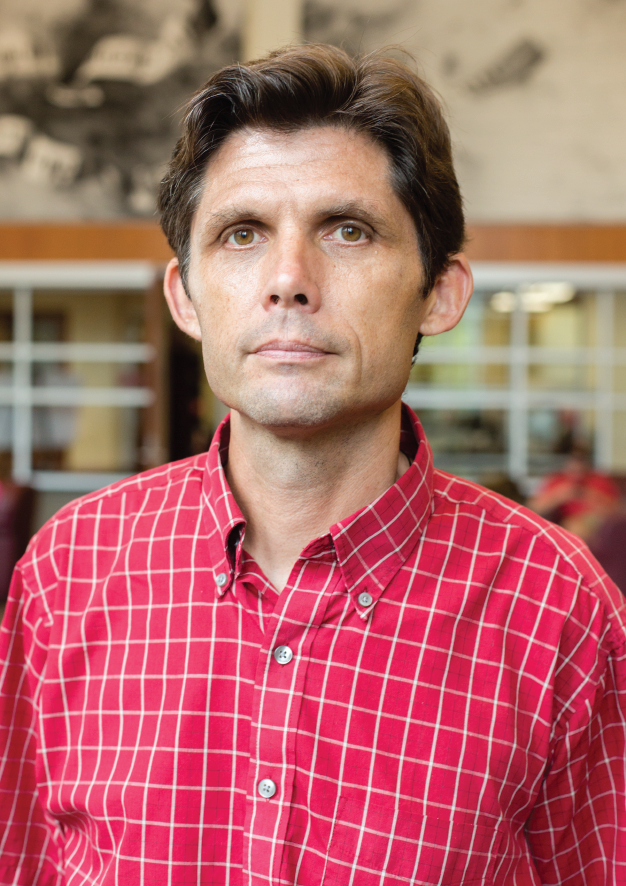
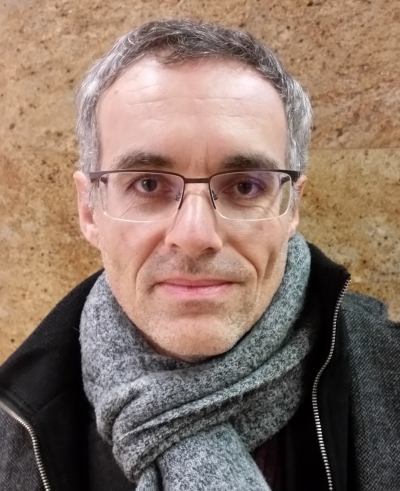
Jamie H. Ferguson is an Associate Professor in the Department of English at the University of Houston, with a cross-appointment to the Honors College. He specializes in Renaissance and early modern literature, focusing on intersections between biblical hermeneutics, literary poetics, and translation theory. Renaissance Literature Shakespeare Studies Biblical Translation Great Books Tradition His research explores how theological debates shaped vernacular literary production in Early Modern Europe, with particular attention to textual materiality and interconfessional dialogues. Ferguson's publication record spans Latin, Italian, French, Polish, and English contexts. Recent projects include the annotated translation of Joachim du Bellay's Deffence et illustration de la langue françoyse and a forthcoming book on European Biblical Poetics . He has received multiple Martha Gano Houstoun Research Grants and been recognized with Honors College lecture awards.
Andreas J. Beck is Professor and Department Chair of Historical Theology at ETF Leuven, where he also serves as Director of the Institute of Post-Reformation Studies and Co-Director of the Jonathan Edwards Center Benelux. His research focuses on early modern Reformed theology, particularly Reformed scholasticism, Scotist philosophy, and post-Reformation intellectual history. Research areas include: Reformed Orthodoxy and scholastic methodology Historical development of doctrinal formulations Gisbertus Voetius studies and Scotist reception Early modern theological controversies Textual analysis of confessional documents Beck has led major editorial projects including the three-volume Synopsis Purioris Theologiae and supervises numerous PhD students. His publications demonstrate consistent focus on Protestant scholasticism and its medieval roots. Scientific Recognition: H. Henry Meeter Center for Calvin Studies Fellow (1995) He serves on editorial boards of Jonathan Edwards Studies , Augustiniana , and directs the book series 'Studies in the History of Church and Theology'.
Fr. Prof. Stefan Szymik is a theologian and biblical scholar at the Faculty of Theology of the John Paul II Catholic University of Lublin, where he has served since 1995. Specializing in biblical hermeneutics and exegesis, his work focuses on New Testament studies, Christology, and biblical anthropology. He holds the rank of Professor of Theological Sciences since 2017. His research explores themes such as anti-Epicurean polemics in the New Testament, the role of the Bible in Christian life, and the historical context of biblical texts. Education includes theological and philosophical studies at the Major Seminary of the Missionaries of the Holy Family in Kazimierz Biskupi, followed by advanced biblical studies at the Catholic University of Lublin and the Pontificio Istituto Biblico in Rome. His academic roles include editorships of journals like Roczniki Teologiczne and the Biblical Annals , as well as leadership in the Institute of Biblical Studies. Research interests span biblical methodology, theological anthropology, and the application of biblical texts to contemporary Christian practice. He has authored numerous books and articles, including Anti-Epicurean Polemics in the New Testament (2023) and Ziemia Przymierza (2022). His academic contributions are recognized through awards like the Silver Cross of Merit (2001) and the Gold Cross of Merit (2018). Prof. Szymik’s work bridges biblical scholarship with pastoral theology, emphasizing the Bible’s role in liturgy and faith formation. He has been a member of prestigious organizations such as the Lublin Scientific Society and the Polish Biblical Society, contributing to interdisciplinary dialogue on biblical interpretation.
Tijana Krstic is a Professor in the Department of Historical Studies at Central European University (CEU), where she conducts research and teaches on the early modern Ottoman Empire and its religious, cultural, and social dynamics. She is affiliated with the Doctoral School of History and the Center for Eastern Mediterranean Studies and the Center for Religious Studies at CEU. From 2015 to 2021, she led the ERC-funded OTTOCONFESSION project, which explored the formation of Sunni orthodoxy in the Ottoman Empire and its connections with Christian confessional developments in Europe. PhD in History, University of Michigan, Ann Arbor (1998–2004) MA in History, University of Michigan, Ann Arbor (1998–1999) B.A. in History and Southeast European Studies, American University in Bulgaria (1994–1998) Her research focuses on religious conversion, confessionalization, Ottoman-Muslim identity, and cross-cultural interactions in the early modern Mediterranean. She examines how narratives of conversion shaped imperial identity and religious orthodoxy, and how Ottoman intellectual and religious life evolved in dialogue with broader Eurasian developments. Her work often draws on understudied sources, including conversion narratives, polemical texts, and diplomatic records. Her recent publications reflect a sustained engagement with the themes of religious identity, orthodoxy, and interconfessional dynamics. She has published on Morisco refugees, Ottoman catechisms, intertextuality in religious polemics, and the role of interpreters in imperial diplomacy. Her research demonstrates how the Ottoman Empire was deeply interconnected with early modern European religious transformations. European Research Council Consolidator Grant (OTTOCONFESSION project, 2015–2020) Krstic has advised and collaborated with numerous scholars and research teams. She currently represents CEU on the Board of Directors of the Cluster of Excellence 'Eurasian Transformations' (EurAsia), funded by the Austrian Science Fund, coordinating research and teaching with international partners. Her work continues to shape the field of Ottoman and early modern religious history.
Thomas-Andreas Põder is Professor of Systematic Theology at the Estonian Evangelical Lutheran Church's Institute of Theology (Tallinn), Associate Professor of Philosophy of Religion (with special focus on semiotics) at University of Tartu, and Study Secretary for Theology and Ecumenical Dialogue in the Communion of Protestant Churches in Europe (Vienna, Austria). He holds a doctoral degree (Dr. theol.) from the University of Greifswald, Germany. Fields of research: Systematic Theology, Ecumenical Theology, Philosophy of Religion, Theosemiotics Current research: Cultural Theosemiotics and doctrinal diversity in church communions His scholarly contributions include co-editing the book Sign, Method and the Sacred (2021) and guest-editing the special issue Religion in the Semiosphere (2023) in Sign Systems Studies . He has authored two monographs: Usukultuur evangeelses luterlikus vaatevinklis (2018) and Solidarische Toleranz (2016). Scientific awards include the 2019 Marie Sklodowska-Curie Seal of Excellence, 2018 and 2016 Estonian Evangelical Lutheran Church Honors, and 2015 and 2002 Silver Prizes from the journal Akadeemia . He coordinates international theological dialogues between Protestant churches and Catholic/Orthodox denominations, and serves in editorial boards for theological journals like Kirik & Teoloogia and Usuteaduslik Ajakiri .
Janusz Andrzej Podzielny is a Professor at the Faculty of Theology of the University of Opole , specializing in Catholic Moral Theology and Evangelical Theological Ethics . His work focuses on contemporary ethical challenges in marriage, family, work, and bioethics, with a strong emphasis on ecumenical dialogue between Catholic and Evangelical traditions. Key research areas: Catholic Moral Theology , Evangelical Ethics , Marital/Family Ethics , Work Ethics , Sport Morality , Ecumenical Cooperation Active in interdisciplinary bioethics (euthanasia, prenatal diagnostics, human dignity) and social theology (e.g., Austrian Ecumenical Council's Social Word) Contributed to debates on contraception ethics, Amoris Laetitia implementation, and theological responses to pluralistic societies His publications appear in Polish, German, and English, reflecting international collaborations with institutions like the Pontifical Biblical Institute and University of Graz . While his h-index remains low (0), his ministerial score of 857 reflects significant contributions to Polish theological scholarship.
Rajmund Porada is a professor at the Faculty of Theology, University of Opole, specializing in systematic theology and ecumenism . With 57 publications and a WoS h-index of 1, his work focuses on reconciling theological differences between Lutheran and Catholic traditions, including apostolic succession, sacraments, and church unity. Key roles: Faculty member, researcher, ecumenical dialogue expert. Research areas: Theological anthropology, justification, purgatory doctrine, sacramental theology, and interconfessional cooperation. His recent articles address topics like secularization's impact on ecumenism and theological frameworks for church pluralism. He has participated in ecumenical projects and ministerial dialogues, contributing to the Joint Declaration on the Doctrine of Justification and related agreements.
Katharina Opalka is a theologian at the Protestant Theological Faculty of the University of Bonn, holding a 50% professorship for Systematic Theology/Dogmatics and Ethics since April 2024 in a shared position with Prof. Folkart Wittekind. She specializes in spirituality (particularly Taizé practices), narrativity, performance theories, empirical systematic theology, Christology, existential theology (Paul Tillich), and 19th-century theology (Albrecht Ritschl). Her habilitation project "The Ambiguity of Candlelight" explores spirituality through the cross narrative in Tillich's sermons and Taizé, with venia legendi scheduled for May 14, 2025. She previously served as a pastor in substitute service (2023-2024) and received the Annemarie-Schimmel Fellowship (2022-2023). University of Bonn (Dr. theol., 2020) Evangelical Theology studies at Marburg and Göttingen (2005-2011) 2. Theologisches Examen (2014) Theological training at Predigerseminar Loccum Her research focuses on theology's functional capacity in interdisciplinary discourse, examining how theological concepts like humility, patience, and prayer operate within collective contexts while preserving divine transcendence. Key works explore Albrecht Ritschl's theology through narrative and performative frameworks, analyze Taizé spirituality's atmospheric effects, and investigate resilience through Christological narratives. Her publications span theological ethics, biblical hermeneutics, and contemporary spiritual practices. Recent publications include monographs on humility's performance in Ritschl's theology (2021), analyses of Taizé's spiritual music (2023), explorations of resilience in grief processes (2023), and critiques of divine omnipotence (2017). She engages with Paul Tillich's existential theology, Ricoeur's hermeneutics, and interdisciplinary approaches to theological concepts. Annemarie-Schimmel-Fellowship (2022-2023) Member of Wissenschaftliche Gesellschaft für Theologie (since 2025) Advisory board member of Haus der Stille der EKiR (since 2021) Active in Luther-Gesellschaft (since 2015), European Society for Philosophy of Religion (2014-2018), Deutsche Gesellschaft für Religionsphilosophie (since 2013) Opalka contributes to theological education through courses on dogmatics, systematic theology, and pneumatology at Bonn and Cologne Universities. She co-leads seminars with Prof. Cornelia Richter and Prof. Folkart Wittekind, including doctoral colloquia and interdisciplinary modules with sociology departments. Her teaching certificate includes 240 academic units in pedagogical innovation and academic advising.
Nicolas Fornerod is a Lecturer at the Institute of Reformation History, University of Geneva. His research focuses on the institutionalization of Reformed Churches, religious dissidence, and historical migrations during the Early Modern period. Affiliation: Institute of Reformation History, University of Geneva Academic Role: Lecturer in Department of General History His work examines critical aspects of the Synod of Dort, spiritual biographies like Jean de Labadie, and missionary practices in Renaissance Europe and colonies. Recent research includes the impact of the Reformation on daily life in Geneva and the critical analysis of travel literature from the 16th century. Fornerod's publications reveal trends in Reformation studies, religious networks, and interdisciplinary approaches combining theology, history, and cultural studies. He has co-authored works with leading scholars like Philip Benedict and Daniela Solfaroli Camillocci. Notable Collaborations: EMoDiR Research Group, Society of the Historical Museum of the Reformation Committee Memberships: Scientific Committee of Venice/Verona EMoDiR, Disciplinary Council of University of Geneva
Nina Valbousquet, agrégée and doctor in history from Sciences Po Paris (2016), has been a member of the École française de Rome (2019-2023) and is currently a postdoctoral researcher at Manchester University (2023-2024) under the Rothschild Foundation Hanadiv Europe fellowship. She also held visiting researcher status at Yad Vashem (Jerusalem, 2024). Her work focuses on Vatican archives, Holocaust studies, and transnational migration history. PhD in History from Sciences Po Paris (2016) Member of École française de Rome (2019-2023) Postdoc: Manchester University (2023-2024) Visiting researcher: Yad Vashem (2024) Her research spans migration history , refugee studies , antisemitism , and Jewish-Catholic relations , with a particular emphasis on Vatican archives post-2020. She has organized international conferences and curated exhibitions at institutions like the Mémorial de la Shoah in Paris. Her publications analyze the Vatican's role during the Holocaust and its post-war humanitarian engagements. Recent publications examine Vatican refugee camps , transatlantic migration , and intermarried family survival strategies under Nazi regimes. She contributes to historiographical debates on archival transparency and religious ethics. 2015 City of Paris Prize for antisemitism research Rothschild Foundation Hanadiv Europe Fellowship (2023-2024) She participates in major research programs including ANR GLOBALVAT (2022-2025) and Austrian Science Fund projects (2024-2027), focusing on Vatican archives and Holocaust memory. Her work bridges academic research with museum exhibitions and public history.
Pablo Blanco Sarto es profesor catedrático del Departamento de Teología Sistemática de la Universidad de Navarra, especializado en ecumenismo, teología sacramentaria y ministerio. Además, es profesor asociado del Instituto Core Curriculum y profesor del máster en Cristianismo y Cultura Contemporánea en Madrid, así como de la Especialización en Ecumenismo en la Universidad Pontificia de Salamanca. Doctor en Filosofía (1997, Pontifical University of Santa Croce) con investigación sobre estética y hermenéutica de Luigi Pareyson. Doctor en Teología (2005, University of Navarra) con tesis sobre la teología dogmática y religiones de Joseph Ratzinger. Profesor visitante en el Weltethos-Institut de la Universidad de Tübingen. Miembro de la Cátedra de Ecumenismo (University of Navarra), Societas Oecumenica, y comités editoriales de publicaciones teológicas. Sus campos de investigación abarcan: Ecumenismo (diálogos católico-luteranos, sacramentos, ministerio). Estética y hermenéutica del arte (Luigi Pareyson, Dostoevsky, Nietzsche). Teología de Vatican II (interpretación, continuidad con tradición). Fe y razón (Joseph Ratzinger, diálogo interreligioso). Legado de Benedicto XVI (unidad cristiana, crítica cultural). Teología del trabajo (Lutero a pentecostalismo). Entre sus obras destacan 31 publicaciones desde 1997, incluyendo Benedicto XVI, el papa de la razón (2024) y Ecumenismo hoy (2022). Ha dirigido 11 tesis doctorales sobre temas como la liturgia, la fe en Benedicto XVI, y la cristología espiritual. Reconocimientos: Premio Ratzinger (2023). Dos sexenios de investigación en filosofía, filología y lingüística. Miembro de la Academia Skepsis, European Society for Catholic Theology y otras sociedades científicas. Participa en grupos de estudio como "Verdad y discurso histórico" y "Seminario de filosofía del arte", y colabora con instituciones teológicas en Europa y América Latina.
Vladimir Latinovic is a researcher at the Institute for Ecumenical and Interreligious Research within the Faculty of Catholic Theology at Eberhard Karls University of Tübingen. He holds a visiting fellowship at Princeton University (2024) and is completing a habilitation project at Heidelberg University on Orthodox theological hermeneutics of modernity. His research bridges Orthodox theology with contemporary challenges, focusing on ecumenical dialogue between Orthodox and Eastern Catholic Churches, historical heresy definitions, and modern identity intersections between religion, state, and gender. He contributes as co-editor of the Palgrave Macmillan series Pathways for Ecumenical and Interreligious Dialogue and has lectured extensively on topics like Orthodox ecclesiology and interfaith relations. Publications include a three-volume monograph series on Christology and Communion , analyzing Nicene theology's impact on liturgy and piety, and edited volumes on decolonial theological horizons. His 15 most recent works span 2015-2024, emphasizing ecclesial synodality, sacramental praxis, and postmodern theological hermeneutics. Latinovic participates in academic networks like the Orthodox Eastern-Catholic Dialogue Group and the international Ecclesiological Investigations Research Network. He teaches courses on ecumenical challenges, interreligious competence, and Russian Orthodox film theology at Tübingen and Heidelberg.
Carsten L. Wilke is a Professor in the Department of Historical Studies at Central European University (CEU), where he teaches graduate and undergraduate courses on European and Mediterranean religious history, with a focus on Jewish history from the Middle Ages to the present. He is affiliated with multiple academic programs, including Jewish Studies, Cultural Heritage Studies, Eastern Mediterranean Studies, and Early Modern Studies. From 2016 to 2020, he served as director of the Center for Religious Studies at CEU, and in 2023–2024, he directed the Erasmus Mundus program History in the Public Sphere . He is currently on sabbatical during the 2024–2025 academic year. His academic training includes a PhD in Jewish Studies from the University of Cologne (1994, summa cum laude), a diploma in Religious Studies from the École Pratique des Hautes Études, Paris, and an MA from the University of Cologne. Before joining CEU in 2009, he held research positions in France, Germany, Mexico, and the USA. Wilke’s research centers on transcultural aspects of European Jewish history, with specializations in Sephardic and crypto-Jewish communities, Jewish-Christian relations, early modern Iberian Judaism, book and manuscript culture, and modernization processes in 19th-century Judaism. His publications include the monograph Farewell to Shulamith: Spatial and Social Diversity in the Song of Songs (2017) and edited volumes such as Modern Jewish Scholarship in Hungary (2016) and Isaac Orobio: The Jewish Argument with Dogma and Doubt (2018). His recent articles explore themes like clandestine Jewish networks, religious polemics, synagogue architecture, and intellectual exchanges between Jewish and Christian thinkers. His recent publications reveal a strong focus on early modern Jewish identity formation, particularly among Iberian exiles and crypto-Jews. He frequently examines the interplay between religious texts, political events, and cultural memory, with a methodological emphasis on manuscript studies, transnational networks, and cross-confessional dialogue. Wilke has received several honors, including the CEU Outstanding Research Award (2016) and the French Jewish Book Award (2008). He has been a research fellow at institutions such as the Israel Institute for Advanced Studies and Yeshiva University, and has held visiting professorships in Paris, Brussels, Tokyo, and Germany. He has supervised numerous doctoral and MA theses at CEU, including prize-winning works on topics such as interwar Jewish beauty pageants, Nigerian literary history, and Sephardic Purim festivities. His teaching includes both classroom courses and experiential learning, such as walking tours on Jewish commemorative landscapes in Budapest. Wilke is involved in several ongoing research projects, including Sephardic Manuscripts of the Early Modern Period , Jewish Cemetery Inscriptions in Europe , and The Alliance Israélite Universelle in Germany, 1860–1914 . He is also a member of the ÖAW Cluster of Excellence EurAsian Transformations .
Riho Altnurme is a Professor of Church History and Vice Dean for Research at the Faculty of Arts and Humanities, University of Tartu. He has held numerous leadership roles including Dean of the Faculty of Theology (2006–2015) and has been a visiting professor at the University of Latvia. His academic work is deeply rooted in Estonian and Baltic religious history, with a focus on church-state relations and theological developments under Soviet rule. His research interests include: Church history, particularly of Estonia and the Baltic region History of theology in Estonia Secularization and religious change Church-state relations in the 20th century Interconfessional and ecumenical relations Historiography and methodology of church history Altnurme's recent publications reflect a strong engagement with transnational religious history, the impact of secularization, and the role of religious institutions in modern society. His work spans book chapters, edited volumes, and journal articles, often analyzing the interplay between religion, nationalism, and political transformation in Eastern Europe. He has contributed significantly to understanding how religious communities navigated persecution and maintained identity under Soviet rule. His scientific honors include: Honorary doctorate from the University of Latvia (2024) Honorary doctorate from the University of Helsinki (2023) University of Tartu Medal (2021) Rektor-von-Ewers-Preis for his doctoral thesis (2002) Altnurme has supervised over 15 doctoral and master’s students and has led major research projects on secularization, church history, and religious heritage. He is actively involved in academic service, including editorial work for the Theological Journal and leadership in the Estonian Church History Society, which he co-founded in 1997 and continues to chair. He also directs a research group on Estonian church and religious history and participates in international scholarly networks such as the Commission Internationale d’Histoire et d’Etudes du Christianisme. He has led or contributed to numerous research projects funded by the Estonian Research Council, the European Commission, and national archives, focusing on mapping religious heritage, ecumenism, and the dynamics of religiosity in civilizational context.
Priit Rohtmets is an Associate Professor of Church History at the School of Theology and Religious Studies , University of Tartu (2021–present) and a Professor of Church History at the Theological Institute of the Estonian Evangelical Lutheran Church (2017–present). He has held various research and teaching roles at the University of Tartu since 2011, including Senior Research Fellow positions (2018–2020) and Lecturer (2017–2018). Rohtmets was a Postdoctoral Fellow at the Leibniz Institute of European History (2013–2014). Rohtmets specializes in Church History , with a focus on Estonian religious dynamics during the 20th century. His research spans Orthodox and Lutheran Churches in Estonia, secularization processes, ecumenism , and geopolitical religious conflicts (particularly regarding the Russian Orthodox Church's role in the Ukraine War ). His work intersects theology , political history , and sociocultural transformations . Recent publications analyze religious adaptation (2024), orthodox imperial identity (2024), and Estonian Lutheran survival strategies (2024). His research shows consistent engagement with post-totalitarian religious recovery , church-state tensions , and modern ecclesiastical governance . Awards : 2020 – Silver Prize (Akadeemia) for Best Article in Socialia 2015 – Estonian Government Stipendium for Friedrich Akel Biography 2013 – Pfalz Evangelische Kirche Stipendium 2012 – 2nd Place (Estonian Student Research) 2008 – Estonian Students Fund (USA) and Estonian World Council Stipendium Rohtmets contributes to international advisory committees (Lutheran-Orthodox Joint Commission, 2025–), Estonian Public Broadcasting (2024–), and serves as Vice-Head of the School of Theology (2023–). He has participated in 10+ funded projects , including Religious Toleration and Peace (€194,750) and Orthodoxy as Solidarity (€168,750).