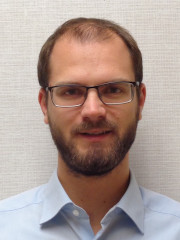
Dr. Philipp Grete is a postdoctoral research associate at the Hamburg Observatory (University of Hamburg), previously holding a Marie Skłodowska-Curie Fellowship at the same institution and a postdoctoral position at the Department of Physics & Astronomy, Michigan State University . His interdisciplinary research bridges astrophysics and computational methods , focusing on: Magnetohydrodynamic turbulence in astrophysical systems Performance-portable exascale simulation frameworks (Parthenon, AthenaPK) Cosmic ray transport mechanisms Anisotropic transport processes in weakly collisional plasmas Supercomputer-driven AGN feedback analysis He leads the XMAGNET project using DOE INCITE allocations on exascale systems and recently secured DFG funding for three years. His work has been recognized with the Postdoctoral Excellence in Research Award (MSU), SC23 Best Paper nomination, and CUG23 Best Paper Runner-up award.
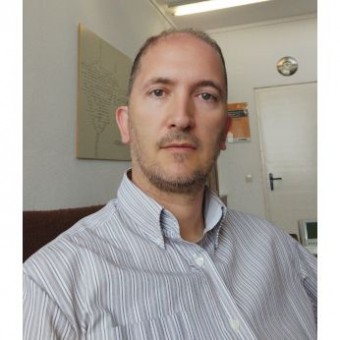
Angelo Sifaleras is a Full Professor at the Department of Applied Informatics, School of Information Sciences, University of Macedonia (Thessaloniki, Greece). He also serves as an Adjunct Professor of Quantitative Methods at the Hellenic Open University. His academic credentials include a Ph.D. in Applied Informatics (University of Macedonia, 2007) and a B.Sc. in Mathematics (Aristotle University of Thessaloniki, 1999). Research Focus: Professor Sifaleras specializes in Mathematical Programming , Network Optimization , and Heuristic Methods . His work integrates computational optimization with real-world logistics, supply chains, and sustainable systems. Key research themes include metaheuristic algorithms for vehicle routing, pollution-aware logistics, and parallel computing solutions for network analysis. Publication Trends: His 15 most recent articles emphasize hybrid metaheuristics (e.g., combining reinforcement learning with Variable Neighborhood Search), sustainable supply chain modeling, and high-performance computing applications. Dominant domains include operations research, environmental optimization, and educational algorithm visualization. Teaching & Service: He instructs courses in Combinatorial Optimization, Linear Algebra, and Heuristic Methods, employing tools like CPLEX, Gurobi, and SageMath. As an editor for Operations Research Forum and the Yugoslav Journal of Operations Research , he supports academic discourse in optimization. A Senior ACM member, he contributes to conferences like ICVNS and ITS.
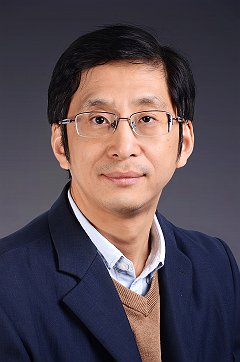
Hongyu Zhang is a Professor and Dean of the School of Big Data and Software Engineering at Chongqing University, China, and an Honorary Professor at The University of Newcastle, Australia. Previously, he served as a Lead Researcher at Microsoft Research Asia and an Associate Professor at Tsinghua University, China. He received his PhD from the National University of Singapore in 2003. His academic journey spans prestigious institutions, combining industry research experience with academic leadership. Dr. Zhang's research interests focus on intelligent software engineering, software analytics, data-driven software engineering, software fault management, testing and debugging, and software maintenance and reuse. His work centers on improving software quality and productivity by mining and analyzing vast amounts of software data. Over the years, he has developed innovative methods that apply data mining, machine learning (including deep learning), and information retrieval techniques to extract knowledge from software data and solve complex software engineering problems. His research spans three major areas: intelligent programming (code search, code summarization, code generation), intelligent quality prediction (defect prediction, cloud failure prediction, performance prediction), and intelligent fault detection and diagnosis (log-based fault detection, crash-based fault localization, bug report analytics). His recent publications demonstrate a clear trend toward integrating large language models and deep learning techniques with traditional software engineering practices. The research spans intelligent programming assistance, code security, UI automation, distributed systems optimization, and performance analysis. His work increasingly focuses on practical applications of AI in software engineering, with emphasis on real-world impact in industrial settings, particularly in microservices, cloud systems, and large-scale software development environments. 8 ACM Distinguished Paper Awards Best Paper Award: How Long Will it Take to Mitigate this Incident for Online Service Systems? David Lorge Parnis Fellowship Senior Member of IEEE Distinguished Member of ACM Distinguished Member of CCF Fellow of Engineers Australia (FIEAust) Recognized in The Australian's Top Researchers special edition as leading researcher in Software Systems World's Top 2% Scientists (career-long) Dr. Zhang has successfully advised numerous PhD and Master's students who have gone on to prominent positions at leading technology companies and academic institutions worldwide. His research has been supported by significant grants including Australian Research Council Discovery Projects (as Lead CI) and multiple National Science Foundation of China projects. His work has made tangible impacts in industry, most notably through the Microsoft Developer Assistant project which received over 450K downloads in 2016. He leads research groups focused on intelligent software engineering and software analytics, with strong collaborations between Chongqing University, The University of Newcastle, and Microsoft Research. His teams develop practical tools for code intelligence, log analysis, and fault diagnosis that are deployed in real-world online service systems.
Sung-Eui Yoon is a Professor at the Department of Computer Science, Korea Advanced Institute of Science and Technology (KAIST), where he leads the Scalable Graphics, Vision, & Robotics Lab (SGVR Lab). He also holds affiliations with KAIST AI, KAIST Robotics Program, and CS Robotics. His academic career spans over 15 years at KAIST, where he has established himself as a leading researcher in graphics, vision, and robotics. Dr. Yoon received his Ph.D. from the Department of Computer Science at the University of North Carolina at Chapel Hill under the advisory of Dr. Dinesh Manocha, completed a postdoc at Lawrence Livermore National Lab, and earned his B.S. and M.S. from the Department of Computer Science at Seoul National University. His academic lineage traces back to Carl Friedrich Gauss through a distinguished line of mathematicians and computer scientists. His research spans scalable graphics, vision, robotics, and AI problems, with a particular focus on real-time rendering, collision detection, motion planning, and image retrieval. Dr. Yoon's work bridges theoretical foundations with practical applications, resulting in numerous publications, tutorials, and workshops at major conferences including SIGGRAPH, ICRA, and CVPR. His publications demonstrate a consistent focus on scalability and efficiency in graphics and robotics systems, with recent work emphasizing deep learning applications in image search and advanced motion planning algorithms for robotics. His research has evolved from foundational work in massive model rendering to cutting-edge applications in robotics and AI. Among his notable recognitions are the Outstanding Paper Award at ICRA 2023, Outstanding Navigation Award Finalist at ICRA 2022, Next-Generation Scientist Award (IT category) in 2019, and Technical Innovation Award from KAIST in 2018. Dr. Yoon has advised 4 Ph.D. students at KAIST between 2007-2014 and has secured numerous research grants supporting his lab's work. He has also authored influential books including "Rendering" (2018) and "Real-Time Massive Model Rendering" (2008). His teaching portfolio includes graduate courses on Web-Scale Image Retrieval, Motion Planning, and Graduate-level Computer Graphics, as well as undergraduate courses in Computer Graphics and Data Structures.