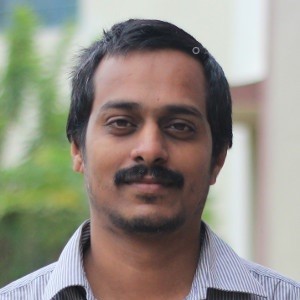
Phanindra Varma Jampana is an Associate Professor in the Department of Chemical Engineering at Indian Institute of Technology Hyderabad, India. His research focuses on compressed sensing, system identification, and stochastic differential equations, with applications to industrial process control and tomography. Education: Ph.D. in Process Control, University of Alberta (2004-2010) B.Tech. in Chemical Engineering, IIT Madras (2000-2004) His work spans electrical resistance tomography, image processing, and control systems optimization, with key contributions to particle filtering and homotopy optimization. Recent publications highlight applications in hydrocyclone air-core measurements and sparse-view tomography. Contact: pjampana@che.iith.ac.in
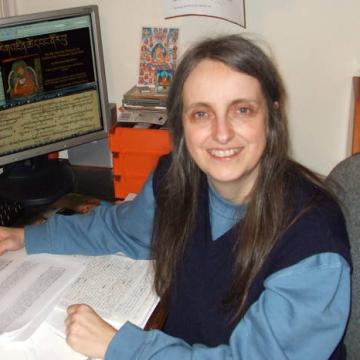
Cathy Cantwell is an Associate Professor and Associate Faculty Member at the Faculty of Asian and Middle Eastern Studies , University of Oxford, and a fellow at Wolfson College. Her research focuses on the rNying ma tantric tradition, critical editing of Tibetan texts, Dunhuang tantric manuscripts, and contemporary Tibetan ritual practices, particularly within the Dudjom gter ma tradition. She has extensively studied the works of Nyang ral Nyi ma’od zer and Gu ru Chos dbang, contributing to the AHRC-funded project on authorship and innovation in Tibetan revelatory traditions. Co-authored significant publications including Dudjom Rinpoche's Vajrakīlaya Works (2020) and A Noble Noose of Methods, the Lotus Garland Synopsis (2012). Teaches Issues in the Study of Tibetan Religion (Lecture series, 2020). President of the U.K. Association for Buddhist Studies (2015-2019), with earlier roles as Acting President and Secretary. Her scholarly work spans the analysis of Dunhuang Phurpa texts (2010), longevity rituals in Bon Phurpa tradition (2015), and methodological challenges in editing Mahāyoga texts from Dunhuang (2009). Publications include co-edited studies on the rNying ma'i rgyud 'bum and contributions to History of Science in South Asia and Journal of the Oxford Centre for Buddhist Studies . Her 2017 article on Rasāyana and bcud len practices explores Tibetan tantric medicine, while her 2019 work on sensory engagement in sgrub chen rituals bridges textual and experiential dimensions of Tibetan Buddhist practice. Key electronic publications include The Medicinal Accomplishment (sman sgrub) Practice in the Dudjom Meteoric Iron Razor Tradition (2015) and The Rig 'dzin Tshe dbang nor bu Edition of the rNying ma'i rgyud 'bum: An Illustrated Inventory (2002). Her research also addresses the transmission of Tibetan texts through manuscripts like the sGang steng-b rNying ma'i rgyud 'bum from Bhutan (2006).
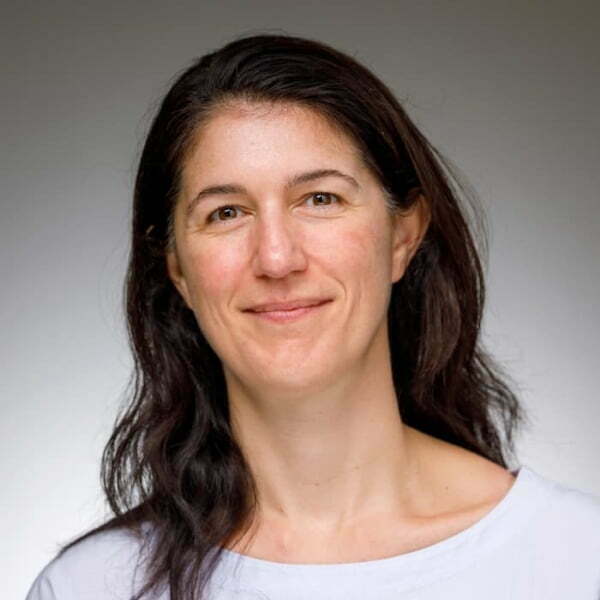
Grete Grindal Patil serves as Dean of the Faculty of Landscape and Society at the Norwegian University of Life Sciences (NMBU), where she holds a Professorship. Her leadership in Education Administration underscores her institutional role within Norway's premier agricultural and environmental sciences university. Her research centers on nature-health interactions , with dominant focus on dementia care through farm-based day services and therapeutic horticulture . She investigates how care farming environments impact emotional well-being, quality of life, and retention rates for dementia patients, while also examining nature exposure in offices for stress reduction and productivity. Her work spans environmental psychology , rehabilitation science , and green care interventions across diverse populations including stroke patients and office workers. Analysis of her 15 most recent publications (2016-2022) reveals three dominant research streams: (1) Farm-based dementia care protocols and stakeholder mapping in Norwegian contexts, (2) Nature exposure mechanisms for psychological distress reduction in workplaces, and (3) Green exercise accessibility and therapeutic horticulture applications in clinical rehabilitation. Her methodology emphasizes longitudinal studies, comparative analyses, and mixed-methods approaches focusing on Norwegian populations.
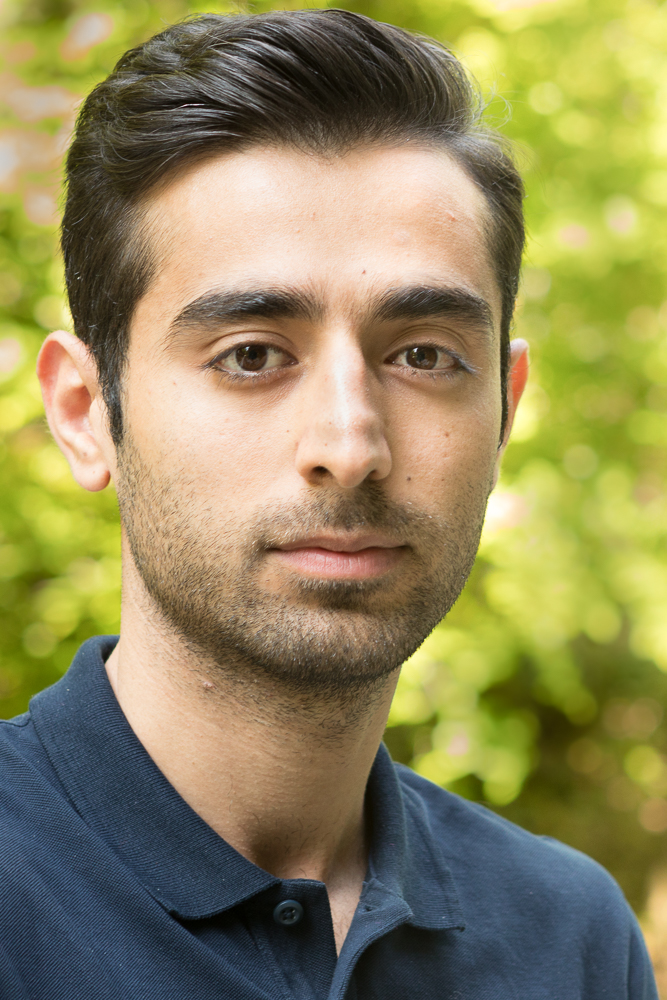
Michelle Karnes is a Professor at the University of Notre Dame in the Department of History and Philosophy of Science, with affiliations in Italian Studies. Her research bridges late medieval literature, philosophy, and religious studies through comparative analysis of Arabic and Latin traditions. Education: Ph.D. & M.A., University of Pennsylvania; B.A., University of California, Berkeley Her scholarship explores how medieval literature interacts with cognitive theories, particularly the role of imagination in religious meditations and marvel narratives. Karnes examines intersections between philosophical discourse and fictional storytelling , focusing on metaphor mechanisms and truth claims in medieval texts. Recent research trends include cross-cultural marvel studies (Latin West vs. Islamic World), cognitive mapping in travel literature, and philosophical fables as epistemological tools. Her 2022 book Medieval Marvels and Fictions challenges simplistic views of marvels as mere superstition, emphasizing their imaginative scrutiny demands. Scientific Awards Outstanding Faculty Mentor Award (2022) Karnes holds fellowships from Radcliffe Institute, Huntington Library, and Yale Institute of Sacred Music. She co-edits Studies in the Age of Chaucer and teaches courses on Chaucer, medieval romance, animal studies, and comparative literature.
Joanna Fountain is an Associate Professor in the Department of Tourism, Sport & Society at Lincoln University's Faculty of Environment, Society and Design. She serves as Theme Leader for the Centre of Excellence Lincoln University's Sustainable Tourism for Regions, Communities and Landscapes initiative and as Postgraduate Convenor for the Faculty. Her academic leadership extends to committee roles including membership on the Postgraduate Committee and previously on the Faculty Teaching Committee. PhD from Murdoch University, Perth, Australia BA from University of Canterbury, Christchurch, New Zealand As a social scientist, Fountain's research focuses on change and resilience in rural regions, particularly examining agrifood products within complex rural value chains from farm to market. Her work explores how local factors like regional networks and social capital interact with external influences including tourist flows, policy shifts, and natural hazards. She views agritourism and rural festivals as strategic tools for enhancing rural resilience, community networks, and tourist experiences. Her current research spans multiple industry contexts and regions including Kaikōura, North Canterbury, and Marlborough through externally-funded projects addressing disaster resilience, climate adaptation in wine regions, and eco-tourism development in blue economies. Her extensive publication record demonstrates consistent contribution to tourism and resilience scholarship, with recent work examining post-disaster recovery in Kaikōura, wine tourism in pandemic contexts, Chinese tourist behavior, and climate adaptation in agricultural regions. Her research integrates multiple disciplinary perspectives including human geography, rural sociology, and tourism studies. Fountain actively contributes to the academic community through committee service including Co-Leadership of the Tourism Risk, Recovery and Resilience Special Interest Group for CAUTHE, representation on the Lincoln University Chapter of CAUTHE, and editorial roles for the International Journal of Wine Business Research and the International Journal of Festival and Event Management. She regularly reviews for major tourism journals including Tourism Management and Journal of Sustainable Tourism. She supervises numerous graduate students working on diverse topics including Tibetan dance commodification, Chinese wine tourism development, food tourism in Suzhou, tourist resilience to natural hazards, and heritage food perceptions. Her completed supervision portfolio includes over 15 PhD and Master's students whose research spans tourism development across Asia, New Zealand, and beyond. Fountain leads multiple significant research initiatives including as Workstream Lead for 'Disaster Resilient Outcomes' in the Rural Research Theme of Resilience to Nature's Challenges II NSC, Senior Researcher for 'Enabling adaptation to interacting stressors: Climate, water, and wine' in the Deep South NSC, and Researcher for 'Growing eco-tourism in a blue economy' in the Sustainable Seas NSC.
Mojtaba Bemana is a researcher in the Computer Graphics department at the Max Planck Institute for Informatics, Saarbrücken, Germany, specializing in neural rendering, virtual reality displays, and computational photography. His work bridges computer graphics and vision with deep learning applications. His academic background includes: Ph.D. in Computer Science from Universität des Saarlandes and Max Planck Institute for Informatics (2018-2023) M.Sc. in Electrical Engineering from Sharif University of Technology, Iran (2014-2016), thesis: 'Novel view synthesis using the Light Field camera' supervised by Dr. Arash Amini B.Sc. in Electrical Engineering from Shiraz University, Iran (2010-2014) Dr. Bemana's research focuses on high dynamic range imaging , neural radiance fields , and perception-aware image processing . He develops novel techniques combining classical computer graphics with deep learning for real-time rendering, image quality assessment, and video enhancement. His methodology emphasizes perceptual accuracy and computational efficiency in virtual reality applications. Analysis of his 12 publications (2019-2025) reveals a strong trajectory toward diffusion-based HDR generation , real-time radiance field rendering , and self-supervised video processing . Key trends include the integration of physics-based models with neural networks for refractive effects, dual-exposure sensor optimization, and perceptual quality metrics that eliminate reference image dependencies. He actively contributes to the Saarbrücken Research Center for Visual Computing, Interaction and Artificial Intelligence (VIA) and the European Laboratory for Learning and Intelligent Systems (ELLIS Unit SAM), collaborating on cutting-edge visual computing projects within the Saarland Informatics Campus ecosystem.
Dr Bronwyn Howell is a Senior Lecturer at the School of Management, Victoria University of Wellington, where she serves as the undergraduate programme director for the BCom Management major. With a multidisciplinary background spanning Operations Research, Economics, Management and Public Policy, Dr Howell brings both academic expertise and practitioner experience from the information technology and health sectors to her teaching and research. Dr Howell's educational background includes: PhD in Management from Victoria University of Wellington (2016) MBA from Victoria University of Wellington (1998-1999) Her research focuses on the governance, policy and management of new technology projects, particularly mobile telecommunications and distributed ledger (blockchain) applications. Dr Howell examines decision-making under uncertainty, risk management, and the intersection with government funding, policy decisions and regulatory interventions. She has a particular interest in comparing technology project effects in small, remote and developing countries versus large, centralized economies, emphasizing how scale and distance impact outcomes. Her work adopts a systems view of interactions within projects, firms, industries and economies. Dr Howell's recent publications reveal a growing emphasis on telecommunications policy, AI regulation, and spectrum allocation issues. Her research increasingly addresses indigenous rights in spectrum allocation contexts and cross-cultural comparisons of technology adoption. She critically examines regulatory challenges in digital markets and the political influences on telecommunications and internet economy markets, often drawing comparisons between different national approaches. Dr Howell holds several notable professional positions: Law and Economics Association of New Zealand Fellow Secretary of the International Telecommunications Society Associate Editor of the Journal Telecommunications Policy Senior Research Associate of the Public Utility Research Center, University of Florida Adjunct Scholar at the American Enterprise Institute Research Principal at the Institute for Technology and Network Economics Dr Howell currently supervises doctoral research on topics including the carbon footprint of the New Zealand healthcare system, resilience in tourism SMEs, and stakeholder conflict in sports management. She has undertaken consulting projects for public and private firms in New Zealand and internationally, and has participated by invitation in forums and regulatory proceedings across multiple countries. Based at the Institute for Technology and Network Economics, Dr Howell also maintains research affiliations with the Public Utility Research Center at the University of Florida and the American Enterprise Institute in Washington, DC, where she blogs on technology policy matters. Her unique perspective is informed by residing on a lifestyle block in Te Horo on the Kapiti Coast, which grounds her understanding of the challenges of remoteness and small scale.
Lutz Kindler serves as a Lecturer at the University of Mainz and as a scientific Assistant at MONREPOS Archaeological Research Centre and Museum for Human Behavioural Evolution, part of the Leibniz Center for Archaeology. He has maintained these positions since 2004 and 2003 respectively, establishing himself as a prominent researcher in Paleolithic archaeology. Dr. Kindler earned his Master's degree in 2002 from the University of Cologne with studies spanning Prehistory and Early History, Ancient History, Geology/Paleontology, and Biology. He completed his doctorate in Prehistory and Early History at the University of Mainz in 2007. His academic credentials reflect the interdisciplinary nature of his research approach. His primary research interests encompass Taphonomy, Zooarchaeology, Paleolithic studies, Paleoecology, human evolution, Human ecology, and Nutrition and subsistence. Through meticulous analysis of faunal remains and stable isotope studies, Kindler has significantly advanced our understanding of Neanderthal hunting practices, landscape utilization, and adaptation to interglacial environments. His work demonstrates that Neanderthals possessed sophisticated ecological knowledge and hunting capabilities previously underestimated by scholars. Analysis of Dr. Kindler's publication record reveals a consistent focus on Neanderthal exploitation of large mammals, particularly straight-tusked elephants, and the reconstruction of Pleistocene environments through interdisciplinary approaches. His research at the Neumark-Nord site in Germany has been particularly influential, showing that Neanderthals actively hunted elephants weighing up to 13 metric tons during the Last Interglacial period. His methodological approach integrates zooarchaeology, stable isotope analysis, and GIS-based spatial analysis to reconstruct past human behaviors and ecological contexts. This comprehensive methodology has produced groundbreaking insights into Neanderthal social organization, suggesting either temporary aggregation in larger groups than previously believed or sophisticated methods of food preservation. Dr. Kindler's research has been conducted primarily at key Pleistocene sites in Germany, including Neumark-Nord, Balver Cave, and other locations that provide critical insights into Neanderthal adaptations during different climatic periods. His work challenges simplistic views of Neanderthals as cognitively inferior to modern humans, instead portraying them as sophisticated hunters with complex social structures and deep ecological knowledge.
Andrew D. Gross serves as Associate Professor in the Department of Semitic and Egyptian Languages and Literatures at Catholic University of America, Washington D.C., specializing in ancient Near Eastern languages and biblical textual analysis. His academic profile demonstrates deep engagement with Jewish legal tradition and scriptural interpretation. Dr. Gross earned his Ph.D. in Hebrew and Judaic Studies from New York University in 2006. His major publications include Continuity and Innovation in the Aramaic Legal Tradition (Brill, 2008) and The Temple Scroll: 11Q19, 11Q20, 11Q21, 4Q524, 5Q21 with 4Q365a (co-authored with Lawrence H. Schiffman, Brill, 2021). His research spans multiple interconnected domains: Ancient Near Eastern Languages Hebrew and Aramaic Linguistics Dead Sea Scrolls Analysis Jewish Legal Tradition (Halakha) Biblical Interpretation Methods Ancient Legal Systems Dr. Gross's scholarly work reveals a consistent focus on the intersection of religious authority and legal frameworks in ancient texts, particularly examining how divine revelation interacts with human legal interpretation in Rabbinic literature. His analysis of the Oven of Akhnai story demonstrates how competing views of divine authority in legal matters existed between mainstream Rabbinic tradition and the Qumran sect. His research methodology combines linguistic analysis with historical contextualization, particularly evident in his work on Aramaic legal documents and the Temple Scroll. This interdisciplinary approach bridges philology, religious studies, and legal history to illuminate ancient interpretive practices.
Marloes Penning de Vries is an Assistant Professor at the University of Twente's Faculty of Geo-information and Remote Sensing, specializing in satellite-based environmental monitoring. Her research bridges remote sensing technology with critical Earth system processes. Her research interests focus on Remote Sensing , Hydrology , and Environmental Health , with particular expertise in satellite applications for water cycle monitoring, air quality assessment, and climate-related health impacts. Her work integrates multi-sensor satellite data to address challenges in water resources management and atmospheric composition. Analysis of her publication record reveals strong thematic continuity in satellite geophysics and environmental monitoring , with increasing emphasis on interdisciplinary applications connecting hydrology, atmospheric science, and public health. Recent work demonstrates sophisticated integration of GRACE satellite data with traditional hydrological models and expanding applications in geohealth frameworks. Her professional trajectory shows progression from atmospheric chemistry foundations to broader Earth system science applications, maintaining consistent methodological expertise in satellite data processing while expanding into water resources and health applications.
Kris M. Kitani is an Associate Research Professor at the Robotics Institute of Carnegie Mellon University and a Research Scientist at Meta's Artificial Intelligence division. He co-directs the Extended Reality Technology Center (XRTC) at CMU and holds courtesy appointments in the Electrical and Computer Engineering Department at CMU and as a Guest Professor at the University of Tokyo's Institute of Industrial Science. Education : BS in Electrical Engineering (University of Southern California), MS and PhD in Computer Science (University of Tokyo) Labs : Cognitive Assistance Laboratory His research focuses on computer vision , human activity forecasting , and inverse reinforcement learning with applications in human-centered robotics and assistive technologies . Recent work explores 3D scene understanding , multi-modal sensing , and generative models for physical simulation . Publications analyze pedestrian interaction modeling , human pose estimation , and zero-shot learning for robotic applications. Scientific Awards : Marr Prize Honorable Mention, ICCV 2017 Best Paper Honorable Mentions at CHI 2017/2020 Best Papers at W4A 2017/2019 Best Application Paper, ACCV 2014 Kitani has advised 8 current PhD students and 18 past PhD/MSc students. He has taught graduate-level courses in Computer Vision and Statistical Techniques in Robotics since 2013. The lab develops autonomous systems for real-world perception and interactive decision-making.
Dr. Min Xu is a Professor at the School of Electrical and Data Engineering (SEDE) within the Faculty of Engineering and Information Technology at the University of Technology Sydney (UTS). She leads the Visual and Aural Intelligence Laboratory at UTS's Global Big Data Technologies Centre (GBDTC). Her research focuses on multimedia, computer vision, and machine learning, with recent emphasis on machine learning algorithms for data analytics, computer vision applications, and CV/RF integrated sensing for healthcare and smart homes. Education: Doctorate of Philosophy, University of Newcastle, Australia Master of Computing, National University of Singapore Bachelor of Engineering, University of Science and Technology of China Dr. Xu has authored over 250 publications in top-tier venues like IEEE T-PAMI and CVPR, secured over $5M in research funding since 2018, and holds editorial roles at IEEE Transactions on Multimedia and Neurocomputing. Her work bridges theory and application, addressing challenges in multi-modality data fusion, personalized services, and affective computing. Key Contributions: Pioneer in multimedia affective/semantic analysis and multi-modality fusion Developed frameworks for privacy-preserving cross-domain recommendation and WiFi-based human tracking Recipient of ARC Future Fellowship (2018–present) She supervises PhD and Master’s students and teaches courses including Image Processing and Cloud Computing. Current projects emphasize AI-driven healthcare solutions and multimodal AI search engines.
Mark Schiefsky is the C. Lois P. Grove Professor of Classics and Director of the Center for Hellenic Studies at Harvard University. His research focuses on the history of ancient philosophy and science, particularly in the domains of medicine, mechanics, and Graeco-Arabic intellectual transmission. He is a leading figure in digital humanities, having developed the Arboreal software for semantic network analysis of textual corpora, and led major projects like the Archimedes Project (NSF-funded) and the Mellon Foundation corpus initiative. His work bridges classical antiquity with later reception, including Renaissance commentary on ancient mechanics and Arabic translations of Greek texts. Schiefsky’s publications span critical editions, historical analyses, and interdisciplinary studies in natural language processing applied to ancient texts. Roles: Classics Faculty, Harvard University Key Projects: Arboreal software, Graeco-Arabic Translation Movement studies Recent Work: Digital humanities methodologies for conceptual history His research interests include the interplay between philosophy and science in antiquity, with a focus on techne (art/craft expertise) as a conceptual framework. He also explores the reception of Greek thought in Arabic and Renaissance contexts, emphasizing how scientific and philosophical ideas were transmitted and transformed across cultures. Publications highlight technical studies of ancient texts (e.g., Philo of Byzantium’s artillery treatises, Galen’s anatomical theories) alongside methodological innovations in digital scholarship. His 2005 book on Hippocrates’ On Ancient Medicine remains a foundational text in the field.
James Tompkin is an Associate Professor in the Department of Computer Science at Brown University, specializing in visual computing. His research focuses on computer graphics, computer vision, and human-computer interaction, with an emphasis on techniques for image/video creation, editing, analysis, and interaction. His lab develops methods for scene reconstruction (especially from multi-camera systems), dynamic scene modeling, and applications in 2D, multi-view, and VR/AR displays. Research interests include neural radiance fields (NeRFs), Gaussian splatting, time-of-flight sensing, and generative adversarial networks (GANs). He has collaborated extensively with industry partners (Adobe, Amazon, Meta) and received funding from NSF, DARPA, NASA, and UK/EPSRC. His work is disseminated via top-tier venues like CVPR, SIGGRAPH, and ECCV. Teaching includes visual computing topics, and his lab maintains active projects on GitHub and project webpages. Office hours are held weekly, with scheduling via Google Calendar integration.
Sebastian Wohner is a researcher at the Chair of Computer Graphics and Visualization (Prof. Westermann) at the Technical University of Munich. His work focuses on advanced visualization techniques, machine learning applications in graphics, and GPU-accelerated algorithms for 3D design and simulation. He actively contributes to projects such as the NVIDIA CUDA Research Center and ERC-funded initiatives like SaferVis and realFlow, emphasizing real-time liquids and safer visualization systems. His research interests span 3D Gaussian splatting, topology optimization, neural fields for statistical dependencies, and spatio-temporal flow visualization. He has pioneered methods for compressing meteorological ensembles and accelerating novel view synthesis in consumer devices. Wohner also explores GPU-based linear algebra optimizations and efficient rendering techniques for ribbons and twisted lines. In teaching, he leads courses on game physics, visual data analytics, deep learning in computer graphics, and topology optimization. Notable contributions include the development of the Particle Engine and Bunny Demo applications, as well as advancements in differentiable rendering and robotic perception systems. His work bridges theoretical foundations with practical implementations in both academia and industry.