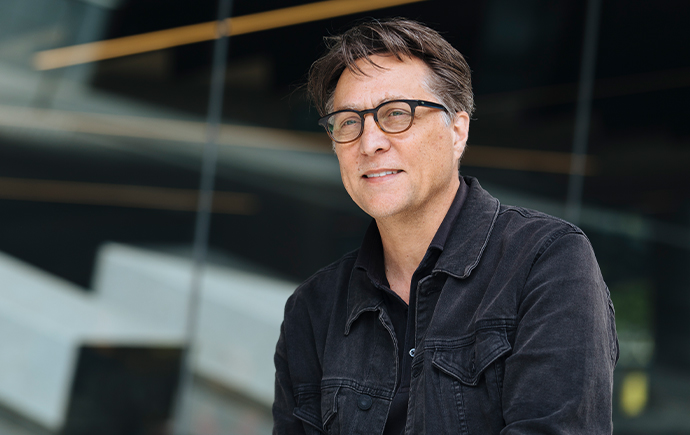
Greg Heffernan, known as 'Cosmo D,' is a Lecturer in Game Development at the NYU Game Center. He combines a background in cello performance, audio engineering, and composition with game design since 2013. His work emphasizes creativity, agency, mystery, and music, producing atmospheric and dreamlike games. Notable achievements include Tales From Off-Peak City Vol.1 (IGF Finalist, 2020) and The Norwood Suite (A.Maze Best Longform Game, 2010s standout). He actively participates in game development communities, organizing playtest events and mentoring through NYU’s programs. Key Roles: Game Developer, Educator, Sound Designer Teaching Focus: Prototyping, narrative-driven games, and audio integration His games blend experimental storytelling with technical innovation, reflecting a cross-disciplinary approach to interactive media.
Dr Vince Dziekan is a Senior Lecturer in the Department of Design at Monash University, Australia. He holds academic leadership roles including former Associate Dean (Research), Associate Dean (Education), and Head of Multimedia & Digital Arts. His research focuses on curatorial practices at the intersection of design, creative technology, and museum culture. He has supervised over 40 PhD and Master’s students and developed innovative programs such as the Prato Academy. Education: PhD in Art & Design, Monash University (2009) MA in Art & Design, Monash University (1996) Graduate Diploma in Education, University of Melbourne (1989) Diploma of Fine Arts, Emily Carr Institute of Art & Design (1986) Research Interests: Curatorial design, museum technology, digital humanities, new media art, and speculative design. His work bridges academic research with curatorial practices, including exhibitions at international venues like ISEA2009 and ISEA2011. Recent Projects: Co-leads ASSEMBLY (museum collaboration initiative) and Future Museum (Austria). Involved in accessibility research for museums (e.g., Bendigo Art Gallery project). Editor of key publications including the Routledge Handbook of Museums, Media and Communication . Labs/Initiatives: Sensilab (interdisciplinary research lab), Institute for Digital Culture (Honorary Research Fellowship), and MWX (Museums and the Web exhibition initiative).
Joshua Clayton is a Clinical Professor of Computer Science at New York University's Department of Computer Science, part of the College of Arts and Science. He holds an MPS in Interactive Telecommunications from NYU (2011) and a BFA in Graphic Design from Western Michigan University (2001). His work bridges art and technology, focusing on computational creativity, web-based art, and interactive media. Education: MPS, Interactive Telecommunications, NYU (2011) BFA, Graphic Design, Western Michigan University (2001) Research Interests: Digital media, generative art, spatiotemporal data visualization, and the expressive potential of code in web design. His creative projects explore intersections between computational logic and artistic expression. His artistic works include Codex Lucida (spatiotemporal metadata interfaces), Polychromatics (procedural color composites), and Locative Waves (GPS-driven sound installations). Clayton has taught extensively since 2011, covering introductory programming, web design, and specialized topics like Drawing on the Web . While no formal awards are listed, his contributions to teaching and digital art practice are central to his profile. He advises via his course development and creative projects rather than traditional academic supervision.
Dafna Naphtali is a Visiting Assistant Professor of Music Technology at the Steinhardt School of Culture, Education, and Human Development at New York University. She holds an M.M. in Music Technology and a B.Mus. in Vocal Performance from NYU. Prior to her full-time role starting Fall 2024, she served as adjunct faculty at NYU for over 25 years, specializing in teaching music technology, Max programming, electronic music performance, and soundwalking. Her artistic practice focuses on experimental, interactive electro-acoustic music , incorporating custom computer programming (Max) for live processing of acoustic instruments and voice. Notable projects include works with music robots, Disklavier pianos, and site-specific soundwalks. Collaborations include duos with artists like Luis Tabuenca, Chuck Bettis, and NYU faculty members Gordon Beeferman and Hans Tammen, culminating in her DUOS++OCTET ensemble performance at Roulette Intermedium, supported by a Guggenheim Fellowship. Awards & Fellowships: Guggenheim Fellowship (Music Composition, 2023) 3-time NY Foundation for the Arts Fellow Residencies at MacDowell, Kimmel Harding Nelson, and other institutions Grants & Projects: Guggenheim-supported work on Live Processing & Improvisation (forthcoming book, Taylor & Francis, 2026) Collaborative performances with international artists and ensembles Her research bridges technology and experimental music performance , emphasizing live processing, improvisation, and interdisciplinary sound art.
Dr. Elinor Carmi is a Senior Lecturer in Data Politics and Social Justice at the Department of Sociology & Criminology , School of Policy and Global Affairs , City, University of London . She is also the Co-Director of the MSc Data, Policy and Society and serves as Associate Dean for Postgraduate Research. Her research sits at the intersection of data politics, digital rights, feminist media studies, and social justice, with a strong focus on data literacies, disinformation, and platform governance. Dr. Carmi holds a PhD from Goldsmiths, University of London, an M.A. from Tel Aviv University, and a B.A. from College of Management Academic Studies, Israel. Her academic journey includes postdoctoral and teaching roles at the University of Liverpool, Royal Holloway, and Goldsmiths. Her research interests span data citizenship , critical data studies , feminist critiques of digital consent , algorithmic accountability , and sound studies as a framework for understanding media power. She has developed key concepts such as processed listening and rhythmedia to analyze how platforms like Facebook engineer sociality and filter behavior. Her recent work emphasizes resistance to big tech, digital inclusion, and the development of societal immunity to misinformation. Her publications and funded projects reveal a strong trend toward interdisciplinary, policy-relevant research. She has led and collaborated on major grants from UKRI, ESRC, Nuffield Foundation, and Google, focusing on digital living standards, fake news immunity, and responsible AI education. Her recent articles explore feminist epistemologies in media, cyber espionage (e.g., Pegasus), and the political use of chatbots. Expert Member, UK Information Commissioner’s Office (ICO) Technology Advisory Panel (2024–present) Trustee, Media and Information Literacy Alliance (2024–present) Open Fellow, Weizenbaum Institute (2024) Parliamentary Academic Fellow, POST (2021–2023) Academic Editor, Internet Policy Review Dr. Carmi is an active public intellectual, advising organizations such as WHO, UNESCO, Amnesty International, and the Royal Society. She has testified before the UK House of Lords and contributed to high-impact policy reports, including the WHO’s Public Health Research Agenda for Managing Infodemics . She mentors PhD students and leads collaborative research teams focused on digital equity and resistance. She is also involved in public engagement, frequently appearing in media and delivering talks at institutions like MIT. Her work bridges academia, policy, and activism, with a clear commitment to democratizing data and challenging structural inequalities in digital systems.
Dylan Cawthorne is an Associate Professor at the Maersk Mc-Kinney Moller Institute, University of Southern Denmark (SDU), and a key member of the SDU UAS Center. His work integrates engineering, ethics, and societal impact, particularly in the domain of unmanned aircraft systems (drones). He actively contributes to interdisciplinary research, public discourse, and academic collaboration. Research Interests: Dylan's research centers on the ethical and environmental implications of drone technology. He investigates drone noise pollution, its effects on wildlife and human health, and advocates for value-sensitive design in early-stage engineering. His work emphasizes nonmaleficence, ethical principles, and human-centered technological development. The recent publications reflect a strong trend toward interdisciplinary inquiry, combining engineering innovation with ethical reasoning and environmental responsibility. His work spans topics such as drone-wildlife interactions, noise management, and public health applications of technology. Scientific Awards: No formal awards listed in the provided text. Advising and Grants: Dylan collaborates with multiple researchers and students, many of whom are co-authors on his publications. He is a project participant in the 'Citizen Science talent programme,' a research initiative focused on engaging gifted students in digital media and natural sciences. His advising role is evident through collaborative work with early-career researchers in public health and drone technology. Labs and Teams: He is affiliated with the SDU UAS Center, a research hub dedicated to unmanned aircraft systems, and contributes to the Maersk Mc-Kinney Moller Institute’s broader robotics and AI initiatives. He participates in events such as the International Conference on Social Robotics + AI and 'Drones for Good,' highlighting his engagement with ethical technology communities.
Bart Hengeveld is an Assistant Professor at Eindhoven University of Technology's Department of Industrial Design, specializing in the 'body language' of the Internet of Things and the role of sound in computational technologies. His research focuses on how embedded systems present themselves appropriately in human environments, with particular attention to tangible user interfaces (TUIs), social interaction design, and data embodiment. Academic Background: BSc/MSc in Industrial Design Engineering from Delft University of Technology (2003), PhD at TU/e (2011) Key Roles: Member of the ACM TEI Steering Committee, Program Chair of TEI’16 in Eindhoven Teaching: Awarded two Teacher of the Year titles, oversees courses like 'The Sound of Smart Things' and 'From Idea to Design' Research Interests emphasize sound as a communication medium for ubiquitous technologies, including projects on public displays for nursing homes (R2S system), pedestrian trajectory sonification, and embodied passwords. His work bridges design, computer science, and social sciences, with over 50 publications in venues like TEI, CHI, and Creativity & Cognition. Notable Projects: LOOP (physical data artifact), Slots-Memento (intergenerational storytelling), and LinguaBytes (language learning for toddlers) Awards: Multiple teaching accolades for innovative pedagogy Current affiliations include the Future Everyday research cluster and the Making With… group, exploring speculative design and embodied interaction paradigms.
Christopher Tonkin is a Senior Lecturer at the Conservatorium of Music, The University of Western Australia, specializing in music composition, electronic music, and sound design. He holds a BMus from the University of Western Australia, a MusA from Hous (likely a typo, likely Houston), and a PhD from UCSD. Since 2008, he has taught composition, electronic music, and screen/video game sound design. Key roles include Chair of Composition Studies (2008–2018), Chair of Electronic Music and Sound Design (2016–present), and Graduate Research Coordinator (2016). Research interests focus on algorithmic computer music, live electronics, and interdisciplinary collaborations. Notable projects include the 2016 launch of the Electronic Music and Sound Design major and collaborations with institutions like the Nouvel Ensemble Moderne and IRCAM. Recent works include the 2025 critical edition of Roger Smalley's *Transformation* and multimedia installations like *Get Pasted* (2022) and *Colour Warp* (2021). Current projects involve generative ambient video game music (2023–present) and a score edition of Smalley's *Transformation* (anticipated 2024–2025). Teaching responsibilities include coordinating the EMSD major and supervising postgraduate students.
Peter Reichl is a Professor in the Faculty of Computer Science, leading the Research Group Cooperative Systems. His work spans interdisciplinary research in Human-Computer Interaction, IoT systems, and Digital Ethics. He actively contributes to the UN Sustainable Development Goals through innovative technology solutions. Key projects include the European Distributed Data Infrastructure for Energy, COMPASS, and symbIoTe. Research interests include mobile computing, tangible interfaces, quantum computing education, and ethical implications of digital transformation. Over 134 publications since 2008 reflect his work in music technology, IoT frameworks, and socio-technical systems analysis. Recent articles highlight creative tech solutions like LEGO-based music sequencers and philosophical explorations of Digital Humanism. He has organized major events like the Dagstuhl Workshop on Quality of Experience (QoE Vadis?) and contributed to policy discussions on digital democracy in Austria. Key Projects: symbIoTe (2016-2018), COMPASS (IoT solutions), European Energy Data Infrastructure (2023-2025) Notable Activities: Panellist on Digital Transformation Ethics (2024), Poster Presenter for Muco app (2022) Labs/Teams: Research Group Cooperative Systems focuses on IoT interoperability and human-centered tech design.
Tomi Knuutila is a University Lecturer at the Faculty of Art and Design, University of Lapland. His research focuses on simplicity in interactive art, spatial interaction design, and alternative game design. He teaches in the Audiovisual Media Culture program, specializing in Media Science, Multimedia, and Moving Image studies. Core roles: Senior Lecturer, Curriculum Designer (UBIQ program) Key networks: DAMA Media & Dance collaboration, UArctic Digital Media Arts Research interests span physical computing, sensor-based interaction, and history of new media. Active in international teaching across Scandinavia and beyond. Recent projects include: Virtual Production Studio Technologies (2023-2025) AI & Robotics in Art (2019-2020) Teaching emphases include animation, microprocessors, and prototyping methodologies.
Professor Elise Payzan is a leading academic in neurofinance and behavioral economics at the University of New South Wales Business School, where she holds a position in the School of Banking and Finance. Her research bridges finance, neuroscience, and experimental economics to investigate how humans perceive and react to financial risks through theoretical and experimental methodologies. Her educational background includes a PhD in Finance from the Swiss Finance Institute at École Polytechnique Fédérale de Lausanne, with prior studies at the London School of Economics and Princeton University. She holds a diploma as Engineer Statistician from ENSAE Paris and graduated from École Normale Supérieure de la rue d'Ulm, Paris. She joined UNSW Business School in September 2010 and served as a visiting associate at the California Institute of Technology from 2010-2013. Payzan's research program focuses on the neurobiological foundations of financial decision-making, examining phenomena like 'outlier blindness' where humans neglect extreme risks due to neural coding constraints. Her work integrates decision neuroscience, experimental economics, and financial economics to reveal how cognitive mechanisms shape market behaviors. Current investigations explore craving mechanisms for monetary rewards, ambient sound effects on risk perception, and neural adaptations to extreme risk events. Her publication trends demonstrate consistent interdisciplinary innovation, with recent work (2022-2024) increasingly connecting laboratory findings to field data in financial markets. Key themes include neural representations of uncertainty, risk perception distortions after extreme events, and neuroscientific approaches to generating investment alpha. Her research methodology combines controlled laboratory experiments with real-world market analysis. Payzan actively engages with public audiences through TEDxSydney (2016) and BX2018 Conference presentations, with media features in ABC TV and financial publications. She teaches Behavioral Finance (FINS3655) and supervises research in neurofinance. Her UNSW Scientia Research Grant (A$170,000, 2017-2024) supports ongoing investigations into human risk perception mechanisms.
Dr. George Meikle is a Senior Lecturer in Music Production at the University of Salford, specializing in electronic/computer music and human-computer interaction (HCI) in music. His work spans generative music systems, interactive digital media, and sound design. He holds a PhD from the University of Salford, focusing on interactive computer music systems, alongside an MA and BA in music-related disciplines. Education: PhD in Music (2013–2017): "Towards the Realisation of a fully integrated Interactive Computer Music System (ICMS)" MA in Music (2011–2012) BA in Popular Music and Recording (2008–2011) Research interests include algorithmic composition, interactive systems for music, and the application of Markov chains in generative tools. His work often bridges music technology with environmental and community-focused art, as seen in projects like An UnSound Environment and Together Un/Tethered . Major projects include the development of gtm.markov software for generative audio systems and collaborations with interdisciplinary teams on immersive performances. His research has been showcased in software releases, live performances, and academic journals. Notable contributions include: Generative music software tools (e.g., gtm.humaniser , gtm.4Live ) Interactive systems for live music performance Eco-acoustic sound installations
Warren Fearn is an Associate Professor at York St John University and a Postgraduate Researcher in the School of Arts and Creative Technologies at the University of York . He straddles creative industries and academia, leading postgraduate programmes while pursuing a PhD that explores how augmented reality (AR) can enrich primary science education. Education & Career Path: MA in Furniture Design, Bucks University Freelance designer with Pentland Centre on European women’s footwear 3D graphics specialist at Alias Wavefront Virtual Set Designer, BBC VR Studios London 3DFX department contributor, BBC (Horizon, CBeebies, National Geographic) Research Focus: Dr Fearn’s scholarship centres on augmented reality , extended reality (XR) , and service design methodologies to overcome barriers to AR adoption in UK primary schools. His work combines immersive 3D graphics expertise with pedagogical insight to design meaningful AR experiences that support Key Stage 2 science curricula. Across his recent publications and keynote talks—including a TEDxDoncaster talk and contributions to Teaching and Learning with Technologies in the Primary School (Routledge)—a clear trend emerges: leveraging service-design thinking to align AR tools with teacher workflows, pupil engagement patterns, and curriculum objectives, thereby accelerating mainstream uptake of XR technologies in classrooms. Awards & Recognition: Promax Award (BBC 3DFX projects) Emmy Award nomination Grants & External Engagement: Unreal Mega Grant (2019) – exploring AR for primary science education Keynote & invited speaker: TEDxDoncaster 2024, Animex Festival 2024, Pint of Science 2024 Media coverage: BBC Sounds, York Press, That’s York TV Warren Fearn currently advises postgraduate students at York St John University while developing funded AR prototypes that bridge classroom and remote learning environments.
Dr. Anna Felicity Bramwell-Dicks is a Senior Lecturer in Interactive Media and Subject Head of Creative Technologies at the University of York's School of Arts and Creative Technologies. She holds a PhD in Computer Science and has extensive experience in interdisciplinary research focusing on accessibility, disability representation, and the intersection of technology, music, and health. Her roles include teaching programming, empirical methods, and supervising projects in interactive media. Education: B.Sc. in Electronic Engineering with Music Technology Systems (2004), M.Sc. in Human-Centred Interactive Technologies, and PhD in Computer Science from the University of York. She has held roles as a Research Associate in Computer Science and worked on EU and Innovate UK-funded projects like SoundTact and Co-Musicate. Research interests include multimodal sensory substitution, disability representation in storytelling formats (e.g., video games, VR), and the psychological impact of music. She actively collaborates with disabled communities, advocating for inclusive design principles. Recent projects include the SoundCeption app for blind users and the 'Destigmatising Disability in Past, Present and Future Stories' initiative. Teaching includes modules like Experience Evaluation and Disability, Accessibility, and Representation in the Creative Industries . She supervises 5 PhD students and has co-authored publications on topics ranging from VR prosocial behavior to web accessibility tools. Notable awards include the Best Paper Award at BCS-HCI 2022. Her work extends to organizing conferences like the Sound and Music for Immersive Storytelling (SAMIS) and co-investigating projects bridging film/TV industries with game-based learning.
Mr. Sam Leak serves as Senior Lecturer in Music Performance (Practice) at Middlesex University's School of Arts. As a London-based Jazz Pianist , he combines academic research with active performance, focusing on areas like livestreamed music analysis , absolute pitch education , and jazz improvisation . His work bridges practice-based research with empirical studies of contemporary music consumption. Research Focus : Leak's academic output spans music technology (2021 UK livestreaming studies), jazz pedagogy (absolute pitch papers 2017-2019), and performance ecology (festival appearances). His creative practice includes 15+ albums and live recordings from 2014-2019, featuring collaborations with artists like Dan Tepfer and Johannes Ludwig. Performance Trends : Analysis of his discography reveals consistent exploration of jazz trio dynamics (2014-2019), transnational collaborations (Italy 2015, Germany 2018), and genre experimentation (electronic-jazz fusion 2019, classical cross-pollination 2014 Steinway festival performance).