

Dr. Balaraman Ravindran is a Professor and Head of the Department of Data Science and Artificial Intelligence (DSAI) at IIT Madras. He also leads the Robert Bosch Centre for Data Science & Artificial Intelligence (RBCDSAI) and the Centre for Responsible AI (CeRAI). His research focuses on reinforcement learning, geometric deep learning, and ethical AI deployment. Education includes a PhD from the University of Massachusetts Amherst (2004) and MSc from the Indian Institute of Science, Bangalore (1996). He holds prestigious fellowships from AAAI and INAE, and is an ACM Distinguished Member. Key contributions include work on class imbalance learning (e.g., TODUS algorithm) and applications in healthcare, transportation, and social networks. He has advised over 20 students and secured grants from Google, TCS Research, and others. Labs/Teams: Heads RBCDSAI and CeRAI, collaborates with TCS Research and Google.
جستجوی استاد راهنمای دانشگاهی
برای مسیر پژوهشیتان، استاد راهنما، استاد دانشگاه و پژوهشگر مناسب را پیدا کنید و با آنها ارتباط بگیرید.
نمایش ۱-۱۵ از ۱۷ استاد راهنما
اطلاعات پروفایلها از صفحات عمومی دانشگاهها گرفته شده و ممکن است بهروز نباشد.
Shivaram Kalyanakrishnan is an Associate Professor at the Department of Computer Science and Engineering , Indian Institute of Technology Bombay , specialising in Artificial Intelligence and Machine Learning . His research spans sequential decision making , multiagent learning , multi-armed bandits , and humanoid robotics , with applications in robot soccer , computer games , and online advertising . He teaches advanced courses like CS 747: Foundations of Intelligent and Learning Agents and CS 748: Advances in Intelligent and Learning Agents , focusing on end-to-end system design and theoretical analysis. His scientific awards include the Best Student Paper Award at RoboCup International Symposium 2006 and nomination for Best Student Paper Award at AAMAS 2007 . His work on reinforcement learning and policy iteration has been published in leading venues such as IJCAI , ICML , and COLT , with recent contributions to railway scheduling and bandit algorithms. While no explicit list of advisees is provided, his research projects and publications suggest mentorship of students in collaborative efforts. Contact : shivaram@cse.iitb.ac.in .
Vineeth N Balasubramanian is a Professor in the Department of Computer Science & Engineering at the Indian Institute of Technology Hyderabad, with affiliate faculty status in the Department of Artificial Intelligence. His research focuses on the intersection of deep learning, machine learning, and computer vision, emphasizing explainability, robustness, and real-world applications. He leads Lab 1055, which investigates problems such as Explainable and robust AI/ML systems Lifelong learning in evolving environments Multimodal vision-language models Applications in agriculture, autonomous navigation, and human behavior analysis His recent work includes causal reasoning in transformers, vision-language model capabilities, and drone-based object detection. Funded by organizations like Google, Microsoft, Intel, and DST, he has received multiple awards including the World's Top 2% Scientists (2022-23), INSA/INAE Fellowships, and Best Paper recognitions. Lab 1055 collaborates with institutions like CMU, UBC, and Monash University, contributing to cutting-edge advancements in AI.
- Deep Learning
- Machine Learning
- Computer Vision
- +۸ مورد دیگر
Kishalay Mitra is a Professor at the Indian Institute of Technology Hyderabad , with affiliations to the Department of Chemical Engineering , Department of Climate Change , and Department of Artificial Intelligence . He also holds visiting professorships at Washington University in St. Louis and University of Washington, Seattle . His work in the Global Optimization & Knowledge Unearthing Laboratory (GOKUL) spans interdisciplinary optimization, machine learning, and their applications in industrial-scale engineering problems. Education : Ph.D. from IIT Bombay. Research Interests : Mitra's research focuses on optimization under uncertainty , surrogate modeling , multi-objective optimization , and integrating machine learning with physics-based models . His work addresses real-world challenges in wind energy , bioenergy supply chains , chemical process control , nanoscience , and environmental modeling (e.g., PM10 spatiotemporal analysis, forest fire prediction, and carbon capture). Article Trends : His recent publications emphasize wind energy systems (layout optimization, yaw control, forecasting), materials science (precipitate growth prediction, polymerization), and industrial processes (crystallization, grinding circuits). Techniques include neural operators , Bayesian optimization , generative adversarial networks (GANs) , and explainable AI .
Pranamesh Chakraborty serves as an Assistant Professor in the Department of Civil Engineering at the Indian Institute of Technology Kanpur (IIT Kanpur), where he specializes in Transportation Engineering with expertise spanning Intelligent Transportation Systems, Machine Learning, Big Data Analytics, and Naturalistic Driving Studies. Faculty position: Assistant Professor, Department of Civil Engineering Academic qualifications: PhD from Iowa State University (2019), M.Tech from IIT Kanpur (2014), B.E. from IIEST Shibpur (2012) Previous appointments: Assistant Professor at Techno India University and KIIT University Dr. Chakraborty's research program focuses on developing innovative computational approaches to transportation challenges, with particular emphasis on applying machine learning techniques to traffic management, incident detection, and policy analysis. His work bridges civil engineering principles with cutting-edge data science methodologies. Analysis of his publication record reveals a consistent research trajectory centered on data-driven transportation solutions, with increasing emphasis on deep learning applications and real-world policy implications. His work demonstrates strong interdisciplinary integration across engineering, computer science, and urban planning domains. Research Excellence Award, Iowa State University, 2019 Best Student Paper, TRB Managing Roadways and Transit Together Conference, Seattle, 2018 Student Essay Competition Winner, ITS America, San Jose, 2016 Academic Excellence Award, Indian Institute of Technology Kanpur, 2013 Dr. Chakraborty maintains an active research program with multiple publications in high-impact transportation journals. His previous experience includes serving as a Graduate Research Assistant at Iowa State University and teaching positions at multiple Indian institutions before joining IIT Kanpur.
Karthik P. N.مشاهده پروفایل
استادیار
Karthik P. N. is an Assistant Professor in the Department of Artificial Intelligence at the Indian Institute of Technology Hyderabad (IIT Hyderabad). He previously served as a Research Fellow at the Institute of Data Science, National University of Singapore (NUS), and completed his Ph.D. and Master of Science (Engineering) at the Department of Electrical Communication Engineering, Indian Institute of Science (IISc), Bengaluru, under the guidance of Prof. Rajesh Sundaresan. Earlier, he worked as a Project Assistant in Prof. Chandra R. Murthy's lab at IISc and earned a Bachelor of Engineering in Electronics and Communications from R V College of Engineering, Bengaluru. Ph.D., Electrical Communication Engineering, IISc Bengaluru M.Sc. (Engineering), IISc Bengaluru B.E., Electronics and Communications, R V College of Engineering His research focuses on Probability Theory, Detection and Estimation Theory, Markov Decision Processes , and Multi-armed Bandits , with applications in Federated Learning, Differential Privacy, Reinforcement Learning, Information Theory , and Statistics . Recent work explores optimal strategies for best arm identification in restless bandits and privacy-preserving machine learning. He has received high instructor ratings for courses like Stochastic Processes and Programming for AI , and was honored with the Faculty Teaching Excellence Award 2025 at IIT Hyderabad. His Google Scholar articles highlight advances in 3D point cloud security, railway accident prevention, and vision-language model robustness . Scientific awards include the Faculty Teaching Excellence Award 2025 and First place in the INAE Kanpur Chapter 100 Seconds Competition (2021) . He collaborates with researchers like Prof. Vincent Y. F. Tan and Prof. Yeow Meng Chee, and has served on technical program committees for conferences such as APWDSIT 2025 and ISIT 2025 . Teaching roles at IIT Hyderabad involve graduate-level courses on Probability and Stochastic Processes , cross-listed with Electrical Engineering.
Professor K. Muralidhar of the Department of Mechanical Engineering at Indian Institute of Technology Kanpur specializes in fluid dynamics, thermal sciences, and optical imaging techniques. With over 35 years of academic leadership, his work bridges experimental and computational approaches in transport phenomena. PhD from University of Delaware (1985) 20+ Doctoral students supervised 500+ Publications across 13 research areas Fellow of ASTFE, NAS, and INAE His key research domains include: Drop dynamics on hydrophobic surfaces Heat transfer in porous media Crystal growth visualization Biofluid mechanics in vascular systems Advanced tomographic imaging Cryogenic flow modeling Recent work focuses on CO2 sequestration , solar desalination , and non-invasive medical diagnostics , with significant contributions to Physics of Fluids and International Journal of Heat and Mass Transfer . Scientific awards highlight his global recognition: 2019: Fellow-ASTFE 2014: Keynote speaker, International Heat Transfer Conference 2006: INAE Fellowship 1995: Institution of Engineers Prize 1981: IIT Madras Institute Medal Pioneering optical measurement techniques for convection and phase change processes, he has developed novel approaches in schlieren tomography, interferometry, and digital holography. His laboratory's patent portfolio includes medical devices and fluid control systems.
- Fluid Dynamics
- Heat Transfer
- Thermal Sciences
- +۶ مورد دیگر

Dinesh Acharya U serves as a Professor in the Department of Computer Science and Engineering at Manipal Institute of Technology, Manipal University. His academic leadership spans both foundational computer engineering and interdisciplinary medical applications, with research output consistently growing since 2006. Current affiliations include active roles at the School of Computer Engineering with verified ORCID profile (0000-0002-0304-4725) and institutional webpage. Research interests prominently feature Machine Learning (68% fingerprint weight), Data Mining (40%), and Medical Informatics applications. His work bridges computer science with healthcare challenges, particularly in neonatal sepsis detection, diabetic complications, and low-resource language processing. The research fingerprint shows strong emphasis on prediction (52%), algorithms (53%), and India -specific healthcare contexts (40%). Publication trends reveal accelerating output since 2018, with 12 papers in 2022 and continued productivity through 2025. Recent work demonstrates interdisciplinary convergence, particularly in Medical AI (neonatal sepsis, diabetic kidney disease) Natural language processing for low-resource languages Transformer-based architectures across domains Notable patterns include increasing clinical collaborations and emphasis on practical implementation tools. Professional recognition includes an h-index of 13 with 596 citations across 71 research outputs. Key distinctions: Scopus profile verification ORCID registration Multi-institutional collaborations evident in co-authorship Academic supervision and grant activity cannot be confirmed from available data, though 15+ recent publications suggest active research teams. Current projects appear focused on Medical diagnostic tool development Low-resource language technology Clinical decision support systems with evident laboratory infrastructure supporting computational healthcare research.
- Machine Learning
- Data Mining
- Image Processing
- +۴ مورد دیگر

Hemant Gehlotمشاهده پروفایل
استادیار
Hemant Gehlot is an Assistant Professor in the Department of Civil Engineering at the Indian Institute of Technology Kanpur (IIT Kanpur), specializing in transportation engineering and related fields. Education: PhD, Purdue University, 2021 BTech-MTech (dual degree), IIT Kanpur, 2015 Dr. Gehlot's research focuses on transportation network modeling, combinatorial optimization, intelligent transportation systems, and disaster management. His work addresses critical challenges in transportation systems, particularly in the areas of network resilience, congestion management, and emergency response planning. He employs advanced modeling techniques including optimal control approaches, stochastic network analysis, and agent-based simulation to develop solutions for complex transportation problems. His research bridges theoretical advancements with practical applications in transportation systems engineering. Dr. Gehlot has received several prestigious awards throughout his academic career: Best Student Paper Award Finalist, IFAC Workshop on Distributed Estimation and Control in Networked Systems 2019 Purdue Civil Engineering Awards: Essam and Wendy Radwan Graduate Fellowship 2019-20 STV Civil Engineering Graduate Assistantship Endowment 2018-19 Academic Excellence Awards 2012-13 and 2011-12, IIT Kanpur CBSE Merit Scholarship for Professional Studies 2010 National Talent Search Examination Scholarship 2008 His publications demonstrate expertise in developing innovative approaches to transportation network management, disaster response, and infrastructure resilience, with work appearing in leading journals such as IEEE Transactions on Automatic Control and Transportation.
Partha Chakroborty is a Professor in the Department of Civil Engineering at the Indian Institute of Technology Kanpur. He has been a faculty member since July 1993 and has held visiting positions at the University of Delaware during Spring 1996 and Fall 2002. His educational background includes a PhD (1993) and M.C.E. (1990) from the University of Delaware, and a B.Tech (Hons.) from IIT Kharagpur (1988). Research Focus: Dr. Chakroborty specializes in transportation systems with core interests in: traffic flow theory (particularly for heterogeneous traffic streams without lane discipline), optimization techniques for resource allocation in transportation networks, urban transit routing/scheduling, and mathematical modeling of traveler behavior. His work bridges theoretical frameworks with practical applications in infrastructure design. Research Output: Publications demonstrate strong emphasis on mathematical optimization applied to transportation challenges, including stochastic modeling of traffic phenomena, behavioral analysis of drivers, and efficiency improvements in railway/transit operations. Recent works show increased focus on uncertainty quantification in transportation systems. Awards & Honors: University of Delaware Competitive Fellowship (1991) ASCE Journal of Transportation Engineering Best Paper Award (1996) AICTE Career Award for Young Teachers (1998) Frontiers of Engineering Award (2008) Rajeeva and Sangeeta Lahri Chair Professorship (2012) Infrastructure: Leads the Transportation Engineering Laboratory at IIT Kanpur, which supports experimental and computational research in traffic flow dynamics and transportation network analysis.
Ashutosh Guptaمشاهده پروفایل
دانشیار
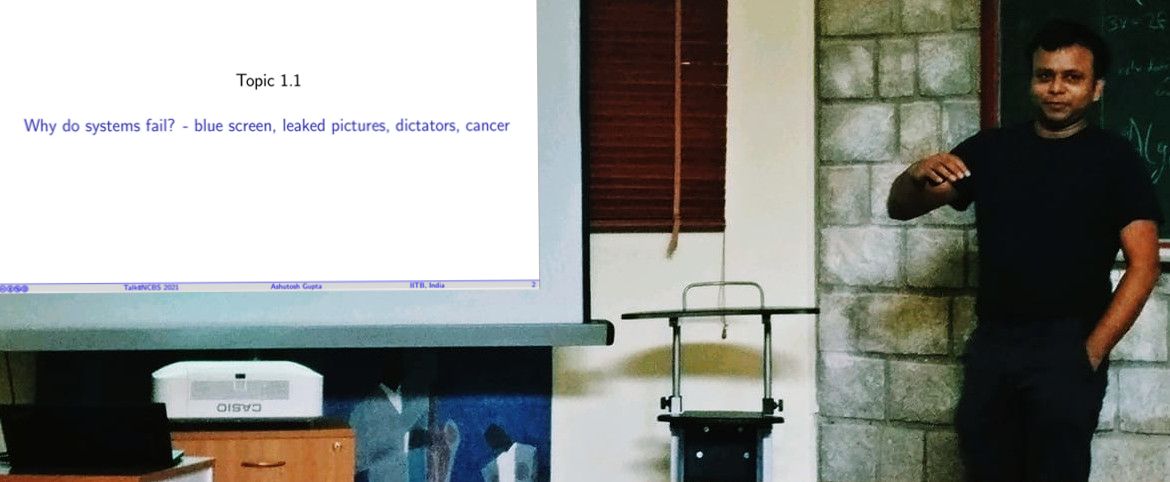
Ashutosh Gupta is an Associate Professor in the Department of Computer Science and Engineering at the Indian Institute of Technology Bombay, where he has been a faculty member since 2018. His research focuses on formal methods for software verification, particularly in the areas of model checking, constraint solving, and automated reasoning for both sequential and concurrent programs. He teaches advanced courses including Automated Reasoning (CS433), Analysis of Concurrent Programs (CS766), and Logic for Computer Science (CS228). Dr. Gupta received his Ph.D. in Computer Science from Technical University of Munich (TUM) in 2011, with affiliations during his doctoral studies at TUM, Max Planck Institute for Software Systems (MPI-SWS), and École Polytechnique Fédérale de Lausanne (EPFL). Prior to joining IIT Bombay, he served as a faculty member at Tata Institute of Fundamental Research (TIFR) in Mumbai and completed post-doctoral research in the Henzinger group at IST Austria. His research interests span formal verification of sequential and concurrent software, modeling of biological systems, and constraint solving including constraint logic programming, decision procedures, and automated theorem proving. He has developed several verification tools including VAJRA, HSF, and InvGen. His work bridges theoretical foundations with practical applications, particularly in verifying safety-critical systems and biological processes. Dr. Gupta's publication record shows a consistent trajectory of high-impact research in top venues like POPL, CAV, TACAS, and AAAI. His recent work has expanded into neural network verification, reinforcement learning verification for medical devices, and applying formal methods to biological systems, demonstrating both depth in core verification techniques and breadth in application domains. Best Paper Award at TACAS 2015 Best Paper Award at TACAS 2009 Dr. Gupta actively mentors numerous students through course projects, research presentations, and specialized workshops like SATfest. He has supervised students working on SAT/SMT solvers, verification of concurrent programs, and applications of formal methods to biological systems. His teaching philosophy emphasizes hands-on experience with verification tools and encourages students to engage with cutting-edge research through reading and presenting recent conference papers. He maintains active research collaborations with institutions including TUM, MPI-SWS, EPFL, IST Austria, and TIFR, reflecting his continued integration into the international formal methods research community.
Lohithaksha Maniraj Maiyar is an Assistant Professor and Head in Entrepreneurship and Management at IIT Kharagpur. Their interdisciplinary research bridges AI/ML with critical societal challenges. Education: Ph.D. from IIT Kharagpur Research Interests: Focus areas include Artificial Intelligence , Machine Learning , and applications to Climate Change , Waste Management , and Transportation systems.
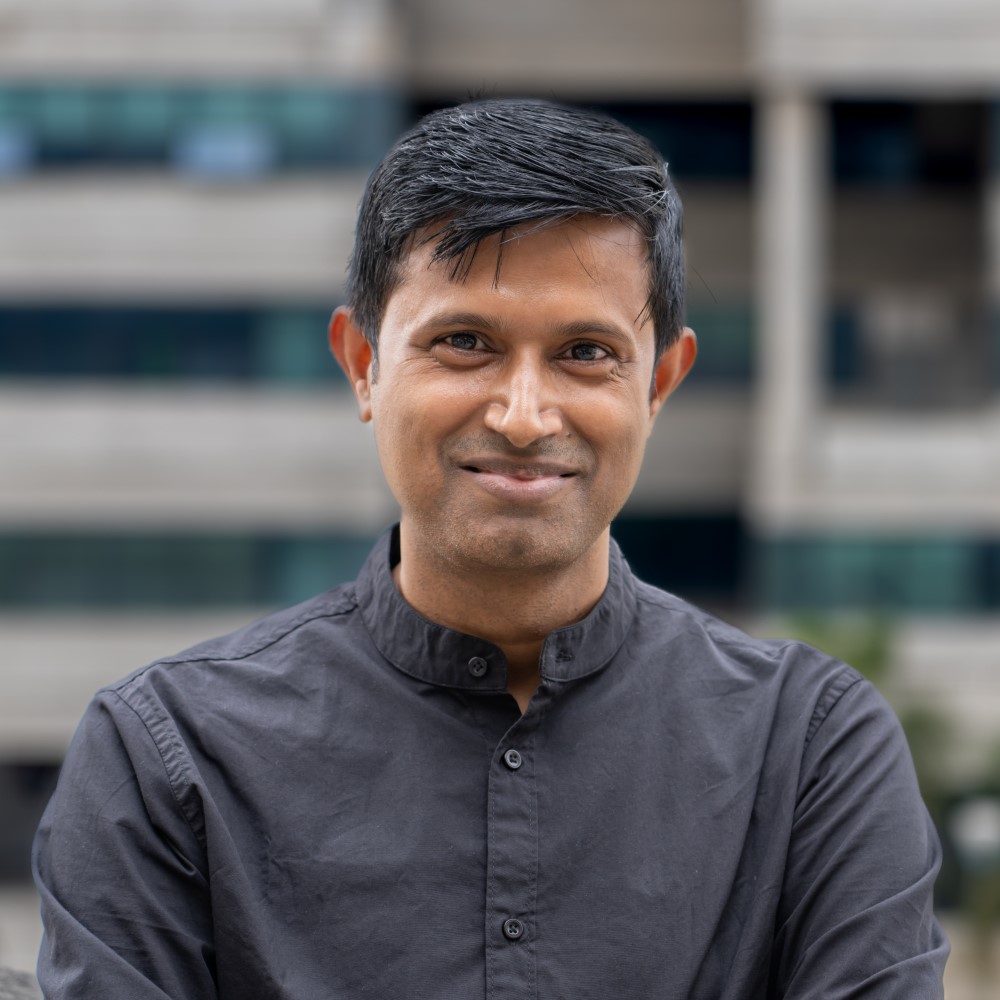
Dr. Maunendra Sankar Desarkar is an Associate Professor at the Computer Science and Engineering Department of Indian Institute of Technology Hyderabad , India, with affiliations to the AI Department. His research spans Natural Language Processing , Information Retrieval , and Machine Learning , focusing on robust, responsible, and culturally-aware AI systems. Education: B.E. (University of Burdwan), M.Tech (IIT Kanpur), Ph.D. (IIT Kharagpur, 2014) Current work emphasizes zero-shot cross-lingual transfer , dialogue interpretability , and ethical NLP (non-toxicity, empathy). Recent articles explore large language model evaluation , hallucination detection , and tokenization for Indic languages . Collaborations include Microsoft and JICA-funded projects. Scientific contributions include: Microsoft India Ph.D. Fellowship Award Yahoo Key Scientific Challenges Honorable Mention (2012) Students include Suvodip Dey (Ph.D. in Dialogue Systems), Aishwarya Maheswaran , Debolena Basak , Kaushal Kumar Maurya , and Maharaj Brahma . Advises on projects involving disaster response systems , generative AI , and multilingual NLP .
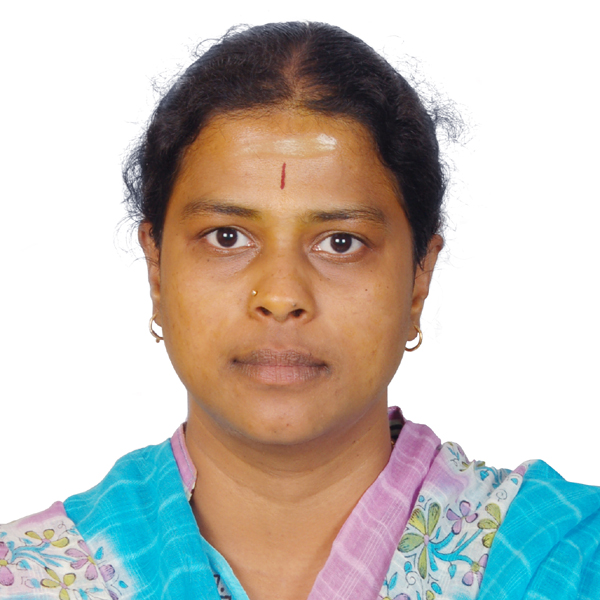
Rajalakshmi P. is a Professor in the Department of Electrical Engineering at the Indian Institute of Technology Hyderabad. Her research spans interdisciplinary domains combining artificial intelligence with engineering applications. Research Interests: Internet of Intelligent Things Artificial Intelligence & Machine Learning Computer Aided Diagnosis Intelligent and Autonomous Transportation Systems Biomedical Devices Sensors and Wireless Networks Contact: Office: Room A-404, Academic Block A Indian Institute of Technology Hyderabad Kandi-502284, Sangareddy, Telangana, India Phone: (040) 2301 - 6452
Ankit Agarwalمشاهده پروفایل
استادیار
Ankit Agarwal is an Assistant Professor in the Department of Hydrology at the Indian Institute of Technology Roorkee (IIT Roorkee), where he has been serving since January 2019. He additionally holds concurrent positions as a Visiting Scientist at the Potsdam Institute for Climate Impact Research (Germany) and as a Doctoral Researcher at the University of Potsdam, both positions starting from August 2020. His academic profile reflects strong international collaboration, particularly with German research institutions. His educational background includes a Bachelor of Engineering in Civil Engineering from Jai Narayan Vyas University Jodhpur (2013), followed by a Master of Technology in Water Resource Engineering from IIT Delhi (2015), and culminating in a PhD in Hydrology from the University of Potsdam, Germany (2018). Dr. Agarwal's research spans Hydrometeorological Extreme Events, Water and Climate, Big Data & AI/ML applications in hydrology, Hydrological Modelling, and Impact-based Modelling. His work uniquely integrates complexity science, network analysis, and machine learning approaches to understand climate-hydrology interactions, with a specific focus on the Indian monsoon system, extreme events, and water resource management under climate change. He has developed innovative methodologies using complex networks to analyze precipitation patterns and climate teleconnections. His publication record demonstrates a strong trajectory of high-impact research, with recent work increasingly focusing on compound extremes (particularly dry and hot events), atmospheric moisture transport, flood dynamics in Himalayan river basins, and the application of satellite remote sensing data with hydrological modeling. His research shows a clear progression from theoretical hydro-climatic analysis toward practical applications for water resource management and disaster risk reduction. Dr. Agarwal leads multiple significant research projects funded by various national and international agencies including the Ministry of Education (STARS scheme), THDCIL, Belmont Forum, SERB, NHPC, ISRO, and Microsoft AI4Earth grants. His projects cover diverse areas including predictive modeling of Indian Summer Monsoon considering Arctic teleconnections, operational inflow forecasting systems for dams, assessing vulnerability to flood and drought hazards using machine learning, and studying compound dry and hot extremes in India. His collaborative network spans institutions including the Potsdam Institute for Climate Impact Research, GFZ German Research Centre for Geosciences, Technical University-Dresden, Research Institute for Development (IRD) France, and Indian institutions like IIT Delhi and the Indian Institute of Tropical Meteorology. This international collaboration framework supports his research on hydro-climatic extremes and their societal impacts.