Liu Lili is a Lecturer (Educator Track) in the Department of Computer Science at the School of Computing, National University of Singapore. She holds a Ph.D. from Nanyang Technological University and a Master's in Computer Science from Shanghai University. Prior to NUS, she served as a Senior Research Scientist at Singapore Polytechnic and a Scientist at A*STAR's Institute of High-Performance Computing. Her research focuses on Machine Learning, Computer Vision, and Multi-modal Learning, with applications in FinTech, Social Media Analysis, and Algorithms & Theory. Notable projects include AI-driven coating inspection systems for marine assets and behavioral competency assessment tools for navigational safety. She has contributed to robotics for construction quality assessment and interactive virtual environments for rehabilitation. Liu's publications span AI applications in finance, robotics, and material science, reflecting her expertise in bridging theoretical computer science with practical industrial solutions. Her work emphasizes automation, anomaly detection, and multi-modal data integration.
Dr. Liyi Zhou is a Lecturer in the School of Computer Science at the University of Sydney, specializing in systems security, blockchain, and AI. His research focuses on developing automated and adaptive security tools using machine learning and reinforcement learning. He co-founded D23E.ch, a platform addressing blockchain security and privacy challenges. Research interests include AI-driven vulnerability detection, large security models, real-time intrusion prevention, advanced program analysis (fuzzing/symbolic execution), and privacy-preserving systems. He actively recruits PhD students for projects advancing AI in cybersecurity. Notable achievements include pioneering 'sandwich attacks' discovery in DeFi protocols, contributing to Ethereum Foundation grants, and receiving bug bounties from Flashbots and Ethereum Foundation for vulnerability disclosures. His work has been published in venues like IEEE S&P, USENIX Security, and SIGMETRICS. Teaching includes the course INFO2222. He seeks collaborations and funding to bridge academic research with real-world industry problems, emphasizing practical impact.
Bart De Keijzer is a Senior Lecturer in Computer Science at King's College London, within the Department of Informatics. He serves as Deputy Director of the Distributed AI Research Group and is the Finance Hub Champion. His research focuses on the intersection of economics and theoretical computer science, particularly algorithmic game theory, mechanism design, and financial networks. Education includes a PhD in Algorithmic Game Theory from Centrum Wiskunde & Informatica (CWI) and Vrije Universiteit Amsterdam, and a Computer Science degree from Delft University of Technology. Prior to King's, he held roles at the University of Essex, Sapienza University of Rome, and the University of Liverpool. His research interests span financial networks, systemic risk mitigation, auction design, and multi-agent systems. Recent work explores strategies to reduce systemic risk in financial networks and the development of strategyproof mechanisms. Awards: EPSRC New Investigator Award (2024). Labs/Teams: Distributed AI Research Group, Informatics Finance Hub.
Saurabh Bagchi is a Professor at Purdue University, West Lafayette, USA. He holds a PhD in Computer Science from the University of Illinois Urbana-Champaign (2001). His research focuses on distributed systems security, networking, and embedded systems. Key areas include IoT security, cyber-physical systems resilience, and machine learning applications in edge computing. Bagchi's work spans theoretical and applied domains, addressing challenges in distributed algorithms, fault tolerance, and secure communication protocols. His contributions to firmware analysis, serverless computing optimization, and anomaly detection in industrial IoT systems have been widely recognized. He has published over 300 papers in top-tier conferences and journals such as IEEE Transactions on Dependable and Secure Computing, ACM Transactions on Sensor Networks, and CVPR. He collaborates with researchers in academia and industry to advance resilient networked systems, including projects funded by NSF and industrial partnerships. His lab explores cutting-edge topics like federated learning security, edge computing architectures, and game-theoretic approaches to cyber defense.
David Blaauw is the Kensall D. Wise Collegiate Professor of Electrical Engineering and Computer Science (EECS) at the University of Michigan. His research focuses on ultra-low-power analog/mixed-signal circuits, mm-scale sensors, neural networks, and biomedical applications. He leads the Blaauw Lab, which has pioneered innovations like the Michigan Micro Mote (M^3) and neural recording probes. His work emphasizes real-world deployability, with applications in environmental monitoring (e.g., monarch butterflies), medical devices, and robotics. Education: B.S. in Physics and Computer Science, Duke University (1986) Ph.D. in Computer Science, University of Illinois Urbana-Champaign (1991) Research Interests: Blaauw’s lab explores ultra-low-power computing, mm-scale systems, RF communication, in-memory computing, and genomics acceleration. Key projects include: Millimeter-scale computers (e.g., 0.04mm³ temperature sensors) Wireless neural interfaces for brain-machine communication Energy-efficient accelerators for edge AI and genomics Micro-robotics with sensing/actuation/computation Awards: IEEE Fellow 2016 SIA-SRC Faculty Award Motorola Innovation Award Best Paper Awards at ISSCC, ISCA, and RFIC Advising & Impact: Over 600 publications, 65 patents, and 4 startup companies spun from his lab. Current research includes genome sequencing accelerators (GenAx) and neural recording dust for brain mapping. He directs the Michigan Integrated Circuits Lab and chairs major conferences like ISSCC and DAC. Labs/Teams: Blaauw Lab (University of Michigan) Michigan Integrated Circuits Lab (MICAL)
Hasan Davulcu is a Professor in the School of Computing and Augmented Intelligence at Arizona State University (ASU). He holds a B.S. in Mathematics from Middle East Technical University (Turkey) and M.S./Ph.D. in Computer Science from Stony Brook University (NY). His research focuses on sociocultural modeling, AI, machine learning, and behavioral analytics for fraud detection. He leads the CIPS-AI Lab, developing data mining tools for semantic information extraction from social media and web data. Affiliations: Senior Global Futures Scientist (Global Futures Scientists and Scholars Program), Co-founder & CIO of ARTIS MAGI (AI-driven behavioral analysis startup). Education: Ph.D. Computer Science (Stony Brook, 2002), M.S. Computer Science (Stony Brook, 1995), B.S. Mathematics (METU, 1993). Research interests include: Sociocultural modeling and persuasive AI. Web/social media mining, information extraction, and database systems. Behavioral analytics for fraud detection and countering extremist influence. Key achievements: 2011 HSCB Focus Exceptional Scientific Achievement Award for work on sociocultural modeling in the DOD Minerva project. Principal Investigator on NSF and DoD grants, including behavioral analytics for financial fraud and social influence analysis of extremist groups. Grants & Projects: NSF PFI:BIC Grant (2014-2019): Behavioral analytics for fraud detection via visual analytics infrastructure. DoD Minerva (2015-2019): Measuring social influence of extremist groups. ONR Projects (2018-2021): Modeling polarization, adversarial framing, and disinformation tracking. Labs/Teams: Cognitive Information Processing Systems (CIPS-AI) Lab, which pioneers data mining techniques for unstructured social media data and semantic representation systems.
Florence d'Alché-Buc is a Professor at Télécom Paris (Institut Polytechnique de Paris), holding an Isaac Newton Institute Simons Chair (2025) and leading the Data Science and Artificial Intelligence for Digitalized Industry & Services (DSAI) Chair. She heads the Image, Data, and Signal Department and is part of the Signal, Statistics, and Learning (S2A) team at the LTCI laboratory. Her research focuses on machine learning, bioinformatics, and industrial applications, emphasizing kernel methods, structured prediction, and reliable AI. Education: Previously a professor at Université d’Evry and deputy director of the IBISC lab. Co-director of the Paris-Saclay Data Science Master and creator of specialized AI programs (e.g., Certificate of Specialized Studies in AI). Research highlights include contributions to operator-valued kernel methods, graph prediction, and frugal AI. She actively collaborates with institutions like Inria, École Polytechnique, and industry partners (Airbus, Engie, etc.). Notable roles: Scientific director of Digicosme Labex, Ellis Fellow, and board member of IVADO (Montreal). Her recent work addresses AI explainability, robustness, and sustainability, including projects on interpretable networks and energy-efficient models.
Uzi Vishkin is a Professor at the University of Maryland's Institute for Advanced Computer Studies (UMIACS) and Department of Electrical and Computer Engineering, with additional affiliation in the Department of Computer Science. His work focuses on parallel computing, including the PRAM-On-Chip vision to bridge parallel algorithms and hardware. He holds a D.Sc. from Technion (1981), M.Sc. and B.Sc. in Mathematics from Hebrew University (1975/1974). Research interests span parallel algorithms, PRAM (Parallel Random Access Machine) architecture, machine learning applications, and pattern matching. His PRAM-On-Chip project aims to create a coherent computing stack for many-core processors. Vishkin has contributed to theoretical foundations and practical implementations, including the XMT architecture and compiler. He has been recognized with ACM Fellow (1996), Highly Cited Researcher (2003), and National Academy of Inventors Fellow (2024). Awards highlight his pioneering work in parallel algorithms and computing systems. Teaching spans courses like Parallel Algorithms and Mathematical Foundations for Computer Engineering. He emphasizes parallel algorithmic thinking in education and has developed teaching materials for high school and university levels. Key projects include the XMT architecture, simulations, and tools for parallel programming. His work integrates algorithmic theory with hardware design to address programming challenges in many-core systems.
Dr. Yanchao Liu is an Associate Professor at Wayne State University's College of Engineering, Department of Industrial and Systems Engineering. He has received research funding from the National Science Foundation and the State of Michigan, including the NSF Career Award. His academic career spans prior industry roles as a Data Scientist and Manager of Advanced Analytics at Sears Holdings Corporation (2016-2017) and Director of Brand Marketing Analytics at Catalina Marketing Corporation (2017). He teaches courses in data science, IoT, and stochastic processes. B.S. Industrial Engineering, Huazhong University of Science and Technology (2006) M.S. Industrial Engineering, University of Arkansas (2008) Ph.D. Industrial and Systems Engineering, University of Wisconsin-Madison (2014) Dr. Liu's research focuses on mathematical modeling for transportation systems, industrial AI, and data analytics. His work addresses drone traffic management, battery-constrained delivery routing, and optimization algorithms for urban mobility. He has developed novel methods for UAV safety diagnostics, random forest implementations, and fairness-aware path planning in urban air mobility. His publications span journals like Journal of Guidance, Control and Dynamics , Transportation Research Part C , and IEEE Transactions on Intelligent Transportation Systems , with conference contributions at IISE and FAIM. His research combines theoretical advancements with practical applications in smart cities and logistics. NSF Career Award (2020) Faculty Research Excellence Award (2021) IEEE PES Best Conference Paper (2015) IEEE Transactions on Smart Grid Best Reviewer (2015) Hubei Province Distinguished Bachelor’s Thesis Award (2006) Dr. Liu advises PhD students like Zhenyu Zhou and J. Chen. He has contributed to energy market modeling (with M.C. Ferris) and published extensively on drone operations, machine learning algorithms, and stochastic processes. His work includes U.S. patent pending applications for UAV safety systems.
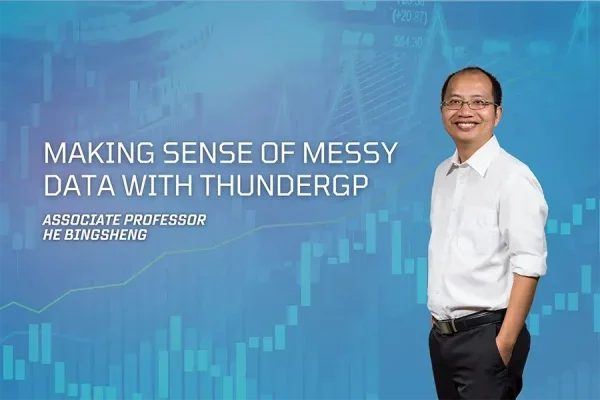
Professor He Bingsheng is a faculty member at the Department of Computer Science, School of Computing, National University of Singapore (NUS), where he also serves as Vice-Dean, Research. He holds a Ph.D. in Computer Science from the Hong Kong University of Science & Technology (2008) and dual bachelor’s degrees in Computer Science & Engineering and Business Administration from Shanghai Jiao Tong University (2003). Education: Ph.D. (HKUST, 2008), B.E./B.B.A. (SJTU, 2003) Prior roles: Microsoft Research Asia (2008-2010), Nanyang Technological University (NTU), Singapore His research focuses on Big Data management systems , particularly on cloud computing and emerging hardware architectures (GPU, FPGA, NVM). He has led projects like ThunderGP, a novel FPGA-accelerated graph processing framework achieving 419x speedup for Covid-19 prevalence estimation. His work spans parallel/distributed systems and graph algorithms , with publications in ACM SIGMOD, VLDB, SC, and IEEE Transactions. The selected articles highlight his contributions to GPU/FPGA optimization , LLM applications , and graph analytics . He has received multiple best paper/demo awards, including IEEE/ACM ICCAD (2017), IEEE IC2E (2016), and ACM SIGMOD (2008). As a PC chair and editorial board member for journals like IEEE TPDS and TCC, he actively shapes academic discourse. PhD Students: Chen Xinyu, Tan Hongshi Courses Taught: CS4225/5425 Big Data Systems for Data Science
Natacha Crooks Dr. Natacha Crooks is an Assistant Professor in the Department of Electrical Engineering and Computer Science (EECS) at UC Berkeley. Her research focuses on distributed systems, databases, and security, with a particular emphasis on consistency models, BFT protocols, and cloud computing. She is a founding member of the SkyLab and a core contributor to the Data Systems and Foundations Group at Berkeley. She holds a Ph.D. in Distributed Systems from the University of Texas at Austin (2019) and a BA in Computer Science and Law from the University of Cambridge (2012). Affiliations & Roles: Assistant Professor, UC Berkeley EECS Visiting Researcher at Azure Research, Security & Privacy Founding Member of SkyLab Member of Berkeley Center for Decentralized Intelligence Former Scientific Advisor at Improbable and Astronomer Research Interests: Her work bridges distributed systems and database research, addressing challenges in transactional consistency, fault-tolerant protocols, and cloud resource optimization. Key themes include: Designing scalable BFT consensus algorithms Secure multi-cloud storage solutions Optimizing distributed transaction processing Privacy-preserving distributed systems Awards & Recognition: Sloan Research Fellow (2025) NSF CAREER Award ACM SIGOPS Dennis M. Ritchie Doctoral Dissertation Award (2020) IEEE CS TCDE Early Career Award (2024) Teaching: Fall 2025: CS 294-282 (Research Culture and Community Norms), Wheeler 130. Industrial Collaboration: Prior roles include visiting researcher at Cornell University, Microsoft Research (DMX group), and Imperial College London. Industrial partnerships include work with Materialize, Astronomer, and Improbable.
Anant Sahai is the Qualcomm Chair Professor in the Department of Electrical Engineering and Computer Sciences (EECS) at the University of California, Berkeley. He holds affiliations with the Berkeley Artificial Intelligence Research Lab (BAIR), Berkeley Laboratory for Information and System Sciences (BLISS), and the Berkeley Wireless Research Center (BWRC). His academic journey includes a BS from UC Berkeley (1994), and MS (1996) and PhD (2001) degrees from MIT. He previously worked at Enuvis, Inc., focusing on adaptive software radio techniques for low-SNR GPS environments. Research interests span machine learning, wireless communication, information theory, signal processing, and decentralized control, with a focus on intersections between these fields. Key areas include spectrum sharing, ultra-reliable low-latency wireless protocols, and the foundations of overparameterized machine learning. Recent work explores in-context learning in modern AI models. He has received awards such as the IEEE ComSoc Leonard G. Abraham Prize (2012) and teaching/mentorship accolades at Berkeley. He advises UC Berkeley’s Eta Kappa Nu chapter and coordinates machine learning efforts for NSF’s SpectrumX. Current teaching includes CS 182/282A on deep neural networks. His lab focuses on theoretical and applied challenges in communication systems, AI, and control theory. Awards: IEEE ComSoc Leonard G. Abraham Prize (2012), Teaching Excellence Awards (2015–2017) Grants: NSF Center for Spectrum Innovation (SpectrumX), multiple collaborative projects in wireless and AI Labs/Teams: BLISS, BAIR, BWRC
Brad Hayes is an Associate Professor of Computer Science at the University of Colorado Boulder within the College of Engineering and Applied Science, where he directs the Collaborative AI and Robotics (CAIRO) Laboratory. He also serves as Chief Technology Officer at Circadence, leading efforts in developing AI-enabled products for cybersecurity training and assessment. Undergraduate degree from Boston College PhD in Computer Science from Yale University Postdoctoral Associate at MIT Professor Hayes' research focuses on developing techniques that enable autonomous agents and robots to learn from and collaborate with humans safely, reliably, and productively. His work occurs at the intersection of pervasive and personalized artificial intelligence, human-robot teaming, and decision support. He has made significant contributions to collaborative robotics, dependable explainable AI, and imitation learning, with applications spanning manufacturing, healthcare, disaster response, autonomous vehicles, and space exploration. His recent publications reveal a strong emphasis on human-robot interaction, with particular focus on improving predictability in collaborative tasks, developing explainable AI systems that build trust, leveraging augmented and virtual reality for enhanced collaboration, and creating more efficient learning algorithms from human demonstrations. His work increasingly integrates large language models and advanced neural network architectures while maintaining a strong human-centered design approach. Sustainability Recognition (2025) for computational efficiency in motion planning Best Student Paper Runner-up at AAMAS 2022 Nominated for Best Technical Paper at HRI 2024 Best Technical Paper Runner-up at HRI 2019 Hayes has successfully mentored numerous graduate students through the CAIRO Lab, including multiple PhD graduates in 2024 alone. His lab receives funding from various organizations supporting research in human-robot interaction and collaborative AI. He frequently collaborates with industry partners and has established connections with major technology companies through his research and speaking engagements. The CAIRO Lab, under Hayes' direction, is a vibrant research environment focused on turning theoretical concepts into practical applications through hands-on work with real robots and human participants. The lab's research spans multiple domains including manufacturing, disaster response, autonomous vehicles, and space exploration, with a consistent emphasis on safe and effective human-machine teaming.
Dr. Changyou Chen is an Associate Professor in the Department of Computer Science and Engineering at the University at Buffalo, State University of New York. His research focuses on Multi-Modal Learning Foundation Models Deep Generative Models Large-scale Bayesian Sampling with applications in document understanding, music-AI integration, and molecular representation learning. Research Trends revealed through his recent publications include Optimizing Multimodal Large Language Models Developing Novel Retrieval-Augmented Generation Frameworks Creating Benchmark Datasets for Visual Text Understanding Advancing Diffusion Models with Domain-Specific Constraints across domains from music sheets to biomedical documents. Scientific Contributions : UB Young Investigator Award (2020) Architect of LoCAL Framework for Long Document Understanding Co-developer of MusiXQA Benchmark Pioneering Work in Probability Contrastive Learning Academic Leadership includes mentoring 10+ graduate students and serving as Area Chair for major AI conferences (ICML, NeurIPS, AAAI, IJCAI). His Labs develop scalable solutions for multimodal reasoning, with recent work demonstrating practical GPU memory optimization through LoRA adapter sharing.
Veysel Murat İstemihan Genç is a Professor in the Department of Electrical Engineering at Istanbul Technical University (ITU), College of Engineering. His research is centered on modern power systems, with a focus on transient stability, cybersecurity, and integration of renewable energy sources. He actively leads multiple research projects and supervises graduate students in advanced power system technologies. Research Interests: His work spans key areas including transient stability assessment, machine learning applications in power systems, cyber-attack detection in AGC systems, and dynamic security evaluation under high renewable penetration. He employs cutting-edge techniques such as ensemble learning, deep neural networks, and hybrid optimization algorithms. Publication Trends: Recent publications (2023–2025) highlight a strong trend toward integrating AI and machine learning for real-time transient stability prediction, cybersecurity in distributed energy systems, and performance optimization of solar and wind-integrated grids. His work frequently addresses challenges in low-inertia systems and false data injection attacks. Scientific Projects: Strengthened Machine Learning-Based Dynamic Security Evaluation for Transient Stability under False Data Injection Attacks (BAP, 2025) Analysis and Control Methods for Stability of Large-Scale Low-Inertia Power Systems (BAP, 2023–2024) Dynamics Security Evaluation of Renewable-Rich and Cyber-Attacked Power Systems (BAP, 2022–2024) Risk-Based Stability Assessment and Corrective Control Methods in Power Systems (BAP, 2019–2022) Wide-Area Monitoring Protection and Control System Design Using Advanced Signal Processing and Machine Learning (TÜBİTAK, 2018–2020) Advising and Grants: He is the principal investigator (PI) on multiple funded research projects from BAP and TÜBİTAK, indicating strong grant acquisition and leadership. His supervision of 27 ongoing theses reflects an active role in mentoring graduate students in electrical engineering and power systems. Labs and Teams: While specific lab names are not mentioned, his projects suggest leadership in a research group focused on smart grid technologies, AI-enabled power system security, and renewable integration at Istanbul Technical University.