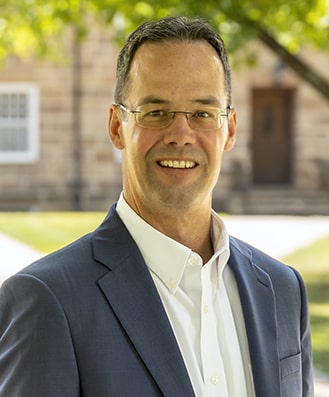
Jud Murray is an Associate Professor in the Department of Religion and Philosophy at Capital University, teaching courses on world religions, Asian religions, ethics, and advanced topics in Buddhism and meditation. He serves as the program coordinator for Interdisciplinary Studies and is an active member of the steering committees for the Midwest Conference on Chinese Thought and the Confucian Traditions Unit of the American Academy of Religion. Education: Ph.D., Brown University M.T.S., Harvard University B.A., The Ohio State University Research Interests: Dr. Murray specializes in East Asian religious and philosophical traditions, with a focus on Confucian moral education, Confucian and Daoist mysticism, and agrarianism in early imperial China. His current research employs contemplative studies methodologies to examine Confucian contemplation and its application in contemplative pedagogy for improving student learning and wellness. Publications Trends: His scholarly output from 2004 to 2021 centers on Chinese intellectual history, particularly the Huainanzi and Han dynasty thought. Notable recent works include entries on Confucian and Daoist mysticism for the Oxford Research Encyclopedia of Religion (2019, 2021), reflecting his expertise in mystical dimensions of East Asian traditions and their contemporary relevance. Advising and Grants: The available information does not specify any graduate students advised or research grants received.
Dr. Marc Ph. Stoecklin is a Principal Research Staff Member and head of the Security Research Department at IBM Research Europe in Zurich, Switzerland. He co-leads IBM's global research strategy on Quantum Safe Cryptography and Migration, focusing on cryptographic artifact identification and migration implementation. Previously, he directed Threat Management research, applying AI and automation to threat detection, investigation, and response. Education: PhD in Computer, Communication and Information Sciences, École Polytechnique Fédérale de Lausanne (EPFL), Switzerland His research spans quantum safe cryptography, threat management, AI security, threat detection, identity management, cyber deception, big data analytics, and security visualization. He pioneered AI-powered security operations, contributing to Watson for Cyber Security and QRadar Advisor with Watson, and analyzes AI/quantum computing misuse in cyber attacks. His 2016-2020 publications emphasize advanced threat detection, malware analysis, and AI security, featuring evasive malware deactivation, threat intelligence computing, and neural network watermarking. These works bridge research and product development, directly influencing IBM security offerings. Dr. Stoecklin led IBM's Cognitive Cyber Security Intelligence group (2014-2019) and the Security Research Department since 2019. As tech lead for IBM's COVID-19 task force (2020-2022), he developed IBM Digital Health Pass, deployed in New York's Excelsior Pass with over 1 million passes issued in two months. He heads the Security Research Department at IBM Research Europe in Zurich and has been integral to the Global Security Analysis Lab (GSAL) and Cognitive Cyber Security Intelligence (CCSI) group at IBM T.J. Watson Research Center.
John Linarelli is Vice Dean and John E. Murray Faculty Scholar & Professor of Law at the University of Pittsburgh School of Law, where he has established himself as a leading scholar in international economic law, contract theory, and the intersection of law with emerging technologies. His academic career spans multiple decades with significant contributions to legal scholarship, particularly in areas bridging traditional legal theory with contemporary challenges. Professor Linarelli's research interests encompass a broad spectrum of legal disciplines with particular emphasis on International Economic Law , Contract Law , Commercial Law , and the rapidly evolving field of Artificial Intelligence and Law . His work demonstrates a consistent focus on theoretical foundations while addressing practical legal challenges in global commerce and digital transformation. His scholarship often explores philosophical dimensions of law, particularly examining concepts of justice, certainty, and pluralism in transnational contexts. His recent publications reveal a growing emphasis on the legal implications of artificial intelligence, particularly regarding contract formation and legal personhood, while maintaining his longstanding expertise in international trade, procurement law, and global justice frameworks. The trajectory of his work shows a sophisticated integration of traditional legal theory with cutting-edge technological challenges, positioning him at the forefront of contemporary legal scholarship. Among his notable achievements is the prestigious John E. Murray Faculty Scholar designation, recognizing his exceptional contributions to legal scholarship. His work has appeared in numerous prestigious law journals and edited volumes, demonstrating both breadth and depth across multiple legal disciplines. Professor Linarelli has also contributed significantly to collaborative scholarship, notably co-editing 'Global Justice and International Economic Law: Opportunities and Prospects' with colleagues from leading institutions. His research demonstrates a consistent commitment to examining how legal frameworks can promote justice in increasingly complex global economic systems, with particular attention to issues of inequality, access to credit, and systemic financial risk.
Michael Beaney is Regius Professor of Logic at the University of Aberdeen, holding this position since June 2020. He also maintains a half-time position as Professor of History of Analytic Philosophy at Humboldt University in Berlin (since 2016). Previously, he served as Professor of Philosophy at King's College London (2016-20, part-time), Reader and then Professor of Philosophy at the University of York (2005-15), and held positions at the Open University, University of Manchester, University of Leeds, Birkbeck College London, and University of Sheffield. In Germany, he has held Alexander von Humboldt Research Fellowships at the University of Jena and University of Erlangen-Nürnberg. He has been actively engaged with Chinese academia since 2011, serving as Visiting Professor at Peking University and currently as Visiting Chair Professor at Tsinghua University, while also chairing the British Committee of the Summer School in China Programme. Beaney received his undergraduate education in PPE at St. Catherine's College, Oxford (1978-81), followed by a B.Phil. (1985) and D.Phil. (1990) in Philosophy from the same institution. He also holds an MA from the University of Keele (1983). Professor Beaney's research spans several interconnected areas within philosophy. His primary focus is on the history of analytic philosophy, with special attention to the works of Frege, Wittgenstein, Stebbing, and Collingwood. He has made significant contributions to understanding the development of analytic methodology and the historiography of philosophy. His work on Chinese philosophy explores ancient Chinese philosophy of language and logic, as well as the development of Chinese analytic philosophy, representing an important bridge between Eastern and Western philosophical traditions. Beaney is particularly interested in philosophical methodology, especially the role of analysis and creativity throughout the history of philosophy. His comparative work examines Chinese-Western philosophical comparisons and the philosophy of comparison itself. Additionally, he has made notable contributions to the theory and practice of philosophical translation, particularly between German-English and English-Chinese. Beaney's recent publications demonstrate a consistent focus on the history and methodology of analytic philosophy. His work frequently examines the intersection of historical analysis with contemporary philosophical concerns, particularly regarding conceptual creativity and the evolution of philosophical ideas. A significant portion of his recent scholarship addresses translation issues in philosophy, especially concerning Frege's works and Chinese philosophical texts. His editorial work on the British Journal for the History of Philosophy for nearly a decade reflects his commitment to advancing scholarly discourse in the field. Michael Beaney currently serves as President of the Society for the Study of the History of Analytical Philosophy (SSHAP). He was Editor of the British Journal for the History of Philosophy from 2011 to 2020 and remains on the Editorial Board as an Associate Editor. He serves on the Editorial Board of Russell: the Journal of Bertrand Russell Studies and on the Advisory Boards of the Journal of Chinese Philosophy and the Journal for the History of Analytical Philosophy. Beaney is General Editor of a book series on the history of analytic philosophy published by Palgrave Macmillan (30+ volumes) and Co-Editor of a new book series entitled 'New Texts in the History of Philosophy' published by Oxford University Press. He has been a member of the AHRC Peer Review College since 2010 and is a Fellow of the Royal Society of Arts. Professor Beaney welcomes PhD students in all areas of his research expertise, particularly in history of analytic philosophy, Chinese philosophy, philosophical methodology, historiography of philosophy, comparative philosophy, and philosophical translation. His extensive editorial experience and leadership roles in professional organizations provide valuable mentorship opportunities for graduate students. While specific grant information isn't detailed in the provided text, his ongoing research projects, international collaborations (particularly with Chinese institutions), and editorial work suggest substantial research activity supported by various funding mechanisms. Though not explicitly mentioned as leading a specific laboratory, Beaney is deeply involved in several collaborative research initiatives. His work with Prof. Karyn Lai (UNSW) on ancient Chinese epistemology represents an important international collaboration. His leadership of the British Committee of the Summer School in China Programme fosters ongoing academic exchange between British and Chinese philosophers. Additionally, his editorial roles with multiple journals and book series create virtual research communities centered around the history of analytic philosophy.
Mitchell Dean is a Professor and Head of Department at Copenhagen Business School, specializing in political theology, governmentality, and neoliberalism through interdisciplinary lenses. His work intersects philosophy, political science, and cultural studies, often analyzing power structures and sovereignty. Current Affiliation: Copenhagen Business School Department: Business Humanities and Law Role: Head of Department Recent research explores: Political Theology (post-Carl Schmitt analysis) Governmentality in modern governance Foucault's neoliberalism engagement Indigenous rights and custodial policy Democratic processes and sovereignty Interdisciplinary SDG contributions Articles and lectures demonstrate his focus on: Power dynamics (2014-2025) Political theology's evolution (2023) Critical analyses of authoritarianism (2025) Psychoactive experimentation in intellectual history (2021, 2023)
Prof. Dr. Birgit Krawietz is a distinguished Professor at the Institute for Islamic Studies within the Department of History and Cultural Studies at the Free University of Berlin. Her academic work spans multiple disciplines within Islamic Studies, with particular focus on Islamic law, cultural history, and the intersection of religion with contemporary social practices. She actively supervises doctoral students and serves on important academic committees including as Chair of the Doctoral Committee of the Department of History and Cultural Studies and as a member of the Advisory Board of the Orient-Institut-Beirut (OIB). Her research interests encompass a diverse range of topics including Islamic normativity, Salafism, body and sport studies, and regional studies of the Arabian Gulf and Türkiye. Krawietz has established herself as a leading scholar examining how Islamic legal traditions interact with modern practices, particularly in areas like sports, medical ethics, and consumer culture. Her work often explores the tension between traditional Islamic jurisprudence and contemporary social transformations. Analysis of her recent publications reveals a consistent scholarly trajectory examining Islamic legal traditions through cultural and anthropological lenses. Her work demonstrates particular strength in analyzing bodily practices within Islamic contexts, from oil wrestling traditions in Turkey to medical ethics and sports regulations. She has made significant contributions to understanding how Islamic legal traditions adapt to modern contexts, particularly in the Gulf region where traditional practices intersect with rapid urbanization and globalization. Prof. Krawietz has supervised numerous doctoral projects covering diverse topics including Islamic jurisprudence regarding non-Muslims, theology in the Shafi'i school, and the recited Qur'an. Her academic leadership extends to organizing conferences and workshops, including upcoming events like the "South-South Comparativism" conference scheduled for June 2025. She has also served as co-editor for multiple significant publications that have shaped contemporary discourse in Islamic Studies. Her teaching portfolio demonstrates engagement with both foundational Islamic legal concepts and contemporary applications, including courses on human body modifications in Islamic jurisprudence, food regulations, and space construction in Islamic contexts. Her academic influence extends beyond Berlin through her membership in the Deutsche Arbeitsgemeinschaft Vorderer Orient (DAVO) and her participation in international scholarly networks.
Han Li is Professor and Chair of the Department of Modern Languages and Literatures at Rhodes College, serving since 2008 while concurrently holding the position of Section Head for Chinese. Her academic work centers on East Asian Languages and Literatures with specialized focus on Chinese cultural and media studies. Education: Ph.D. in East Asian Languages and Literatures, University of California, Irvine B.A. in Chinese Literature, Nanjing University Research Profile: Dr. Li's scholarship bridges material cultural history of late imperial China with contemporary Chinese cinema and media studies. She critically examines rural representations in social media, gender dynamics in film, and the political economy of Chinese soft power. Her work consistently connects historical contexts with modern digital landscapes, revealing how cultural narratives shape national identity and heritage preservation in transnational frameworks. Publication Trends: Her recent articles demonstrate a clear trajectory from historical analysis (17th-century fiction) toward contemporary media phenomena, with increasing emphasis on rural China's digital transformation. Key thematic clusters include cinematic representations of national trauma, the commodification of revolutionary culture, and the geopolitical dimensions of cultural heritage in US-China relations. Academic Engagement: Beyond her departmental leadership, Dr. Li actively contributes to Gender and Sexuality Studies, Media Studies, and Asian and Asian American Studies programs. Her public scholarship includes interviews with major international media outlets and commentary for Sixth Tone on Chinese soft power and media trends.
Alvaro Pires serves as a Professor and Canada Research Chair in Legal Traditions and Penal Rationality at the University of Ottawa's School of Criminology. With an extensive publication record spanning over two decades, he has established himself as a leading scholar in historical criminology, penal rationality, and qualitative research methodology. His academic work bridges Enlightenment philosophy with contemporary criminological concerns, focusing particularly on the evolution of penal systems and legal traditions from the 18th century to modern risk societies. Dr. Pires' research interests encompass a broad spectrum of criminological inquiry, with particular emphasis on the historical development of penal rationality, qualitative research methodology, and philosophical foundations of criminal justice. His scholarly contributions demonstrate deep engagement with Enlightenment thinkers like Beccaria and Kant, examining how their philosophies shaped modern penal systems. His methodological expertise in qualitative research has positioned him as an important voice in methodological debates within social sciences, particularly regarding causal analysis and sampling techniques in qualitative studies. His publication record reveals a clear trajectory of intellectual development, beginning with methodological concerns in the 1980s and evolving toward increasingly sophisticated historical analyses of penal rationality. The progression shows how his early work on qualitative methodology laid the foundation for his later historical investigations into the philosophical underpinnings of criminal justice systems. His work consistently connects historical analysis with contemporary criminological challenges, demonstrating the enduring relevance of historical philosophical frameworks. As a Canada Research Chair, Dr. Pires has received significant recognition for his scholarly contributions. This prestigious appointment reflects his standing as a leading researcher whose work has substantially influenced criminological discourse in Canada and internationally. His research has been published in prominent French-language academic publications, indicating strong connections with Francophone scholarly communities. While specific details about his graduate supervision are not provided in the available materials, his extensive publication record and research leadership suggest active involvement in mentoring the next generation of criminologists. His methodological expertise, particularly in qualitative research, has likely shaped research approaches for numerous students and colleagues. His collaborative work with scholars like Christian Debuyst and Françoise Digneffe demonstrates his engagement with broader academic networks.
Dr. Kate Baker is a Programme Leader at the MRC Cognition and Brain Sciences Unit, University of Cambridge, and holds joint appointments as Assistant Professor of Clinical Genetics in the Department of Pathology and Honorary Consultant at Cambridge University Hospital. Her research bridges clinical genetics and cognitive neuroscience, focusing on neurodevelopmental disorders of genetic origin. She leads the Genomic Disorders and Cognitive Development group and the BINGO project, investigating how genetic variations impact neural systems and cognitive abilities like communication and social interaction. Her work emphasizes translational genomic medicine, aiming to improve evidence-based, person-centered care for individuals with intellectual disabilities. Research spans neurogenetics, cognitive phenotyping, synaptic function, and developmental trajectories. Publications consistently explore genotype-phenotype correlations in disorders like SYT1, ZDHHC9, and DDX3X, with recent work expanding into pandemic impacts on neurogenetic families. Key funders include the Baily Thomas Charitable Trust, NIHR Cambridge Biomedical Research Centre, and Great Ormond Street Hospital Charity. No awards are documented in available sources.
Thomas D. Conlan is Professor of East Asian Studies and History at Princeton University, specializing in Medieval Japanese History with particular focus on the political, social, and intellectual transformations of Japan from the eleventh through the sixteenth centuries. His scholarly work has significantly reshaped understanding of premodern Japan through meticulous analysis of historical documents and visual sources. Professor Conlan received his B.A. in History and Japanese with highest honors from the University of Michigan as a Phi Beta Kappa graduate. He continued his academic journey at Stanford University, where he earned both his M.A. and Ph.D. in History. Conlan's research interests span multiple dimensions of premodern Japanese society, with particular emphasis on warfare, political structures, and cultural transformations during Japan's medieval period. His scholarship often challenges conventional narratives about Japanese history, as evidenced by his groundbreaking reinterpretation of Ōuchi rule that reveals Japan as a multiethnic state with an economy based on mining and trade. Through careful examination of primary sources including picture scrolls and historical documents, Conlan has transformed our understanding of samurai culture, political thought, and military practices. His publications demonstrate a consistent trajectory from specific military history studies toward broader interpretations of political and social structures in premodern Japan. Conlan's work with visual materials like the Scrolls of the Mongol Invasions of Japan showcases his innovative approach to historical interpretation, while his most recent monograph provides a paradigm-shifting understanding of Japan's premodern political landscape. Guggenheim Fellowship Professor Conlan has developed numerous digital humanities projects that make historical materials accessible to broader audiences, including the Kyoto Princeton Project featuring collections like the Tannowa Collection, Suruga Date Collection, and Japanese Documents (Komonjo) resources. His work translating and analyzing historical materials has created valuable resources for students and scholars worldwide, demonstrating his commitment to both academic rigor and public scholarship.
Modhurima Dey Amin is an Assistant Professor at Texas Tech University's Department of Agricultural and Applied Economics within the College of Agricultural Sciences & Natural Resources. Her work bridges econometric methodologies with contemporary issues in food and agricultural markets, emphasizing precision agriculture, energy economics, and industrial organization. PhD in Economics (Econometrics & Quantitative Economics) – Washington State University MSc in Statistics – Washington State University MSc in Applied Financial Economics – Illinois State University BSc in Economics – University of Dhaka, Bangladesh Dr. Amin's research explores: Food safety in retail environments and equitable access to nutritious food Market structures of specialty crops, particularly apple varieties Structural change detection in high-dimensional datasets using statistical methods Machine learning applications in agricultural and environmental economics Key trends in her publications include: Machine learning for causal inference and predictive modeling in agricultural economics Food retail dynamics, including store closures and consumer behavior Environmental economics and sustainable agricultural practices Precision agriculture and technology-driven farm management Her teaching focuses on: Econometrics Agribusiness Finance Corporate Finance Economic theory and policy analysis Contact: modhurima.amin@ttu.edu | Personal Website
Dr Mahsheed Ansari serves as a Senior Lecturer in Islam and Contemporary Islamic Studies and Higher Degrees Research Coordinator at the Centre for Islamic Studies and Civilisation at Charles Sturt University. She also holds positions as a Research Fellow at the Centre for Religion and Ethics and Society (CRES) at Charles Sturt University and as a sessional Law lecturer at Western Sydney University. Her academic career spans teaching, research supervision, and community engagement focused on Islamic studies and Australian Muslim communities. Ansari holds a double degree in Law and Arts from Western Sydney University, a Master of Arts in Arabic and Islamic Studies from Sydney University, and a PhD in Historical Studies and Islamic Studies from Monash University. Her educational background provides a strong foundation for her interdisciplinary work bridging legal, historical, and religious studies. Her research explores multiple facets of Islamic intellectual history, theology, philosophy, and ethics, with a particular focus on the historical and cultural presence of Islam and Muslims in Australia. She has developed significant expertise in oral history methodologies to capture Muslim heritage, particularly through her Australian Muslim Heritage Project. Her work often examines the intersection of Islamic thought with contemporary social issues, including prophethood debates, Muslim women's experiences, and interfaith relations in the Australian context. Through her book Modern Debates in Prophecy and Prophethood in Islam: Muhammad Iqbal and Said Nursi (2023), she has contributed to contemporary theological discourse on Islamic prophetic tradition. Analysis of her recent publications reveals consistent thematic development across three main trajectories: historical and theological studies of Islamic thought (particularly regarding prophethood and Islamic modernism), Australian Muslim history and identity formation, and contemporary social issues affecting Muslim communities including gender, trauma, and political representation. Her work demonstrates increasing interdisciplinary engagement, moving from purely theological studies toward sociological, historical, and public policy applications. Ansari has received multiple research grants supporting her work on Australian Muslim history, including funding from Charles Sturt University ($1,700 in 2023, $14,500 in 2019, $15,000 in 2017-2018), the Islamic Foundation for Education & Welfare ($12,000 in 2023, $22,000 in 2017-2019), Cumberland Council ($8,000 in 2019), and the Public & Contextual Theology Research Project Grant ($9,500 in 2019, $25,000 in 2017-2018). As Higher Degrees Research Coordinator at CISAC, she supervises PhD candidates including Carol Mroue researching Islamic spirituality in post-traumatic growth for Australian Muslim women and previously supervised Mukesh Chander's work on citizenship issues. She has also co-supervised research on transnational Islamic movements and online religious education. Her teaching portfolio includes subjects on Islamic spirituality, women in Islam, Muslims in Australia, and Islamic morality across undergraduate and postgraduate levels. Her current research focuses on the Australian Muslim Heritage Project and Muslim Pioneers Project, particularly documenting Dr Ashfaq Ahmad's contributions to institutional development of Islam in Australia. These projects represent significant community-engaged scholarship that bridges academic research with cultural preservation efforts.
Prof. Dr. Ali AVCU is a Turkish academic specializing in the history of Islamic sects. He has held faculty positions at Ankara Social Sciences University (2020-), Cumhuriyet University (2011-2015), and others, with a focus on Basic Islamic Sciences . His administrative roles include Department Head and Deputy Dean . Education : PhD in History of Islamic Sects (Ankara University, 2009); MSc in Fundamental Islamic Sciences (Ondokuz Mayıs University, 2002); BA in Theology (Ondokuz Mayıs University, 1999) Research Areas center on Islamic sectarian movements, particularly Shia, Kharijism, and Ismaili traditions. His work explores doctrinal conflicts (e.g., Imamate legitimacy), esoteric interpretation systems, and historical interactions between Islamic theological schools. Recent publications analyze Gnostic influences in Ismailism, Batinism's epistemology, and the evolution of sectarian concepts like zekat. His teaching includes undergraduate and graduate courses on Islamic sectarian history, methodological issues in sectarian research, and classical text analysis. Academic Leadership : Served as Director of Research Application Center (2015-2016) and thesis advisor for 9 students. His 32 publications (192 citations) reflect deep engagement with Islamic intellectual history.
Holger Strutwolf is a Professor at the University of Münster , where he chairs Patristics and New Testament Textual Research. He also serves as director of the Institute for New Testament Textual Research (INTF) and the Bible Museum. Education Studied Protestant theology at Bethel and Heidelberg Universities 1988: First theological examination at the Evangelical Lutheran Church of Oldenburg; MTheol at Heidelberg 1991: Doctorate at Heidelberg 1997: Habilitation at Münster Research Focus Strutwolf specializes in New Testament textual research, ancient church history (with particular interest in Gnosticism, Origen, and Eusebius of Caesarea), and the intersection of ancient theology with philosophy. His work explores Platonic influences on early Christian thought and methodological approaches to biblical textual criticism. Publications & Methodological Contributions His scholarship spans critical editions, book reviews, and analyses of scribal practices in manuscript transmission. Key themes include the reception of Gnosis in patristic writings, theological cosmology in late antiquity, and digital tools like the New Testament Virtual Manuscript Room for textual analysis. Academic Roles After academic and pastoral roles (1998–2004), he has led the INTF since 2004. His career integrates textual scholarship with systematic theological inquiry, particularly in patristic contexts.
Liu Shan is a Professor in the Department of Radio and Television at Tongji University's School of Art and Media, serving since 2002 with a PhD in Modern and Contemporary Literature from Fudan University. His international academic engagements include visiting positions at City University of Hong Kong, University of Illinois at Urbana-Champaign, and University of Utah under China's Ministry of Education program. His educational trajectory features: Postdoctoral Fellowship, Journalism & Communication, Fudan University (2000-2002) PhD in Modern & Contemporary Literature, Fudan University (1997-2000) MA in Literature & Aesthetics, Xiamen University (1994-1997) BA in Chinese Language & Literature, Hunan Huaihua University (1989-1992) Specializing in media culture and new communication's societal impact , his research examines audience psychology, media representation, and cultural identity formation. Key contributions include analyzing WeChat public spheres, hip-hop subcultures, and historical media narratives, consistently bridging traditional scholarship with digital age phenomena through rigorous textual and audience analysis. His 15 most recent publications (2006-2021) reveal evolving focus from foundational media theory to contemporary digital culture, with increasing attention to Chinese social dynamics. Early works address news reform and audience theory, while recent studies tackle WeChat public life, cosmetic surgery commodification, and underground hip-hop, demonstrating methodological versatility across historical analysis, ethnography, and critical discourse studies. Major recognitions include: Shanghai Philosophy & Social Sciences Award (2006 monograph) Shanghai Academic Year Conference Excellent Paper Awards (2006, 2007) Tongji University 'Famous Course & Excellent Teacher' (2015) Multiple Excellent Thesis Supervisor Awards (2006-2022) 14th Shanghai College Student TV Festival Instructor Award (2021) As Master's Supervisor, he has mentored numerous students evidenced by eight Tongji University thesis awards (2006-2022). His research is funded by National Art Science projects ('Television Audience Theory Research') and Ministry of Education key initiatives ('Contemporary Art Practice & Cultural Competitiveness'). He serves as Editor-in-Chief of Media Criticism and SSCI journal reviewer for CSMC, while contributing to academic governance as Ministry of Education Degree Committee expert. He actively participates in the School's Omnimedia Research Institute and Media Experiment Teaching Center, collaborating with the University Film & Television Association's Media Culture Committee to advance China's media studies landscape through conferences and publications.