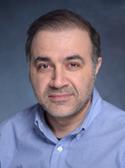
Fernando Lledo Macau is a Full Professor at the Department of Mathematics at University Carlos III of Madrid (UC3M) . His research focuses on Operator Algebras , Quantum Mechanics , and Spectral Theory , with applications to Graph Theory and Mathematical Physics . Recent publications highlight his work on spectral bracketing , magnetic graphs , and Følner sequences in operator algebras. He investigates discrete weighted graphs , quantum symmetries , and amenability in inverse semigroups. His 2025 article on Isospectral graphs and 2024 work on weighted digraphs reflect trends in geometric and spectral analysis. He supervises theses on topics like coarse geometry and magnetic Laplacian matrices , contributing to grants such as QUITEMAD-CM and 6G-INTEGRATION-3 . His collaborations span institutions in Barcelona , Durham , Münster , and ICMAT .
Karl Kunisch is University Professor at the Department of Mathematics and Scientific Computing, University of Graz , and simultaneously Scientific Director of the Radon Institute (RICAM) of the Austrian Academy of Sciences in Linz. A SIAM Fellow and recipient of the 2021 W.T. and Idalia Reid Prize, he leads the ERC Advanced Grant OCLOC and heads the research group “Optimization and Optimal Control”. Education: Dipl.-Ing. (1975), Dr. techn. (1978) and Habilitation (1980), Graz University of Technology Research Interests: His work centres on optimization and optimal control of partial differential equations , nonsmooth optimisation in function spaces , inverse problems and mathematical imaging , together with advanced numerical analysis . Current emphases are life-science applications , closed-loop control and machine-learning based feedback design. Publications Profile: With over 400 papers and two monographs, his recent output is dominated by high-impact studies on infinite-horizon optimal control , feedback stabilisation of semilinear parabolic and Navier–Stokes systems, risk-averse and data-driven control , and sparse control strategies . A clear trend is the fusion of rigorous PDE analysis with cutting-edge machine-learning techniques. Scientific Awards & Distinctions: W.T. and Idalia Reid Prize (2021) SIAM Fellow (2017) ERC Advanced Grant Horizon 2020 (2015) Alwin Walther Medaille (2008) ICM Invited Lecture, Hyderabad (2010) SIAM Outstanding Paper Prize (2006) Christian Doppler Laboratory Fellowship (1992) Fellowship of the Japanese Society for the Promotion of Science (1990) Max Kade Scholarship (1982/83) Fulbright Travel Grants (1979/80, 1985) Theodor-Körner-Fonds Research Award (1979) Pro Scienta Scholarship (1974–1977) Grants & Leadership: Principal Investigator, ERC Advanced Grant “ OCLOC – From Open to Closed Loop Control ” Scientific Director, Radon Institute (RICAM), Austrian Academy of Sciences Head of Research Group “Optimization and Optimal Control”, RICAM Co-Speaker, International Research Training Group IGDK Former member/consultant: MATHEON Scientific Advisory Board, Weierstrass Institute Scientific Advisory Board, Christian Doppler Forschungsgesellschaft Senate, DFG and INRIA evaluation boards Laboratory & Team: Prof. Kunisch currently leads the “Optimization and Optimal Control” group at RICAM, comprising post-docs, doctoral researchers and international visitors, focusing on interdisciplinary projects at the interface of PDE control, numerical optimisation and life sciences.
Cesar Cuenca is an Assistant Professor of Mathematics at The Ohio State University, within the Department of Mathematics, part of the College of Arts and Sciences. Previously, he was a Benjamin Peirce Fellow at Harvard University (2020–2023) and an Olga Taussky & John Todd Instructor at Caltech (2019–2020). He earned his PhD in Mathematics from MIT in 2019 under the supervision of Alexei Borodin. His research focuses on Probability Theory and Algebraic Combinatorics, with particular emphasis on random matrices, random partitions, symmetric functions, and asymptotic representation theory. His work bridges probability, combinatorics, and mathematical physics, exploring topics like Jack polynomials, integrable systems, and asymptotic analysis of random structures. His research is supported by an NSF grant (DMS-2348139, 2024–2027) and a Simons Foundation Travel Grant (MP-TSM-00006777, 2024–2029). His publications span theoretical developments in random matrix asymptotics, determinantal processes, and applications of symmetric function theory. Recent work includes studies on high-temperature particle systems, elliptic kernels, and deformation theories in representation spaces. Cuenca’s academic journey reflects a deep engagement with algebraic structures and probabilistic methods, with contributions to both foundational theory and interdisciplinary applications in mathematical physics.
Poul G. Hjorth is an Associate Professor in the Department of Applied Mathematics and Computer Science (DTU Compute) at the Technical University of Denmark (DTU). He specializes in dynamical systems, mathematical modeling, and industrial applied mathematics, with strong interdisciplinary ties to neuroscience and industrial problem-solving. He has held visiting positions at the University of Southern Denmark and maintains affiliations with the University of Copenhagen as an External Lecturer. Ph.D. in Mathematical Physics, University of California, San Diego (1988) cand.scient in Mathematics, University of Copenhagen (1982) His research focuses on mathematical physics, classical mechanics, dynamical systems, and geometry , particularly in real-world industrial applications. He has been instrumental in organizing the European Study Groups with Industry (ESGI) in Denmark and is Executive Director of the European Consortium for Mathematics in Industry (ECMI). His recent work includes modeling the glymphatic system and cerebrospinal fluid dynamics in the brain, contributing to neuroscience and medical research. The most recent publications reflect a shift toward interdisciplinary applications, especially in neuroscience, fluid dynamics, and environmental modeling , while maintaining a strong foundation in pure and applied mathematics. Themes include brain efflux, phytoplankton dynamics, and philosophical explorations of probability and cosmology. DTU Teaching Award (2010) Hjorth has supervised students and led multiple long-term research projects since the 1990s. He serves as Editor for the Danish Mathematical Society Newsletter Matilde and the Fields Institute journal Mathematics in Industry Case Studies . His collaborative network spans institutions in Denmark, Israel, the UK, and the USA, reflecting his international engagement in both research and academic service.
Prof. Dr. Margit Rösler is a Professor in the Department of Mathematics at the University of Paderborn, affiliated with the Faculty of Computer Science, Electrical Engineering and Mathematics. Her research focuses on Harmonic Analysis , Dunkl Theory , and Multivariable Special Functions , with significant contributions to representation theory and stochastic analysis. Current Projects: TRR 358 - Integral Structures in Geometry and Representation Theory Editorial Roles: Member of the editorial board for Studies in Applied Mathematics (SAPM), Guest Editor for SIGMA Special Issue on Dunkl Operators Her recent publications highlight connections between Dunkl operators, Macdonald polynomials, and Bessel functions, advancing harmonic analysis on root systems and symmetric cones. She teaches courses such as Theory of Dunkl Operators , Macdonald Polynomials Seminar , and Geometric and Harmonic Analysis . Scientific Awards: Studienstiftung des deutschen Volkes, Stiftung Maximilianeum Scholarship Academic Leadership: Co-editor of Travaux en Cours 71, Senior researcher in DFG Research Training Group Groups and Geometry
Dr. Guilherme Barros serves as a Research Fellow at the University of Newcastle within the School of Engineering and Centre for Geotechnical Science and Engineering, specializing in computational geomechanics and machine learning applications for rockfall hazard prediction. His academic credentials include: B.Sc. in Civil Engineering from Fluminense Federal University (UFF) M.Sc. in Civil Engineering from Pontifical Catholic University of Rio de Janeiro (PUC-Rio) Ph.D. in Civil Engineering from the University of Newcastle Barros' research centers on Modelling and simulation (30% focus), Geomechanics and resources geotechnical engineering (30%), and Deep learning (20%), with additional expertise in Granular mechanics and Solid mechanics. His work pioneers hybrid approaches combining physics-based numerical methods (BEM, DEM, FEM) with machine learning to address rockfall hazards in mining, seismic wave propagation in unbounded domains, and computational limit analysis. This interdisciplinary framework significantly enhances predictive accuracy for geotechnical risk assessment in complex terrain. His publication record reveals a clear trajectory toward advanced multi-scale numerical coupling, particularly BEM-DEM integration for dynamic geomechanical problems across 1D to 3D domains. These works address critical challenges in infinite domain modeling, wave propagation discontinuities, and rockfall fragmentation prediction, demonstrating strong applicability to mining safety and civil infrastructure resilience. His scientific recognition includes: AGS NSW Research Award (Australian Geomechanics Society, 2025) Barros has co-supervised two Master's students on rockfall analysis projects: one at the University of Parma investigating material layer impacts on hazard prediction, and another at Newcastle comparing machine learning techniques (Random Forest, KNN) for trajectory modeling. His international research network spans Brazil (6 publications), Australia (5), and Poland (5), supported by funding from the Australian Geomechanics Society. As an active contributor to the Centre for Geotechnical Science and Engineering, he develops computational frameworks for real-world mining safety challenges, with current projects focusing on machine learning-enhanced rockfall prediction systems for NSW and QLD open-pit mines.
Lionel J Mason is a Professor of Mathematics at the University of Oxford and a Tutorial Fellow at St Peter's College. His research focuses on mathematical physics, particularly twistor theory and its applications to general relativity, quantum theory, string theory, and scattering amplitudes. He has contributed to advancements in ambitwistor string theory and the study of integrable systems. University of Oxford, Mathematical Institute Tutorial Fellow, St Peter's College Mason's work bridges complex geometry and theoretical physics, with recent publications exploring curved twistor spaces, celestial charges, and gauge-gravity dualities. His research has been cited in high-energy physics and mathematical physics journals. Scientific awards include the Leverhulme Senior Research Fellowship (2005–2006) and Leverhulme Research Fellowship (2011–2013). His publications often address connections between twistor theory, integrable systems, and quantum field theory.
Prof. Dr. Thomas Schmidt is a full-time Professor for Geometric PDEs at the University of Hamburg , affiliated with the Department of Mathematics under the Faculty of Mathematics, Informatics and Natural Sciences . He leads the research group on Geometric Partial Differential Equations , focusing on calculus of variations, nonlinear PDEs, geometric measure theory, and regularity theory. Education: Diplom in Mathematics (2004, HHU Düsseldorf), Doctor in Mathematics (2006, HHU Düsseldorf), Habilitation in Mathematics (2015, FAU Erlangen-Nürnberg). Career: Appointed as W2 Professor at University of Hamburg since 2016; postdoctoral positions at SNS Pisa, University of Zurich (2011–2013), and FAU Erlangen-Nürnberg (2008–2016). His research investigates boundary/obstacle problems for BV functions, currents near the Plateau problem, least gradient problems, Mumford-Shah functionals, quasiconvex integrals, and PDEs with degenerate ellipticity. Recent work includes existence theory for linear-growth functionals with signed measures, optimal Hölder exponents in Massari-type theorems, and duality frameworks for BV minimizers. Publications span journals like Advances in Calculus of Variations , Mathematische Annalen , and J. Lond. Math. Soc. . Key trends in his publications involve geometric measure theory, regularity analysis, and convex duality. His group addresses existence/uniqueness of generalized solutions, L p estimates, and partial regularity. He has collaborated with researchers such as Eleonora Ficola, Jule Helena Schütt, and Christoph Scheven. For administrative support, contact his team assistant Katrin Kopp at the department office.
René Hosfeld is a Research Associate in the Department of Numerical Mathematics at the Institute of Mathematics, Technical University of Berlin (since December 2023). His work focuses on infinite-dimensional systems and control theory within functional analysis and operator theory frameworks. His educational background includes a Master of Science in Mathematics (2017-2019) and Bachelor of Science in Mathematics (2014-2017), both from the University of Wuppertal. He is currently completing his doctorate at the University of Wuppertal (scheduled February 2025), with prior research stays at the University of Bordeaux (2021-2022) and University of Hamburg (2020-2022). Hosfeld's research centers on stability analysis of infinite-dimensional control systems, particularly examining input-to-state stability for bilinear systems with unbounded operators, Orlicz space admissibility characterizations, and funnel control methodologies. His recent publications demonstrate strong integration of functional analytic techniques with control-theoretic problems, often addressing challenges in semilinear dynamics and evolution equations. His publication trends reveal consistent focus on stability theory for infinite-dimensional systems, with increasing sophistication in handling unbounded operators and nonlinear dynamics. Recent works bridge abstract operator theory with concrete applications in PDE control, particularly through bilinear system analysis and Orlicz space generalizations of classical Lp frameworks. SS25: Assistant for Linear Algebra I for Mathematicians (TU Berlin) WS 24/25: Assistant for Numerical Mathematics I (TU Berlin) SS24: Assistant for Functional Analysis I (TU Berlin) WS 22/23: Assistant for Analysis 1 and Linear Algebra for Engineers (TU Berlin) DFG Project JA735/18-1/SCHW 2022/2-1: "Evolution equations: input functions and stability" (2020-2023) Hosfeld works within the Numerical Mathematics department's research ecosystem at TU Berlin, collaborating closely with Professor Birgit Jacob and Felix Schwenninger. His office (MA 470) is situated in the main mathematics building at Straße des 17. Juni 136, where he maintains regular office hours on Tuesdays from 12:00-13:00.
Selcuk Koyuncu is an Associate Professor in the Department of Mathematics at the University of North Georgia. His work focuses on advanced matrix theory, topology, operator theory, and combinatorial mathematics. He holds a prominent role in the Mathematics academic programs, contributing to both research and education. His research interests include structural analysis of matrices (e.g., Toeplitz, centrosymmetric, doubly stochastic), topological properties of mathematical objects, and applications in fields like evolutionary biology and signal processing. He has published extensively in journals covering matrix theory, combinatorics, and operator theory. Recent work explores topics such as extreme points of matrix polytopes, sub-defect variations in substochastic matrices, and Lie group structures of Toeplitz operators. His contributions have addressed applications ranging from numerical methods to algebraic topology. Dr. Koyuncu has no listed scientific awards or grants in the provided information. He can be contacted at selcuk.koyuncu@ung.edu and is located in the Watkins Academic Building, Gainesville campus.
Professor Hugues MOUNIER is affiliated with Paris Saclay University and the Laboratoire des Signaux et Systèmes (L2S) at CentraleSupélec. His primary role is as a Professor leading the COMEDY team, focusing on control systems and their applications. He has been a permanent member of L2S since 2010 and joined Paris Saclay University in 2008. His research spans theoretical and applied domains: differential flatness (for nonlinear and infinite-dimensional systems), Liouvillian systems, controllability/observability properties, and applications in contemplative neuroscience, physiological systems, and engineering systems like drilling, automotive, and network control. He leads the ANR project MindMadeClear, integrating mathematical models for meditation practices with physiological and phenomenological analysis. Key contributions include modeling oilwell drilling vibrations, model-free control strategies for vehicles and data centers, and neuroscientific studies using EEG classification for meditation states. His work bridges abstract theory (e.g., flatness analysis for HPA axes) with real-world applications (e.g., congestion control, energy management). He collaborates internationally, presenting at venues like ECC, IFAC, and IEEE conferences. His lab teams include SYCOMORE and MODESTY, focusing on dynamical systems modeling and estimation. No awards are explicitly listed, but his extensive peer-reviewed publications reflect sustained academic impact.
Gloria Marí Beffa is a Professor of Mathematics and Associate Dean for Research in the College of Letters and Science at the University of Wisconsin–Madison. She has held significant leadership roles, including Chair of the Mathematics Department (2014–2018) and Interim Associate Dean for Research (2020–2023). Her academic home is the Department of Mathematics, where she conducts research and contributes to academic governance. Ph.D. in Mathematics, University of Minnesota–Twin Cities, 1991 Licenciatura, Universidad de Málaga, Spain, 1985 Her research lies at the intersection of geometry and integrable systems, focusing on discrete and continuous geometric flows, Poisson structures, differential invariants, and moving frames. She investigates the algebraic and geometric foundations of integrable systems, especially through the lens of Lie group actions and invariant theory. Her work connects abstract mathematical structures to concrete geometric evolutions, such as the pentagram map and its generalizations. The recent publications highlight a consistent focus on discrete integrable systems, particularly lattice W-algebras, twisted polygons, and discrete moving frames. These works reveal deep connections between algebraic structures (like Adler-Gel'fand-Dikii brackets) and geometric configurations (like centro-affine polygons). The trend shows increasing sophistication in discrete geometry and its application to soliton theory and Hamiltonian systems. Letters and Science Academic Staff Excellence Mid-Career Award, 2006 Letters and Science Faculty Advising Award, 2007–08 Philip R. Certain Award, 2011–12 Simons Fellowship, 2012–13 Gloria Marí Beffa has advised numerous students and collaborated widely, including with Elizabeth Mansfield and Anton Izosimov. She has secured prestigious recognition and funding, such as the Simons Fellowship, supporting her research in integrable systems and geometric invariants. Her leadership roles reflect her significant contributions to both research and academic service. She leads or participates in interdisciplinary initiatives connecting geometry, algebra, and computational mathematics. She is actively involved in research groups and seminars focused on symmetry, integrability, and geometric methods. Her collaborations span institutions in the U.S., Europe, and Mexico. She frequently presents at international conferences and workshops on integrable systems and differential geometry. Her work contributes to foundational developments in discrete differential geometry and its applications.
Professor Jan Grabowski is a faculty member at Lancaster University’s School of Mathematical Sciences, holding the title of Professor of Algebra since August 2024. His research focuses on quantum algebra, Lie alge0bras, cluster algebras, and their connections to mathematical physics, including Verlinde algebras and quantum cohomology. PhD in Mathematics, Queen Mary, University of London (2006) MMath(Hons), University of Warwick (2002) PGCert in Academic Practice, Lancaster University (2013) Jan’s work explores noncommutative algebraic structures through quantum deformations of classical objects, such as quantum cluster algebras and quantized coordinate rings. His recent projects include Schubert calculus via cluster categories and combinatorial methods in representation theory. His research outputs include studies on quantum Grassmannians, cluster maps, and Braided Lie bialgebras. He has secured grants from EPSRC, Marie Curie, and the London Mathematical Society, and serves as Subject Editor for the Glasgow Mathematical Journal. Scientific Awards: EPSRC Small Grant EP/W017881/1 (£33,573) Marie Skłodowska-Curie Fellowship COMBGEOREP (€212,934) EPSRC First Grant EP/M001148/1 (£98,663) LMS Scheme 1 Conference Grant (£2,567.80) Grabowski supervises PhD students like Thomas Booker-Price and Wookyung Kim, with interests in quantum groups, cluster algebras, and integrable systems. He is part of Lancaster’s Algebra and Geometry research group and contributes to non-associative algebra and homological methods in representation theory seminars.
Prof. dr. Sjoerd Verduyn Lunel is a Professor at the Mathematical Institute within the Faculty of Science at Utrecht University. He also serves as Research Director at ASML and has held leadership roles at Leiden University, including Dean of Science (2007-2013) and Scientific Director of the Mathematical Institute (2014-2018). His research spans analysis, dynamical systems, and applied mathematics. His research areas include Mathematical modeling of complex systems Applying data science to biological dynamics Stability analysis in nonlinear differential equations Development of numerical methods for delay equations His recent publications focus on delay differential equations, stochastic stability, and applications in biophysics and oncology. Key journals include SIAM Journal on Applied Dynamical Systems , Journal of Differential Equations , and Radiation and Environmental Biophysics . Notable scientific awards : Elected member of the Royal Holland Society of Sciences and Humanities (2012) He has advised numerous PhD students and collaborated on interdisciplinary projects, integrating mathematical analysis with biomedical and industrial applications. His editorial roles include Associate Editor, SIAM Journal on Mathematical Analysis Member of multiple editorial boards
Brendan Kinnane Beare is a Professor of Econometrics at the University of Sydney , affiliated with the School of Economics under the Faculty of Arts and Social Sciences. His research focuses on econometric theory, time series analysis, copula modeling, and stochastic processes. Education: PhD in Economics (2007) from Yale University Research areas: Time series, copulas, Markov modulation, unit root testing, financial econometrics Recent work includes stochastic arbitrage with options, Pareto exponents in economic models, and tests for copula symmetry Beare's publication trends span econometric theory, applied statistics, and financial modeling, with a focus on mathematical rigor and empirical relevance. He teaches undergraduate and postgraduate econometrics courses and participates in international seminars on unit roots and cointegration.