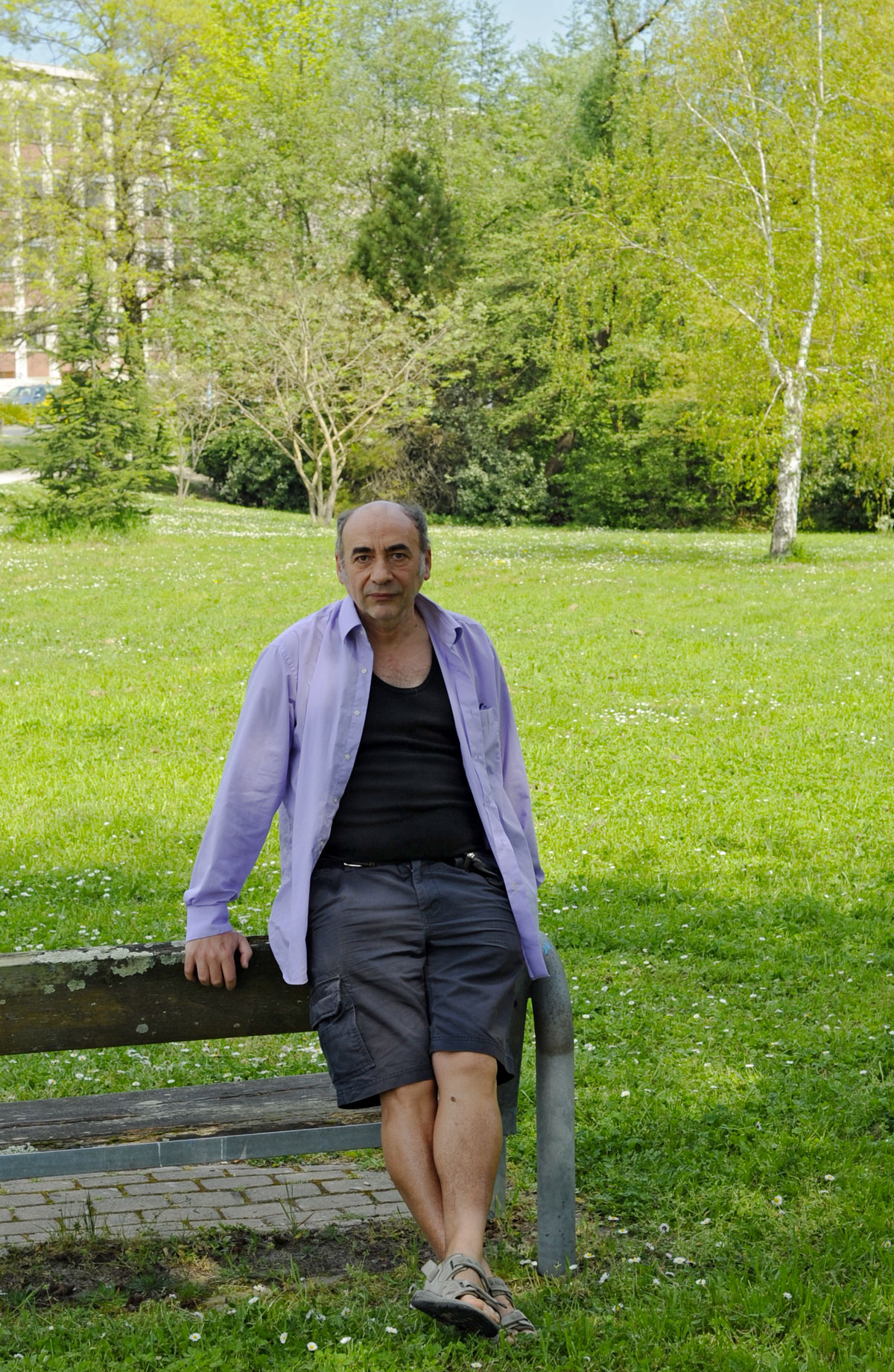
Pierre Castéran is a Professor at the University of Bordeaux, affiliated with the LaBRI (Laboratoire Bordelais de Recherche en Informatique). He is a co-author of Coq'Art , the first book on the Coq Proof Assistant, and has contributed extensively to its development through tutorials, technical papers, and research projects. His work includes exploring Hydra Battles and ordinal notations in Coq, as well as foundational contributions to type classes, inductive definitions, and epsilon operators. ACM Software System Award (2013) for Coq development His research interests span formal verification, mathematical logic, proof assistants, and the intersection of computer science with discrete mathematics. He has led projects like A3PAT (Assisting Proof Assistants) to enhance automation in formal methods. His technical work includes defining recursive path orderings, denumerable sets, and axiomatic presentations of ordinals. Collaborations include Yves Bertot ( Coq'Art ), Evelyne Contéjean (rpo termination proofs), and Matthieu Sozeau (type classes). He has created educational materials for Coq, including tutorials for Type Classes and inductive types, with examples updated across Coq versions.
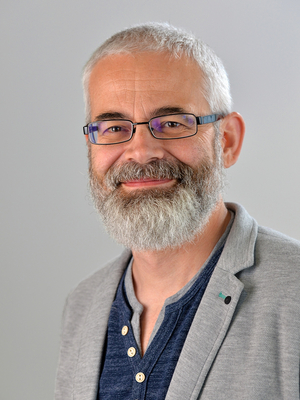
Jérôme Leroux is a Directeur de Recherche (DR CNRS) at the Laboratoire Bordelais de Recherche en Informatique (LaBRI) , affiliated with the University of Bordeaux , France. His research focuses on formal verification of infinite-state systems, vector addition systems, Presburger arithmetic, and acceleration techniques for symbolic computation. Key research themes include: Vector Addition Systems (VASS) and Petri Nets Automata-based representations for Presburger arithmetic Abstract interpretation and CEGAR frameworks Verification of asynchronous distributed systems His recent publications highlight work on acceleration techniques for convex binary relations, serialized digit automata, and regular acceleration methods for number decision diagrams. These contributions are implemented in tools like the Talence Presburger Arithmetic Suite (TAPAS) and the FAST tool for symbolic verification. Scientific awards include a Best Paper Award at TURING'100 . He has advised several Ph.D. students and postdoctoral researchers, including Alexander Heußner and Thibault Hilaire (current Ph.D. candidate). Leroux is actively involved in organizing conferences like MFCS'23 and serving on program committees for venues such as VMCAI'26 .
Professor Ute Schmid is a Full Professor of Cognitive Systems at the University of Bamberg, where she has been a faculty member since September 2004. She leads the Cognitive Systems Group within the Bamberg Center of AI (BaCAI), focusing on creating AI systems that generate human-like explanations and reasoning processes. Her research bridges cognitive science and artificial intelligence to develop methods for explanation generation, inductive programming, and interactive machine learning. Professor Schmid's work emphasizes practical applications of explainable AI across diverse domains including image classification, medical diagnosis, and educational technologies. Her research on contrastive explanations, near misses, and human-AI alignment has significantly advanced the field of XAI. She has also pioneered research on AI literacy, recognizing the growing importance of basic AI understanding for responsible tool usage by non-experts. Her publication record demonstrates exceptional productivity and impact, with numerous articles in top-tier venues including Nature Machine Intelligence, IEEE Transactions on Visualization and Computer Graphics, and the Journal of Web Semantics. Her 2025 paper 'Aligning generalization between humans and machines' represents a significant theoretical contribution to understanding human-machine cognitive alignment. Professor Schmid actively contributes to gender diversity research in computer science through studies examining why women pursue PhDs in the field. She has also made important contributions to computing education, investigating how students acquire programming skills and how AI tools like code generators are integrated into learning processes. As an educator and researcher, Professor Schmid maintains strong international collaborations, with co-authors spanning multiple countries and institutions. Her interdisciplinary approach is evident in her diverse publication venues and collaborative work that bridges computer science, cognitive science, education, and application domains.
Professor Christian Wiesner is a University Professor of Relationship and Developmental Pedagogy as well as Pedagogy of Diversity at the University College of Teacher Education Lower Austria (Pädagogische Hochschule Niederösterreich). He serves as Academic Director of the university course with Master's degree "Pedagogy of Diversity - emotional, prosocial and social development." Previously, he was responsible for the review of educational standards in Austria at the Austrian Federal Institute for Educational Research, Innovation and Development (BIFIE). His academic affiliations span multiple institutions including the University of Vienna, University of Salzburg, University of Innsbruck, and University of Music and Performing Arts Vienna. Professor Wiesner's research focuses on developmental pedagogy, relationship pedagogy, diversity education, mentoring, educational leadership, and transformative learning. His work integrates phenomenological approaches with attachment theory to understand educational processes, particularly examining the didactic triangle, student-teacher relationships, and professional identity development. A member of both the Society for New Phenomenology and the International Ernst Cassirer Society, his theoretical framework draws heavily on semiotics and phenomenology. Analysis of his recent publications (2023-2024) reveals a strong emphasis on care ethics, futures literacy, teacher well-being, and social-emotional learning. His research consistently bridges theoretical frameworks with practical applications in educational settings, with particular attention to evidence-based approaches to school development and mentoring practices. The work shows increasing collaboration with international researchers across Europe, particularly in projects focused on teacher well-being and social-emotional learning interventions. Jurymitglied Medida-Prix 2003, Mediendidaktischer Hochschulpreis der Gesellschaft für Medien in der Wissenschaft (GMW) Professor Wiesner actively supervises research through multiple funded projects including OPEN2chat (2020-present), COMET for Kids (2023-2026), and Teaching to be (Erasmus+ Project, 2021-2024). His mentoring approach emphasizes relational aspects of professional development, viewing mentoring as "a space of possibility" that fosters both personal and professional growth. As Academic Director of the Master's program in Pedagogy of Diversity, he oversees a significant graduate education program focused on emotional, prosocial, and social development. Professor Wiesner leads the OPEN2chat research platform, which serves as a hub for his work on relationship pedagogy, mentoring, and care ethics in educational contexts. This platform connects multiple research projects focused on social-emotional learning, teacher well-being, and evidence-based educational practices. His team includes collaborators from Karl Landsteiner University of Health Sciences, Caritas Niederösterreich, and the Ludwig Boltzmann Gesellschaft, reflecting the interdisciplinary nature of his work.
Dr. Abdelhakim SAIM serves as a Senior Lecturer in the Department of Electrical Engineering at Polytech Nantes, University of Nantes, where he teaches Power electronics, analog electronics, electrical system control, and introduction to Smart Grids. His academic home is the Department of Electrical Engineering within Polytech Nantes at the Gavy Campus in Saint-Nazaire. Dr. Saim's research focuses on the control of electrical microgrids, power electronic converters, power quality and stability of microgrids, and maritime microgrids. His work bridges theoretical control strategies with practical implementation, addressing critical challenges in renewable energy integration and grid stability. He has developed advanced control methodologies including adaptive fuzzy control, fractional controllers, and virtual impedance techniques to enhance microgrid performance. Analysis of his publication trends from 2016-2026 reveals a consistent research trajectory with increasing emphasis on AI applications for microgrid design, maritime electrical systems, and optimal energy management in multi-energy systems. His work spans theoretical control algorithms to practical implementation in renewable energy systems, with particular attention to stability challenges in islanded operations. Dr. Saim maintains an active research program with numerous collaborations, particularly with Josep M. Guerrero, Azeddine Houari, and Mohamed Machmoum. His supervision likely focuses on graduate students working on microgrid control systems, power electronics, and renewable energy integration. While specific grant information isn't detailed, his continuous publication record suggests ongoing research funding. His research group appears to focus on practical implementation of advanced control strategies for electrical systems, with growing interest in maritime applications and AI-enhanced microgrid management. Students in his group would gain expertise in both theoretical control methods and hands-on implementation of power electronic systems for modern energy applications.
Dr. Juan Shi is an Associate Professor at Victoria University's College of Sport, Health & Engineering, where she has held academic positions since 1994, progressing from Lecturer to Senior Lecturer and ultimately Associate Professor in 2016. With a PhD in Electrical Engineering from VU (1995) and over 100 peer-reviewed publications, her research focuses on intelligent control systems, renewable energy integration, and power system stabilization. Research Interests: Dr. Shi's expertise spans intelligent control applications, power system stability enhancement, battery energy storage optimization for grid support, fuzzy logic controllers, and renewable energy microgrid design. Her recent work emphasizes practical solutions for integrating solar/wind energy with battery storage systems. Teaching & Awards: She coordinates multiple engineering courses including Control Systems and Fuzzy Logic applications. Her teaching excellence has been recognized with the Vice-Chancellor's Award (2014) and a national teaching citation from the Australian Government (2015). Awards: Vice-Chancellor's Excellence in Learning and Teaching Award (2014) National Citation for Outstanding Contribution to Student Learning (2015) Student Supervision: Has graduated 2 PhD and 2 Master's students, currently advising 4 PhD candidates on renewable energy and control systems projects. As WISE coordinator, she actively supports female engineering students through mentorship programs.
Zachary Kincaid is an Associate Professor at Princeton University, specializing in Programming Languages and Formal Methods . His work bridges Program Analysis , Static Analysis , and Concurrency , with a focus on compositional and robust methods. Email: zkincaid@cs.princeton.edu Office: 194 Nassau St, Room 230 (Second floor), Princeton, NJ 08540 His research in Algebraic Program Analysis and Robust Program Analysis explores scalable, predictable verification techniques. Recent work includes leveraging Vector Addition Systems for procedure summarization, Nonlinear Ranking Functions for termination, and Quantified Linear Arithmetic for satisfiability. Selected Trends : Compositional Analysis via Algebraic Structures Termination & Invariant Synthesis Concurrency Verification Network Relational Analysis Scientific Awards : NSF CAREER award 1942537 Students : Jake Silverman Nicolas Koh Nikhil Pimpalkhare
Işıl Dillig is an Associate Professor of Computer Science at the University of Texas at Austin, where she leads the UToPiA research group. Her academic career spans over a decade of significant contributions to programming languages research, particularly in program analysis, verification, and synthesis. Dr. Dillig received all her academic degrees (BS, MS, and PhD) from Stanford University before joining the faculty at UT Austin. Her educational background established the foundation for her innovative research approach that bridges theoretical computer science with practical applications. Her research focuses on developing techniques to make software systems more reliable, secure, and easier to build through advanced program analysis, verification, and synthesis methods. She has pioneered approaches that combine symbolic reasoning with machine learning to tackle complex software engineering challenges across multiple domains including security, databases, and programming language theory. Her work demonstrates exceptional depth in creating practical tools that address real-world software development problems while maintaining strong theoretical foundations. Analysis of Dr. Dillig's publication record reveals a consistent trajectory of innovation in program synthesis, with recent work expanding into neurosymbolic approaches that bridge neural networks with formal methods. Her research shows strong connections between theoretical foundations and practical applications, particularly in security-critical systems, database technologies, and blockchain applications. The evolution of her work demonstrates increasing sophistication in handling complex program structures while maintaining practical usability. Dr. Dillig has received prestigious recognition for her research contributions: Sloan Fellowship NSF CAREER award As a dedicated educator and research leader, Dr. Dillig has served in significant roles including Program Chair for PLDI 2022 and Steering Committee member for PLDI. She has mentored numerous students through her UToPiA research group, guiding research in program synthesis, verification, and analysis. Her work has been supported by substantial research grants that have enabled innovative projects at the intersection of programming languages and security. Dr. Dillig leads the UToPiA (UT Austin Programming, Languages, and Analysis) research group, which focuses on developing novel techniques for program analysis, verification, and synthesis. The group maintains strong collaborations with industry partners and academic institutions worldwide, translating theoretical advances into practical tools that address real software engineering challenges.
Shachar Itzhaky is an Associate Professor in the Department of Computer Science at Technion - Israel Institute of Technology, Haifa. His research spans multiple areas of programming languages, formal methods, and software engineering, with a focus on making program development and verification more accessible and efficient. He has served on program committees for numerous prestigious conferences including PLDI, POPL, SPLASH, and ICFP. Dr. Itzhaky's research interests center around program synthesis, automated reasoning, and formal verification. His work in program synthesis explores techniques for automatically generating programs from high-level specifications, with applications in end-user programming and software development. In automated reasoning, he has made significant contributions to e-graph based reasoning, invariant inference, and property-directed verification. His research in formal methods focuses on practical applications for program verification, particularly for data structures and security properties. An analysis of his recent publications reveals a strong focus on leveraging advanced formal techniques for practical program understanding and generation. His work consistently bridges theoretical foundations with practical applications, particularly in program synthesis, verification, and end-user programming tools. The trend shows increasing integration of machine learning techniques with traditional formal methods, as well as expanding applications to security and privacy domains. ACM SIGPLAN John C. Reynolds Doctoral Dissertation Award Dr. Itzhaky has been actively involved in the programming languages research community, serving on numerous program committees and contributing to the advancement of formal methods and program synthesis. His work has practical implications for software development tools, security analysis, and end-user programming environments. While specific grant information isn't detailed in the provided text, his extensive publication record in top-tier venues suggests successful funding for his research endeavors. His work on projects like Object Spreadsheets and Lifty demonstrates a commitment to creating practical tools that address real-world programming challenges. Dr. Itzhaky's research is conducted within the vibrant programming languages and formal methods group at Technion's Computer Science department. His work intersects with multiple research threads including program synthesis, verification, and security, suggesting collaboration across these areas within the department. His tools like EPR-based Verification, PDR∀, and VeriCon represent significant technical contributions that likely form the basis of ongoing research projects with students and collaborators.
Ranjit Jhala is a Professor of Computer Science Engineering in the Jacobs School of Engineering at the University of California, San Diego. His research focuses on building reliable computer systems through programming languages and software engineering techniques. His primary research interests include Programming Languages, Formal Verification, and Software Engineering. He draws from and contributes to areas such as Type Systems, Model Checking, Program Analysis, and Automated Deduction, bridging theoretical foundations with practical implementations for real-world software development. Prof. Jhala's publication record shows a consistent trajectory in refinement type systems, evolving from Liquid Haskell to Flux for Rust, while also exploring neurosymbolic approaches to error repair and type error diagnosis. His work demonstrates a commitment to making formal verification techniques accessible to practitioners. He leads the Programming Systems Group at UCSD, mentoring graduate students and collaborating with researchers across the programming languages community. His service includes General Chair roles for POPL 2018 and PLDI 2022, reflecting his leadership position in the field. Prof. Jhala is also known for his mentoring activities, including talks on academic presentation skills and participation in ICFP's mentoring programs for students and early-career researchers.
Nadia Polikarpova is an Associate Professor in the Computer Science and Engineering Department at the University of California, San Diego. She leads the Programming Systems group and serves as a member of IFIP Working Group 2.8 on Functional Programming since 2022. Her academic journey includes a PhD from ETH Zurich (Switzerland) under Bertrand Meyer's supervision in 2014, followed by postdoctoral work at MIT CSAIL with Armando Solar-Lezama. Her research interests center around program synthesis, program verification, and type systems, with a focus on building practical tools that enhance software security and reliability. Polikarpova's work bridges theoretical foundations with real-world applications, particularly in the emerging area of AI-assisted programming. Her recent publications demonstrate a strong trajectory in program synthesis techniques, with increasing integration of machine learning approaches. The research spans from foundational type-driven synthesis methods to practical applications for validating AI-generated code and synthesizing heap-manipulating programs. Her work frequently appears in top-tier programming languages venues including PLDI, POPL, ICFP, and OOPSLA. 2020 Sloan Fellow 2020 Intel Rising Stars Award 2020 NSF CAREER Award Distinguished paper awards at PLDI'21, ICFP'20, and POPL'19 Best paper award at FM'15 Polikarpova actively mentors PhD students and has advised numerous graduates who now work at Microsoft Research, University of Michigan, and various tech companies. She teaches core programming languages courses including CSE 130 and specialized graduate courses on program synthesis (CSE 291). Her service to the community includes program committee roles for major conferences and co-chairing the Haskell conference in 2022.
Ilya Sergey is an Associate Professor at the National University of Singapore (NUS) School of Computing, with previous faculty appointments at University College London (2015-2018). His academic career spans multiple prestigious institutions including IMDEA Software Institute (postdoctoral position) and KU Leuven (PhD). His educational background includes a PhD in Computer Science from KU Leuven (2012), an MSc in Mathematics and Computer Science from Saint Petersburg State University (2008), and professional experience as a software engineer at JetBrains prior to academia. Sergey's research focuses on the intersection of programming language theory and practical software verification, with particular emphasis on concurrent systems , smart contracts , and program synthesis . His work bridges theoretical foundations in type theory and separation logic with practical applications in blockchain technology and Rust programming. He has developed novel techniques for verifying heap-manipulating programs, analyzing commutativity in distributed transactions, and synthesizing correct-by-construction code. Analysis of his recent publications reveals a clear trajectory toward practical verification of blockchain systems and concurrent data structures, with increasing focus on Rust programming language applications. His work demonstrates consistent innovation in mechanized reasoning techniques while maintaining relevance to real-world software challenges, particularly in the domains of smart contracts and distributed systems. Sergey maintains an active research group at NUS, as evidenced by his social media references to lab traditions and student collaborations. He frequently participates in major programming languages conferences as both author and committee member, serving in leadership roles including General Chair for ICFP 2025. His research lab follows distinctive traditions, including location-based Mattermost status updates when traveling. Sergey is deeply engaged with the programming languages community through conference organization, mentoring activities, and outreach initiatives such as nature walks for conference attendees.
Stacey Allred serves as Assistant Professor in the Department of Education at Taylor University, bringing over 25 years of professional experience in educational practice and research. Her expertise spans classroom management, special education, and community engagement initiatives. Her academic credentials include: Educational Administration Licensure from Ball State University Director of Exceptional Needs Licensure from Ball State University MA in Learning Disabilities from Ball State University BS in Elementary Education from Ball State University Dr. Allred's research centers on evidence-based classroom management techniques, including proximity strategies and the Responsive Classroom Approach. She maintains strong specialization in special education accommodations, summer learning program development, and family-school partnership frameworks. Her work emphasizes practical applications for K-12 educators through teacher training and resource development. Her publication record demonstrates consistent focus on classroom management fundamentals, with encyclopedia contributions analyzing established methodologies and co-authoring implementation guides for foundational teaching practices. These works collectively address teacher preparation for classroom climate establishment and behavioral support systems. Recognition includes: Faculty Immersive Learning Award (2019) Departmental Teaching Award (2019) Multiple Ball State University Excellence in Teaching Award nominations (2014-2022) Panhellenic Council Teaching Excellence Awards (2014, 2015) Departmental Award for Outstanding Teaching (2012) She has secured $150,000+ through 11 funded grants as PI/Co-PI and co-developed Delaware County's elementary summer camp program. Her professional engagement extends to camp education through American Camp Association membership and therapeutic animal-assisted learning with her certified therapy dog Izzy. Dr. Allred maintains active involvement in educational communities through Kappa Delta Pi (2018) and ASCD (2016-2019), while continuing agility training with Izzy for therapeutic school visits and dog sports competitions.
Bernd Fischer is a Professor and the current Head of Division in the Division of Computer Science at Stellenbosch University, South Africa. Previously, he held positions at TU Braunschweig, NASA Ames Research Center, and University of Southampton, establishing a strong international academic background in software engineering and formal methods. Professor Fischer's research focuses on automated software engineering, particularly logic-based techniques. His work spans specification-based component reuse, program synthesis, and program verification, with current emphasis on annotation inference, software model checking, and human-oriented presentation of verification results. His research bridges theoretical foundations with practical applications, particularly in concurrent program verification, grammar-based testing, and fault localization techniques. His work has significant implications for improving software reliability and developer productivity. Analysis of his recent publications reveals a strong focus on concurrent program verification through lazy sequentialization techniques, with substantial contributions to tools like CSeq and ESBMC. His research demonstrates consistent innovation in software verification, particularly in addressing the challenges of concurrency, bounded model checking, and fault localization. The interdisciplinary nature of his work connects theoretical computer science with practical software engineering challenges. ASE 2012 Most Influential Paper Award ACM Distinguished Paper Award Best Presentation Award Professor Fischer has successfully advised PhD students including Gillian Greene, who defended her thesis on "Concept-Based Exploration of Rich Semi-Structured Data Collections," and Geoff Birch, who completed work on "Fast, Fully-Automated, Model-Based Fault Localisation and Repair with Test Suites as Specification." His mentoring approach integrates theoretical rigor with practical tool development. His research has been supported through various academic grants enabling the development of multiple software verification tools. Professor Fischer leads development of several important software engineering tools including AutoBayes for statistical program synthesis, ConceptCloud for interactive visualization of software repositories, CSeq for concurrent program verification, and ESBMC for software model checking. These tools represent significant contributions to the software engineering research community and have been recognized in international verification competitions.
Kate Hyde, PhD, is an Associate Professor in the Department of Biochemistry and Molecular Biology at the University of Nebraska Medical Center (UNMC) College of Medicine. She also serves as Associate Director for Shared Resources at the Fred & Pamela Buffett Cancer Center. Her laboratory investigates molecular mechanisms of acute myeloid leukemia (AML), with emphasis on chromosome 16 inversion (Inv(16))-driven AML and the oncogenic fusion protein CBFβ-SMMHC. Education includes: Bachelors of Arts in Biology from Washington University in St. Louis PhD in Cellular and Molecular Biology from University of Wisconsin-Madison Post-doctoral fellowship at National Human Genome Research Institute, NIH Her research integrates: Leukemia and normal blood development pathways Regulation of gene expression in hematological malignancies Development of targeted therapies using mouse models and drug delivery systems She collaborates extensively, including projects with UNMC College of Pharmacy on polymeric CXCR4 inhibitors. Recent publication trends (15 most recent) focus on: Leukemia stem cell persistence mechanisms in bone marrow CXCR4-targeted drug delivery systems Epigenetic regulators (HDAC1) and metabolic dependencies in AML Novel therapeutics like liposomal miR-497-5p/venetoclax combinations RUNX1/CBFβ-SMMHC transcriptional networks Dr. Hyde actively mentors students interested in leukemia research and encourages inquiries about lab opportunities.