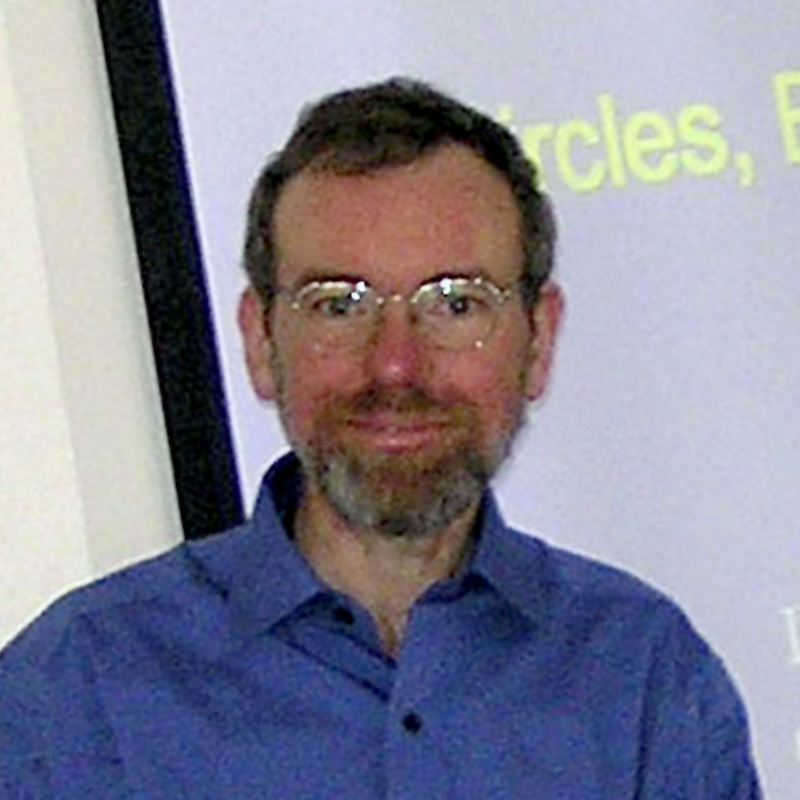
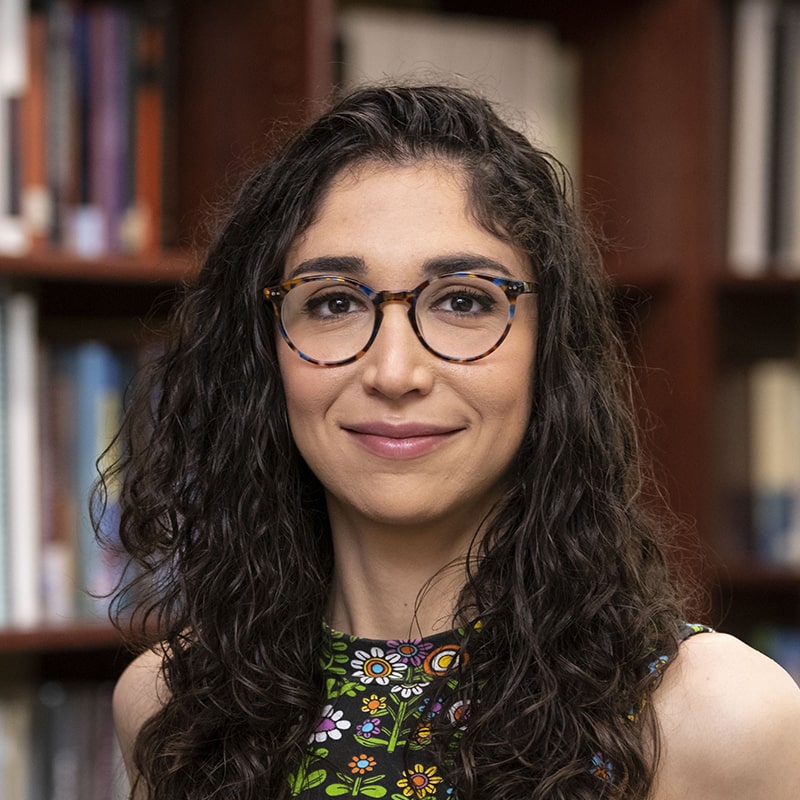
Kevin Kelly is a Professor of Philosophy at Carnegie Mellon University and the Director of the Center for Formal Epistemology. His work bridges formal epistemology, computational learning theory, and philosophy of science, with a focus on Ockham's razor, belief revision, and the topology of inquiry. Key Research Areas: Ockham's Razor, Epistemology, Formal Learning Theory, Modal Epistemic Logic, and Interdisciplinary Applications of Topology. Grants: John Templeton Foundation grant for research on truth-finding efficiency and scientific simplicity. Scientific Awards: John Templeton Foundation grant (2018–2021) Kelly's publications emphasize connections between probabilistic reasoning and qualitative belief, solutions to the lottery paradox, and computational models of knowledge acquisition. His recent work explores lighting design, human-centric ergonomics, and machine learning epistemology, reflecting a deep interdisciplinary engagement with technology and science.
Francesca Zaffora Blando serves as an Assistant Professor in the Department of Philosophy at Carnegie Mellon University's Dietrich College of Humanities and Social Sciences. Her academic profile bridges rigorous formal methods with foundational questions in epistemology and scientific methodology. Her educational trajectory includes: Ph.D. in Philosophy and Symbolic Systems, Stanford University (2020) M.Sc. in Logic, Institute for Logic, Language and Computation, University of Amsterdam M.A. in Philosophy, University of Edinburgh Zaffora Blando's research centers on algorithmic randomness —a computability-theoretic framework for patternless sequences—and its implications for inductive learning and Bayesian inference . She investigates how algorithmically random data streams constrain the learning performance of computationally bounded agents, revealing deep connections between randomness, convergence to truth, and probabilistic reasoning. Her work spans modal logic applications in dynamic epistemic scenarios and historical analyses of probability theory from von Mises to contemporary formalizations. Her publication record (2015-2025) demonstrates sustained innovation at the intersection of computability and epistemology, with increasing focus on Schnorr randomness, Bayesian consistency, and learning-theoretic characterizations. Key themes include the role of randomness in merging opinions, disintegration of measures, and historical evolution of randomness concepts. She actively contributes to the Center for Formal Epistemology through event organization including the Pittsburgh Formal Epistemology Workshop (PFEW), the September 2024 Workshop on Chance, Credence, Computation, and Progic 2025—the Twelfth Workshop on Combining Probability and Logic with special focus on theoretical learning approaches.
Andrej Risteski is an Associate Professor at the Machine Learning Department of Carnegie Mellon University (CMU) since 2025. He previously held the Norbert Wiener Research Fellow position jointly between the Applied Math Department and IDSS at MIT (2017–2019) after completing his PhD in Computer Science at Princeton University (2012–2017) under Sanjeev Arora . His research focuses on the intersection of machine learning, statistics, and theoretical computer science , emphasizing generative models, representation learning, and out-of-distribution generalization with applications to natural language processing and scientific domains . His recent publications explore edge embeddings in Graph Neural Networks (GNNs) , score matching efficiency , and theoretical foundations of diffusion models . Key contributions include analyzing computational bottlene.com/activities/statistical-and-computational-challenges-in-probabilistic-scientific-machine-learning-sciml/">NSF CAREER Award , DOE Computational Science Graduate Fellowship for Stephen Huan, and co-organizing the COLT workshop on Theory of AI for Scientific Computing . He advises PhD students across Machine Learning, Computer Science, and Mathematics , including Bingbin Liu (Kempner Institute Fellow) and Elan Rosenfeld (Google Research Scientist). Teaching includes Probabilistic Graphical Models and Advanced Deep Learning at CMU, plus Applied Mathematics at MIT. His work is supported by NSF, DoD , and OpenAI Superalignment grants. Education : PhD in Computer Science (Princeton), BSc in Computer Science (Princeton) Current Positions : Associate Professor, CMU Machine Learning Department Former Positions : Norbert Wiener Fellow, MIT IDSS & Applied Mathematics Research Areas : Generative Models (GANs, Diffusion Models) Representation Learning Out-of-Distribution Generalization Neural Language Models AI for Scientific Applications Sampling and Optimization Algorithms Scientific Awards : NSF CAREER Award (2023) Google Research Award (2024) Amazon Research Award (2022) OpenAI Superalignment Grant (2023) Recent Talks (2023–2025): "Architectural Nuances and Benchmark Gaps in Scientific ML" (UC Berkeley, 2025) "The Statistical Cost of Score-Based Losses" (Simons Institute Boot Camp, 2024) "Neural Networks for PDEs" (ETH Zurich, 2024) "Discernible Patterns in Transformers" (Theory of Interpretable AI, 2024) He leads a research group producing work at the interface of computational complexity and graph learning , with empirical validation on topological bottlenecks and hub node dynamics . Current projects include ICML 2025 paper on edge embeddings in GNNs and COLT 2025 workshop on AI for Scientific Computing co-organized with MIT, Duke, and ETH Zurich collaborators.
Abulhair Saparov is an Assistant Professor of Computer Science at Purdue University , where he focuses on statistical machine learning applications in natural language processing (NLP), reasoning, and symbolic/neuro-symbolic systems. Prior to Purdue, he was a postdoctoral researcher at the Center for Data Science at New York University under Professor He He. He holds a Ph.D. and M.S. in Machine Learning from Carnegie Mellon University (advised by Professor Tom Mitchell) and a B.S.E. in Computer Science from Princeton University with certificates in Applied Mathematics and Neuroscience. His research emphasizes improving the generalizability of ML models through reasoning over knowledge and symbolic representations. He has developed algorithms for abductive theory formation, generative probabilistic models of grammar for semantic parsing, and frameworks for neuro-symbolic integration. Techniques used include Bayesian nonparametrics, approximate posterior inference, and combinatorial optimization. Active on GitHub , he maintains repositories like learning_to_search (transformer scaling analysis), prontoqa (synthetic QA dataset for LLM reasoning), and PWL (probabilistic abduction for theory induction). No formal awards or student advisees are listed in available texts.
Hanghang Tong is a Professor in the Department of Computer Science at the University of Illinois at Urbana-Champaign (UIUC), holding the title of University Scholar. He specializes in large-scale data mining, machine learning, and AI with a focus on graph and multimedia data. His research addresses applications in social networks, healthcare, cybersecurity, and cyber-physical systems. Education: PhD and M.Sc. in Machine Learning from Carnegie Mellon University (2008–2009). Prior to UIUC, he was an Associate Professor at Arizona State University. Research: Leads the IDEA Lab, focusing on network robustification, fair network learning, and multi-network alignment. Key areas include optimizing graph connectivity, algorithmic fairness, and developing tools like FASTEN and Sylvester Equation solvers. Awards: IEEE Fellow (2021), NSF CAREER Award (2017), multiple best paper awards, and the ICDM 10-Year Highest Impact Paper Award (2015). Editor-in-Chief of ACM SIGKDD Explorations and associate editor of ACM Computing Surveys. Teaching: Courses include CS512 (Data Mining Principles), CS514 (Advanced Network Science), and CS412 (Introduction to Data Mining). Authored influential textbooks like Data Mining: Concepts and Techniques (4th ed., 2022). Service: Organized key conferences (CIKM, DSAA) and workshops on adversarial activity modeling. Active in academic leadership and editorial roles. Labs/Teams: Runs the IDEA Lab, collaborating on projects like NetFair (fair network learning) and Network Correspondence Mining. Supervises a vibrant group of PhD and Master’s students in graph algorithms and data science.
Konstantin Genin is the leader of the Epistemology and Ethics of Machine Learning Research Group within the Cluster of Excellence – Machine Learning for Science at the University of Tübingen , and a member of the Department of Computer Science. His research focuses on the intersection of formal epistemology, machine learning, and statistics, emphasizing topics like inductive inference, algorithmic fairness, causal discovery, and Ockham’s razor. He previously held a postdoctoral fellowship in Philosophy at the University of Toronto, supervised by Franz Huber, and completed his PhD in Logic, Computation, and Methodology at Carnegie Mellon University under Kevin T. Kelly. Genin’s work employs topological methods to address foundational questions in statistical and machine learning theory. Key contributions include non-circular epistemic justifications for Ockham’s razor, and applications to causal inference and algorithmic fairness. He has presented his research globally, including at institutions like Seoul National University, the University of Milan, and the University of Coimbra. His educational background includes a PhD (2018) and dual BAs in Math and Philosophy (2009) from Brown University. Genin’s academic contributions span workshops and conferences on philosophy of science, formal epistemology, and machine learning ethics. His research group explores the epistemological challenges and ethical implications arising from machine learning’s role in scientific inquiry and societal decision-making. He maintains active collaborations across disciplines, bridging philosophy, computer science, and statistics.
Lenore Blum is a Professor at the Department of Computer Science within the School of Computer Science at Carnegie Mellon University . She has held significant roles such as Founding Director of Project Olympus and Co-Director of the NSF-ITR ALADDIN Center . Her career spans institutions including UC Berkeley, Mills College, ICSI, and MSRI. Research Interests : Blum's work bridges computational complexity and real computation, focusing on algorithms over continuous domains, polynomial equation solving, and transfer principles between discrete and continuous models. She also advocates for diversity in STEM through initiatives like Women@SCS and Expanding Your Horizons . Scientific Awards : Recognized with an NSF Career Advancement Award, AAAS Fellowship (1979), and an honorary Doctor of Laws from Mills College (1999). Grants & Outreach : Led the NSF-funded ALADDIN Center for algorithm adaptation and co-founded the Association for Women in Mathematics. Her outreach includes organizing symposia on mathematics' societal impact and advising the President's Diversity Advisory Council at CMU.