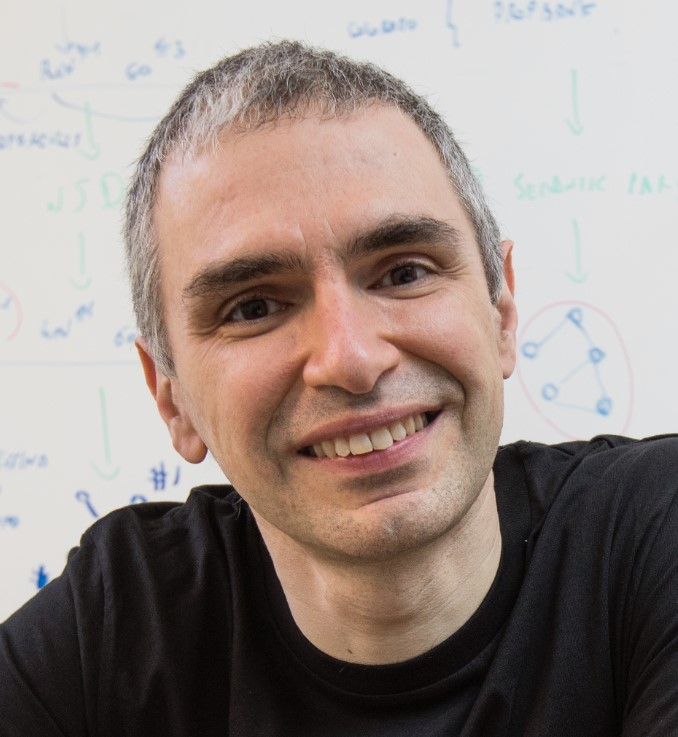
Professor Ihab Ilyas is a leading figure in data management and machine learning at the Cheriton School of Computer Science , University of Waterloo , where he holds the Thomson Reuters Research Chair in Data Quality . He is currently on leave from the university, serving as a Distinguished Engineer, Proactive Intelligence at Apple Inc . His research focuses on data cleaning , large-scale data integration , knowledge graphs , and machine learning applications in data quality . He has pioneered systems like HoloClean and Saga , with commercial impacts through co-founded startups Inductiv (acquired by Apple) and Tamr . PhD in Computer Science from Purdue University Co-founder of Inductiv (acquired by Apple) Co-founder of Tamr Research Interests include: Probabilistic and uncertain data management Machine learning for data quality and enrichment Big data systems and information extraction Knowledge graph construction and optimization Scientific Awards and Recognitions include: Fellow of the Royal Society of Canada (2024) C.C. Gotlieb Computer Award (2024) IEEE Fellow (2021) ACM Fellow (2020) Cheriton Faculty Fellowship (2013-2016) Ontario Early Researcher Award
Roberto Navigli is a Full Professor in the Department of Computer, Control and Management Engineering at Sapienza University of Rome, where he leads the Sapienza NLP Group. He has held academic positions at Sapienza since 2007, progressing from Researcher to Associate Professor, and now Full Professor. Navigli is internationally recognized for his groundbreaking work in multilingual natural language processing and computational semantics. His research spans multiple areas within Natural Language Processing, with a particular focus on multilinguality , lexical semantics (Word Sense Disambiguation and induction), sentence-level semantics (Semantic Role Labeling and Semantic Parsing), and Large Language Models . As the leader of the Minerva LLM project, he pioneered the development of the first pretrained LLM in Italian. His creation of BabelNet, the largest multilingual encyclopedic computational dictionary covering 271 languages and about 14 million concepts, represents a landmark achievement in computational linguistics. Professor Navigli's recent publications demonstrate a strong focus on advancing multilingual capabilities of language models, addressing challenges in semantic understanding across languages, and developing robust evaluation frameworks. His work on Italian LLM optimization, lexical ambiguity in machine translation, and cross-lingual safety gaps reflects his commitment to building more accurate and reliable language technologies that work effectively across diverse linguistic contexts. AAAI Fellow (2025) EurAI Fellow (2024) ELLIS Fellow (2024) ACL Fellow (2023) Outstanding Paper Awards at ACL 2024, ACL 2023, and NAACL 2021 Best Resource Paper Award at ACL 2022 Prominent Paper Awards from the Artificial Intelligence Journal (2023, 2017) META Prize 2015 for BabelNet Professor Navigli has successfully secured substantial research funding, including two prestigious ERC Grants (MultiJEDI ERC Starting Grant 2010-2016 and MOUSSE ERC Consolidator Grant 2017-2023, totaling around 3 million euros), PI of PRIN 2017 and PRIN 2020 projects (overall 1.4 million euros), and a Google Focused Research Award (around 300k$). He has mentored over 30 PhD students, many of whom have gone on to successful careers in academia and industry. His leadership extends to major international conferences, serving as General Chair of ACL 2025 and Program Co-Chair of ACL-IJCNLP 2021. As the director of the Sapienza NLP Group and co-leader of the Transversal Project on Large Language/Multimodal Models in the FAIR (Future Artificial Intelligence Research) project, Professor Navigli oversees a vibrant research ecosystem focused on advancing the state-of-the-art in natural language understanding across languages. His spinoff company, Babelscape, translates academic research into practical applications for industry.
Charles D. Sprenger is a Professor of Economics at the California Institute of Technology (Caltech), where he has served since 2020 and held the position of Executive Officer from 2022 to 2025. He is affiliated with Caltech's Division of the Humanities and Social Sciences (HSS) and holds key roles at the Ronald and Maxine Linde Institute of Economic and Management Sciences and the Center for Theoretical and Experimental Social Sciences (CTESS). His external appointments include Board of Editors for the American Economic Review and Associate Editor roles for the Journal of the European Economic Association and Quantitative Economics . His educational background includes a B.A. from Stanford University (2002), an M.Sc. from University College London (2005), and a Ph.D. from the University of California, San Diego (2011). These credentials established his foundation in economic theory and experimental methodology. Sprenger is a leading behavioral and experimental economist specializing in intertemporal decision making and choices under uncertainty. His research designs innovative experiments across diverse contexts—from food deserts in the United States to polio vaccination drives in Pakistan—to test the validity of standard economic models. His work consistently reveals significant deviations from rational choice theory, particularly regarding time inconsistency, risk preferences, and reference-dependent behaviors. He has pioneered methods for measuring time preferences and testing cumulative prospect theory, with implications for public policy and behavioral interventions. Analysis of his 15 most recent publications (2015-2024) shows a cohesive research program centered on behavioral anomalies in decision making. His work bridges laboratory precision with real-world field applications, demonstrating how psychological factors like procrastination and loss aversion manifest in high-stakes environments. Key trends include the development of tailored incentive structures, validation of rank-dependent utility models, and exploration of dynamic inconsistency across domains including health, finance, and public policy. His notable recognition includes: Sloan Foundation Fellowship (2016-2018) Sprenger actively contributes to the academic community through editorial leadership and collaborative research. His work has been featured in Caltech news for projects like "Reducing Procrastination with Tailored Incentives" (2023) and the graduate summer program "Experimental Economics in Theory and Practice" (2023). Though specific advisees aren't listed, his teaching of advanced courses like Experimental Economics (SS 212 abc) indicates mentorship of graduate researchers. He secures significant research funding through fellowships and institutional support, enabling large-scale field experiments. As a core member of CTESS, Sprenger leads a multidisciplinary team conducting cutting-edge experimental economics research. His lab integrates theoretical modeling with empirical validation, focusing on how behavioral insights can improve policy design in areas like tax compliance, vaccination programs, and financial decision making. Current work emphasizes scalable interventions for procrastination and preference-based incentive customization.
Susan J. Simkins is a Professor of Psychology at The Pennsylvania State University, where she serves as Lead of the CTSI-Team Science Core and is based in Moore Building at University Park. Her contact details include email sxm40@psu.edu and phone (814) 863-7387. Education Ph.D., Ohio State University, 1996 Research Interests Dr. Simkins' research centers on effective teamwork and performance through three interconnected streams: team composition/diversity (examining demographic, cognitive, and personality-based diversity within contingency frameworks), team cognition/mental models (focusing on shared understanding of tasks and teamwork dynamics), and temporal integration in teams (investigating time-based diversity, temporal leadership, and pacing styles). Her work emphasizes individual differences, cognitive processes, and temporal dynamics as critical determinants of team effectiveness in organizational contexts. Publication Trends Her 2013-2017 publications reveal a strong focus on temporal dimensions of teamwork, including polychronicity diversity, temporal conflict in specialized teams (e.g., culinary environments), and time-sensitive mental models. Key methodological approaches involve multilevel analysis and contingency frameworks, with applications spanning leadership theory, decision-making diversity, and climate interactions. Work appears consistently in top organizational psychology journals like Journal of Applied Psychology and Organizational Behavior and Human Decision Processes. Scientific Awards No scientific awards were documented in the provided text. Advising and Grants While the text confirms her faculty role and research leadership, specific details about graduate student advising, grant funding, or sponsored projects were not included in the source material. Labs and Teams Dr. Simkins leads the CTSI-Team Science Core, an initiative dedicated to advancing methodologies for studying team-based research structures and improving collaborative effectiveness in scientific and organizational settings.
Mahzarin R. Banaji is the Richard Clarke Cabot Professor of Social Ethics at Harvard University and a Harvard College Professor. She is affiliated with the Department of Psychology and is a key figure in the Mind, Brain, and Behavior (MBB) Interfaculty Initiative. Her research is centered at the intersection of social cognition, implicit bias, and ethical behavior. Institution: Harvard University School: Harvard College Department: Psychology Email: banaji@fas.harvard.edu Dr. Banaji earned her Ph.D. from Ohio State University and has been a leading scholar in the study of unconscious bias. Her work explores how implicit attitudes shape perception, judgment, and behavior outside conscious awareness. She co-developed the Implicit Association Test (IAT) , a groundbreaking tool for measuring unconscious biases related to race, gender, age, and other social categories. Her research spans social cognition, prejudice, stereotyping, moral psychology, and the neuroscience of social behavior . More recently, she has extended her work into the domain of artificial intelligence, investigating how human-like biases emerge in large language models. The 15 most recent publications reflect a strong trend toward computational social science , combining psychological theory with natural language processing and AI. Her team analyzes bias in digital corpora, studies the transmission of stereotypes in AI systems, and develops tools to measure intersectional and implicit attitudes at scale. These works bridge psychology, ethics, and technology, highlighting the societal implications of implicit cognition. Among her notable scientific honors are: Fellow of the American Academy of Arts and Sciences William James Fellow Guggenheim Fellowship Kurt Lewin Award (SPSSI) Harvard College Professorship Dr. Banaji has advised numerous graduate students, including Tessa Charlesworth and Kerry Morehouse, many of whom are now active researchers in social and cognitive psychology. She has secured major grants through the Mind, Brain, and Behavior Initiative and has led interdisciplinary teams exploring bias in education, law, and technology. She is also the co-creator of OutsmartingHumanMinds.org , a public education platform on implicit bias. Her lab serves as a hub for collaborative research on implicit social cognition, bringing together psychologists, neuroscientists, and computer scientists to understand and mitigate unconscious bias in human and artificial systems.
Jin Ma is a Professor in the Department of Mathematics at the University of Southern California (USC), where he has served since 2007. He previously held professorships at Purdue University (1994–2008). His research focuses on stochastic analysis, stochastic differential equations, mathematical finance, and control theory. He directs USC's Mathematical Finance Program and serves on editorial boards for journals like Probability, Uncertainty and Quantitative Risk and SIAM Journal on Control and Optimization . Ma received his Ph.D. in Mathematics from the University of Minnesota (1992) and M.S./B.S. in Applied Mathematics from Fudan University (1985/1982). His work bridges theoretical stochastic analysis and applied domains like finance and insurance, with notable contributions to forward-backward SDEs and mean-field games. Research Highlights: Developed frameworks for stochastic control and backward SDEs in financial and insurance contexts. Advanced mean-field game models for limit order book dynamics and equilibrium analysis. Explored set-valued stochastic differential equations and their applications in risk management. Grants & Advising: Advised numerous graduate students in stochastic processes and mathematical finance. Research supported by NSF grants and industry collaborations.
Vera Liao is a Principal Researcher at Microsoft Research, where she is part of the FATE (Fairness, Accountability, Transparency, and Ethics of AI) group. She will join the University of Michigan Computer Science and Engineering department as an Associate Professor in fall 2025. Her work focuses on human-AI interaction, explainable AI, and responsible computing. Liao has made significant contributions to IBM products such as AI Explainability 360 and Uncertainty Quantification 360 during her time at IBM T.J. Watson Research Center. Dr. Liao received her education from the University of Illinois at Urbana-Champaign and Tsinghua University. Her academic journey has positioned her at the intersection of human-computer interaction and artificial intelligence, with a strong emphasis on creating AI systems that are transparent, accountable, and user-centered. Vera Liao's research primarily centers around human-centered AI explainability and transparency. She investigates how to design AI systems that effectively communicate their capabilities, limitations, and decision-making processes to users. Her work examines the intersection of AI transparency with trust, control, and user experience. Liao has pioneered approaches to bridging the socio-technical gap in AI evaluation and has developed frameworks for contextualized evaluation of explainable AI systems. Her research spans multiple domains including conversational interfaces, data storytelling, and creative work with generative AI. Liao's publications reveal a clear trend toward addressing the challenges of large language models and their impact on human-AI interaction. Her recent work focuses on understanding how uncertainty communication affects user trust, how to design for appropriate reliance on AI systems, and how to create authentic co-creation experiences with generative models. She has been examining the risks in AI-infused information ecosystems and developing methods for human-centered evaluation of language technologies. Her scientific contributions have been recognized with multiple honors: Best Paper Award, Honorable Mention at CHI 2025 (two papers) Best Paper Award at CHI 2024 Best Paper Award, Honorable Mention at FAccT 2023 Best Paper Award, Honorable Mention at HCOMP 2022 Best Paper Award, Honorable Mention at CHI 2021 Best Paper Award, Honorable Mention at CHI 2014 Outstanding Paper Award at IUI 2019 Dr. Liao is an active mentor, having guided numerous research interns from top universities including Cornell, Princeton, CMU, Stanford, and MIT. She serves in editorial roles as Co-Editor-in-Chief of the Springer Human-Computer Interaction Book Series and as an Editor for ACM CSCW. Liao has secured research funding through her work at Microsoft Research and previously at IBM, focusing on projects related to AI explainability, transparency, and responsible AI development. As part of Microsoft Research's FATE group, Liao collaborates with a multidisciplinary team of researchers focused on the ethical implications of AI technologies. Her work bridges the gap between technical AI development and human-centered design principles, ensuring that AI systems are developed with user needs and societal impacts in mind.
Ali Lazrak is an Associate Professor at the Sauder School of Business , University of British Columbia , specializing in Finance . He holds the Peter Lusztig Professorship in Finance and teaches courses such as International Financial Markets and Institutions and Theory of Finance (2024-2025). His research bridges Political Economy , Asset Pricing , and Behavioral Finance , with a focus on ESG concerns , Voting Theory , and Time Inconsistency . Education: ENSAE (B.Sc.), Sorbonne (M.Sc.), Toulouse (Ph.D.) Contact: Henry Angus Building (HA 872), +1 604.822.9481, ali.lazrak@sauder.ubc.ca His work explores group decision-making in corporate investment, green finance (e.g., the green premium in ESG markets), and time-inconsistent preferences in continuous games. Recent publications highlight how responsible consumption and demand elasticity shape asset prices, and how institutional divestiture impacts harmful asset stranding through informational and economic channels. Scientific accolades include the Jacob Gold & Associates Best Paper Prize (2019), Best Paper Awards at HEC-McGill, UBC, Luxembourg, and Stanford conferences, and the Peter Lusztig Professorship . His methodological expertise spans stochastic control , recursive utility , and dynamic equilibrium analysis .
Tomasz Strzalecki is a Professor in the Department of Economics at Harvard University. His research centers on decision theory, with a focus on ambiguity aversion , temporal preferences , stochastic choice , and bounded rationality . He earned his PhD in Economics from Northwestern University in 2008. Education: PhD in Economics (2008), Northwestern University His scholarly work spans theoretical and applied economics, including key contributions to random utility models , dynamic decision-making , and neuroeconomic modeling . Recent publications, such as Stochastic Choice Theory (2025) and Variational Bayes and non-Bayesian Updating (2024), reflect his ongoing exploration of Bayesian inference and behavioral deviations. Earlier work in Econometrica and American Economic Review established foundational models for choice aversion , time inconsistency , and ambiguity evaluation . Tomasz’s research has been published in top journals like Econometrica , American Economic Review , and Proceedings of the National Academy of Sciences , covering themes such as probabilistic sophistication , decision timing , and collective action in development economics. His co-authors include prominent economists like Drew Fudenberg, Mira Frick, and Larry Epstein.
Rick Busselle is an Associate Professor at Bowling Green State University (BGSU), affiliated with the School of Media & Communication within the College of Arts & Sciences. His research focuses on how mediated narratives influence perceptions of social issues like poverty and crime, emphasizing engagement, perceived realism, and the social construction of reality through media. He holds a B.S. in Journalism from BGSU, an M.A. in Telecommunication, and a Ph.D. in Mass Media, both from Michigan State University. Dr. Busselle’s work appears in journals like Communication Theory and Media Psychology , with a focus on narrative engagement, media effects, and psychophysiological responses. He has served on editorial boards for Media Psychology , The Journal of Broadcasting & Electronic Media , and co-edited Media Psychology . His courses include Media Effects, Quantitative Research Methods, and Strategic Communication. His scholarship bridges narrative theory and audience psychology, exploring how stories shape social realities. Recent publications (2022–2008) highlight themes like epistemic monitoring in stories, narrative persuasion, and the cultivation of perceived realism. His research underscores the interplay between cognitive processes and media influence, with applications in communication studies and journalism. Busselle’s contributions extend to editorial leadership and academic mentorship, shaping discourse in media psychology and communication theory without explicit awards but recognized through peer contributions and publication impact.
Matteo Brunelli is Associate Professor of “Mathematical Methods of Economics and Actuarial and Financial Sciences” at the University of Trento , Department of Industrial Engineering, and Adjunct Professor (docent) at Lappeenranta University of Technology , Finland. He is nationally habilitated as Full Professor in Italy and has held long-term visiting positions at Berkeley, Turku, Auckland, JAIST and Binghamton. Education: Ph.D. (Doctor of Science) in Information Technologies, Åbo Akademi University, Finland, 2011 – graded Eximia cum laude approbatur M.Sc. in Economics, University of Trento, 2007 – grade 110/110 cum laude B.Sc. in Economics, University of Trento, 2005 Research focus: Brunelli’s work sits at the intersection of multi-criteria decision analysis , operations research and computational optimisation . He develops axiomatic foundations and algorithms for pairwise comparison matrices , consistency indices , the best-worst method and fuzzy preference relations , and applies them to energy planning, sustainable inventory, maintenance scheduling, 3-D printer selection, and blockchain governance. His 2023-2025 articles reveal intensified interest in uncertainty modelling (Dempster-Shafer theory), bi-objective optimisation of inventory and maintenance, and group decision protocols that integrate probabilistic or active-learning components, demonstrating both methodological depth and practical relevance. Scientific awards & grants: Academy of Finland Postdoctoral Researcher grant (€254 670, 2014-2017) Claudio Dematté Research Grant (€19 000, 2008) Teacher of the Year Award, Aalto University (2013 – both Spring & Autumn semesters) Bernard Roy Award 2021 for outstanding contribution to Multiple Criteria Decision Aiding (under-40 category) Supervision & funding: While specific doctoral students are not listed, Brunelli currently supervises graduate theses at Trento and has continuously held competitive national grants. His Academy of Finland project “Consistency of valued preference relations for decision analytics methods” financed three years of full-time research and international collaboration. Editorial & community roles: He serves on the editorial boards of International Journal of General Systems and Mathematical and Computational Applications , and acts as area editor for Journal of Multi-Criteria Decision Analysis , positioning him among the key gatekeepers of the MCDA community.
Andrei Khrennikov is Professor of Mathematics at the Department of Mathematics, Linnaeus University, where he also serves as director of the International Center for Mathematical Modeling (ICMM) . He leads a vibrant research group focused on interdisciplinary modeling in physics, biology, cognition, and social systems. Research Interests: His work spans a vast interdisciplinary landscape, including mathematical physics, p-adic and non-Archimedean analysis, quantum foundations, quantum-like modeling of cognition and decision-making, econophysics, and biological dynamics . He is a pioneer in applying quantum probability and formalism outside quantum physics, especially in psychology and social sciences. The Växjö series of quantum theory conferences , which he organizes, is the longest-running continuous conference series on quantum foundations, fostering dialogue between theorists, experimentalists, and philosophers. His recent publications (2021–2025) show a strong focus on quantum cognition, p-adic biology, entanglement models, and social laser theory , often leveraging generalized probability and open quantum systems frameworks. Scientific Contributions: Developed quantum-like models for cognition, decision-making, and biological processes. Pioneered use of p-adic and ultrametric analysis in genetics and brain dynamics. Advanced classical random field models as alternatives to quantum interpretations. Introduced the social laser model for collective emotional amplification in societies. He is actively involved in major research projects such as QUARTZ (Quantum Information Access and Retrieval Theory) and DYNALIFE (Information, Coding, and Biological Function) . His work bridges mathematics, physics, and cognitive science, promoting a unified framework for understanding complex systems through quantum-inspired tools.
David Newbery serves as Professor of Applied Economics at the University of Cambridge's Faculty of Economics since 1988 and Research Director of the Electricity Policy Research Group (EPRG). His career spans prestigious appointments including Visiting Professorships at Stanford, Princeton, UC Berkeley, and Imperial College London, alongside significant policy roles at the World Bank and IMF. His research focuses on electricity market design , climate policy economics , and transport pricing , addressing critical challenges in energy transition and regulatory frameworks. Key contributions include foundational work on supply function equilibria, market power assessment in liberalized utilities, and optimal climate policy instruments. Analysis of his publications reveals consistent leadership in energy market restructuring (1990s-2000s) renewables integration economics (2000s-2010s) climate policy-market power interactions (2000s-present) with methodological strengths in game theory and empirical industrial organization. Major recognitions include: CBE (2012 Birthday Honours) Frisch Medal (1990) Fellowships of Econometric Society and British Academy IAEE Outstanding Contributions Award (2003) Honorary Degree from University of Antwerp (2004) Newbery's policy impact extends through World Bank advisory roles (1981-83 as Division Chief of Public Economics), IMF consultations (1987), and sustained engagement with European energy regulators via EPRG. His work informs critical infrastructure pricing frameworks globally, particularly in electricity and transport sectors. He leads the Electricity Policy Research Group at Cambridge, fostering interdisciplinary collaboration between economists, engineers, and policy experts to address energy transition challenges through rigorous market design analysis.
Benjamin William Cashore is the Li Ka Shing Professor in Public Management and Director of the Institute for Environment and Sustainability (IES) at the National University of Singapore's Lee Kuan Yew School of Public Policy. Previously, he spent 18 years at Yale University as a professor of environmental governance and political science, where he directed the Governance, Environment and Markets (GEM) initiative and the Yale International Fox Fellows exchange program from 2014-2019. PhD from University of Toronto Postdoctoral research at Harvard University and University of British Columbia Former policy advisor to the leader of the Canadian New Democratic Party Expertise spans Southeast Asia, North America, Latin America and Europe Cashore specializes in global and multi-level environmental governance, comparative public policy and administration, and transnational business regulation/corporate social responsibility. His research focuses on climate policy, biodiversity conservation/land use change, and sustainable environmental management of forests and related agricultural sectors. Theoretically, he examines the legitimacy requirements of non-state market driven (NSMD) global governance, the influence of economic globalization on domestic environmental policies, and anticipatory policy design for addressing 'super wicked' environmental problems. His work integrates around developing multi-stakeholder policy learning processes and nurturing multiple step policy pathways. His recent scholarship demonstrates consistent engagement with climate change governance, forest policy, and the intersections between private regulation and public policy. Cashore's publications reveal a strong focus on identifying effective governance mechanisms for addressing complex environmental challenges through both state and non-state approaches. Author of two influential books: 'Global Environmental Forest Policies: An International Comparison' (2010) and 'Governing Through Markets: Forest Certification and the Emergence of Non-State Authority' (2004) Extensive publication record in top journals across political science, environmental policy, and governance fields Cashore has developed significant expertise in designing stakeholder learning dialogues and identifying policy pathways for addressing complex environmental governance challenges. His work bridges theoretical insights with practical policy applications across multiple continents and governance contexts.
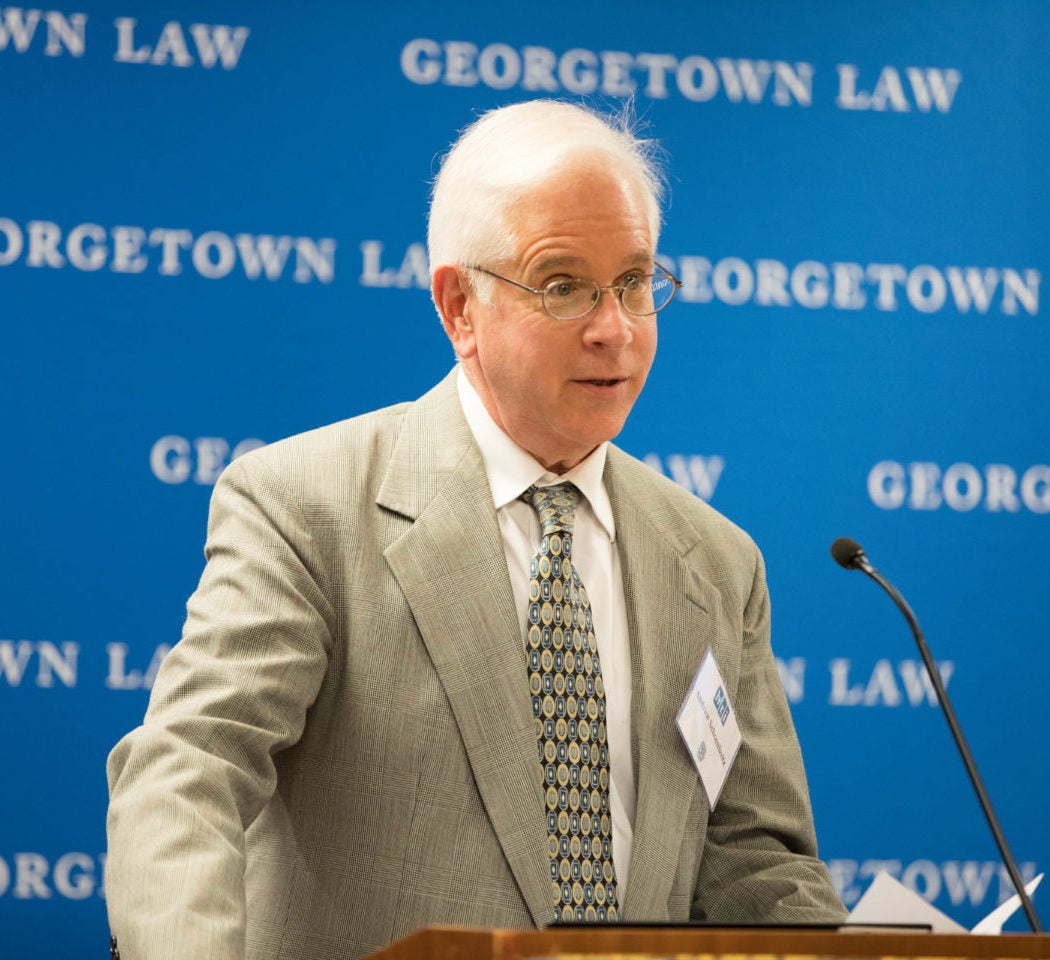
Andrew I. Schoenholtz is a Visiting Professor of Law and Professor from Practice at Georgetown University Law Center, where he directs the Human Rights Institute and Center for Applied Legal Studies asylum clinic. He also oversees the Certificate in Refugees and Humanitarian Emergencies program. His teaching includes courses on Refugee Law, Immigration Policy, and experiential learning on detained immigrants' rights. Previously, he served as Deputy Director of the U.S. Commission on Immigration Reform and practiced immigration law at Covington & Burling. Dr. Schoenholtz holds a Ph.D. from Brown University , a J.D. from Harvard Law School , and a B.A. from Hamilton College . His research focuses on refugee protection, asylum adjudication, and the intersection of migration policy with human rights. He has conducted fieldwork in Haiti, Cuba, Germany, and other regions to analyze root causes of forced migration and humanitarian responses. His work emphasizes reforming legal frameworks to ensure fair treatment of migrants, particularly through publications like Refugee Roulette and Lives in the Balance , which critique systemic disparities in asylum processes. He actively advocates for policies balancing national security with refugee rights, informed by his extensive field experience and legal expertise. Key affiliations include the Institute for the Study of International Migration (ISIM) as Deputy Director and leadership roles in Georgetown Law’s clinical programs. His interdisciplinary approach integrates academic research with practical advocacy, influencing both legal education and policy debates globally.