Francisco Díaz Barrancas is a PostDoctoral Researcher at the University of Extremadura, Spain, with affiliations to the Centro Universitario de Mérida. His work spans virtual reality systems, color science, and cybersecurity, supported by international collaborations including the ERC project "Color 3.0" at Justus-Liebig University and research stays in Portugal and Italy. PhD in Real-Time Rendering (UEx, 2022) M.Sc. in Computer Technologies Research (UEx, 2018) B.Sc. in Computer Engineering (UEx, 2017) Research focuses on hyperspectral imaging , color constancy , and VR device optimization , with recent work on neural network training in VR and cybersecurity in immersive environments . Publications span JCR-indexed journals and IEEE conferences , emphasizing perceptually-motivated solutions. Best Poster Award at XIV CONFERENZA DEL COLORE (2018) Teaching experience includes courses in Programming Fundamentals and Multimedia Communication at UEx. Internationally active with research stays at Colour Science Laboratory (Portugal), MIPS LAB (Italy), and ICVS Summer School (UK).
Professor Park Woo-chan is affiliated with the Department of Computer Engineering at Sejong University. His research focuses on real-time ray tracing, GPU architecture for mobile devices, and FPGA implementations. He has a strong publication record in 3D graphics and AI semiconductors. 1989-1993: Bachelor's in Computer Science, Yonsei University 1993-1995: Master's in Computer Science, Yonsei University 1995-2000: Doctorate in Computer Science, Yonsei University He leads the Processor Lab, which specializes in media processors including high-performance mobile GPUs and AI semiconductors. The lab has extensive experience with industry projects for Samsung and LG, national initiatives, and industry-academia collaborations. Research interests span real-time ray tracing algorithms, GPU memory systems, lossless data compression, computer arithmetic, and hardware acceleration for 3D graphics and sound rendering. Recent publications show a strong focus on real-time sound propagation, multi-threaded algorithms, depth level control, and FPGA implementations for ray tracing. Keywords from his work include: Computer Science , Neural Networks , GPU Architecture , 3D Rendering , Mobile Graphics , and FPGA Acceleration . Contact: pwchan@sejong.ac.kr
Dr. Mohammad Farid Azampour is a Researcher at the Chair of Computer Aided Medical Procedures within the Department of Informatics at the Technical University of Munich (TUM). His work bridges robotics, medical imaging, and deep learning, with affiliations extending to the German Heart Center Munich (DHM) and collaborations across TUM's NARVIS and IFL labs. Research Focus: Azampour specializes in physics-inspired AI for healthcare, including robotic ultrasound systems, neural representations for medical image reconstruction, and anatomy-aware deep learning. His projects emphasize real-time surgical guidance, weakly supervised learning for clinical data, and multi-modal registration (e.g., CT-US/MRI fusion). Teaching & Supervision: He coordinates courses such as Medical Augmented Reality , Advanced 3D Computer Vision , and Innovation Generation in Healthcare . Azampour actively mentors students through IDPs, theses, and practical projects in computer-aided medical procedures. Publications: His recent work (2020-2025) demonstrates consistent focus on enhancing medical imaging through neural networks (e.g., Ultra-NeRF for ultrasound, diffusion models for simulation) and improving surgical robotics via real-time navigation/registration. Key themes include reducing annotation dependency, leveraging physics-based models, and enabling intraoperative decision-making.
Dr. Tsukasa Fukusato is an Assistant Professor at the School of Fundamental Science and Engineering , Waseda University since April 2023. His work spans Human Interface and Interaction , Entertainment Informatics , and High-Performance Computing , with a focus on interactive systems for digital art and animation. Current Research: Developing interactive tools for 2D/3D animation, workflow systems in bioinformatics, and AI-assisted artistic creation Technical Expertise: Latent diffusion models, motion segmentation, sketch-based interfaces, garment transfer, and aerodynamic design His recent publications (2022-2024) demonstrate advancements in: Animation and motion design (15+ papers) Workflow execution services AI-guided facial synthesis Interactive garment/textile modeling Biomechanical simulation systems Visual language interfaces Scientific Awards: 2024 Best Poster Award (NICOGRAPH) 2023 Honorable Mention (Computational Visual Media) Multiple Best Paper/Poster awards (2014-2023) 2014 Nishida Award from the Institute of Image Information and Television Engineers of Japan Teaching Activities (2025): Lecturer for Computer Graphics, Media Science, and Project-Based Learning Supervising graduation theses and advanced digital media projects
Ana Serrano is an Associate Professor at the Universidad de Zaragoza, affiliated with the Graphics & Imaging Lab in the College of Engineering. Her research lies at the intersection of visual computing, perceptual modeling, and virtual reality, with a focus on improving user experience through perceptually-driven tools for content creation. Her research interests span computational imaging, material appearance perception and editing, virtual reality, and crossmodal perception. She investigates how human perceptual systems can inform the design of more effective and immersive visual technologies, particularly in VR environments. Her work integrates psychophysics, machine learning, and computer graphics to develop models of attention, saliency, and appearance perception. The recent publications (2023–2025) reflect a strong trend in perceptual modeling in immersive environments, with a focus on audiovisual integration, saliency prediction (AViSal360, SAL3D), HDR rendering (Cinematic Gaussians), and material appearance (gloss prediction). Many works combine deep learning with human perception studies, often validated through user experiments. There is a consistent emphasis on real-world applicability in VR content creation and cinematic VR. Eurographics 2020 PhD Award Eurographics 2023 Young Researcher Award VGTC VR 2024 Significant New Researcher Award Adobe Research Fellowship (Honorable Mention, 2017) NVIDIA Graduate Fellowship (2018) Ana Serrano actively supervises PhD and Master’s students and has taught courses such as Virtual Reality and Computational Imaging. She has secured research funding from ERC and national grants. She serves on editorial boards of Computer Graphics Forum , ACM Transactions on Applied Perception , and Computers & Graphics , and has chaired major conferences including Eurographics 2023 Tutorials and SAP 2022. She leads the Graphics & Imaging Lab, which conducts interdisciplinary research combining computer graphics, perception, and machine learning.
Alexei Efros is a Professor in the Electrical Engineering and Computer Sciences Department at UC Berkeley's College of Engineering, where he holds the Howard Friesen Professorship. He is a leading researcher in computer vision and computer graphics, with a focus on data-driven techniques and self-supervised learning. His work bridges the intersection of vision and graphics, leveraging large quantities of unlabeled visual data to tackle complex problems. Dr. Efros received his PhD from UC Berkeley in 2003 and joined the Berkeley faculty in 2013 after spending a decade at Carnegie Mellon University. He has also held affiliations with École Normale Supérieure/INRIA and the University of Oxford. His research group is part of the Berkeley Artificial Intelligence Research Lab (BAIR). His research interests span computer vision, computer graphics, artificial intelligence, and machine learning, with particular emphasis on data-driven approaches, self-supervised learning, computational photography, and visual data mining. Efros has pioneered numerous techniques in image synthesis, scene understanding, and visual representation learning that have shaped modern computer vision research. An analysis of his recent publications reveals a strong focus on generative models, particularly diffusion models and their applications; interpretability of vision-language models like CLIP; 3D scene understanding and reconstruction; and the application of self-supervised techniques to video and spatial reasoning problems. His work continues to push boundaries in how machines understand and generate visual content. Among his numerous accolades are the ACM Prize in Computing (2016), multiple Helmholtz Test-of-Time Prizes, the SIGGRAPH Significant New Researcher Award, Sloan and Guggenheim Fellowships, and teaching awards including the Jim and Donna Gray Award for Excellence in Undergraduate Teaching (2023). Professor Efros has mentored an impressive cohort of students who have gone on to prominent positions in academia and industry, including faculty positions at CMU, TTIC, Stanford, and research scientist roles at OpenAI, Google DeepMind, and Anthropic. His teaching includes core computer vision courses at both undergraduate and graduate levels.
Jürgen Singer is a Professor of Visual Computing at Harz University of Applied Sciences, coordinating the Media Informatics degree program. His academic career spans over two decades, including prior roles as Professor of Computer Graphics, Animation, and Virtual Reality (2006-2015) and senior research positions at institutions like MIT and the University of Texas. Education: PhD in Mathematics (1995), University of Houston Diploma in Theoretical Physics (1988), Friedrich-Alexander University Erlangen-Nuremberg Research Interests focus on visual computing, encompassing image processing, computer graphics, virtual reality, and machine learning. He explores applications in game development, 3D rendering, and web technologies, particularly emphasizing procedural generation, AI integration, and real-time visualization. Teaching Contributions include core courses in Java programming, software tools (Git, Docker, Jenkins), mathematics for computer graphics, and advanced topics like concurrency and distributed programming. His supervised theses reflect ongoing innovation in DevOps, metaverse content creation, and accessibility in UI design. Scientific Awards are not explicitly mentioned in the provided text. Labs & Teams: While specific lab details aren't provided, his work with student theses indicates collaboration in media informatics, game development, and visualization research groups.
Daniel Ruijters is a part-time Full Professor in the Electronic Systems department at Eindhoven University of Technology (TU/e), specializing in data-driven value-based healthcare for image-guided therapy. His research develops intelligent systems that optimize data utilization in minimally invasive treatments, translating population datasets to individual patient care. He simultaneously serves as a Principal Scientist at Philips Healthcare, where he has worked since 2001, developing clinical prototypes for image-guided interventions. Education Engineering degree from University of Technology Aachen, Germany (2001) Master's research at École Nationale Supérieure des Télécommunications (ENST), ParisTech, France PhD from TU/e and KU Leuven (2010) on multi-modal image fusion Research Focus Ruijters' work integrates medical imaging, deep learning, and computational modeling to advance image-guided interventions. His research spans GPU-accelerated image processing, angiography-based diagnostics, computational fluid dynamics for vascular analysis, and AI-driven detection systems for neurovascular procedures. This includes developing real-time tracking methods and personalized treatment approaches using large-scale clinical datasets. Projects & Initiatives He leads the PERSEUS project (2023-2029) focusing on patient-centered healthcare optimization through data science. His work contributes to UN Sustainable Development Goals through improved medical technology accessibility. Academic Contributions Ruijters teaches courses in DSP fundamentals, medical image analysis, and signal processing. His 90+ publications demonstrate consistent output since 2003, with recent emphasis on deep learning applications in angiography and computational hemodynamics.
Andrei C. Jalba is an Assistant Professor in the Department of Mathematics and Computer Science at Eindhoven University of Technology (TU/e), specializing in Visualization and Visual Analytics. His research spans computer graphics, geometric processing, and visualization techniques with significant applications in medical imaging, simulation systems, and real-time graphics. Research Expertise Dr. Jalba's research fingerprint reveals strong specialization in curve skeletonization (95%), diffusion tensor analysis, point cloud processing (64%), and graphics hardware acceleration (59%). His work focuses on developing advanced algorithms for skeletonization, regularization techniques, and geometric processing with applications across multiple domains. His research intersects computer vision, medical diagnostics, and computational fluid dynamics, demonstrating practical implementations in MRI data processing, fire safety simulations, and interactive visualization systems. The integration of physics-based approaches with computational techniques represents a significant thread throughout his publication history. Publication Trends Dr. Jalba's recent publications show a clear progression from fundamental geometric algorithms to practical applications in medical imaging and real-time systems. His 2023 work on volumetric light transport demonstrates continued innovation in rendering techniques, while his 2021 eye tracking research shows expansion into AI applications. The consistent theme across his work is the development of efficient computational methods for complex visualization problems. Academic Contributions Teaching: Computer Graphics (since 2012), Seminar Visualization (since 2015), Simulation in Computer Graphics (since 2015) Supervision: 48 research projects across visualization and computer graphics topics Research Output: 68 publications with over 1,100 citations according to Scopus His work contributes to UN Sustainable Development Goals through applications in medical diagnostics, safety engineering, and computational science, though specific goals are not detailed in the available information.
Xiaoming Liu is a Professor at Michigan State University with extensive contributions to computer vision and biometrics. His research spans face recognition, 3D reconstruction, image forgery detection, and adversarial machine learning, with over 300 publications from 1999 to 2025. His primary research interests include Computer Vision , Biometrics , and Adversarial Machine Learning . Liu's work focuses on developing robust systems for face recognition at scale, detecting image manipulations, and creating 3D reconstruction techniques. Recent projects include SapiensID for human recognition, FRCSyn for synthetic face recognition, and proactive watermarking schemes. Liu's publication trends show increasing focus on multi-modal biometrics (combining face, body, and gait), image forgery detection using hierarchical approaches, and adversarial defense mechanisms . His 2023-2025 work emphasizes synthetic data applications and physics-driven recognition systems. Liu has mentored numerous students including Feng Liu, Minchul Kim, and Xiao Guo, who frequently co-author his papers. His research has been supported by grants enabling projects like FarSight (long-range biometrics) and ProMark (proactive watermarking). He leads research in biometrics security and computer vision, with recent work focusing on ethical AI applications and robust recognition systems. His team develops tools for detecting deepfakes and improving recognition in challenging conditions.
Abhijeet Ghosh is a Professor of Graphics & Imaging in the Department of Computing at Imperial College London, leading the Realistic Graphics and Imaging group. His research focuses on appearance modeling, computational illumination, and photography for graphics and vision. He holds a PhD from the University of British Columbia and has contributed to the USC-ICT Lightstage system, recognized by the Academy of Motion Picture Arts and Sciences. He has received awards including the EPSRC Early Career Fellowship and Royal Society Wolfson Research Merit Award. Education: PhD in Computer Science from University of British Columbia Research Contributions: Multispectral Light Stage, facial capture systems, and computational photography Grants & Awards: EPSRC grants totaling over £1M, H2020 funding, and industry partnerships. Advising: Supervised over 30 students, including PhD graduates now in academia and industry. Labs & Activities: Hosted EGSR 2024 and organized conferences like EGSR 2020. Teaches Advanced Computer Graphics (COMP70001) and Computer Graphics (COMP60005).
Fabrizio Lamberti is a Professor at the Polytechnic University of Turin, Italy. His research focuses on Virtual Reality (VR), Extended Reality (XR), and Human-Computer Interaction (HCI), with applications in medical training, cultural heritage, robotics, and educational technologies. He holds a PhD in Distributed Systems and Information Technologies from the same institution (2005). Key contributions include pioneering work on immersive VR training systems for emergency response, medical procedures, and industrial robotics. He has extensively explored motion capture, real-time rendering, and AI-driven solutions for virtual environments. His work bridges theoretical advancements with practical implementations, such as VR-based surgical simulations and digital twin frameworks for manufacturing. Lamberti's interdisciplinary approach integrates computer vision, machine learning, and semantic technologies. Notable projects include semiotic AI frameworks for facial image analysis and blockchain-based interfaces for autonomous vehicle communication. He frequently collaborates with industry partners like KUKA and IEEE, contributing to standards in consumer electronics and entertainment computing. He has authored over 150 peer-reviewed articles spanning journals like IEEE Transactions on Visualization and Computer Graphics, IEEE Consumer Electronics Magazine, and Medical Image Analysis. His editorial roles include guest editorships for special issues on VR in education and medical imaging. Lamberti's research also addresses ethical and accessibility challenges in emerging technologies, such as cybersickness mitigation in immersive systems.
Nicolas Audebert is a Computer Vision and Machine Learning researcher working as a junior research director at the French National Institute of Geographic and Forest Information (IGN) in the LASTIG laboratory, STRUDEL team. He is currently on leave from his position as Associate Professor of Computer Science at the Conservatoire national des arts et métiers (Cnam) where he was part of the Vertigo team. His research spans computer vision, machine learning, and Earth Observation with applications in remote sensing and video games. Dr. Audebert earned his PhD in Computer Science from ONERA and IRISA in 2018, followed by an MEng in Computer Science from Supélec and an MSc in Human-Computer Interaction from Université Paris-Sud in 2015. In May 2025, he successfully defended his habilitation à diriger des recherches (HDR) titled "Learning representations from observations". His research focuses on representation learning , where he develops methods to create abstract representations of raw data that allow computers to manipulate high-level concepts numerically. In Earth Observation , he processes and makes sense of large volumes of satellite data for land cover mapping, change detection, and image interpretation. His work in machine learning for games explores how to use reinforcement learning to generate diverse and challenging AI in video games. Additional research interests include generative models, multimodal learning, and domain adaptation techniques. His recent publications demonstrate expertise in cross-sensor learning, super-resolution of satellite imagery, diffusion models for Earth Observation, and robust image retrieval systems. His work bridges theoretical advances in deep learning with practical applications in geospatial analysis, with a particular focus on developing methods that work across different sensor types and environmental conditions. Outstanding Reviewer for ECCV 2024 Outstanding Reviewer for BMVC 2021 Outstanding Reviewer for ICCV 2021 Best Benchmarking Contribution Award at GEOBIA 2016 2nd best student paper award at JURSE 2017 Google Research Scholar Program gift Dr. Audebert currently advises four PhD students: Maxime Merizette (semantic segmentation of 3D point clouds), Georges Le Bellier (domain adaptation for Earth Observation), Léo Géré (generative models for music), and Aimi Okabayashi (super-resolution of satellite image time series). He has successfully supervised two PhD students to completion: Perla Doubinsky (controlling generative models) and Elias Ramzi (robust image retrieval), whose thesis won the AFRIF PhD award 2024. He has mentored numerous MSc students on diverse topics including flood detection, procedural generation of video game levels, and deep learning for communication systems. He leads the MAGE project (2022-2026), funded by the Agence Nationale de la Recherche, which investigates using procedural generation and modern rendering engines to create labeled synthetic data for Earth Observation models, particularly for disaster mapping applications. He also leads the SESURE project (2021-2023) focused on super-resolution of Sentinel-2 time series, and previously led the RL-Games project (2020-2022) exploring reinforcement learning applications for video games.
John F Hughes is a Professor of Computer Science at Brown University's School of Engineering. His work bridges computer graphics and mathematics, with a focus on intuitive interfaces for 3D modeling and visualization. He has made significant contributions to sketch-based interfaces, art-based graphics, and shape modeling. Education: PhD in Mathematics, University of California, Berkeley (1982) MA in Mathematics, University of California, Berkeley (1982) BA in Mathematics, Princeton University (1977) Professor Hughes's research centers on computer graphics with strong mathematical foundations. He specializes in the modeling of shape and form at multiple scales, human-computer interaction, and art-based graphics. His work explores how artists' techniques can be utilized to enhance human-computer communication about shape. He has recently expressed interest in machine learning applications to graphics problems. His approach emphasizes informal modes of input and output, particularly sketching as a means to describe shape and expressive renderings for information communication. His publication record shows a consistent focus on sketch-based interfaces for 3D modeling, art-based rendering techniques, and mathematical approaches to graphics problems. Over time, his work has evolved from foundational mathematical approaches to more applied interactive systems, while maintaining a strong connection to mathematical principles. Recent publications indicate expanding interests into machine learning applications for graphics and computational approaches to sparse data. Scientific Awards: User Interface Software and Technology (UIST) Best Paper Award Professor Hughes has received substantial research funding from major technology companies and government agencies. His funded research includes a gift from Pixar supporting graduate fellowships in computer graphics (since 2000), research grants from Microsoft, NSF, and collaborations with IBM and Sun Microsystems. His work has been instrumental in advancing sketch-based interfaces and art-based rendering techniques, with applications ranging from character animation to document navigation interfaces. He maintains active collaborations with researchers across the computer graphics community, particularly in the areas of sketch-based interfaces and modeling. His work with Takeo Igarashi, Tomer Moscovich, and other collaborators has been highly influential in the computer graphics community, shaping how we interact with 3D content through intuitive sketching interfaces.
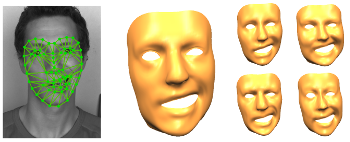
Dr. Dominik Sibbing is affiliated with the Department of Computer Science at RWTH Aachen University , Germany. His research focuses on 3D reconstruction , computer vision , and medical imaging . Developed markerless 3D face tracking systems using deformation models and smoothness priors Created volume-based fiber tracking techniques for diffusion MRI data Contributed to quad meshing methods for vascular structures Proposed SIFT-realistic rendering for laser-scanned point clouds His work combines statistical modeling with interactive GPU-based visualization . Notable award: VMV 2015 Honorable Mention . Collaborated with Leif Kobbelt and others on applications spanning facial animation, medical imaging, and physics-based simulations. Scientific Awards: VMV 2015 Honorable Mention Key Collaborations: Leif Kobbelt (RWTH Aachen) Martin Habbecke Robin Tomcin