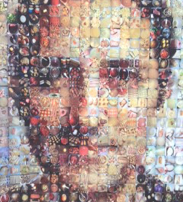
Matthieu Cord is a Professor at Sorbonne University and Scientific Director of valeo.ai, leading research in computer vision, deep learning, and computational cooking. He heads the MLIA team at ISIR Lab, focusing on multimodal models, transformers, and efficient architectures. Research areas include computer vision, large language models with vision, and AI-driven food analytics. Key projects: VISA-DEEP AI chair, Foundation VaViM models, and SmolVLA collaboration with Hugging Face. His recent work examines scalable multimodal models , trajectory prediction , and diffusion-based segmentation , with studies on in-context learning and biased shortcut learning in visual question answering. Articles highlight DeiT variants , fishr for OoD generalization , and STEEX for counterfactual explanations . Scientific awards include IUF Honorary Membership (2009), BMVC 2017 Best Paper, and ICIP 2018 Best Paper. As an advisor, he supervised PhD theses on topics like GAN editing , semantic segmentation , and multimodal retrieval . Current roles involve mentoring the 'Research Band' at MLIA and leading EU-funded initiatives like SCAPE. His work bridges theoretical AI exploration with practical applications in autonomous driving and food technology.
Amalia Foka is an Assistant Professor in Computer Science Applications for the Arts at the Department of Fine Arts & Art Sciences , School of Fine Arts , University of Ioannina , Greece. She has held academic positions at the University of Patras (2005-2013), University of Ioannina (2005-2008), and Computer Technology Institute & Press "Diophantus" (2014-2015). Her research bridges Artificial Intelligence with Digital Art , focusing on Generative AI , Social Media Mining , and Human-Computer Interaction within artistic contexts. Education: BEng in Computer Systems Engineering (1998) from the University of Manchester Institute of Science & Technology (UMIST) , UK MSc in Advanced Control (1999) from UMIST PhD in Robotics (2005) from the Department of Computer Science , University of Crete Her artistic research includes projects like Bushwalking (StyleGAN2 landscape generation), Breaking the Silence (NLP analysis of taboo topics), and The Invisible Structures of the Artworld (social media-driven network visualization). She leads the Multimedia Lab at the University of Ioannina, focusing on AI in Creative Processes and Digital Interaction methodologies.
Rozenn Dahyot is a Professor of Computer Science at Maynooth University within the Faculty of Science & Engineering. She previously held roles as Assistant and Associate Professor in Statistics at Trinity College Dublin (2008-2021) and Lecturer in Computer Science (2005-2008). Her research interests bridge Digital Signal Processing, Computer Vision, Machine Learning, and Statistical Analysis. She organized the European Signal Processing Conference (EUSIPCO2021) in Dublin and served as President of the Irish Pattern Recognition and Classification Society (IPRCS) from 2014-2020. Her work spans topics like semantic scene understanding, CNN compression, and medical image segmentation. Key contributions include advancements in graph-based image analysis, reinforcement learning optimization, and AI-driven systems for disaster management. Dahyot is a member of IEEE, ACM, and EURASIP, contributing to both academic and industrial collaborations.
Teemu Roos is a Professor at the Department of Computer Science , University of Helsinki , and a Principal Investigator for the Complex Systems Computation Group under the Helsinki Institute for Information Technology. He serves as a Supervisor for the Doctoral Programme in Computer Science and leads multiple research initiatives, including Distributed AI in Supercomputing , AI & Kids , and Generation AI . Dr. Roos also holds a Docent title in Computer Science. His research spans Artificial Intelligence , Machine Learning , and Data Science , with a focus on AI education , graph neural networks , Bayesian modeling , and health informatics . He has pioneered tools like Elements of AI , a free online course now translated into 22 EU languages, and explores the ethical implications of AI-generated content in authorship and inventorship. The 15 most recent publications highlight applications in environmental forecasting (e.g., Mediterranean Sea via graph-based deep learning), healthcare (e.g., skin cancer detection with transfer learning), and social media analysis (e.g., explainable AI platforms for K-12 education). Methodologically, his work advances clustering algorithms , dimensionality reduction , and approximate nearest neighbor search . Scientific Awards: Cor Baayen Award (2009) Nokia Foundation Recognition Award (2019) Best Paper Honorable Mention Award (2013) ICT Influencer of the Year 2019 (Vuoden TiVi-vaikuttaja 2019) World Summit AI's Top-50 Innovators in 2020 Dr. Roos has supervised 2 doctoral students and contributed to 163 academic activities , including invited talks at MIT, University of Cambridge, and the Finnish Institute in Rome. He has secured funding from the Academy of Finland and the Strategic Research Council, focusing on projects like Fast AI-assisted Space Environment Prediction and Urban Exerciser .
Dr. Arnab Bhattacharya is a Professor in the Department of Computer Science and Engineering at the Indian Institute of Technology (IIT) Kanpur since December 2020. He previously served as Associate Professor (2014–2020) and Assistant Professor (2007–2014) at IIT Kanpur. Education: PhD in Computer Science (2007), University of California, Santa Barbara MS in Computer Science (2007), University of California, Santa Barbara Bachelor of Computer Science and Engineering (2001), Jadavpur University Research Focus spans Databases , Data Mining , Information Retrieval , and Artificial Intelligence . His work emphasizes graph analytics , skyline queries , probabilistic data , and knowledge graph management . Article Trends reveal expertise in graph neural networks , trajectory-aware systems , statistical significance in databases , and legal/medical data mining . His methodologies often integrate chi-square statistics , approximate indexing , and provenance tracking . Scientific Awards: IBM Faculty Research Award Yahoo! Faculty Research and Engagement Program Award Best Paper at COMAD 2011 Best Student Paper at COMAD 2010 Top-Five Student Paper at ICDM 2005 ICDM Student Travel Award sponsored by IBM Contact: Office RM 409, Department of Computer Science and Engineering, IIT Kanpur Email: arnabb@iitk.ac.in | Phone: +91-512-259-7650
Professor Jun Zhang is a leading academic in cybersecurity at Swinburne University, Australia, where he directs the Cybersecurity Lab. He has been honored as Australia's top cybersecurity researcher and instrumental in establishing Swinburne as a globally recognized cybersecurity research institution. His work includes high-impact papers and multi-million-dollar R&D projects, culminating in awards like the 2021 'Top Cybersecurity Research Institution' accolade. As course director of the Bachelor of Cyber Security, he pioneered an industry-driven teaching model with Deloitte and CSIRO, significantly boosting course enrollment. His collaborations extend to Adobe's Curriculum Innovation Program and the Australian P-TECH initiative, promoting STEM education and cybersecurity awareness. He supervises doctoral candidates and leads grants focused on AI-driven cybersecurity, smart home security, and blockchain-based edge computing. His research spans vulnerability detection, GAN forensics, IoT security, and privacy preservation in OSNs. Research interests include cybersecurity fundamentals, data science applications, and distributed systems. Notable achievements include the PTFix framework for Java vulnerabilities, the IoTFuzz smart home testing system, and CTI mining methodologies. Awards reflect his mid-career research excellence and industry partnerships. His grants with CSIRO and defense organizations emphasize real-world impact, addressing challenges from malware detection to adversarial machine learning. The Cybersecurity Lab and collaborative projects like Artchain demonstrate his commitment to bridging academia and industry. Professional activities include supervising over 20 HDR students and securing grants totaling millions. His work on blockchain-based edge storage (CSEdge) and SDCCP congestion control highlights innovation in networking. Future directions include advancing AI for design collaboration with CSIRO and enhancing privacy in smart energy technologies. His contributions span technical, educational, and community outreach domains, positioning him as a pivotal figure in cybersecurity's evolution.
Anna Levina is an Assistant Professor for Computational Neuroscience at the University of Tübingen , affiliated with the Department of Computer Science under the Faculty of Science. Her research focuses on the self-organization of neuronal activity, critical dynamics in neural networks, and the excitation/inhibition balance in cortical circuits. Current positions: Assistant Professor (since 2018), Group Leader (2017-2018), Equality Officer (Computer Science) Previous roles: IST Fellow (2015-2017), Associated Researcher (2011-2015), Postdoc/PI (2011-2015), Postdoc (2008-2011) Her research integrates mathematical modeling , statistical physics , and computational neuroscience to study criticality phenomena, neural avalanches, and adaptive network dynamics. Key interests include: Self-organized criticality in neural systems Excitation/Inhibition balance mechanisms Network topology and dynamics Timescale analysis in neural processing Stochastic modeling of neural activity Recent publications reveal trends in understanding critical dynamics across biological and artificial networks, with applications to memory systems, sensorimotor integration, and disease modeling. She has received recognition as an IST Fellow .
Jonathan Shihao Ji is an Associate Professor in the School of Computing at the University of Connecticut (UConn), leading the Intelligent Systems Lab. He holds a Ph.D. in Electrical and Computer Engineering from Duke University and previously served as an Associate Professor at Georgia State University and Director of the DoD Center of Excellence (CiARE). His research focuses on deep learning applications in computer vision, NLP, robotics, and high-performance computing, with over 50 publications in top venues like CVPR, NeurIPS, and IEEE journals. He has secured grants from NSF, NIH, DoD, and industry partners including VMware and Nvidia. His work emphasizes efficient algorithms for large-scale data processing, parameter-efficient model fine-tuning (e.g., VB-LoRA), and 3D perception benchmarks for UAVs (UAV3D). Notable contributions include sparse network optimization (Dep-L0), energy-based models (M-EBM), and robust defenses against adversarial attacks (Defense-VAE). He is a Senior Member of IEEE and has developed open-source tools like Parallel Word2Vec and WordRank. Recent projects include accelerating Llama2 models on FPGAs (LlamaF) and improving text-to-image synthesis via contrastive learning. His research spans theoretical advancements and practical applications, with industry collaborations in healthcare, robotics, and embedded systems.
Xuezhe Ma is an Assistant Professor in the Department of Computer Science at the University of Southern California's Viterbi School of Engineering. Previously, he was a Ph.D. student at Carnegie Mellon University's Language Technologies Institute, where he worked under the supervision of Professor Eduard Hovy. His academic journey includes a Master's degree from Shanghai Jiao Tong University's Center for Brain-like Computing and Machine Intelligence and a Bachelor's degree in Computer Science from the same institution. Ph.D. in Computer Science, Carnegie Mellon University (completed ~2020) M.S. in Brain-like Computing, Shanghai Jiao Tong University B.S. in Computer Science, Shanghai Jiao Tong University Dr. Ma's research spans multiple areas at the intersection of Natural Language Processing and Machine Learning, with particular focus on structured prediction, syntactic and semantic parsing, machine translation, language generation, and deep generative models. His recent work has expanded into vision-language models, large language model architectures, and applications across computer vision tasks. His research combines theoretical foundations with practical implementations, as evidenced by his development of tools like NeuroNLP2 and MaxParser. His publication record shows a clear trajectory from foundational NLP work during his PhD (including papers on dependency parsing and sequence labeling) to more recent contributions in generative models and large language systems. The 15 most recent publications reveal a strong focus on addressing fundamental challenges in generative modeling, context handling, and multimodal integration, with applications spanning literary translation, medical imaging, and news diffusion analysis. AI2 Outstanding Intern Award (2018) Dr. Ma has secured research funding supporting his work in generative models and language technologies, with projects focusing on improving the efficiency and capabilities of large language models. His research group at USC is actively working on next-generation language understanding and generation systems, with particular emphasis on context-aware modeling and multimodal integration. He has established collaborations with industry partners including the Allen Institute for AI and has contributed to open-source projects like Texar. At USC, Dr. Ma leads research in the Information Sciences Institute, directing projects on efficient large language model architectures and multimodal reasoning systems. His lab focuses on developing novel approaches to context handling, model efficiency, and multimodal integration, with applications across diverse domains including healthcare, literary analysis, and news media.
Heng Ji is a Professor at the Siebel School of Computing and Data Science , affiliated with the Department of Computer Science , Electrical and Computer Engineering Department , and multiple research labs including the Coordinated Science Laboratory and Carl R. Woese Institute for Genomic Biology at the University of Illinois Urbana-Champaign. She serves as an Amazon Scholar and Founding Director of the Amazon-Illinois Center on AI for Interactive Conversational Experiences (AICE) and CapitalOne-Illinois Center on AI Safety and Knowledge Systems (ASKS) . B.A. and M.A. in Computational Linguistics from Tsinghua University M.S. and Ph.D. in Computer Science from New York University Her research bridges Natural Language Processing with Vision-Language Models , Knowledge-Enhanced LLMs , and AI for Science (e.g., chemical language modeling). She leads major multi-institutional projects such as DARPA ECOLE MIRACLE , KAIROS RESIN , and DEFT Tinker Bell , while advising governments (U.S. Air Force Data Analytics Expert Panel) and industry (Amazon, Google, IBM). Her work on multimodal reasoning, agent-based systems, and chemical language models (e.g., mCLM ) has been supported by NSF, DARPA, and corporate partners. Recent publications (2025) focus on LLM agents , vision-language integration , and scientific knowledge acquisition . Awards include NSF CAREER , IEEE Intelligent Systems' AI's 10 to Watch , and multiple Outstanding Paper Awards at ACL/NAACL. She advises students like Chi Han (ACL/NAACL awardee) and post-docs Xiusi Chen and Yuji Zhang , and leads the BLENDER Lab , which develops frameworks like WiNELL (Wikipedia updating) and ProteinZero (protein generation). She has also served as NAACL Secretary and Program Co-Chair for ACL-IJCNLP2022. Outstanding Paper Award at ACL2024 Two Outstanding Paper Awards at NAACL2024 Young Scientist by World Laureates Association (2023-2024) AI's 10 to Watch by IEEE (2013) NSF CAREER (2009) Google/IBM/Bosch Research Awards
Stephen Bach is an Assistant Professor in the Computer Science Department at Brown University, where he leads the BATS (Bach's Awesome Team of Students) research group. His research focuses on improving how humans teach computers through programmatic weak supervision and methods for learning from fewer examples like zero-shot and few-shot learning. His primary research interests include weak supervision, data programming, probabilistic soft logic (PSL), statistical relational learning (SRL), information extraction, zero-shot learning, and few-shot learning. Bach's work often focuses on exploiting high-level, symbolic or semantically meaningful domain knowledge, with applications in information extraction, image understanding, scientific discovery, and data science. Bach's recent publications show a strong focus on language models, weak supervision techniques, and multimodal learning, particularly examining the capabilities and limitations of models like CLIP. His research has increasingly emphasized practical applications in low-resource settings and cross-lingual scenarios. Best Paper Award at NeurIPS Workshop on Socially Responsible Language Modelling Research (SoLaR) 2023 Larry S. Davis Doctoral Dissertation Award Selected for oral presentation at ICLR 2024 Best of VLDB 2018 paper selection Bach advises numerous Ph.D., Master's, and undergraduate students, many of whom have gone on to positions at leading tech companies, research institutions, and graduate programs. His research group has developed several influential frameworks including Snorkel (for weak supervision), PSL (Probabilistic Soft Logic), T0 (for zero-shot task generalization), ZSL-KG (for zero-shot learning with knowledge graphs), TAGLETS (for semi-supervised learning with auxiliary data), and WISER (for programmatic weak supervision in sequence tagging).
Zaiqiao Meng is a Lecturer (Assistant Professor) at the University of Glasgow's School of Computing Science, affiliated with the Information Retrieval Group and IDA section. He also holds an Affiliated Lecturer position at the University of Cambridge's Language Technology Lab. His research focuses on the intersection of machine learning, knowledge graphs, and NLP, particularly in biomedical applications. Key areas include AI agents, large language models, and healthcare informatics. Current roles include co-leading the Glasgow AI4BioMed Lab, which develops AI solutions for biomedical knowledge extraction. He has extensive postdoctoral and visiting research experience, including at KAUST's MINE lab. Meng has published widely in top conferences like ACL and EMNLP, with over 40 publications since 2019. His work spans topics such as drug-target interaction prediction, clinical summarization, and knowledge graph construction. Teaching includes courses on Recommender Systems and Data Science at both undergraduate and graduate levels. He advises multiple PhD students on projects involving LLMs, biomedical entity representation, and conversational agents.
Dr. Wenjing Zhang is an Assistant Professor in the School of Computer Science at the University of Guelph, Canada. She holds a Ph.D. in Computer Science from the University of Guelph (2024) and was a visiting research scholar at the University of Arizona's Department of Electrical and Computer Engineering (2016–2018). Her research focuses on cybersecurity in AI/ML, including security threats to models, privacy-preserving techniques, and data privacy in generative AI. She leads projects on robust defenses against adversarial attacks, secure federated learning, and privacy-preserving prompt engineering for LLMs. Dr. Zhang’s research areas include: Security in AI/ML (e.g., poisoning, evasion, prompt injection attacks) Model Privacy (protection of internal parameters) Data Privacy (synthetic data generation, privacy-preserving prompt engineering) She has secured a five-year NSERC Discovery Grant (2025–2030) for her research on enhancing security, privacy, and fairness in generative AI. Her work has been published in top-tier venues such as NeurIPS, IEEE Transactions on Information Forensics and Security, and IEEE Transactions on Communications. She is a recipient of the 2022 Westin Scholar Award and serves on technical committees for IEEE conferences including CNS 2025 and ICC 2025. Her team collaborates on interdisciplinary projects involving federated learning, information theory, and reinforcement learning. She actively seeks partnerships in security, privacy, and generative AI applications.
Dongwoo Kim is a researcher affiliated with Hanyang University, ERICA Campus (Department of Electronics and Communication Engineering) and has previously collaborated with institutions like POSTECH , Chungnam National University , and Microsoft . His work spans interdisciplinary domains in Computer Science and Engineering . Hanyang University, ERICA Campus - Department of Electronics and Communication Engineering POSTECH - Power Analog Electronics & Semiconductor Devices Lab Microsoft Chungnam National University Kim's research focuses on formal verification of automotive control software, deep learning applications in environmental monitoring, 3D modeling for indoor positioning, and machine learning for signal processing. His recent publications highlight advancements in graph neural networks (GNNs), including analyzing oversmoothing and gradient dynamics, as well as developing geometric vision-language models with domain-agnostic encoders. His 15 most recent articles (2023-2025) address topics like: Optimizing hybrid electric vehicle engine performance 3D modeling for indoor localization GNN training stability UAV-based environmental monitoring Algorithm difficulty prediction for programming problems Millimeter-wave antenna design Kim collaborates with researchers in software engineering , signal processing , and environmental science domains. His work intersects formal methods , applied machine learning , and embedded systems research.
Christoph Bostedt holds dual appointments as a Professor of Physical Chemistry at the Ecole Polytechnique Fédérale de Lausanne (EPFL) and as Head of the Laboratory for Synchrotron Radiation and Femtochemistry (LSF) at the Paul Scherrer Institut (PSI). He leads strategic operations for the LSF, managing five research groups and overseeing four beamlines at the Swiss Light Source and the Alvra Endstation at SwissFEL. His research focuses on ultrafast x-ray science, including single-shot imaging, non-linear x-ray spectroscopy, and femtosecond pump-probe techniques. He collaborates globally on initiatives like the Athos project, aiming to advance ultrafast x-ray technologies. Bostedt has over 150 publications and is a Fellow of the American Physical Society, recipient of the Röntgen Prize. Education: Ph.D. from the University of Hamburg with research at Lawrence Livermore and Berkeley National Laboratories. Prior roles include leadership at Argonne National Laboratory and SLAC National Accelerator Laboratory. Research Interests: Single-particle imaging and coherent diffraction X-ray free-electron laser applications Ultrafast dynamics in nanoparticles and molecular systems Non-linear x-ray spectroscopy Time-resolved x-ray pump-probe methods Awards: Fellow of the American Physical Society Röntgen Prize (University of Giessen) Labs & Projects: Spearheads the Athos beamline project at SwissFEL, developing the Maloja endstation for ultrafast x-ray studies. Oversees the Laboratory for Femtochemistry and collaborates on advanced imaging techniques for nanoscale science.