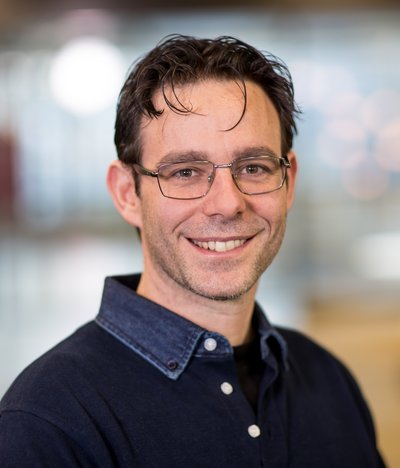
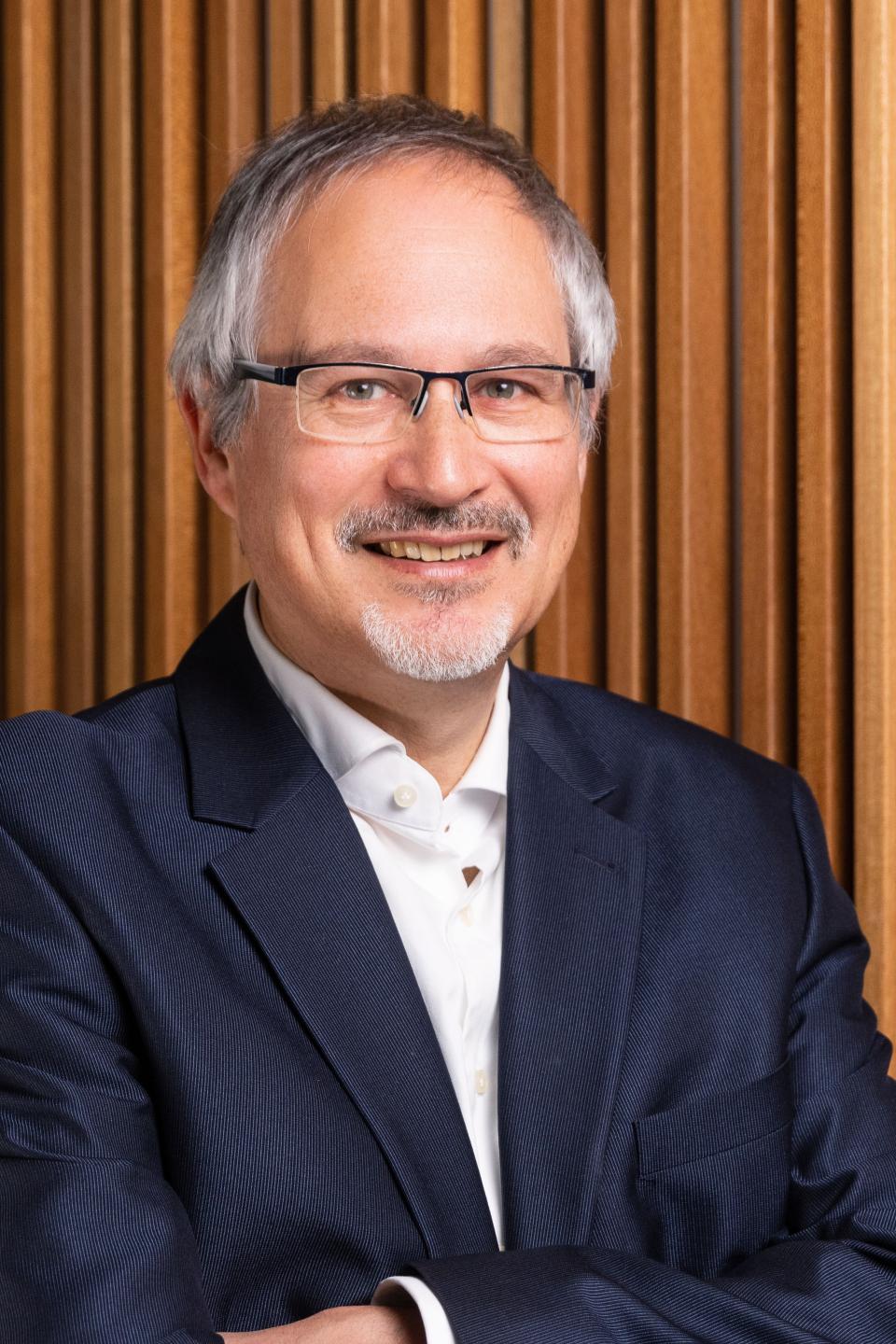
Massimo Mischi is a Full Professor at the Faculty of Electrical Engineering of the Eindhoven University of Technology (TU/e) and chairs the Signal Processing Systems (SPS) Division , the largest division at TU/e with over 250 researchers. He founded the Biomedical Diagnostics (BM/d) Lab in 2012, which now includes 180 researchers and clinical/industrial advisors, focusing on biomedical signal processing for diagnostics and monitoring.
Michel Versluis is a Full Professor at the University of Twente, Netherlands, specializing in Physical and Medical Acoustics within the Physics of Fluids group. His work focuses on microbubbles and microdroplets for medical imaging and therapy, as well as microfluidic applications in medicine and nanotechnology. University of Twente, Physics of Fluids group His research bridges physics and biomedical engineering, with publications in high-impact journals like PNAS and IEEE Transactions. Recent work emphasizes ultrasound-driven microbubble dynamics, additive manufacturing of flow phantoms, and deep learning for super-resolution imaging. 2025 publications: vascular phantoms, PROTEUS simulator, acoustic microbubble control 2024 innovations: 3D-printed medical devices, immunogenic cell death optimization Contact: m.versluis@utwente.nl
National Research Institute for Mathematics and Computer ScienceNetherlands
Prof. Sander Bohte is a part-time full professor of Computational Neuroscience at the University of Amsterdam (Swammerdam Institute of Life Sciences) and an honorary full professor of Bio-inspired Neural Networks at the University of Groningen. He serves as a Scientific Staff Member and Group Leader in the Machine Learning department at CWI, Amsterdam. His work bridges computational neuroscience and machine learning with a focus on continuous-time information processing. Key research interests include: Spiking Neural Networks with predictive coding and multi-compartment models Biologically Plausible Learning in recurrent and deep architectures Working Memory modeling via reinforcement learning Neuromorphic Computing for real-time systems and GPU acceleration His recent publications highlight trends in neural adaptation , predictive coding , and SNN hardware-software co-design . Awards include the Veni Innovational Research Grant (2004) and ERCIM grant (2013) . He actively supervises MSc theses and leads grants like the NWO KIC project 'Selfhealing Neuromorphic Systems' (2024).
Guy G. Drijkoningen is an Associate Professor in Applied Geophysics at Delft University of Technology (TU Delft), Faculty of Civil Engineering and Geosciences. He is actively involved in teaching and research within the Department of Applied Geophysics & Petrophysics. Education: MSc, Delft University of Technology, The Netherlands PhD, Cambridge University, UK Research Focus: His work centers on Seismic Experiments & Modelling , particularly in exploration and shallow-subsurface contexts. Key areas include: Seismic data acquisition on land Continuous seismic monitoring Shallow shear-wave imaging (land and marine) Seismic wave propagation in porous media Current projects leverage advanced sensor networks (e.g., LOFAR), full-waveform inversion for tunnel-boring machines, and novel vibrator technologies. Publications Trend: Recent works (2011–2016) emphasize seismic modeling, inversion techniques, and experimental validation across marine and terrestrial environments. Topics span poroelastic wave theory, ambient-noise interferometry, and innovative seismic source design, reflecting a blend of theoretical and applied geophysics. Scientific Awards: Best-paper award Geophysics 2015 for "A seismic vertical vibrator driven by linear synchronous motors" Professional Memberships & Editorial Roles: Member: Society of Exploration Geophysicists (SEG) Member: European Association of Geoscientists and Engineers (EAGE) Associate Editor: Geophysics Teaching: He teaches undergraduate and graduate courses including Introduction to Geophysics, Reflection Seismology, and specialized PhD-level modules on seismic data analysis.
Florian Bociort is an Assistant Professor at the Optics Research Group , Delft University of Technology (Faculty of Applied Sciences). He holds a PhD in Physics from TU Berlin (1994) and has dedicated his career to optical system design, gradient-index optics, and computational methods in lens design. Research Interests Bociort’s research focuses on design landscapes of optical systems , where he pioneered the use of saddle points to escape local minima in optimization. His work spans Gradient-index optics (conversion of homogeneous lenses to GRIN media) Artificial intelligence in lens design Optics education (simulation-driven learning) Academic Contributions He has supervised multiple PhD theses on topics like: A. M. Boyd (2025): Generalized gradient-index lens optimization Z. Hou (2023): Systematic lens design searches Y. Shao (2021): Imaging coherence and optimization M. Strauch (2020): Tunable optics M. Mout (2019): Ray-based diffraction simulation Recent Publications His 2025-2018 publications show a trajectory from classical optical design to modern computational approaches, including simulation-driven education, gradient-index conversions, and high-NA diffraction modeling. The 2024 paraxial reconstruction and 2025 simulation-education articles exemplify this evolution. Patents & Expertise He co-invented two ASML-related patents in lithographic design and served as expert witness in the 2018 ASML-Nikon patent lawsuit. His personal webpage details his networks of local minima and fractal basins in optimization.
Joost Batenburg is a Professor at Leiden Institute of Advanced Computer Science (LIACS) , with a chair in Imaging and Visualization . He is affiliated with the Centrum Wiskunde & Informatica (CWI) and serves as Program Director for the interdisciplinary Society, Artificial Intelligence and Life Sciences (SAILS) initiative. His research focuses on tomographic image processing and reconstruction , where he has published over 80 journal articles and 60 conference papers. Current projects include Universal Three-dimensiOnal Passport for process Individualization in Agriculture (UTOPIA) and Center for Optimal, Real-Time Machine Studies of the Explosive Universe (CORTEX) , both funded by NWO grants. He leads the FleX-Ray Lab , a custom CT system integrated with advanced data processing algorithms. His research spans discrete tomography , real-time imaging pipelines , and AI-enhanced reconstruction methods , with applications in industrial inspection, agricultural analysis, and cultural heritage conservation. Recent articles demonstrate novel approaches to: Single-shot dynamic object tomography using level-set methods and motion modeling X-ray scattering quantification for defect detection in real-time systems Cross-modal image registration between CT scans and physical photographs Auto-differentiation in CT workflows combining classical and machine learning algorithms Scientific Awards: Dutch Award for ICT Research (2018) C.J. Kok Prize (2007) Philips Mathematics Prize (2006) He has supervised numerous PhD candidates including Mary Go, Eani Lachmansingh, and Zhichao Zhong, while maintaining editorial roles at IEEE Transactions on Computational Imaging and Journal of Mathematical Imaging and Vision . His work bridges theoretical mathematics with practical applications in agriculture, industry, and art conservation.
Prof. Freek J. Beekman is a Full Professor and head of the Biomedical Imaging section within the Department of Radiation Science & Technology at Delft University of Technology (TU Delft), Faculty of Applied Sciences. He is a leading figure in biomedical imaging, with extensive contributions to nuclear imaging technologies, including SPECT, PET, and CT. His research spans detector development, image reconstruction algorithms, hybrid photonic imaging, and the application of artificial intelligence in medical imaging. Research Interests: His work focuses on advancing imaging modalities through innovations in hardware (e.g., multi-pinhole collimators) and software (e.g., deep learning for attenuation correction). He has pioneered ultra-high-resolution imaging systems, particularly for preclinical and clinical SPECT, and has developed integrated platforms like U-SPECT-BioFluo. His recent research explores glymphatic delivery of nanoparticles, infection imaging, and AI-driven reconstruction techniques, reflecting a strong translational focus. Publication Trends: His most recent publications (2021–2023) emphasize deep learning in SPECT, multi-isotope imaging, high-resolution ex vivo systems, and applications in neuroimaging and oncology. The articles demonstrate a consistent focus on improving image quality, resolution, and clinical utility through physics-informed and AI-enhanced methods. Scientific Awards: NWO Physics Valorization Prize Innovation of the Year Award by the World Molecular Imaging Society (2015, 2018) Edward Hoffman Memorial Award (2017) Bruce Hasegawa Memorial Award (2021) FOM Valorization Award (2013) TU Delft Entrepreneurial Award (2010) Advising and Grants: While specific student names are not listed, his leadership in large collaborative projects and supervision of numerous publications suggests active mentoring. He has secured significant funding through national and international grants, evidenced by his invention of over 20 patent families and successful technology transfer. His founding and leadership of MILabs BV (sold to Rigaku) highlights his impact on commercialization and industry-academia collaboration. Labs and Teams: He leads the Biomedical Imaging research group at TU Delft, which develops cutting-edge imaging systems such as VECTor (SPECT-PET) and EXIRAD-HE. His teams have produced technologies used globally in academic and pharmaceutical research, contributing to tracer development and therapeutic innovation.
Dr. Dierck Hillmann is an Associate Professor at the Faculty of Science, Department of Biophotonics and Medical Imaging, Vrije Universiteit Amsterdam. He holds a PhD in Holoscopy from Luebeck University (2013). His research focuses on advanced optical imaging techniques, particularly Optical Coherence Tomography (OCT), with applications in retinal imaging, functional signal analysis, and computational imaging. He is affiliated with the LaserLaB - Biophotonics and Microscopy research group. Key research areas include improving OCT resolution through holographic methods, functional imaging of retinal neurons and photoreceptors, and developing computational adaptive optics to enhance imaging quality. His work addresses challenges like speckle reduction, aberration correction, and real-time data processing in biomedical imaging. Dr. Hillmann’s contributions span over 37 publications, including innovations in full-field OCT, optoretinography, and phase-sensitive measurements. He teaches courses such as Computational Optical Imaging and Light-Tissue Interaction. His current project explores imaging individual retinal cells and their functions using advanced techniques. No scientific awards are explicitly listed, but his extensive publication record reflects significant academic impact. Students advised are not specified in the provided materials.
Ralf Peeters is a Full Professor in Mathematics of Knowledge Engineering at Maastricht University's Faculty of Science and Engineering , Department of Advanced Computing Sciences. He serves as Vice-Dean of Research and Director of the STEM Graduate School, while leading the university's team at the inter-university research school DISC and co-chairing the Mathematics Centre Maastricht. Education: PhD in Mathematics (Free University, Amsterdam, 1994) Technical Mathematics (Delft University of Technology, 1988) Research Interests span applied mathematics, systems and control theory, signal/image processing, artificial intelligence, and biomedical engineering applications. His work bridges mathematical techniques with real-world challenges in healthcare and industrial systems. Recent Publications highlight advancements in deep learning for cardiac signal reconstruction, tensor-based signal decomposition, and recurrence plot analysis. These works integrate machine learning with clinical diagnostics, particularly in electrocardiographic imaging and arrhythmia characterization. Key Collaborations: Mathematics Centre Maastricht Dutch Mathematics Platform Dutch Institute of Systems and Control Leadership Roles: Vice-Dean of Research (FSE), Director of STEM Graduate School, Head of DISC-affiliated team, and Co-Chair of Mathematics Centre Maastricht. He has supervised over 25 PhD projects, emphasizing applied research across health and industrial domains.
Maurice van Keulen is an Associate Professor affiliated with the University of Twente's research institutes including Datamanagement & Biometrics, Digital Society Institute, and TechMed Centre. His multidisciplinary work bridges computer science, healthcare, and social systems. Research Focus: Van Keulen specializes in artificial intelligence applications with emphasis on: Data management (quality, integration, probabilistic databases) Explainable AI and interpretable machine learning models Healthcare informatics (cancer prediction, medical imaging, outcome analysis) Natural language processing and social media analytics His recent work explores dynamic sparse training, meta-learning for data imputation, and ethical AI frameworks. Publication Trends: Recent articles (2023-2025) show strong focus on: Interpretable AI methods in healthcare diagnostics Robust machine learning under data corruption Meta-learning approaches for data preprocessing 3D medical imaging and reconstruction techniques Awards: Beste paper award (2018) for work on probabilistic data conditioning Supervision & Activities: Has supervised 14 research projects and serves on executive boards including EDBT (Extending DataBase Technology) and IFIP WG 2.6. Leads research on ethical dimensions of AI systems.
Ruisheng Su is a Researcher at Erasmus MC's Department of Radiology & Nuclear Medicine . His work focuses on Medical Imaging , Artificial Intelligence , and Vascular Neurology , with a strong emphasis on Stroke Treatment and Cerebral Infarction research. Research Trends: His recent publications highlight the integration of Deep Learning and Neural Networks in endovascular therapy prediction and scoring systems. He explores Image Registration , Perfusion Imaging , and Vessel Segmentation to advance Cerebral Vascular Imaging and Stroke Intervention techniques. Key Contributions: Su has developed tools like CVFSNet for automated mTICI scoring, perfDSA for perfusion imaging in angiography, and segmentation-assisted methods for vessel centerline extraction, addressing critical gaps in Cerebral Infarction and Blood Clot Lysis treatment.
Dr. Thomas Smits is a faculty member at the Faculty of Humanities of the University of Amsterdam , specializing in Digital Humanities , Visual Culture , and Computational History . His research bridges artificial intelligence with historical image analysis, focusing on media history, colonial visual representations, and algorithmic approaches to archival studies. Recent publications highlight his work on multimodal datasets, generative AI in protest memory reconstruction, and the ethical implications of machine learning for historical research. Smits employs computational methods like CLIP and computer vision to analyze large-scale visual collections, including magic lantern slides, historical advertisements, and news images. Key research areas: Digital Humanities, Visual Memory, Algorithmic Analysis, Colonial Media, Gender Studies, Historical Epistemology. Methodological focus: Stochastic modeling, multimodal machine learning, distant reading of visual datasets, and AI-driven archival enhancement.
Bert de Vries is a Professor at the Signal Processing Systems Group at Eindhoven University of Technology (TU/e), where he has been employed since January 2012. He maintains a dual career, also working at GN Hearing in the hearing aids industry since April 1999, where he holds both research and managerial roles. His academic journey began at TU/e, where he earned his MSc in Electrical Engineering in 1986, followed by a PhD from the University of Florida in 1991. Between 1992 and 1999, he worked at Sarnoff Research Center in Princeton, NJ, contributing to diverse signal and image processing projects. Professor de Vries's research centers on Bayesian Machine Learning, with particular focus on the Free Energy Principle and its applications to engineering problems. His work bridges theoretical neuroscience with practical signal processing systems, especially in biomedical applications. He directs the BIASlab research team at TU/e, which develops probabilistic programming tools including RxInfer.jl, ForneyLab.jl, GraphPPL.jl, ReactiveMP.jl, and Rocket.jl. His research spans active inference, variational message passing, probabilistic programming, and Bayesian neural networks, with applications ranging from hearing aids to multi-agent systems. Analysis of his recent publications reveals a strong trend toward practical implementations of Bayesian inference frameworks, particularly through Julia-based probabilistic programming tools. His work shows increasing focus on active inference applications, message passing algorithms, and the intersection of Riemannian geometry with probabilistic modeling. The research demonstrates consistent progression from theoretical foundations toward real-world engineering applications, particularly in biomedical signal processing and autonomous systems. Professor de Vries teaches a graduate-level course on Bayesian Machine Learning at TU/e and actively contributes to open-source software development through his GitHub profile (bertdv), with recent activity as recent as August 2025. His research team has developed several influential probabilistic programming libraries that have gained significant attention in the machine learning community. The BIASlab research group continues to advance the state of the art in Bayesian inference methods with applications in hearing technology, robotics, and signal processing.
Jan Bergmans is a Full Professor in the Department of Electrical Engineering at Eindhoven University of Technology (TU/e). He leads the Signal Processing Systems group and holds professorships at multiple research centers including the Eindhoven MedTech Innovation Center (e/MTIC), Center for Care & Cure Technology Eindhoven, NeuroPlatform, EAISI Health, and EAISI Foundational. With approximately 35 years of experience in signal processing theory and applications, Bergmans focuses on developing computationally efficient signal analysis techniques for healthcare, wireless communication, surveillance, and intelligent lighting applications. Bergmans' educational background includes: MSc in Electrical Engineering from Eindhoven University of Technology (1981) PhD in Electrical Engineering from Eindhoven University of Technology (1987) His research interests center around signal processing and data analytics theories, algorithms, architectures, and systems. Bergmans develops mathematical models that incorporate domain-specific knowledge, such as propagation models for radio communication channels or pathophysiological models for clinical decision support systems. His work emphasizes creating powerful yet computationally efficient signal analysis techniques, with significant applications in healthcare technology and medical diagnostics. The integration of engineering principles with clinical needs is a hallmark of his research approach, enabling practical solutions that address real-world medical challenges. Analysis of Bergmans' recent publications reveals a strong focus on medical signal processing, particularly in ECG and fetal monitoring applications. His work combines advanced signal processing techniques like adaptive Kalman filtering with practical healthcare applications. There's also significant research in visible light communications and sensor network technologies, showing the breadth of his expertise across different application domains of signal processing. The consistent theme across his work is developing computationally efficient algorithms that incorporate domain-specific knowledge to solve practical engineering problems. Scientific recognition includes: Senior Member of the IEEE Author of numerous papers and 2 books Holder of approximately 40 US patents Bergmans has established smooth collaborations with strategic industrial and clinical partners, including Philips Research and multiple hospitals in the Eindhoven region. He co-manages BrainBridge, the strategic collaboration between TU/e, Philips Research, and Zhejiang University (China). His research group has secured numerous projects, including recent third-tier projects like MEDEIA, PISANO SPS, and RAISE projects focusing on medical engineering innovations and robust AI for radar signal processing. As a key figure in the Signal Processing Systems group and one of the founders of the Eindhoven MedTech Innovation Center (e/MTIC), Bergmans plays a central role in bridging academic research with industrial and clinical applications. His leadership extends to managing multiple research teams working on healthcare technology, wireless communications, and sensor systems, fostering an environment where theoretical signal processing advances translate into practical medical and technological solutions.
David Maresca is an Associate Professor in the Imaging Physics department at the Faculty of Applied Sciences, Delft University of Technology. His research focuses on the intersection of ultrasound imaging physics and molecular engineering, with the goal of enabling ultrasound imaging of cells across space and time in living opaque organs. His research interests include: Biomolecular acoustic sensors Functional ultrasound neuroimaging Transcranial ultrasound Nonlinear ultrasound imaging Engineering of acoustic biosensors Ultrasound imaging of brain function Dr. Maresca's work centers on developing technologies that combine ultrasound physics with molecular engineering to create new imaging capabilities. His lab pioneers approaches to image cells within opaque organs using ultrasound, with applications in neuroscience and biomedical imaging. His research spans from fundamental ultrasound physics to the development of acoustic biosensors and imaging techniques that can detect cellular processes. His recent publications demonstrate a strong focus on advancing ultrasound imaging capabilities, particularly in nonlinear ultrasound techniques, contrast-enhanced ultrasound, and applications in neuroimaging. His work shows increasing interdisciplinary collaboration across physics, engineering, and neuroscience. Dr. Maresca has received recognition including the HFSP Cross-Disciplinary Fellowship. His academic background includes a Ph.D. in Biomedical Engineering from Erasmus MC, an M.Sc. in Acoustics, and a Master's degree in Physics from Université Paris Diderot. He completed postdoctoral work at Caltech and Institut Langevin, ESPCI. His research is supported by collaborations across institutions, with recent work involving researchers from multiple universities and research centers. Dr. Maresca's lab is actively contributing to advancing ultrasound imaging technology and its applications in biomedical research.