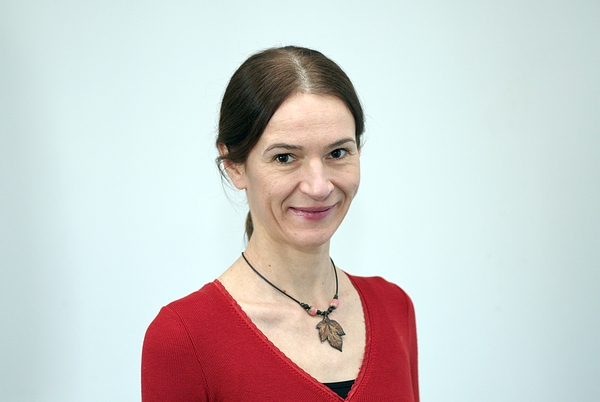
Charaf Hassan is a Professor and Head of Department at the Budapest University of Technology and Economics, specifically in the Department of Automation and Applied Informatics. His work spans interdisciplinary domains, focusing on distributed systems, network coding, and IoT technologies. His research interests include Distributed Systems and Domain-Specific Modeling Network Coding and Mobile Peer-to-Peer Systems Model-Driven Development for Multiplatform Applications Machine Learning in Fluid Dynamics and Pharmaceutical Analysis Recent publications highlight trends in applying convolutional neural networks to viscosity estimation, model-driven methodologies for IoT, and network coding in cloud storage. He teaches advanced courses in distributed systems and software architectures at the university level.
Ildikó Papp is an Associate Professor at the Faculty of Informatics, University of Debrecen , specializing in the Department of Data Science and Visualization . Her academic focus spans geometric modeling , 3D technologies , and experience-oriented teaching methods , bridging theoretical geometry with practical digital applications. Research Interests: Computer modeling of curves and surfaces Constructive and representational geometry 3D printing and visualization Cognitive infocommunication in education Publication Trends: Focus on QR code integration with 3D surfaces (2021-2022) Biomedical applications of FDM printing (2020) Educational impact of 3D technologies (2016-2018) Advancements in Bézier curve isoptics (2012-2013) Optimization techniques in geometric modeling (2012) Contact: Email: papp.ildiko@inf.unideb.hu
Róbert Tornai serves as an Associate Professor in the Department of Data Science and Visualization at the Faculty of Informatics, University of Debrecen, Hungary. His institutional affiliation encompasses active participation in the department's core mission of advancing data processing, visualization, and computational methodologies within Hungary's academic landscape. His primary research focuses on high-performance data transfer in supercomputing environments, parallel data processing using memory-safe Rust programming, and virtual collaboration system development. These interconnected domains emphasize optimizing data-intensive workflows while ensuring system security and user accessibility, reflecting contemporary challenges in distributed computing infrastructure. Analysis of his 15 most recent publications reveals dominant trends in high-speed connectionless networking protocols (2020-2025), where he investigates performance optimization, error detection, and encryption for file transfer systems. Significant secondary themes include biometric security applications (iris/voice recognition) and GPU-accelerated image processing techniques leveraging WebAssembly and Vulkan API, demonstrating technical versatility across networking, security, and visualization domains. His scholarly output consistently addresses practical implementation challenges in data transfer and secure systems, with recent work extending into educational technology applications of 3D printing. This trajectory indicates sustained engagement with evolving computational paradigms while maintaining focus on real-world system performance and security requirements.
Anikó Kern is a Research Fellow at the Institute of Geography and Earth Sciences at Eötvös Loránd University, where she also serves as a lecturer in the Department of Geophysics, Center of Earth Sciences, and HUN-REN-ELTE Űrkutató Csoport. Her work integrates remote sensing , climate science , and geospatial analysis to study vegetation dynamics, agricultural risk management, and environmental modeling. Her recent research focuses on applying MODIS NDVI data and Sentinel satellite imagery to analyze forest phenology (e.g., oak species radial growth projections), crop flowering cycles (sunflower and rapeseed), and extreme hydrological events in Central Europe. She also develops tools like the FORESEE datasets for climate impact studies. Email: aniko.kern@ttk.elte.hu Office: Room 6.68, Address: 1117 Budapest, Pázmány Péter sétány 1/a
Dr. Andrea Ferenczi serves as Associate Professor in the Department of Personality and Health Psychology at Károli Gáspár University of the Reformed Church in Hungary's Faculty of Humanities and Social Sciences. Holding a PhD in Communication Psychology (summa cum laude, University of Pécs, 2010) and dual MA degrees in Theology/Psychology (Austria, 2003) and Biotechnology (Gödöllő University, 1992), she maintains active roles in the Person- and Family-Oriented Health Sciences Research Group and as editor of Psychologia Hungarica Caroliensis . Her research spans conflict resolution mechanisms , suggestive communication in healthcare , school health psychology , psychology of religion , and gratitude studies . Recent work examines gratitude's protective effects during pregnancy and pandemics, materialism measurement, and work-family conflict dynamics. Her publications appear in journals like Studia Universitatis Babeş-Bolyai and Interpersona , with over 100 independent citations. Ferenczi's scientific contributions reveal strong interdisciplinary integration between psychology, theology, and healthcare. Her research demonstrates how dispositional gratitude functions as psychological immunity during crises, while her work on materialism scales and religious schemas bridges quantitative measurement with qualitative meaning-making. The pandemic-era studies particularly highlight how spiritual resources interact with mental health resilience. Scientific Journalism Award (National Association of Hungarian Journalists and Janssen-Cilag, 2003) LAM Award, Medicine and Society Category (Lege Artis Medicinae Medical Journal, 2009) As academic advisor and editor, Ferenczi connects psychological science with practical applications through media consulting (HBO's Therapy series), professional training programs, and editorial work on theological psychology publications. Her Personality and Health Psychology Research Workshop fosters collaborative investigations into relational health and spiritual well-being.
Dániel Bence Erős serves as a teaching assistant at the University of Debrecen's Faculty of Informatics within the Department of Data Science and Visualization. His institutional affiliation places him within Hungary's prominent academic hub for computational sciences, working from office I122 in the Faculty of Informatics building at Kassai Street 26, Debrecen. The Department of Data Science and Visualization conducts research and education across critical computational domains including data processing pipelines , advanced visualization techniques , neural network architectures , and geometric modeling systems . Their work spans both theoretical frameworks and practical implementations in machine learning, image analysis, and spatial data systems. As part of this department, Erős contributes to academic instruction within Hungary's growing AI and data science education ecosystem. The department maintains active research in medical imaging, cryptographic systems, and computational geometry through its diverse faculty team. His professional activities operate within the institutional framework of the University of Debrecen, a major Central European research university with strong computational science programs. The department maintains collaborative relationships across multiple technical domains including medical informatics, blockchain systems, and 3D visualization technologies.
László Kovács serves as an Assistant Professor at the Faculty of Informatics, University of Debrecen, where he focuses on data science research and development. He is also recognized as an Nvidia Deep Learning Institute Certified Instructor and Ambassador, contributing to the advancement of AI education. His work is prominently featured through the Autonomous Vehicle Research Lab at the University of Debrecen. His primary research interests include Digital Image Processing , Fusion Systems , and High Performance Computing , with particular emphasis on medical applications. Kovács has developed data-driven solutions that address market, industrial, and social demands of artificial intelligence across various sectors including healthcare. His work demonstrates how the Faculty of Informatics at the University of Debrecen prioritizes data science in both educational and research contexts. Analysis of his publication record reveals a strong focus on medical image analysis, particularly in ophthalmology applications. His research consistently applies advanced computational techniques to solve diagnostic challenges in retinal imaging and melanoma detection. The publications show a progression from foundational algorithm development to practical medical applications, demonstrating his commitment to translating theoretical computer science into real-world healthcare solutions. Scientific Awards and Recognition: Ányos Jedlik PhD candidate scholarship of the National Excellence Program (2014-2015) János Csere Apáczai PhD scholarship of the National Excellence Program (2013-2014) Uiversitas scholarship from University of Debrecen (2012) Special prize at XXX-th National Scientific Students' Associations (2012) Prize of the Dean for Masters Students (2010) Kovács has supervised PhD research projects including OTKA NK101680 on melanoma detection and HURO/1001/283/2.3.1 on image-based recommendation systems. His teaching portfolio is extensive, covering High Level Programming Languages, High Performance Parallel Computing Tools, Parallel Image Processing, and Data Science. He has also established thesis topics in distributed programming, fusion systems, high-performance computing architectures, and medical diagnostic applications. His research group maintains an active GitHub presence through the Autonomous Vehicle Research Lab.
Dr. Carolin Hannusch is a Senior Lecturer at the Department of Computer Science, Faculty of Informatics, University of Debrecen, Hungary. She holds a B.Sc. (2009) and M.Sc. (2011) in Mathematics from the University of Debrecen, and completed her Ph.D. there in 2015. Her office is located in Room I129 of the Faculty of Informatics building. Her primary research focuses on algebraic coding theory and cryptography , with expertise in error-correcting codes, combinatorial designs, discrete mathematics, and applications in cybersecurity. She also publishes in mathematics education and digital text analysis. Her recent publications demonstrate strong interdisciplinary work across coding theory (e.g., binary self-dual codes, Goppa codes), cryptographic systems (e.g., hash functions, symmetric cryptosystems), and educational technology (e.g., digital text management, online trigonometry instruction). Awards include: Special Price at XXX. Students' Conference Hungary (2011) Universitas Prize for Young Researchers (2015) University of Debrecen's "Thesis of the Year" Prize (2018) She maintains collaborations with researchers across Europe and has presented work at international conferences including FedCSIS, CITDS, and Central European Conference on Cryptology.
Dr. Attila Kuki is an Associate Professor at the University of Debrecen , affiliated with the Faculty of Informatics , Department of Informatics Systems and Networks . His primary research areas include Queueing Theory , Modeling Infocommunication Systems , Reliability Theory , and Modeling Stochastic Systems . Email: kuki.attila@inf.unideb.hu Research Interests: Queueing Theory Infocommunication Systems Reliability Theory Stochastic Systems Recent Publications focus on retrial queues, two-way communication systems, server reliability, collision handling, and stochastic modeling. These works often integrate simulation and numerical analysis to evaluate system performance under catastrophic breakdowns and impatience scenarios. Departmental Affiliation: The Department of Informatics Systems and Networks explores topics such as real-time communication, sensor networks, and distributed systems, aligning with Dr. Kuki's expertise.
Dr. Szilvia Szeghalmy is a Lecturer at the University of Debrecen, Faculty of Informatics, Department of Computer Science. She can be contacted at +36 52 512 900 75116 or via email at szeghalmy.szilvia@inf.unideb.hu, located in room I116, floor 1 of the Faculty of Informatics building. Her research focuses on: Digital Image Processing Imbalanced Learning Recent publications highlight trends in: Imbalanced data handling and noise filtering techniques (2024) Medical imaging applications (2024) Driver-assistance systems and traffic sign recognition (2018-2019) Human-computer interaction using sensors (2013-2014)
Dr. Henrietta Tomán serves as an Assistant Professor in the Department of Data Science and Visualization at the University of Debrecen's Faculty of Informatics, where she bridges advanced mathematical theory with practical medical imaging applications. Her work integrates abstract algebraic structures with cutting-edge AI systems to solve critical healthcare challenges. Her research portfolio spans three interconnected domains: Medical image processing (particularly ensemble-based segmentation and quality assessment for ophthalmic diagnostics) Geometric structures (quasigroups, loops, and differentiable manifolds) Stochastic optimization for resource-constrained AI systems Analysis of her publication trajectory reveals evolving expertise: early work (2010-2014) established foundations in geometric loop theory applied to image processing, while recent research (2020-2024) pioneers stochastic fusion techniques for medical image ensembles under computational constraints. Her most significant contributions involve translating mathematical abstractions into robust clinical decision-support tools, particularly in diabetic retinopathy detection and epidemic modeling. Current work demonstrates increasing focus on real-time AI systems that maintain accuracy under hardware limitations, reflecting urgent needs in telemedicine and mobile health applications. Dr. Tomán maintains active collaboration within the Doctoral School of Informatics and contributes to Hungary's national research initiatives in medical AI, with consistent publication output in top-tier venues spanning computer vision, medical imaging, and mathematical computing.
Dr. Molnár Bence is an Associate Professor at the Department of Photogrammetry and Geoinformatics, Faculty of Civil Engineering, Budapest University of Technology and Economics. His research focuses on AI-supported point cloud processing, accuracy analysis of medical imaging techniques, engineering geodesy, deformation analysis, and web-based photogrammetric applications. Courses taught: Civil Engineering Informatics (BMEEOFTAT42), Database Systems (BMEEOFTMI51), Field Course of Structural Geodesy (BMEEOAFAS42), Information Technologies (BMEEOFTMF-1) Research areas: Laser scanner data acquisition and point cloud processing, MS Kinect-based positioning and modeling, web applications for engineering tasks Contact: Room K. ép / I. em. 31/7; Consultation hours: Wednesday 13:00-14:00
Gégény Dávid is a researcher at the University of Miskolc 's Faculty of Mechanical Engineering and Informatics . His work focuses on fuzzy rough sets, lattice structures, and approximation algorithms. Affiliation: Institute of Mathematics, University of Miskolc Doctoral School: József Hatvany Doctoral School of Informatics (since 2006) Research Interests : Fuzzy Rough Set Theory Lattice and Conceptual Structures Pattern Mining Algorithms Granular Computing Tolerance Relations Mathematical Modeling Publications (2019-2024) span journals like International Journal of Approximate Reasoning , Knowledge-Based Systems , and conferences including IEEE FUZZ-IEEE . Key themes include Optimistic approximations in multigranular systems Rough set applications in image processing Interpolation methods for fuzzy environments Lattice-theoretic foundations for knowledge discovery
János Török is an Associate Professor at the Department of Theoretical Physics, Budapest University of Technology and Economics, affiliated with the Morphodynamics group. His research spans granular materials, social network modeling, and morphodynamics of pebbles. Granular materials: Quasi-static shearing, shear band formation, particle shape effects, hopper flow Social science: Conflicts on Wikipedia, consensus modeling, social network dynamics Morphodynamics: Collective abrasion, fragmentation of pebbles His recent publications focus on computational modeling of granular physics and social dynamics, with applications in machine learning for malaria detection. Articles highlight interdisciplinary approaches to phase transitions, network analysis, and material deformation. Shear zones in granular materials Deep learning for social network parameters Malaria detection software He is involved in open-source projects (WWM, Mozi) and teaches courses in mathematical methods, mechanics, and scientific programming.
Gábor Botfalvai is a Research Fellow at the Institute of Geography and Earth Sciences , affiliated with the College of Earth Sciences and Department of Palaeontology . His research focuses on vertebrate palaeontology , particularly dinosaur fossils , coprolites , ichnology , and geochemical analysis of fossil sites. Key Areas: Dinosaur-bearing strata, Miocene vertebrate coprolites, ichnopathologies, ornithopod dietary evolution, taphonomy, and sedimentology Methodologies: Geochemical dating, 3D fossil imaging, stratigraphic analysis, and paleoenvironmental reconstruction His recent work spans Campanian-Maastrichtian dinosaur sites in Romania, Miocene vertebrate coprolites in Hungary, and Triassic reptile remains in Villány. Trends in his publications highlight interdisciplinary approaches combining sedimentology, geochemistry, and taxonomy. Scientific Awards: None explicitly mentioned in available sources. Advising & Grants: No specific students or grants listed. Collaborations include institutions like the Bakony-Balaton Geopark and Hațeg Basin research teams.