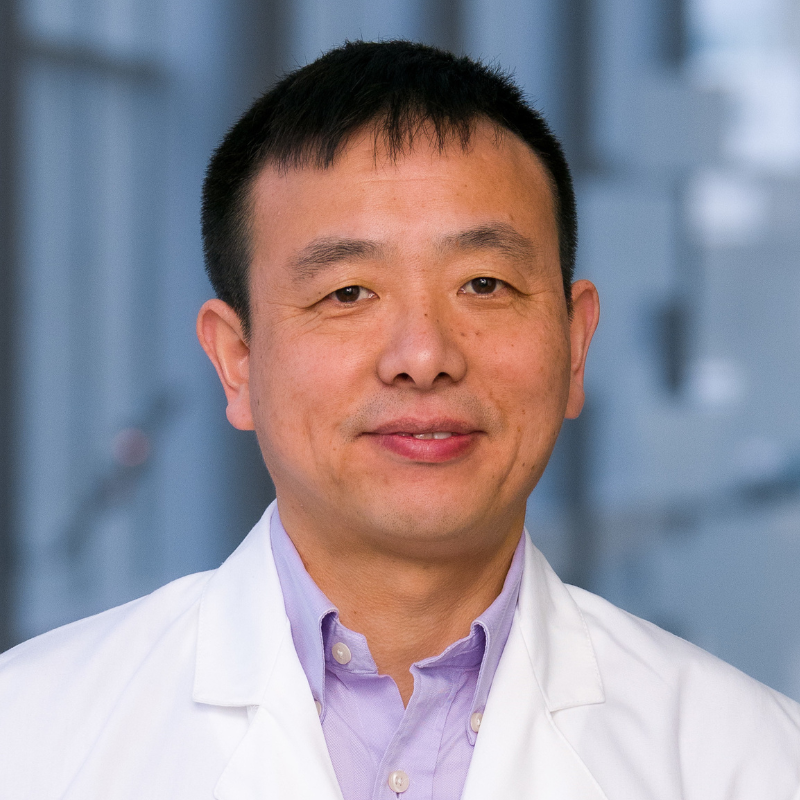
Weiguo Lu, Ph.D., is a Professor in the Department of Radiation Oncology at UT Southwestern Medical Center, where he leads research in the Division of Medical Physics and Engineering. He is also the co-founder of Neural Rad LLC and a board-certified medical physicist by the American Board of Radiology with a license from the Texas Medical Board. Education: Bachelor’s and Master’s in Nuclear Physics – Peking University, China Master’s in Medical Physics – University of Wisconsin–Madison Master’s in Computer Science – University of Wisconsin–Madison Ph.D. in Medical Physics – University of Wisconsin–Madison Dr. Lu’s research focuses on the integration of artificial intelligence and machine learning into radiation oncology, particularly in medical image segmentation, adaptive radiotherapy, dose prediction, and motion management. His work leverages deep learning to improve treatment planning accuracy and efficiency, especially in complex cases involving brain metastases, breast cancer, and head and neck tumors. The recent articles highlight a strong trend toward AI-driven automation in radiotherapy, including unsupervised domain adaptation, semi-supervised segmentation, patient-specific MRI super-resolution, and end-to-end survival prediction models. These works reflect a cohesive research agenda centered on enhancing precision, personalization, and real-time adaptation in cancer treatment using cutting-edge computational methods. Scientific Awards and Certifications: American Board of Radiology Certification Texas Medical Board Medical Physics License Dr. Lu actively mentors a large team of students and researchers, as evidenced by his extensive co-authorship on publications. His lab, the MAIA Lab (Medical Artificial Intelligence and Automation), develops platforms for automated delineation, dose verification (e.g., ART2Dose), and online adaptive radiotherapy. He has contributed to clinical workflow development, such as GammaPod treatments, and has been involved in quality assurance frameworks for FLASH trials. His collaborations span across institutions and involve significant translational research from algorithm development to clinical implementation. Dr. Lu’s research is supported by institutional and clinical grants related to AI in oncology, proton therapy, and adaptive radiotherapy, though specific grant names are not detailed in the provided text. He leads a multidisciplinary team focused on pushing the boundaries of medical physics through innovation in imaging, modeling, and therapeutic delivery.