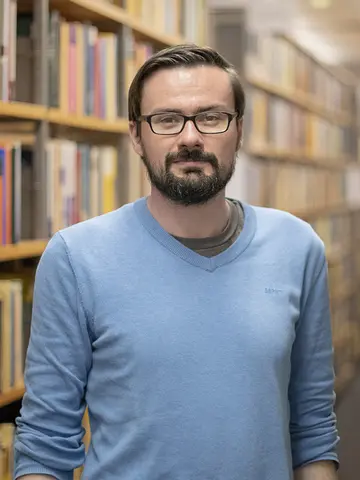
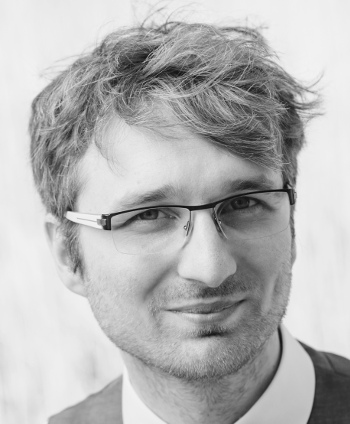
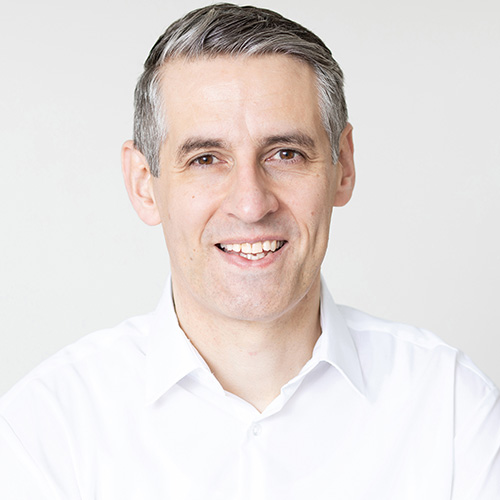
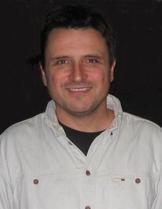
Florian Frick is an Associate Professor at Carnegie Mellon University in Pittsburgh. He received his PhD from TU Berlin and the Berlin Mathematical School, followed by postdoctoral positions at Cornell University and MSRI (Mathematical Sciences Research Institute). Research Focus : Interdisciplinary work at the intersection of combinatorics, geometry, and topology. Specific areas include chromatic numbers of hypergraphs, embeddability in geometric topology, intersection patterns of convex sets, and fair division problems. Interests : Traveling, sports, and food-related activities. Current Affiliation : Max Planck Institute for Mathematics in the Sciences (Nonlinear Algebra Research Group) as a visitor (2022).
Michael Schaub is a tenure-track Assistant Professor in the Department of Computer Science at RWTH Aachen University, specializing in Computational Network Science. His research focuses on analyzing complex systems through network and graph models, integrating dynamical systems, control theory, and machine learning. He leads the Computational Network Science group, advancing methodologies for higher-order network models like simplicial complexes and hypergraphs. Schaub holds a PhD from Imperial College London and has held postdoctoral positions at MIT and Oxford. He is an ERC Starting Grant recipient (2022) and a Marie Curie Fellow, recognized for contributions to network dynamics and topological data analysis. Education: PhD in Mathematics, Imperial College London (2011-2015) MSc in Biomedical Engineering, Imperial College London (2010) BSc in Electrical Engineering, ETH Zurich (2007-2010) Research Interests: Schaub’s work spans interdisciplinary applications of network science, including biological systems, social networks, and technical infrastructures. Key areas include: Higher-order network models (hypergraphs, simplicial complexes) Graph signal processing and dynamics on networks Community detection and dynamical systems analysis Topological data analysis and machine learning Grants & Awards: ERC Starting Grant (2022): HIGH-HOPeS project Marie Skłodowska-Curie Fellowship (2017-2019) Junior Fellow, German Informatics Society (GI) Member of Junges Kolleg (North Rhine-Westphalia Academy) Labs & Teams: Leads the Computational Network Science Lab at RWTH Aachen, collaborating internationally on projects like the ELLIS Society and the European Laboratory for Learning and Intelligent Systems (ELLIS). Active in organizing workshops (e.g., Toponets, SIAM MDS).
Prof. Dr. Martin Burger is a leading scientist at DESY and a Full Professor in the Department of Mathematics at Universität Hamburg, where he leads the Computational Imaging Group. His research bridges applied mathematics, imaging sciences, and machine learning, with a focus on inverse problems, mathematical modeling, and partial differential equations. He has held professorial positions at Universität Münster and FAU Erlangen-Nürnberg prior to his current dual appointment. Full Professor, Universität Hamburg (2023–present) Leading Scientist, DESY, Hamburg (2023–present) Full Professor, FAU Erlangen-Nürnberg (2018–2023) Full Professor, Universität Münster (2006–2018) His research interests include inverse problems, variational regularization, optimal transport, kinetic models, and mathematical modeling in biology and social sciences. He has made significant contributions to imaging reconstruction, sparse neural networks, and the analysis of transformer architectures. His work often integrates theoretical analysis with computational methods, influencing both pure and applied mathematics. The most recent articles reflect a strong trend toward interdisciplinary applications, combining deep learning with PDE-based modeling, analyzing social and biological systems via kinetic and mean-field models, and advancing mathematical imaging through graph-based and optimal transport methods. His publications span high-impact venues in applied mathematics and computational science. Calderon Prize, Inverse Problems International Association (IPIA) ERC Consolidator Grant (2014) Invited speaker at ECM (2021), ICM (2022), and ICIAM (2023) Editor-in-Chief, European Journal of Applied Mathematics (since 2017) Prof. Burger has supervised numerous PhD students and postdoctoral researchers, many of whom appear as co-authors in his publications. His research is supported by major grants, including funding from the German Federal Ministry of Education and Research (BMBF). He is actively involved in collaborative projects across mathematics, physics, and engineering disciplines. He leads the Computational Imaging Group at DESY, fostering a collaborative environment for developing novel mathematical tools in imaging science. The group works on both theoretical foundations and practical implementations, contributing to advancements in tomography, machine learning, and data analysis.
Hao Liu is a researcher affiliated with institutions like Chinese Academy of Sciences , Beihang University , and Stanford University . His work spans Computer Science , Artificial Intelligence , and Robotics . Key affiliations: National Space Science Center (Beijing), School of Astronautics (Beihang), Key Laboratory of Pervasive Computing (Tsinghua) Research interests include Machine Learning , Image Processing , Graph Neural Networks , and Wireless Communication Optimization His recent publications focus on: Advanced control systems for fuzzy models Medical imaging via hyperspectral analysis Transformer-based approaches in NLP and vision Quantum-safe and edge computing protocols
Professor Asaf Shapira is a faculty member in the Department of Theoretical Mathematics at Tel Aviv University's School of Mathematical Sciences. He has been actively contributing to combinatorics and graph theory research for over a decade, with numerous publications in top journals including Journal of the ACM, Advances in Mathematics, and Geometric and Functional Analysis. Professor Shapira's research focuses on extremal combinatorics, graph theory, and property testing. His work explores fundamental questions in Ramsey theory, hypergraph theory, and probabilistic methods in combinatorics. He has made significant contributions to the study of graph regularity, removal lemmas, and extremal problems in dense and sparse graphs. His recent publications demonstrate a consistent focus on theoretical aspects of combinatorics with connections to theoretical computer science. A notable trend is his work on developing polynomial bounds for various combinatorial theorems and exploring connections between combinatorial structures and computational complexity. His research often bridges pure mathematics with theoretical computer science applications. Professor Shapira teaches advanced courses at Tel Aviv University including Extremal Graph Theory, Basic Combinatorics, and seminars on specialized topics in combinatorics. His teaching spans undergraduate and graduate levels, reflecting his commitment to educating the next generation of mathematicians.
Tibor Szabó is a Professor in the Combinatorics and Graph Theory group at the Department of Mathematics, Freie Universität Berlin. He holds a PhD from The Ohio State University, advised by Ákos Seress. Prior to his current position, he held roles at McGill University, ETH Zürich, the Institute for Advanced Study (Princeton), and the University of Illinois (UIUC) as a J.L. Doob Research Assistant Professor. Research Interests: His work focuses on combinatorics and combinatorial optimization, including extremal problems, random structures and algorithms, pseudorandom graphs, positional games, and the combinatorics of linear programming. He explores tools from algebra, probability theory, and topology applied to combinatorics. Teaching: He teaches courses such as Algorithmic Combinatorics, Extremal Combinatorics, and runs the Combinatorics Seminar. His lecture notes include works on positional games and explicit constructions in extremal combinatorics. Students & Postdocs: Notable PhD advisees include Yamaan Attwa, Silas Rathke, Simona Boyadzhiyska, and Patrick Morris. Postdoctoral fellows include Olaf Parczyk and Anurag Bishnoi. His research has involved collaborations with over 50 co-authors. Funding & Grants: Supported by grants from the Swiss National Science Foundation (SNF) and German Research Foundation (DFG), focusing on topics like positional games and extremal graph theory.
Professor Stefan Glock is an Assistant Professor of Discrete Mathematics at the University of Passau's Faculty of Computer Science and Mathematics, a position he has held since September 2022. Prior to this appointment, he spent three years as a Junior Fellow at the Institute for Theoretical Studies at ETH Zurich, following the completion of his doctorate at the University of Birmingham. Stefan Glock received his mathematics education at Technische Universität Ilmenau from 2009 to 2014, then pursued his PhD at the University of Birmingham, which he completed in 2018. His doctoral dissertation, "Decompositions of Graphs and Hypergraphs," was the runner-up for the Richard-Rado-Preis 2018. Professor Glock's research focuses on discrete mathematical structures, with particular emphasis on their asymptotic properties. His work spans several interconnected fields of combinatorics: Extremal Combinatorics : Investigating the maximum or minimum possible size of mathematical structures satisfying certain properties Probabilistic Combinatorics : Applying probability theory to solve combinatorial problems Graph Theory : Studying properties of graphs and networks Ramsey Theory : Examining conditions under which order must appear in large structures Design Theory : Creating arrangements of elements satisfying specific balance properties Discrete Geometry : Analyzing geometric problems with discrete structures Analysis of Professor Glock's recent publications reveals a consistent focus on solving long-standing open problems in combinatorics using innovative methods that combine probabilistic techniques with structural insights. His work often bridges theoretical mathematics with applications in theoretical computer science, particularly in the analysis of algorithms and network structures. A significant portion of his research addresses fundamental questions about graph and hypergraph decompositions, which have implications for coding theory, cryptography, and network design. Professor Glock has received notable recognition for his contributions to mathematics: Runner-up for the Richard-Rado-Preis 2018 for his dissertation "Decompositions of Graphs and Hypergraphs" Awarded funding through the prestigious DFG Emmy Noether Programme in 2024 for his research group on "the interplay of structure and randomness in mathematics" As a faculty member at the University of Passau, Professor Glock leads the Discrete Mathematics research group and actively collaborates with mathematicians worldwide. He has established a strong research program that has attracted funding for academic visitors and supports multiple research projects. His approach to mathematical problems emphasizes developing new methods that have far-reaching implications beyond the specific problems being solved. Professor Glock's research group at the University of Passau focuses on the interplay between structure and randomness in discrete mathematics. The group maintains active collaborations with leading institutions including ETH Zurich, University of Birmingham, and various research centers across Europe. Through the DFG Emmy Noether Programme funding, his group is expanding its research on combinatorial structures and their applications.
Muhammad Waqas is a researcher affiliated with COMSATS University Islamabad , where he holds a position in the Department of Meteorology under the School of Applied Sciences and Humanities . His academic collaborations span institutions like Bahria University, National University of Technology, and University of Bahrain, indicating a multidisciplinary approach. Research interests include Mechanisms for integrating fuzzy logic and machine learning in health monitoring Application of deep learning to medical imaging and clinical diagnostics Development of smart sensors for wearable technology in biomechanics Analysis of social media data for public health surveillance and sentiment analysis Investigation of digital citizenship and ICT leadership in educational contexts Trends in his 15 most recent publications (2025-2024) reveal a focus on medical diagnostics (e.g., monkeypox, breast cancer), smart infrastructure (e.g., sensor placement, structural health monitoring), and social media analytics for health and behavioral insights. These works leverage machine learning , fuzzy systems , and multi-objective optimization .
Maria Axenovich is a Professor at the Department of Mathematics , Karlsruhe Institute of Technology (KIT). Her research focuses on graph theory and combinatorics , emphasizing unavoidable structures in graphs, Ramsey-type problems, Turán densities, and extremal graph theory. Education : Undergraduate in Novosibirsk, Russia; Ph.D. at the University of Illinois at Urbana-Champaign under Zoltan Füredi. Positions : Previously at Iowa State University; since 2012 at KIT. Editorial Roles : Editor-in-Chief of the Electronic Journal of Combinatorics (2020–present); Associate Editor of Order (2016–present). Recent Research Trends : Her 2023–2025 publications address hypercubes , poset Ramsey numbers , interval colorings , extremal subgraphs , and canonical Ramsey theorems . Collaborations span institutions in the US, UK, Hungary, and Germany. Students and Collaborations : Supervises Ph.D., Master’s, and Bachelor students. Current advisees include Dingyuan Liu , Christian Winter , and Lea Weber . Former students like Jonathan Rollin and Torsten Ueckerdt have contributed to extremal graph theory and hypergraphs. Courses : Teaches Linear Algebra , Combinatorics , and Graph Theory at KIT. Leads seminars on Extremal Set Theory and Discrete Mathematics .
Jilles Vreeken is a Professor of Computer Science at Saarland University and tenured faculty at the CISPA Helmholtz Center for Information Security, where he leads the Exploratory Data Analysis research group. He is also an ELLIS Fellow and Faculty of the Saarbrücken Unit on AI and ML. His work bridges theoretical foundations with practical applications in causal inference, unsupervised learning, and exploratory data analysis. Dr. Vreeken's research focuses on developing theory and algorithms for answering fundamentally exploratory questions about data: "what is going on in my data?", "what causes what and how?", and "what can we learn from this model?" without making unnecessary or unjustified assumptions. He takes a principled approach based on information theory to identify what is worth knowing, then develops efficient algorithms for extracting useful interpretable results. His work spans causal inference under realistic conditions (including hidden confounding, selection bias, and non-i.i.d. data), summarizing complex data and models in understandable terms, and combining these threads to create more robust and useful models across diverse data types. His recent publications demonstrate a strong trend toward causal discovery in increasingly realistic settings, including non-stationary time series, event sequences, and scenarios with hidden confounders. He has made significant contributions to federated learning, interpretable machine learning, and pattern mining. His work consistently applies information-theoretic principles to develop methods that are both theoretically sound and practically useful for extracting insights from complex data. Dr. Vreeken has received numerous prestigious awards including: IEEE ICDM'18 Tao Li Award for Excellence in Research IEEE ICDM'18 Best Paper Award UdS-CS'15 Busy Beaver Teaching Award ACM SIGKDD'11 Best Student Paper Award ACM SIGKDD'10 Doctoral Dissertation Runner-Up Award ECML PKDD'09 Best Student Paper Award As an advisor, Dr. Vreeken has mentored numerous doctoral researchers to completion, including Dr. Osman Ali Mian, Dr. David Kaltenpoth, Dr. Boris Wiegand, Dr. Sebastian Dalleiger, Dr. Janis Kalofolias, Dr. Jonas Fischer, Dr. Alexander Marx, Dr. Panagiotis Mandros, Dr. Kailash Budhathoki, Dr. Roel Bertens, Dr. Koen Smets, and Dr. Michael Mampaey. He has secured significant research funding as PI for multiple projects including "AI for Prediction and Therapy Guidance in Acute Stroke" (HAICU, 2025-2028), "Neuro-Explicit Models of Language, Vision and Action" (RTG, DFG, 2023-2028), and "Crushing Antimicrobial Resistance using Explainable AI" (HAICU, 2021-2024). Dr. Vreeken leads the Exploratory Data Analysis (EDA) research group at CISPA, which focuses on developing theory and algorithms for discovering novel insights from data, learning inherently interpretable models, and drawing reliable causal conclusions. The group has produced numerous influential algorithms and frameworks in causal inference, pattern mining, and exploratory data analysis, with applications spanning healthcare, materials science, and cybersecurity.
Prof. Dr. Christopher Voll is a full Professor at the Faculty of Mathematics, Bielefeld University , Germany. He leads multiple subprojects in the Transregional Collaborative Research Center TRR 358 'Integral Structures in Geometry and Representation Theory' , including A1 (lattices), A4 (Euler products), and A6 (quiver zeta functions). His research bridges algebra, number theory, and combinatorics through zeta functions, subgroup growth, and representation theory.
Jingling Xue is a Scientia Professor at the School of Computer Science and Engineering at the University of New South Wales (UNSW) in Sydney, Australia. As an IEEE Fellow of the Computer Society, he leads the Programming Languages and Compilers research group, focusing on practical applications of compiler optimization and program analysis techniques. His work bridges theoretical foundations with real-world software systems, particularly in developing open-source tools for large-scale program analysis. Professor Xue received his B.Eng and M.Eng degrees from Tsinghua University in 1984 and 1987, respectively, followed by a PhD from the University of Edinburgh in 1992. His academic journey has established him as a leading figure in programming languages and compiler technology. Xue's research spans programming languages, compiler technology, and program analysis with emphasis on practical relevance. His current projects include compiler techniques for improving parallelism and locality, pointer/alias analysis for million-line-scale programs, and static/dynamic analysis for detecting bugs and security vulnerabilities in real-world applications like web browsers and Android apps. His group actively develops open-source tools to support scientific replicability and reproducibility in these areas. His recent publications demonstrate a strong focus on applying program analysis techniques to modern challenges including AI compilers, homomorphic encryption, security vulnerability detection, and graph processing systems. The work shows evolution from traditional compiler optimization to addressing emerging domains like privacy-preserving computation and deep learning systems while maintaining rigorous theoretical foundations. Scientific Awards: Best Paper Award at CGO'13 Best Paper Award at CGO'16 Distinguished Paper Award at ECOOP'16 Distinguished Paper Award at ICSE'18 Distinguished Paper Award at ISSTA'19 Distinguished Paper Award at ASE'19 Distinguished Artifact Award at ISSTA'23 Best Artifact Award at FSE'23 Distinguished Paper Award at ASE'23 Test-of-Time Award at CGO'21 Professor Xue has successfully supervised 30 PhD students to completion, many of whom now work as professors or researchers in academia and industry. He has served as Program Chair for major conferences including LCTES'13, CC'18, CGO'20, and General Chair for LCTES'20. His group currently focuses on memory safety in Rust, smart contract analysis, AI compilers, compilation for privacy-preserving computation, and adversarial attacks in deep learning. The Programming Languages and Compilers group maintains strong connections with industry partners, translating theoretical advances into practical tools for real-world software development challenges. Their work on pointer analysis, memory safety, and compiler optimizations continues to influence both academic research and industrial practice.
Georg Gottlob is a Professor at the University of Oxford's Department of Computer Science, with additional affiliation at TU Vienna's Faculty of Informatics. He has maintained an exceptionally productive research career spanning over four decades, with 494 publications documented in the DBLP database from 1983 to the present. His research interests focus on Database Theory , Logic Programming , and Knowledge Graphs , with particular expertise in hypertree decompositions, Datalog systems, and existential rules. His work bridges theoretical foundations with practical applications, as evidenced by his development of the Vadalog system for knowledge graph reasoning. Gottlob's recent publications (2023-2025) demonstrate continued innovation in query optimization, rule-based reasoning, and the integration of large language models with database systems. His work shows a consistent trend toward making theoretical advances in database theory practically applicable, particularly in the context of knowledge graphs and semantic web technologies. Scientific Awards: 2020 ACM PODS Alberto O. Mendelzon Test-of-Time Award for influential contributions to database theory Gottlob maintains extensive research collaborations with scholars including Reinhard Pichler, Andreas Pieris, and Matthias Lanzinger. His work has significant practical impact through systems like Vadalog, which combines machine learning with logical reasoning for knowledge graph applications. He has supervised numerous PhD students (though specific names aren't listed in the DBLP record) and has been instrumental in advancing the field of database theory from theoretical foundations to real-world applications. His research group focuses on the intersection of database theory, knowledge representation, and artificial intelligence, with particular emphasis on developing efficient algorithms for complex query processing and reasoning tasks over large knowledge graphs.
Prof. Martin Otto is a Professor of Mathematics at the Technische Universität Darmstadt, specializing in Logic and Mathematical Foundations of Computer Science. He holds a position in the Department of Mathematics (Fachbereich 4) and serves as Dean of Studies. His academic journey includes a PhD from the University of Freiburg (1990), habilitation from RWTH Aachen (1996), and prior roles as a Lecturer/Reader at Swansea University (1999–2003). Research Interests: Mathematical Logic, Model Theory, Complexity Theory, Algorithmic Model Theory, Finite Model Theory, and Logic in Computer Science. Notable contributions include work on bisimulation, guarded logics, and inquisitive semantics. His research bridges structural properties in mathematics and computational expressiveness. Teaching: Courses span Mathematical Logic, Model Theory, Linear Algebra, and Modal Logics. Recent offerings include Introduction to Mathematical Logic (2024/25), Logic & Knowledge Representation, and advanced seminars on model-theoretic topics. Publications: Over 50 peer-reviewed papers in journals like the Journal of Symbolic Logic, and conference proceedings such as LICS and CSL. Key works address guarded fragments, bisimulation invariance, and finite model theory applications. Affiliations: Member of the Logic Group at TU Darmstadt. Editorships include the Bulletin of Symbolic Logic and Lecture Notes in Logic. Organized workshops like AlMoTh 2020 (cancelled due to pandemic) and participated in Simons Institute programs (2016).
Prof. Alexander Lawall is a Professor of Cyber Security at IU University of Applied Sciences, where he also directs the Bachelor and Master courses in Cyber Security. Formerly, he served as the head of information security management at the REHAU Group, a global private-sector role. He holds a PhD from the Technical University of Dresden, followed by a career in information security architecture and leadership. His research focuses on system/network security, web/cloud security, IoT security, and Industry 4.0. Key themes include access control models, cross-organizational process management, and rights management frameworks. His work bridges academic and industrial cybersecurity challenges, with publications in reputable conferences and journals. Publications span hypergraph-based access control (2016), cloud resource management (2015), and cross-organizational process modeling (2014). He has contributed to advancing cybersecurity in distributed and collaborative environments, particularly through agent-based and formal language approaches. No scientific awards are explicitly mentioned. He has advised no students listed here, but his academic leadership includes curriculum development in cybersecurity education. His professional trajectory reflects a blend of academic research and industry expertise.