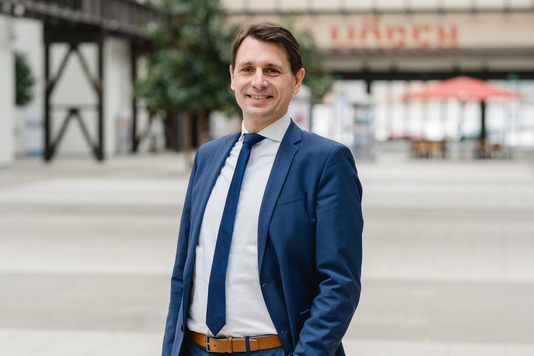
Prof. Dr. Dennis Kundisch is Chair of Digital Markets at the Faculty of Economics (Department 3: Business Information Systems) , University of Paderborn. His research explores behavior of human and machine actors in digital markets through economic lenses, focusing on platform economy, business model innovation, and interdisciplinary methods like online experiments. Research Pillars: Platform governance, gamification, observational data analysis, business model taxonomies, and digital transformation in cultural/industrial sectors Recent publications analyze Cultural Data Ecosystems , Platform Launch Strategies , and Asymmetric Review Dynamics , showcasing his team's engagement with both theoretical frameworks and practical case studies. Collaborations include the Software Innovation Campus Paderborn (SICP) and industry partnerships. Awards: Best Paper Award Nominee (HICSS), Dean's Young Scholar (University of Paderborn), Best Reviewer Award (ICIS)
Stephan Leible is a Researcher at the Department of Computer Science , University of Hamburg (MIN Faculty). Holding both M.Eng. in Business Engineering and an MBA, he focuses on employee-driven digital innovation, intrapreneurship, and leveraging generative AI for organizational transformation. Research Interests : Employee-driven Innovation, Intrapreneurship, Generative AI Governance, Design & Data Thinking, IT Innovation Management Contact : stephan.leible@uni-hamburg.de | Room 117C, Vogt-Kölln-Straße 30, Hamburg His work bridges citizen development with public sector innovation, emphasizing value co-creation, real-time analytics, and ethical AI implementation. Current studies explore: Generative AI adoption patterns and limitations Interpretable machine learning for urban mobility Participatory frameworks for smart city futures Methodologies for continuous improvement in conversational agents
Srishti Yadav is a Research Fellow at the University of Copenhagen and University of Amsterdam , affiliated with the Pioneer Centre for AI and ILLC respectively. She is advised by Dr. Serge Belongie and Dr. Ekaterina Shutova . Education: M.Sc. (Research-Track) in Computing Science, Simon Fraser University , Canada Research Interests: AI and Society Cross-Cultural Competency in Multimodal Models AI Safety and Evaluation Frameworks Model Interpretability and Dataset Creation Scientific Awards: ELLIS PhD Fellowship Advising & Community: Board Member, Women in Computer Vision (WiCV) Advisor for WiCV@ICCV2023 and WiCV@CVPR 2021 Chaired workshops at CVPR 2024, CVPR 2023, CVPR 2020 Labs & Teams: Belongie Lab (University of Copenhagen) Shutova Lab (University of Amsterdam) Collaborator at MILA Biodiversity Monitoring Project
Dr. Jose M. Alcaraz serves as a Research Fellow at Munich Business School (MBS) in Munich, Germany. His academic career spans international institutions including ESDES Lyon Business School (France), Raffles Design Institute (Shanghai), University of Dubai, Leicester University (Dubai campus), Barna Management School (Santo Domingo), and Murdoch University (Perth). Holding a PhD in Digitalization of Human Capital Management, he has directed multiple global MBA programs and maintains industry ties through prior software leadership roles and collaboration with The RBL Group on HR transformation initiatives. His research centers on Human Resource Management, Sustainability, and Business Ethics, with recent focus on science fiction's capacity to envision socio-technical futures. In partnership with SciFutures (dubbed "the coolest company in the world" by Fast Company), he explores sci-fi storytelling for business scenario-building and innovation. This interdisciplinary approach bridges critical management studies with creative foresight methodologies. Dr. Alcaraz's publication portfolio demonstrates consistent output across top-tier journals like Work, Employment and Society and Organization & Environment , with recurring themes in teleworking dynamics, gender equity, planetary boundaries, and sustainability education. His work increasingly integrates narrative techniques from science fiction into management scholarship, reflecting evolving research trajectories toward imaginative scenario planning. At MBS, he teaches Bachelor International Business, Master International Business, Master Sports Business and Communication, and MBA General Management courses. His industry background informs practical applications in classroom instruction, particularly regarding HR transformation and sustainability implementation challenges faced by global organizations.
Muhammad Bilal Khan is an Assistant Professor at the Department of Electronics and Power Engineering, College of Electrical and Mechanical Engineering, National University of Sciences and Technology (NUST), Pakistan. His research spans mathematical theory and practical applications in wireless communication sensing technology. His primary research interests include Fuzzy Set Theory , Fractional Calculus , Mathematical Inequalities , and RF Sensing Applications in healthcare. His theoretical work focuses on developing new mathematical frameworks for fuzzy-number valued functions, particularly exploring pre-invexity, harmonic convexity, and related integral inequalities. On the applied side, he has made significant contributions to non-contact health monitoring systems using software-defined radio technology for detecting conditions like text neck syndrome, spinal curvature disorders, and breathing abnormalities. Analysis of his 15 most recent publications reveals a dual research trajectory: approximately 60% focus on theoretical mathematical contributions in fuzzy analysis and integral inequalities, while 40% address practical applications of wireless sensing in healthcare. His mathematical work frequently appears in journals like Axioms and Symmetry , while his applied research is published in venues including IEEE Access and Sensors . His notable scientific contributions include developing novel frameworks for (q 1 , q 2 )-Linear Diophantine Fuzzy Sets and advancing the theory of Diamond Intuitionistic Fuzzy Sets. His healthcare applications research has pioneered non-invasive monitoring techniques using RF sensing for elderly fall detection, text neck syndrome diagnosis, and breathing pattern analysis. Dr. Khan maintains active collaborations with researchers across multiple institutions, particularly working with Mohamed S. Soliman (13 joint publications), Muhammad Aslam Noor (12 publications), and Savin Treanta (8 publications) on mathematical theory, while collaborating with Najah AbuAli, Mubashir Rehman, and Xiaodong Yang on healthcare sensing applications.
Johannes Paßmann is Junior Professor of History and Theory of Social Media and Platforms at Ruhr University Bochum and Principal Investigator in the CRC/SFB 1472 'Transformations of the Popular' at the University of Siegen. He has held research and teaching positions at Utrecht University, the University of Basel, and the Nordic Centre for Internet & Society. His work bridges media theory, digital culture, and historical praxeology. Research Interests: Media Theory and Platform Studies History and Sociology of Social Media Praxeology and Digital Methods Web Archiving and Historical Reconstruction Paratextuality and Online Commenting Aesthetic Valuation and Recognition His recent publications analyze the social logics of likes, retweets, and comments, tracing their evolution through web archives and software histories. He emphasizes methodological innovation, particularly through the development of Technograph for analyzing archived web data. His work reveals how platform features shape social interaction, public discourse, and cultural recognition. Scientific Awards: Dirlmeyer-Preis for his dissertation Shortlisted for the Volkswagen Foundation’s Opus Primum Prize Grants and Projects: He leads the DFG-funded project 'Historical Technography of Online Commenting' and co-leads 'Medienpraxiswissen' funded by the Stiftung Innovation in der Hochschullehre. He has supervised numerous student research projects and contributes to academic service through peer review and conference organization. Labs and Teams: He is part of the CRC/SFB 1472 at the University of Siegen and collaborates closely with researchers such as Lisa Gerzen, Cornelius Schubert, Anne Helmond, and Martina Schories. Together, they develop tools and methods for qualitative digital research, particularly using web archives to reconstruct past digital practices.
Prof. Dr. Ingmar Ickerott is a faculty member at Osnabrück University of Applied Sciences, affiliated with the School of Management, Kultur und Technik (MKT, Campus Lingen) under the University management department. His academic career spans over two decades, focusing on logistics management, digitalization in supply chains, and smart technology applications like Smart Glasses and Augmented Reality . Academic Background : Diplom-Kaufmann in Business Administration (2001), Ph.D. in Economics (2006). Professional Roles : Senior Project Manager at arvato (2008–2010), Professor since 2010, Dean of MKT since 2019, Vice President for Digitalization since 2019. His research emphasizes logistics innovation , Lean Management , and digital solutions in rural healthcare . Key projects include Land.Digital (2019–2022) and LEAN 4.0 (Erasmus+, 2019–2021). Publications since 2004 cover agent-based simulation , Smart Device economics , and AR in logistics . He actively lectures on topics like Logistics 4.0 and Digital Onboarding . Projects & Grants : Land.Digital : €165,000+ (Erasmus+), 2019–2021. Dorfgemeinschaft 2.0 : €1.46M (BMBF), 2015–2021. Glasshouse : €208,557 (BMBF), 2015–2019.
Prof. Dr. Ulrich Kortenkamp is a Professor for Mathematics Education at the University of Potsdam since October 2014, holding a position in the Institute of Mathematics within the Faculty of Mathematics and Natural Sciences. He also serves as an Adjunct Professor at Griffith University in Gold Coast, Australia since May 2020. His academic career spans multiple institutions across Germany including Martin Luther University Halle-Wittenberg, University of Applied Sciences Karlsruhe, and TU Berlin. Prof. Kortenkamp's research focuses on mathematics education, particularly in the areas of digital learning environments, computational thinking development, place value understanding, and teacher education. His work bridges theoretical frameworks with practical applications in classroom settings, with a strong emphasis on the integration of technology in mathematics instruction. He has extensively studied how digital tools, particularly the Fingu app, can enhance early mathematical understanding and how language affects place value comprehension across different cultural contexts. His recent publications reveal a strong focus on sustainable development in teacher education, cross-linguistic studies of place value understanding, the impact of digital tools on early mathematics development, geometry education, and the integration of subject knowledge with didactic approaches in teacher preparation. His research consistently addresses how digital environments can transform mathematics teaching while maintaining strong conceptual foundations. Ars legendi Faculty Prize in Mathematics category (2020) for outstanding achievements in teaching, advising, and mentoring, awarded by the Stifterverband (Donors' Association) along with major German scientific societies Prof. Kortenkamp leads several significant research projects including DigiProMIN (developing digitally supported continuing education modules for mathematics teachers), Mathematics Education in the Digital Age (fostering international exchange between University of Potsdam and Griffith University), and Place Value Understanding (investigating primary school children's mathematical development across institutions in Germany and Australia). He is also involved in the SPIES-M project focused on quality initiatives for teacher education and the QuaMath project aimed at promoting teaching quality in mathematics through teacher training courses. He directs a research group focused on mathematics didactics at the University of Potsdam, collaborating with colleagues including Prof. Dr. Birte Friedrich and Prof. Dr. Sebastian Geisler, and working with a team of researchers on various aspects of mathematics education research, including digital learning environments, teacher professional development, and early mathematics concepts.
Gero Strobel is an Assistant Professor at the Chair of Business Informatics and Software Engineering, Faculty of Computer Science, University of Duisburg-Essen. His research focuses on intelligent information systems, generative AI, and IoT-enabled smart services with applications in sustainability, healthcare, and industrial transformation. Academic Roles: Assistant Professor (2022–present), Postdoctoral Researcher (2021), Research Assistant (2017–2021) Key Research Areas: Generative AI, Smart Service Systems, E-commerce Ecosystems, Digital Health, Sustainable Business Models His work develops design principles for VR training systems, AI healthcare communication, and smart agriculture architectures. He leads the SOFTEC IoT Innovation Lab and contributes to data ecosystems research as guest editor of Electronic Markets (2024 special issue). Scientific Recognition: 2021 Science Prize of Sparkasse Essen 2021 University of Duisburg-Essen Dissertation Prize Best Paper in Track Award at ICIS 2021 Strobel co-edits the Electronic Markets special issue on data ecosystems (2024) and serves as track chair for data ecosystems at HICSS and AMCIS. His research combines design science methodology with empirical studies across 135+ e-commerce initiatives, 100+ AI startup analyses, and 183 IoT architectures.
Charles L. Isbell Jr. is a Professor in the College of Computing at Georgia Institute of Technology. His work spans foundational research in artificial intelligence, machine learning, and robotics, with a focus on human-robot interaction, reinforcement learning, and educational technology. He leads efforts in scalable online education programs and contributes to policy discussions on AI's societal impact. Research Interests: Isbell's research emphasizes practical and theoretical advancements in AI systems, including Bayesian methods, multi-agent systems, and the ethical implications of AI. He explores how machines can learn from human interaction and adapt to complex environments. His recent work addresses challenges in robotics collaboration, scalable educational platforms, and the development of robust reinforcement learning algorithms. Publications Trends: His articles reflect a commitment to advancing AI through interdisciplinary approaches, with contributions to robotics collaboration (e.g., Nash equilibrium frameworks), scalable education systems, and foundational work in reinforcement learning and imitation learning. Recent collaborations include studies on machine learning systems engineering and long-term AI policy. Awards: No awards explicitly listed in the provided text. Advising & Grants: While specific grants are not detailed here, his extensive publication record indicates sustained research funding and mentorship of students in AI and robotics. His work on online education at scale highlights contributions to pedagogical innovation.
Joseph J. LaViola Jr. is a Professor at the University of Central Florida , specializing in Human-Computer Interaction , Virtual Reality , and 3D User Interface Design . With over two decades of research, his work bridges computer graphics and immersive technologies for applications in gaming, education, and engineering.
Jaime Delgado is a prominent researcher with over three decades of contributions to digital rights management, healthcare information systems, and security and privacy in eHealth. With an extensive publication record spanning from 1994 to 2025, Delgado has established themselves as a leading expert at the intersection of computer science and healthcare, developing practical frameworks that enhance security, privacy, and interoperability in medical systems. Delgado's research spans multiple critical domains: Digital Rights Management and Multimedia Content Security Healthcare Information Systems and eHealth Applications Security and Privacy in Medical Data Management Ontologies and Semantic Web Technologies for Healthcare Genomic Information Systems and FAIR Data Principles Trustworthy Media Systems and Provenance Tracking Analysis of recent publications (2021-2025) reveals a strategic shift toward healthcare applications, particularly focusing on security requirements for Internet of Medical Things (IoMT), privacy-enhancing techniques for medical data, and genomic information systems. Delgado's work demonstrates consistent development of practical architectures addressing real-world security challenges in healthcare settings, with increasing collaboration with medical professionals and participation in European health informatics initiatives like the MedSecurance Project. Delgado has received recognition for contributions to standardization efforts, particularly in developing frameworks for media trustworthiness and international standards for assessing trust in digital media. Their work on the JPEG Privacy and Security framework has significantly influenced industry practices. Through extensive collaboration with researchers like Silvia Llorente (43 joint publications), Eva Rodríguez (29 publications), and Rubén Tous (26 publications), Delgado has built a strong research network across European institutions. Their work consistently combines theoretical framework development with practical implementation considerations, addressing the critical balance between security requirements and clinical workflow usability. Delgado's laboratory work centers on developing secure frameworks for medical data management, with recent emphasis on genomic information systems, provenance tracking in eHealth, and security requirements for medical IoT devices. Their research group actively participates in European health informatics initiatives and contributes to international standards development, maintaining exceptional productivity with 4-7 publications annually in recent years.
Markus Bick serves as a Junior Professor at ESCP Business School in Berlin, Germany, specializing in Business Information Systems. His academic position focuses on the intersection of information technology and business processes, with particular expertise in knowledge management, convergent systems, e-learning, and simulation technologies. As an active faculty member, he contributes significantly to research and teaching within the business informatics domain at one of Europe's leading business schools. Professor Bick's research interests span multiple interconnected domains within business information systems. His primary focus is Knowledge Management, where he has developed frameworks for sustainable implementation of organization-specific knowledge management systems, as evidenced by his 2004 dissertation from the University of Duisburg-Essen. He also explores Convergent Systems that integrate learning and business information systems, with particular attention to interface standards and integration strategies. His work in E-Learning demonstrates how educational technologies can be effectively embedded within business processes, while his research on Simulation approaches provides methods for modeling complex business scenarios. His publications consistently bridge theoretical frameworks with practical business applications. Analysis of Professor Bick's publication record reveals a clear research trajectory from foundational knowledge management work to increasingly sophisticated explorations of mobile and ubiquitous information systems. His early work focused on knowledge management implementation strategies and building block models, while more recent publications address mobile collaboration systems, ambient intelligence applications, and IT service management in educational institutions. A significant portion of his research investigates the convergence between learning systems and business information systems, particularly how knowledge management principles can enhance both educational and business processes. His work demonstrates consistent attention to practical implementation challenges alongside theoretical development. Professor Bick maintains an active research agenda with publications spanning from 2002 to 2010, showing continued scholarly productivity. His work appears in both academic journals and professional publications, indicating relevance to both theoretical and practical audiences. He has contributed to edited volumes including encyclopedias of business information systems and handbooks on information technologies for education and training, demonstrating recognition by his peers as an expert in his field.
Christoph Rosenkranz is a Professor of Information Systems at the Faculty of Management, Economics and Social Sciences , University of Cologne. He serves as Academic Director of the Bachelor's program in Business Informatics and Deputy Managing Director of the Cologne Institute for Information Systems . His research focuses on agile software development , digital transformation , and socio-technical systems , with applications in healthcare and business process management. Academic Director, Bachelor's program 'Wirtschaftsinformatik' (2021–present) Founding Director, Master's program 'Business Analytics and Econometrics' (2019–2021) Visiting Researcher at Towson University and Rochester Institute of Technology (2018) His work bridges information systems , project management , and digital innovation , with empirical studies on: Agile practices in software development Time pressure and software quality Communication theory in IS design Electronic healthcare systems Service network effects Recent publications analyze digital market offerings , ethics in machine learning , and psychological safety in teams . He contributes to the ECONtribute: Markets & Public Policy cluster, researching digital transformation's societal impact. Collaborative projects include: HPDnet (DFG-funded child healthcare networks) C-SEB (Social and Economic Behavior research)
Prof. Dr. Claus H. Carstensen is a full professor at the Faculty of Human Sciences , Otto-Friedrich University of Bamberg , holding the Professorship for Psychological Methods of Empirical Educational Research . His work focuses on educational assessment methodologies, particularly in longitudinal studies and large-scale educational surveys. Professional Background : Professor at University of Bamberg (2008–present) Junior Professor at Kiel University (2002–2008) Research roles at IPN Kiel and Australian Council for Educational Research Academic Leadership : Scientific Director of Scaling and Test Design at LIfBi (2014–present) Interim Head of Department at LIfBi (2016–2017) Member of National Educational Panel Study (NEPS) Network Committee Research Interests center on psychological methodology and empirical educational research , with specific expertise in: Item Response Theory (IRT) applications Longitudinal modeling of educational trajectories Competence diagnostics across the lifespan Large-scale assessment design and analysis International comparative research in education Publication Trends demonstrate sustained focus on educational measurement through: Developing cross-classified multilevel IRT models Advancing plausible value estimation with missing data Addressing response style analysis in cross-cultural assessments Refining test scaling and linking methods Improving assessment for special educational needs Contributing to PISA and NEPS technical frameworks Academic Contributions include: Co-editing Multivariate and Mixture Distribution Rasch Models (Springer, 2007) Co-developing MULTIRA software for multidimensional Rasch models Technical leadership in NEPS (National Educational Panel Study) Editorial roles in Psychological Methods and Studies in Educational Evaluation Membership in DGPs (German Psychological Society) and Psychometric Society Current organizational roles encompass: Dean of Faculty of Human Sciences (2023–2025) Chair of Examination Committees for M.Sc. programs Conflict Commission Chair at University of Bamberg IT Security Team member