Elisabeth Jean Wood is a Professor of Political Science at Yale University and holds a concurrent professorship at the Santa Fe Institute. Her research focuses on political violence, particularly sexual violence during war, civil war dynamics, and social movements. She is renowned for her work on insurgent transitions in South Africa and El Salvador, as well as her analysis of variation in wartime sexual violence. Wood has authored influential books including Forging Democracy from Below (2000) and Insurgent Collective Action and Civil War in El Salvador (2003). Her recent work examines the Myanmar military's sexual violence against the Rohingya, emphasizing ideological motivations and institutional frameworks. Wood teaches courses on comparative politics, political violence, and qualitative research methods at Yale. She serves on editorial boards for Politics and Society , American Political Science Review , and the Contentious Politics series. Her research emphasizes ethical fieldwork practices and transparency in qualitative studies, addressing challenges in conflict zones. Her work bridges theoretical contributions with policy implications for understanding and preventing conflict-related atrocities.
Andy Pavlo is an Associate Professor with Indefinite Tenure in the Computer Science Department at Carnegie Mellon University's School of Computer Science. He is an active member of the CMU Database Group and the Parallel Data Laboratory, where he leads research in database management systems with a focus on self-driving architectures, transaction processing, and large-scale analytics. His work bridges academic research and industry applications through projects like NoisePage, OtterTune (which he co-founded and served as CEO before it ceased operations), and Peloton. Dr. Pavlo's research interests span database management systems with particular emphasis on autonomous database architectures that can self-tune and optimize without human intervention. His work explores transaction processing systems that can handle high-throughput workloads while maintaining consistency, and large-scale data analytics techniques that efficiently process massive datasets. He has made significant contributions to query optimization, database extensibility, and automatic database tuning using machine learning techniques. His recent work on database extensibility revealed critical issues in PostgreSQL's extension ecosystem, showing that approximately 16% of extensions are incompatible with at least one other extension due to API violations and memory errors. His research output demonstrates a consistent focus on practical database systems challenges, with recent publications examining database extensibility, user-defined function optimization, and the cyclical nature of database research. The articles show a strong trend toward making database systems more autonomous, with increasing integration of machine learning techniques for automatic tuning and optimization. His work often combines deep theoretical analysis with practical implementation in open-source systems. Dijkstra Award 2024 for contributions to database systems research Dr. Pavlo actively mentors graduate students, with current advisees including Wan Shen Lim, William Zhang, and Sam Arch (co-advised with Todd Mowry). His former students have gone on to successful careers in both industry and academia. He has secured significant research funding through CMU's affiliate program with major database companies including ClickHouse, DataStax, dbt, Firebolt, MotherDuck, RelationalAI, SingleStore, Spiral, PingCAP/TiDB, Yellowbrick, and Yugabyte. His research is supported by these industry partnerships and likely includes NSF funding given his active participation in the database research community. At CMU, Dr. Pavlo leads the Database Group and organizes several seminar series including "SQL or Death," "Database Building Blocks," and "ML⇄DB Technical Talks." These seminars bring together researchers and practitioners to discuss cutting-edge developments in database systems. He also runs a summer research internship program that has attracted students for multiple consecutive years, indicating a strong research group with ongoing projects and funding.
Dr. Ray Bobrownicki is a Lecturer in Sport Psychology and Co-Programme Director of the BSc (Hons) Applied Sport Science at the University of Edinburgh's Moray House School of Education and Sport. He holds affiliations with the Institute for Sport, Physical Education and Health Sciences (ISPEHS) and the Human Performance Science Research Group. As a chartered psychologist (BPS) and licensed athletics coach, his work bridges academic research and real-world sport practice. Educations: PhD (Sport Psychology and Coaching), University of Edinburgh MSc (Performance Psychology), University of Edinburgh AB (Psychology), Brown University PGCert (Academic Practice), University of the West of Scotland His research focuses on optimizing coaching instruction, motor learning, and performance under pressure. He explores how verbal instructions, analogies, and technology (e.g., VR) influence skill acquisition and athlete motivation. Secondary interests include the societal impacts of sporting policies on athlete welfare and identity. Recent work critiques traditional sport science methodologies and advocates for interdisciplinary, applied research. His publications span 2015–2025, emphasizing critical analysis of coaching practices, motor learning mechanisms, and systemic issues in sport. Key themes include instructional design, constraints-led approaches, and translational research validity. Awards: Fellow of the Higher Education Academy Chartered Psychologist (British Psychological Society) Associate Fellow (British Psychological Society) Teaching responsibilities include programme leadership for BSc Applied Sport Science and contributions to MSc Performance Psychology modules. He currently supervises PhD student Tongyu Liu on esports support taxonomies and welcomes inquiries on coaching instruction, performance psychology, and athlete policy impacts. Dr. Bobrownicki’s career integrates athletic experience (Commonwealth Games finalist, high jumper) with coaching expertise (e.g., mentoring record-breaking athletes) to inform evidence-based practice in sport science.
Marcia O’Malley is the Thomas Michael Panos Family Professor in Mechanical Engineering, Computer Science, Electrical and Computer Engineering, and Bioengineering at Rice University’s George R. Brown School of Engineering. She chairs the Department of Mechanical Engineering and directs the Mechatronics and Haptic Interfaces (MAHI) Lab. Her research focuses on haptics and robotic rehabilitation, particularly wearable robotic systems for training and rehabilitation in virtual environments. She holds adjunct roles at Baylor College of Medicine and the University of Texas Medical School. Educated at Purdue University (B.S., 1996) and Vanderbilt University (M.S./Ph.D., 1999/2001), Dr. O’Malley has been recognized with prestigious awards, including the ONR Young Investigator Award, NSF CAREER Award, and multiple fellowships. She has twice won Rice’s George R. Brown Award for Superior Teaching. Her work bridges engineering and medicine, addressing human-robot interaction challenges in surgical training, workforce safety, and neurorehabilitation. The MAHI Lab develops devices like the hBracelet and Rice Haptic Rocker to enhance human-robot collaboration. She co-founded Houston Medical Robotics, Inc., applying her innovations to real-world medical applications. Research Interests: Haptics, wearable robotics, neural interfaces, surgical training metrics, and rehabilitation robotics. Labs/Teams: MAHI Lab (Biosciences Research Collaborative), collaborations with medical institutions. Grants/Awards: Extensive funding from NSF, ONR, and industry partnerships; leadership in editorial roles for IEEE Transactions on Haptics.
André Gagné is a Full Professor and Chair of the Department of Theological Studies at Concordia University, currently on research leave (July-December 2025). His work bridges theology, political science, and sociology with global recognition through 400+ media features in outlets like The New York Times, The Guardian, and Le Monde. Education: Conjoint PhD from Université catholique de Louvain and Université de Montréal M.A. from Université de Montréal B.Th. from Université de Montréal His research centers on Christian Political Thought (examining theology-state dynamics), Global Pentecostal and Charismatic movements (analyzing their sociopolitical impact worldwide), and Reception History of the Bible (tracing interpretive trajectories across cultures). This interdisciplinary approach integrates historical analysis with contemporary case studies, particularly focusing on evangelical movements in the Americas and Europe. His eight books and recent journal articles reveal consistent thematic focus: the weaponization of spiritual warfare rhetoric in politics, apocalyptic narratives in populist movements, and religious violence in Western traditions. The 2024 publications on Trump-era evangelicalism demonstrate methodological innovation through media discourse analysis combined with theological critique. Scientific awards: Newsmaker of the Week (4 times) Newsmaker of the Month (4 times) President's Opinion Leader of the Year (2016) Expert Communicator of the Year (2024) Dr. Gagné supervises MA students in Theological Studies and PhD candidates in Individualized Programs and Humanities. His policy impact is evidenced by service on Public Safety Canada's National Expert Committee on Countering Radicalization to Violence (2023-2025), where he contributed theological perspectives on religious extremism. His media engagement strategy represents a deliberate effort to translate academic research for public discourse. He co-directs the Spirit, State, and Society podcast and maintains affiliations with Concordia's Centre for the Study of Learning and Performance, Université de Sherbrooke's Centre de recherche Société, Droit et Religions, and the multi-university Political Theology Research Group (McGill, Concordia, UdeM, ULaval).
Janne Lindqvist is an Associate Professor at the Department of Computer Science, Aalto University. His research bridges security engineering, human-computer interaction (HCI), and privacy, with a focus on making security systems usable and user-centric. University: Aalto University Department: Department of Computer Science Rank: Associate Professor Email: janne.lindqvist@aalto.fi Lindqvist’s work spans security engineering , privacy systems , and user research , emphasizing practical authentication methods, password management, and human behavior in security contexts. He explores how users interact with systems like TPM APIs, gesture passwords, and mobile authentication mechanisms. Recent publications highlight trends in authentication systems , ubiquitous computing security , and mobile user behavior . Key themes include biometric authentication, gesture-based security, and balancing usability with cryptographic robustness. CHI'25 Honorable Mention Award CHI'24 Best Paper Award His research integrates empirical studies with technical implementations, such as analyzing password forgetting patterns and developing acoustic sensing for vehicle detection (e.g., Auto++, BO-Ear). Collaborative efforts span machine learning, psychology, and embedded systems.
Virginia Leavell serves as Assistant Professor in Organisational Theory and Information Systems at Cambridge Judge Business School, University of Cambridge. Her research investigates how organisations anticipate technological change through digital prediction systems, AI, and infrastructure transformation, drawing on her decade-long background in political organising for non-profits and labour groups across the US and Thailand. Her academic credentials include: BA in Interdisciplinary Studies, Georgetown University MA in Sociology, University of California Santa Barbara PhD in Technology Management, University of California Santa Barbara Leavell's scholarly work centers on organisational anticipation of technological futures, employing ethnographic and social network analysis methods to examine digital transformation in critical infrastructure contexts. She explores how predictive technologies reshape organisational structures and actions before technological change fully materializes, with particular focus on water systems, urban planning, and labor industries where digital twins and simulation technologies create new governance challenges. Analysis of her 2017-2024 publications reveals consistent examination of prediction performativity across sectors, demonstrating how digital models influence physical realities in infrastructure management. Her research trajectory shows increasing emphasis on sociomaterial dimensions of anticipatory organising, with recent work interrogating the equalization of human and technological agency in digital transformation processes. No scientific awards were specified in source materials. Leavell actively contributes to the Organisational Theory and Information Systems subject group at Cambridge Judge Business School, which engages cross-disciplinary leadership themes. Information regarding student advising and research grants remains unspecified in available documentation.
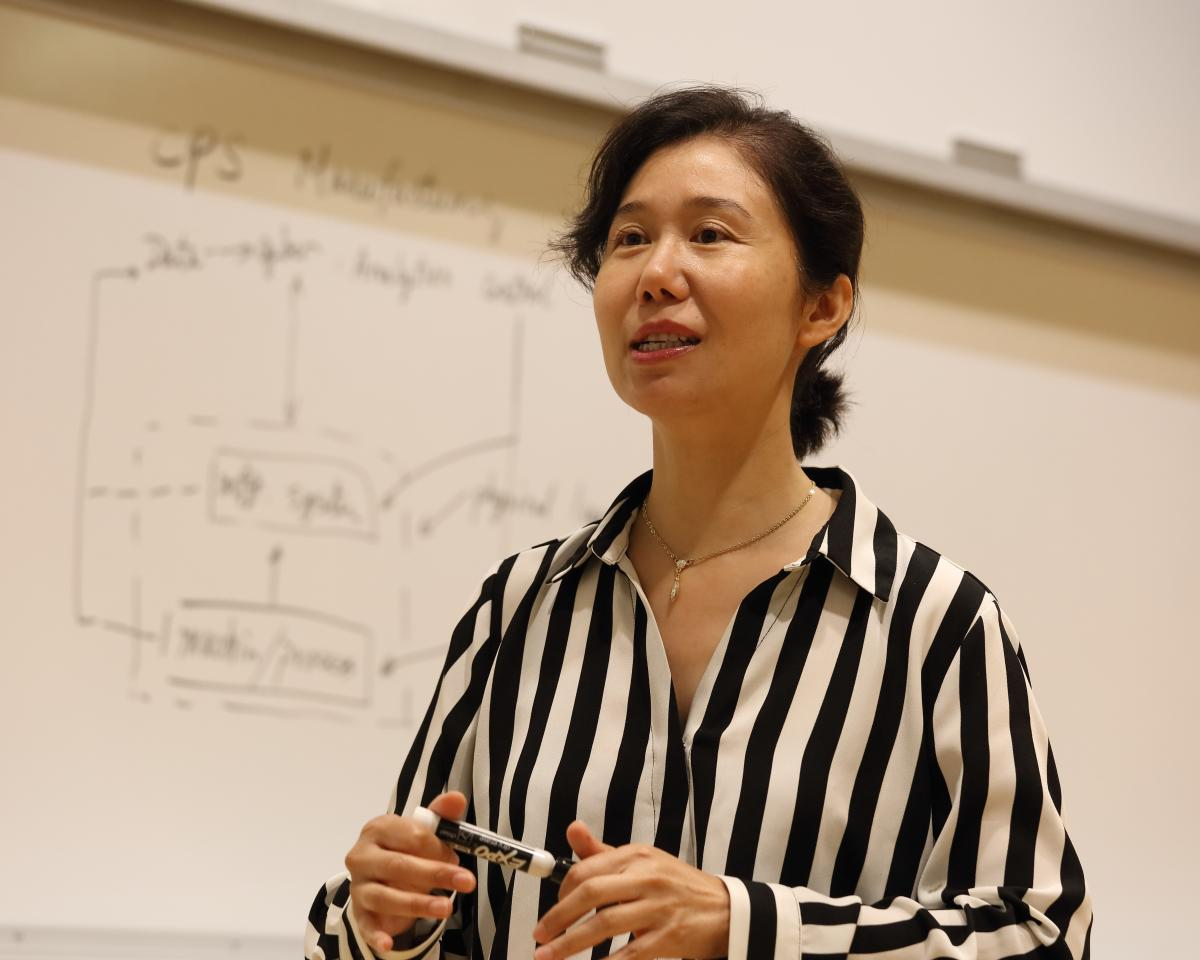
Qing (Cindy) Chang is a Professor in the Department of Mechanical and Aerospace Engineering at the University of Virginia, where she directs the Intelligent Systems Lab. She joined UVA in 2019 after serving as an associate professor at Stony Brook University. Prior to academia, she spent a decade at General Motors R&D, receiving their highest innovation awards. Education: M.S. from University of Wisconsin-Madison Ph.D. in Manufacturing from University of Michigan Research Focus: Chang's work integrates math-based modeling and data-driven methods to optimize manufacturing systems. Key areas include: Adaptive control and machine learning for production efficiency Human-robot collaboration frameworks Sustainable manufacturing through energy management Real-time control of cyber-physical production systems Reinforcement learning applications in industrial automation Research Trends: Her recent publications (2024-2025) demonstrate strong focus on AI-driven manufacturing optimization, with 80% leveraging reinforcement learning/LLMs for robotic control. Key themes include multi-agent coordination (67% of papers), energy efficiency (53%), and flexible production systems (47%). Awards & Recognition: Inducted as SME Scholar (2024) 20 Most Influential Professors in Smart Manufacturing - SME (2020) NSF CAREER Award (2014) Three-time GM Boss Kettering Award winner (2005,2006,2008) ASME and SME Fellow Leadership & Funding: Serves on NAMRI/SME Board of Directors with editorial roles across ASME/IEEE/SME journals. Research supported by NSF (including CAREER), Department of Energy, and multiple industry partners. Leads projects on human-robot collaboration and sustainable manufacturing. Lab & Collaboration: Directs the Intelligent Systems Lab at UVA, focusing on industrial AI applications. Collaborates with automotive and energy sectors to translate research into practical solutions for smart factories.
Jeff Moher is an Associate Professor of Psychology and Co-Chair of the Department of Psychology at Connecticut College, where he has been teaching since 2017. He also serves as the Data, Information, and Society Pathway Co-Coordinator, demonstrating his leadership within the institution. His educational background includes a Ph.D. and M.A. from Johns Hopkins University and a B.S. from the University of Michigan. This strong academic foundation has prepared him for his research and teaching career in cognitive psychology. Moher's research focuses on cognitive psychology and cognitive neuroscience, particularly visual attention and cognition in action. His work investigates why distractions occur, when they are likely to arise, and what mechanisms humans can harness to avoid them. He has found that humans employ various cognitive mechanisms to minimize distractions based on explicit knowledge, task goals, object properties, and recent experience, though he has also discovered surprising limitations in attentional selection. His research is particularly relevant given that over 3,000 people are killed annually in the United States from distracted driving. His recent publications show a consistent trajectory examining attentional mechanisms, distraction, and visual processing across different contexts. His work frequently employs sophisticated methodologies to measure both cognitive and motor responses to distractions, revealing how seemingly minor distractions can accumulate to induce serious performance costs. Moher's research is currently funded by grants from the National Science Foundation and the National Institutes of Health, indicating the significance and quality of his work. He likely mentors numerous students through the department's research groups, contributing to their development as researchers. He directs the CAMELab (Center for Attention, Movement, and Embodied Learning), which utilizes multiple methodologies including eye-tracking, electroencephalography, three-dimensional reach-tracking, and psychophysics to approach questions about attention and distraction. Current projects in his lab explore why salient distractors cause people to give up quickly during visual search, the brain mechanisms involved in learning to ignore distractions, how internal distractions impact physical interactions with the world, and how hand movement paths reveal information about attentional processes.
Elliott Ash is an Associate Professor of Law, Economics, and Data Science at ETH Zurich's Center for Law & Economics. He holds a Ph.D. in Economics and J.D. from Columbia University, a B.A. in Economics, Government, and Philosophy from the University of Texas at Austin, and an LL.M. in International Criminal Law from the University of Amsterdam. His research focuses on empirical legal studies using econometrics, NLP, and ML, examining topics like judicial behavior, legislative impact, and AI-driven governance. He has been funded by the ERC, Swiss NSF, and others. Research Interests: Elliott explores automation of legal decisions, text-as-data analysis in law, and the intersection of AI with legal systems. He develops tools like BallotBot and LePaRD to enhance legal transparency and public understanding. His work bridges law, economics, and computer science, with publications in top journals like the American Economic Journal and Review of Economics and Statistics . Teaching: Courses include Building a Robot Judge , Natural Language Processing for Law , and Big Data for Public Policy . He co-organizes the Zurich Workshop in AI+Economics and Monash-Warwick-Zurich Text-as-Data Workshops. Awards: European Research Council Starting Grant, Swiss National Science Foundation Grant, and multiple grants from U.S. and Swiss institutions. His work has been featured in NPR , VoxEU , and Georgetown Law Journal . Labs/Teams: Leads the Swiss AI Initiative's Human-AI Alignment team, collaborates with the CEPR on Political Economy research, and serves as an Economic Journal Associate Editor.
Professor Beth Williamson is a leading scholar of medieval culture, holding dual roles as Professor of Medieval Culture and Chair in the History of Art at the University of Bristol's Department of History of Art (Historical Studies), and as Academic Director (Research Impact & Translation Partnerships) within the Faculty of Social Sciences and Law. She earned her B.A. from Oxford University (Oxon), an M.A., and a Ph.D. from the University of London (Lond.). Her research focuses on visual, material, and aural dimensions of medieval religious practice, exploring how sensory experiences shaped devotional life. Key themes include sacred imagery (e.g., the Virgin Lactans and Madonna of Humility), liturgical spaces, and the intersection of art with music, time, and political power. Recent projects include studies of Westminster Abbey’s royal patronage and collaborations in interdisciplinary historical research. Her publications span over three decades, addressing topics from Italian Renaissance altarpieces to Irish medieval sculpture, with a strong emphasis on material culture and devotional practices. Despite her prolific output, no formal awards are listed, though her academic leadership roles reflect her scholarly impact. As a mentor, her supervisory activities are noted in her profile but lack specific student names. Her work bridges academic and public spheres, particularly through her role in translating research into societal impact initiatives. She is affiliated with the University of Bristol’s Senate House and contributes to institutional leadership.
Dr. Rene Ferdinands is a Lecturer at the University of Sydney's School of Health Sciences, specializing in sports biomechanics, particularly in cricket and golf. He leads research programs focused on optimizing techniques and minimizing injury risks, such as lumbar load analysis in fast bowlers and spin bowling biomechanics. His work includes developing 3D models for analyzing bowling actions and spin delivery mechanics. Education: MSc and PhD from the University of Waikato. Research Themes: Cricket biomechanics, golf swing dynamics, equine biomechanics, and injury prevention. Professional Roles: Editor of the Cricket Coaching Information service for the International Society of Biomechanics in Sports, Honours Committee Member. His research interests span biomechanical analyses of sports techniques, including the development of smart cricket balls for performance assessment and injury mitigation. Key contributions include refining bowling action legality criteria and advancing understanding of lumbar kinetics in elite athletes. He actively supervises Honours and PhD students in biomechanics research across cricket, golf, and other sports. Notable grants include studies on hydration status in cricket performance (2008), lumbar injury prevention (2013), and biomechanical modeling of fast bowling (2009). His work bridges applied research with practical applications in sports technology and athlete development. Dr. Ferdinands collaborates with the Biomechanics Research Team at the University of Sydney, focusing on innovative tools like smart balls and advanced motion analysis techniques to improve sports performance and safety.
Professor Katharine Cockin is a leading scholar in Victorian theatre, women's suffrage history, and interdisciplinary literary studies at the University of Essex. She holds the Chair of English Literature in the Department of Literature, Film, and Theatre Studies (LiFTS). Her research focuses on Ellen Terry and Edith Craig, pioneering figures in theatre and suffrage activism, with major publications including Edith Craig and the Theatres of Art (2017) and the Collected Letters of Ellen Terry (8 vols., 2010–). She leads the AHRC-funded Searching for Theatrical Ancestors and Ellen Terry and Edith Craig Database projects, recognized nationally for their impact on cultural heritage. Education: BA, MA, and PhD in English Literature from the University of Leicester. Her doctoral thesis examined the Pioneer Players theatre society (1911–25). She previously held professorial roles at the University of Hull, where she established interdisciplinary programs in literature and law. Research interests include archival studies, women's suffrage literature, modern literature, and the 'Literary North'. She advises on topics like science fiction and autobiography. Awards include a Principal Fellowship of the Higher Education Academy and AHRC Peer Review College membership. Administrative roles at Essex include Director of the Centre for Interdisciplinary Research in Literary Studies and former Director of Research for LiFTS. Publications span over 50 articles and edited volumes, emphasizing feminist historiography and cultural preservation. Her work bridges academia and public engagement through digital archives and collaborative projects.
Sophie Whitehouse is a Lecturer in Marketing (Education) at King's Business School, King's College London. She holds a PhD in Marketing, an MA in English Language and Linguistics, and a BA in Management with Marketing from the University of Leicester. She is a Fellow of the Higher Education Academy and has been teaching since 2013. PhD in Marketing, University of Leicester MA in English Language and Linguistics, University of Leicester BA in Management with Marketing, University of Leicester Sophie's research centers on marketing in the creative and cultural industries, especially music. She explores consumer culture, authenticity, nostalgia, and the materiality of consumption in a digital age. Her work employs qualitative methodologies and has examined why consumers remain committed to physical formats like vinyl records despite the dominance of digital streaming. Her recent publications reveal a consistent focus on the intersection of marketing, culture, and emotion. She investigates how nostalgia shapes consumption, how record artwork fosters cultural identity, and how pedagogical tools like crib sheets affect student well-being. Her upcoming work extends into collaborative arts research and societal inclusion in higher education. Her scientific contributions have been recognized with the Elsevier Peer Recommendation Prize at the University of Leicester’s Festival of Postgraduate Research. Elsevier Peer Recommendation Prize, University of Leicester’s Festival of Postgraduate Research Sophie has extensive experience supervising undergraduate, Master’s, and MBA dissertations. She is currently open to supervising PhD students whose projects align with her interests in marketing and nostalgia, consumer culture, and the creative industries. While no specific grants are mentioned, her research output and invited talks indicate active scholarly engagement and external collaboration. Sophie is involved in academic events and roundtables such as 'La Pensée Artistique: Artistic Thinking in Consumer Research' and 'The Future of Higher Education,' indicating her integration into research networks and thought leadership in her domain.
Margarita Boenig-Liptsin is a tenure-track Assistant Professor of Ethics, Technology and Society at ETH Zurich's Department of Humanities, Social and Political Sciences, a position she has held since September 2022. Trained in Science, Technology and Society with dual PhDs from Harvard University (History of Science) and Université Paris-Sorbonne (Philosophy), she brings interdisciplinary expertise to examining the relationship between technology, power, democracy, and ethics. Her research spans several interconnected areas focusing on transformations to human identity and citizenship in relation to information technologies across time and cultures. She investigates the social and political aspects of digital technologies, identity and selfhood in technological societies, ethics of technology, and comparative cultures of innovation. Her work uniquely bridges historical analysis with contemporary ethical concerns, examining how concepts like human dignity evolve alongside technological developments from punch cards to AI governance frameworks. Her recent publications (2023-2025) reveal a strong focus on AI ethics, data justice, and the philosophical implications of algorithmic systems. These works demonstrate her consistent interest in how technology shapes democratic processes, citizenship, and ethical frameworks. Her research shows progression from historical studies of computer literacy programs to contemporary analyses of generative AI's impact on knowledge production and everyday ethics. Her scientific recognition includes: NSF funding for her collaborative project on Silicon Valley's innovation imaginary Mozilla Foundation Responsible Computer Science Challenge grant (2018-2021) Academic Data Science Alliance support (2020-2022) Sorbonne Université's Paris IAS Chair on 'Major Changes' (2021-2022) At ETH Zurich, she leads research and teaching initiatives that build connections between engineering and social sciences. Previously at UC Berkeley, she directed the Human Contexts and Ethics Program, developing the Human Contexts and Ethics component for data science education. Her work consistently emphasizes translating social science theory for diverse audiences and connecting scholarly work to community needs in Zurich, Switzerland, and Europe. She teaches courses including 'Artificial Intelligence and Human Values' and 'Research in Ethics, Technology and Society' for the Fall 2025 semester.