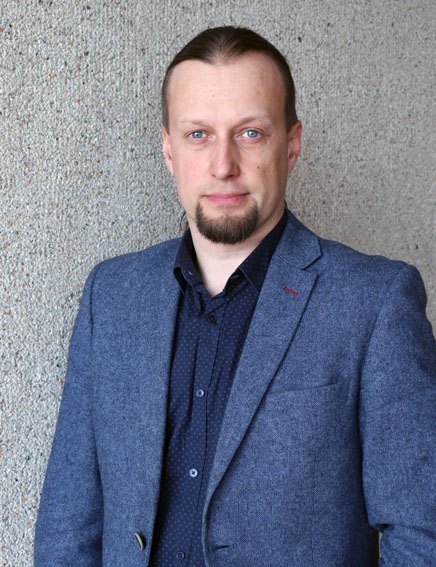
Agnė Brilingaitė is an Associate Professor at the Faculty of Mathematics and Informatics, Vilnius University. Her work bridges cybersecurity with transportation systems and mobile services, focusing on practical skill development, risk assessment, and human-centric approaches to security education.
Kristina Lapin serves as an Associate Professor at Vilnius University's Faculty of Mathematics and Informatics, maintaining continuous teaching responsibilities from the 2016/2017 academic year through the 2025/2026 term. Her role includes delivering lectures and leading exercise sessions for Human-Computer Interaction across multiple student subgroups, with scheduled classes extending into evenings and covering both theoretical and practical components of the discipline. Her academic focus centers on Human-Computer Interaction , reflecting expertise at the intersection of user experience design and computing systems. This specialization aligns with broader engagement in Computer Science and Information Technology through the faculty's institutional framework. Teaching patterns indicate consistent involvement in curriculum delivery without seasonal interruptions. Professor Lapin participates in academic governance as evidenced by scheduled meetings with the study program committee chairperson and curators. However, no details regarding student advising, research grants, laboratory affiliations, or scientific awards were extractable from the provided schedule data, which exclusively documents teaching assignments and institutional service activities.
Assoc. Prof. Dr. Asta Slotkienė is an Associate Professor and Researcher at the Cybersocial Systems Engineering Group , Institute of Mathematics and Informatics, Vilnius University , Lithuania. She has been a faculty member since at least 2009 and is based at Akademijos St. 4, Vilnius. Education PhD in Computer Science Engineering, Kaunas University of Technology (2009) MSc in Computer Science Engineering, Kaunas University of Technology (2004) BSc in Physics and Computer Science, Šiauliai University (2002) Research Interests Dr. Slotkienė’s research spans software quality assurance , development process improvement , e-learning systems , and cognitive decision-making . She investigates how rigorous evaluation methodologies and AI techniques can enhance the reliability and usability of software products and services. Her recent work explores the intersection of large language models and automated software testing , as well as the modeling of web service quality using fuzzy logic and ontology-based approaches. Research Trends Across her latest publications, a clear trend emerges toward leveraging AI and machine learning , particularly large language models , to automate and improve software testing practices. Simultaneously, she continues to deepen the theoretical foundations of software and service quality modeling , integrating fuzzy logic , ontology engineering , and bibliometric analyses to build robust frameworks for quality evaluation. Scientific Service & Awards Program Committee Member: ACM/SIGAPP SAC (2023–2025) Organizing Committee Member: Baltic DB&IS 2024 Program Committee Member: SS AIEDUMED’25, CompSysTech’25 Reviewer for Informatica, Baltic Journal of Modern Computing, New Trends in Computer Sciences Projects & Funding 2022–2026 Master of Science in Smart, Secure and Interconnected Systems (EU Grant 101083531) 2022–2024 Embracing RAD Skills for Employability and Innovation 2020–2022 AI-Enhanced Accounting and Business Management Systems (Grant 01.2.1-LVPA-K-856-01-0083) 2014–2018 Erasmus+ “Open University for Virtual Mobility” (2014-1-LT01-KA203-000550) 2012–2015 Tempus “High Objectives of National Organizational Reform” (530284-TEMPUS+1-2012-1-ES-TEMPUS-JPHES) International Collaboration & Training Through multiple Erasmus+ teaching and learning visits (Las Palmas de Gran Canaria, Madeira, Azores, Maia), as well as participation in DeepLearn schools and professional training (Devbridge/Cognizant Softvision, Robotic Process Automation, Creative Commons, Contextual Modeling), Dr. Slotkienė actively fosters cross-border academic cooperation and continuous professional development.
Tadas Žižiūnas is a researcher at the Faculty of Communication , Vilnius University , specializing in the intersection of 3D technologies , artificial intelligence , and cultural heritage preservation . His work focuses on developing automated systems for monitoring urban heritage, applying advanced digital methods to historical artifact analysis, and integrating spectroscopy with 3D modeling in archaeological contexts. Academic Qualification: PhD (2019) in cultural heritage research, Vilnius University Key research areas include digital urban heritage practices , AI-driven preservation tools , and 3D technology applications in archaeology . His publications demonstrate a consistent focus on technological innovation in heritage management, with projects funded by the European Regional Development Fund (2018–2022). His recent work explores democratization of heritage conservation through 3D scanning and AI, while earlier contributions examined spectroscopy for historical document analysis and augmented reality for preserving genius loci in urban settings. Notable projects include the Automated Heritage Monitoring of Urbanised Areas initiative, which combines AI with 3D digitization to assess risks to cultural assets.
Prof. Ramunė Kasperė is a Professor and Vice-Dean for Research at the Faculty of Social Sciences, Arts and Humanities (FSSAH) at Kaunas University of Technology (KTU). She leads the 'Language and Technologies' research group, focusing on interdisciplinary studies at the intersection of technology, language, and education. Her research explores AI's societal impacts, technopedagogy in language education, and experimental methodologies in research ethics. She holds multiple roles including Chief Project Researcher at the Academic Centre of Social Sciences, Arts and Humanities and serves on KTU's Projects Development Centre as a Project Expert. Research Interests : Prof. Kasperė's work bridges artificial intelligence applications with sociocultural contexts, emphasizing: Machine translation's role in modern education systems Ethical frameworks for technology integration in academia Quantitative analysis of user interactions with translation technologies Post-pandemic adaptations in translator training programs Teaching & Projects : Develops study modules like 'Digital Support for Research Writing' and 'Translation Project Management' Guides students through advanced linguistic analysis and localization projects Leads research initiatives on sustainable technology adoption in multilingual contexts Labs & Teams : Active in KTU's interdisciplinary research networks, particularly in the Language and Technologies group which collaborates with industry partners on localization solutions and educational tech development.
Žilvinas Ledas is an Associate Professor at the Faculty of Mathematics and Informatics, Vilnius University. He has been actively teaching courses like Computer Game Design and Development since at least 2016, with scheduled lectures and exercises continuing into the 2025/2026 academic year. Research Interests focus on game development, interactive systems, and virtual environments. His work bridges software engineering principles with creative digital media applications.
Prof. habil. dr. Gintautas Dzemyda is a leading Lithuanian computer scientist, Professor and Senior Researcher at Vilnius University Institute of Data Science and Digital Technologies (VU DMSTI), and Head of the Cognitive Computing Group . He is simultaneously affiliated with the Institute of Mathematics and Informatics (MII) in Vilnius, where he has built an internationally recognized scientific school in visual data analysis. Education & Qualifications 1984 – Candidate of Technical Sciences (PhD equivalent), thesis on “Problem Structure Analysis – a Tool for More Effective Optimization”. 1997 – Habilitation Doctor of Technical Sciences, dissertation on “Isolation of Necessary Knowledge to Improve Optimization Efficiency”. 1992 – Associate Professor, Institute of Mathematics and Informatics, Vilnius. 1998 – Professor, Kaunas University of Technology. Research Interests Prof. Dzemyda’s research integrates data science, artificial intelligence, optimization, and cognitive computing . Core topics include dimensionality reduction, multidimensional data visualization, neural-network–based analytics, parallel and distributed computing, multi-criteria decision support, and advanced AI applications in medicine (ophthalmology, cardiology, oncology). His work has pioneered Lithuanian capabilities in visual analytics and large-scale data exploration. Publication Trends Across 270+ refereed works and 2 Springer monographs (2013, 2023), recent outputs (2021–2025) emphasize geometric multidimensional scaling for big-data visualization, deep learning for pancreatic-cancer detection on CT images, reinforcement learning for autonomous navigation, and fraud-detection techniques for highly imbalanced financial datasets. These contributions appear in Springer LNCS/LNNS, Informatica, Journal of Global Optimization, Engineering Applications of Artificial Intelligence , and other top venues. Awards & Recognition Lithuanian State Science Prize (2001 & 2021) Honorary Doctor of the University of Latvia (2019) Knight's Cross of the Order “For Merit to Lithuania” (2007) Doctoral Supervision & Committees He has mentored 28 doctoral graduates (15 direct, 13 through academic descendants) and currently supervises: Dalia Breskuvienė – Classifier training-set optimization Modestas Motiejauskas – Emotion recognition in photographs Victor Bulava – Machine-learning methods for cyber-incident early detection He also chairs or serves on doctoral and habilitation committees at VU, KTU, VGTU, VMU and MII. Laboratory & Projects As Head of the Cognitive Computing Group , Prof. Dzemyda coordinates several national and EU projects, including the current Lithuanian Research Council grant “Geometric Method for Multidimensional Scaling” (S-MIP-20-19, 2020-2022) and the SMART programme project “CognitiveSTATS” (2021-2023) focused on combating misinformation during pandemics. His team develops open-access tools for large-scale data visualization and contributes to the MIDAS national research-data archive.
Assoc. Prof. Dr. Gintautas Tamulevičius serves as Director of the Institute of Data Science and Digital Technologies at Vilnius University. His primary affiliation is with the Image and Signal Analysis Group, where he contributes as a Senior Researcher and Chief Researcher in projects. Doctor of Science in Technology (2008) Pedagogical Title: Associate Professor (2014, Vilnius Gediminas Technical University) Active in IEEE Computer Society and Signal Processing Society Dr. Tamulevičius specializes in speech signal processing, with research spanning three core domains: Speech Modeling : Autoregressive/linear prediction, nonlinear fractal modeling, non-parametric approaches Recognition Systems : Deep learning-based methods, Hidden Markov models, Wave-U-Net architectures Quality Assessment : Voice phonation evaluation, vocal fold condition analysis using acoustic methods His publication trends show strong focus on: Deep learning applications for speech processing 2D feature space analysis for recognition tasks Fractal dimension-based emotion classification Language preservation through technological development Human-centered AI applications Biomedical signal processing As an educator, he has taught: Digital Signal Processing (VGTU 2012–present) Speech Signal Processing (VGTU 2008–present) Data Visualization (VGTU 2015) User Interface Design (VU 2018–present) Audio Signal Processing (VU 2020–present) His editorial contributions include reviewing for: Informatica IEEE Access Neurocomputing Baltic Journal of Modern Computing Nonlinear Analysis: Modeling and Control IEEE Journal of Biomedical and Health Informatics International Journal of Applied Mathematics and Computer Sciences He has supervised doctoral research including: Daniel Zakševski (2023–2027): Deep learning models for speech enhancement Monika Danilovaitė (2020–2026): Voice quality assessment methods Tatjana Liogienė (2012–2016): Multistage speech emotion classification
Prof. Dr. Virginijus Marcinkevičius is a Professor at Vilnius University , serving as the head of the Smart Technologies Research Group and the Artificial Intelligence Laboratory within the Institute of Data Science and Digital Technologies . He is also a Senior Researcher , Project Lead Researcher , and Group Leader . Based in Vilnius, Lithuania, he has been instrumental in advancing research in machine learning , artificial intelligence , cybersecurity , and natural language processing . Research Interests: Machine Learning & AI Cybersecurity & Threat Detection Natural Language Processing Hyperspectral Imaging & Remote Sensing Autonomous Systems & Robotics Big Data & Cloud Computing His work spans both theoretical and applied aspects, including IoT security , visual analytics , and intelligent decision support systems . Recent projects include the development of propaganda detection systems , hyperspectral unmixing algorithms , and autonomous driving agents . Doctoral Supervision: He has supervised 19+ PhD students and 5+ consultants , covering topics from machine learning in cybersecurity to neural machine translation and autonomous UAV navigation . Projects & Grants: He has led or contributed to 15+ national and EU-funded projects , including: CognitiveSTATS – COVID-19 data literacy platform Propaganda and Disinformation Research – ML-based detection DAMIS – Data mining system for national research Raštija 2 – Lithuanian language resource integration Publications: He has authored or co-authored 60+ peer-reviewed publications in journals like IEEE Access , Informatica , Frontiers in Psychology , and Machine Vision and Applications . Professional Memberships: He is a member of the Lithuanian Computer Society , Lithuanian Mathematical Society , and Lithuanian Operations Research Society .
Dr. Gerda Ana Melnik-Leroy serves as Senior Researcher at Vilnius University's Institute of Data Science and Digital Technologies, specializing in the Cognitive Computing Group. Her interdisciplinary work bridges cognitive science, linguistics, and data analytics with significant contributions to understanding human factors in decision-making and language processing. Her academic credentials include: Doctorate in Cognitive Sciences (2019) PhD studies at École Normale Supérieure's Laboratory of Cognitive Science and Psycholinguistics, Paris (2016-2019) Master of Cognitive Science (cognitive psychology major) from École Normale Supérieure, Paris (2014-2016) Melnik-Leroy's research examines cognitive biases in data visualization, second language phonetic acquisition, and synthetic speech perception mechanisms. She investigates how exponential growth misinterpretation affects decision-making and explores perceptual differences between congenitally blind and sighted individuals in speech processing contexts. Her methodological approach combines behavioral experiments with computational modeling to address real-world cognitive challenges. Analysis of her 15 most recent publications (2019-2025) reveals two dominant research trajectories: (1) Cognitive bias mitigation in data visualization, particularly regarding exponential growth misinterpretation and graph design optimization, and (2) Cross-modal speech processing, including L2 phonetic training efficacy and synthetic speech evaluation across diverse user populations. These streams demonstrate consistent integration of cognitive theory with practical data science applications. Within the Cognitive Computing Group, Melnik-Leroy contributes to interdisciplinary collaborations that advance human-centered computing. Her experimental work informs both theoretical models of cognition and applied solutions for educational technology and accessible human-computer interfaces, maintaining active research output through university-affiliated projects at Akademijos St. 4, Vilnius.
Dr. Jolanta Miliauskaitė serves as an Associate Professor and Researcher at the Cybersocial Systems Engineering Group within Vilnius University's Institute of Data Science and Digital Technologies. Her academic position reflects her expertise in cybersocial systems engineering and related fields, with a particular focus on the interface between cyberphysical and cybersocial systems. She maintains an active research profile with numerous publications and conference presentations focusing on fuzzy logic applications, quality of service modeling, and information systems. Dr. Miliauskaitė's research centers on cybersocial systems engineering, with significant contributions to understanding complexity issues in data-driven fuzzy inference systems and developing frameworks for membership function construction. Her work bridges theoretical computer science with practical applications in software engineering, particularly in fuzzy logic applications for quality of service planning in enterprise systems. She has conducted systematic literature reviews and developed methodologies for handling uncertainty in information systems. Her publication record shows a consistent research trajectory from foundational work on algorithm concepts to specialized research on interval type-2 fuzzy sets. Recent publications (2023-2024) demonstrate expansion into social factors affecting software quality and more sophisticated modeling of web service quality. Her work often combines theoretical insights with practical case studies, particularly in enterprise business services and web service quality modeling. DAMSS 2019 Best Poster Award for "On issues related to interval type-2 membership function development" Dr. Miliauskaitė actively mentors doctoral students, currently supervising Darius Sabaliauskas whose dissertation focuses on the "Reasoning mechanism of cognitive systems" (2024-2028). She has participated in significant research projects, including the National Complex Program Project "Theoretical and Engineering Aspects of the Development and Use of Internet of Services Technologies in High-Performance Computing Platforms" under Prof. G. Dzemyda's supervision (2012-2015). Her qualifications are continuously enhanced through Erasmus+ programs and specialized training in scientific methodology. As an active member of the academic community, Dr. Miliauskaitė serves on organizing committees for major conferences including Baltic DB&IS (2012, 2018, 2024) and DAMSS (2018), and participates in program committees for ICMarkTech'24, SAC 2025, SS AIEDUMED'25, and CompSysTech'25. She is also a member of the Lithuanian Computer Society (LIKS), contributing to the broader computer science community in Lithuania.
Gediminas Navickas is a Lecturer at Vilnius University's Institute of Data Science and Digital Technologies (DMSTI) within the Faculty of Mathematics and Informatics, specializing in the Image and Signal Analysis Group. His work bridges academic research with practical applications in Lithuanian language technologies. His primary research focuses on automatic Lithuanian speech recognition, speech signal processing, speech synthesis methods and algorithms, and speech synthesis quality assessment. Navickas has made significant contributions to developing speech technologies specifically for the Lithuanian language, addressing the challenges of resource scarcity compared to more widely spoken languages. His work demonstrates strong interdisciplinary connections between computer science, linguistics, and cognitive science. Navickas's publication record reveals a consistent trajectory of innovation in speech technology, with recent work emphasizing cognitive approaches to evaluating synthetic speech, particularly examining differences in perception between blind and sighted users. His research has evolved from foundational work on neural network architectures for speech synthesis to comprehensive studies on speech corpus development and accessibility applications. He has been instrumental in major EU-funded projects including the LIEPA series (2013-present), which have developed comprehensive speech recognition and synthesis systems for Lithuanian. These projects have produced practical applications ranging from educational robots to voice-controlled mobile services and assistive technologies for the visually impaired. Member of Lithuanian Computer Society (LIKS) Council Member of IEEE organization Active participant in COST actions including UniDive and Multi3Generation Navickas regularly engages with the public through media appearances on LRT radio and television, where he explains complex speech technology concepts to general audiences. His science communication efforts demonstrate a commitment to making technical research accessible and relevant to Lithuanian society.