Prof. Dr. Sakibe Nalan BÜYÜKKANTARCIOĞLU is a Professor at Çankaya University, Faculty of Arts and Sciences, Department of Translation and Interpreting Studies (English). She previously served as Professor (2007–2019), Associate Professor (2000–2007), and Assistant Professor (1997–2000) at Hacettepe University, Department of English Linguistics. PhD in English Linguistics (Hacettepe University, 1991) MA in English Language Teaching (Middle East Technical University, 1985) BA in English Teaching (Istanbul University, 1978) Her research spans Linguistics, Cognitive Linguistics, Discourse Analysis, Psycholinguistics, Sociolinguistics, Translation Studies , with a focus on figurative language, interjections, political discourse, and endangered languages. She received the European Language Award (2011) and has supervised numerous PhD and MA theses, including work on Turkish idioms, gender representation, and language awareness. A prolific editor and conference participant, she has contributed to interdisciplinary projects and publications on Turkish sociolinguistics.
Sophie Volpp is a Professor in the Department of East Asian Languages and Cultures and Comparative Literature at the University of California, Berkeley. Her research focuses on Chinese literature from the 16th to 19th centuries, with particular emphasis on theatricality, material culture, and literary objects. She is the author of *Worldly Stage: Theatricality in Seventeenth-Century China* (2011) and *The Substance of Fiction: Literary Objects in China, 1550-1775* (2022). Her current projects include a book on the National Peiping Library’s preservation efforts during the Sino-Japanese War and an analysis of referents in *The Story of the Stone*. Her scholarly work bridges literary analysis and cultural history, examining themes such as gender, power, and spectacle in late-imperial China. She has translated works by pre-modern women poets and dramatists, contributing to gender-centric scholarship in East Asian studies. Her publications span journal articles and edited volumes, addressing topics like Qing-era theatrical design, material circulation in classical novels, and cross-cultural influences in literary production. Her research has been published in venues such as *Harvard Journal of Asiatic Studies* and *Journal of Asian Studies*.
Mark Post is a Senior Lecturer and Honours Coordinator in the Discipline of Linguistics at the Faculty of Arts and Social Sciences, The University of Sydney. He also serves as Deputy Head of School (Humanities) and is affiliated with the China Studies Centre, Sydney Southeast Asia Centre, and The Vere Gordon Childe Centre. His educational background includes a BA Hons from Wesleyan University, an MA from the University of Oregon, and a PhD from La Trobe University. Dr. Post's research focuses on describing and explaining the typologies and relationships among Greater Mainland Southeast Asian and Himalayan languages. His descriptive work relies exclusively on primary field data, with interests in improving fieldwork methodologies. He approaches linguistic explanation from a functional-diachronic perspective, viewing language as a dynamic process whose structures emerge from patterns of discourse and interaction. His extensive publication record reveals a strong focus on Eastern Himalayan languages, particularly Tani languages, with research spanning linguistic typology, historical linguistics, and language documentation. Key themes include classifiers, deixis, applicatives, and the ethnolinguistic prehistory of the Eastern Himalaya across more than 50 publications since 2004. His notable recognition includes: 2011 Recipient of the Association for Linguistic Typology's Pāṇini Award Dr. Post has supervised research students including Chintan SHETH on ethno-linguistic prehistory in the Eastern Himalaya. His grant history includes significant projects such as 'Pseudo grains and adaptiveness in the Eastern Himalayas' (ARC, 2023), 'Center for Cultural Linguistic Diversity - Eastern Himalayas' (Firebird Foundation, 2022), and 'A Documentation of the Upper Belt variety of Minyong (Adi)' (Endangered Languages Documentation Programme). He is a life member of the Galo Language Development Committee (Arunachal Pradesh, India) and actively participates in the Association for Linguistic Typology, Australian Linguistic Society, and North East Indian Linguistics Society.
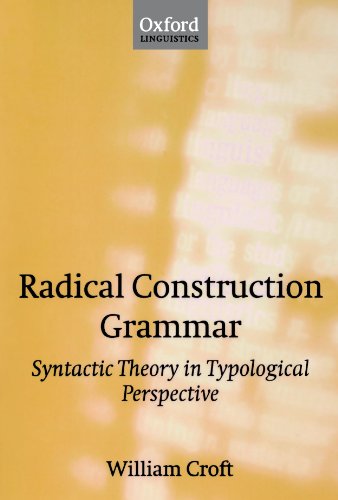
William Albert Croft is an American linguistics educator and Professor of Linguistics at the University of Manchester, United Kingdom. Born on November 13, 1956, in San Francisco, California, he holds a Doctor of Philosophy from Stanford University (1982–1986). His academic career includes roles as Research Fellow, Lecturer, and Reader at the University of Manchester (1994–2005), alongside an Assistant Professorship at the University of Michigan (1996–1998). He is renowned for developing Radical Construction Grammar, a syntactic theory using box-diagrams to analyze cross-linguistic grammar features. His research focuses on functional and cognitive linguistics, language typology, and syntactic universals. Educations: Doctor of Philosophy, Stanford University, California, 1982–1986 Research Interests: Dr. Croft’s work integrates cognitive and functional perspectives to explain language structure and change. His theories emphasize cross-linguistic comparison and the role of usage-based mechanisms in grammatical evolution. He has authored influential textbooks on linguistic typology and syntax, including Radical Construction Grammar and Typology and Universals . Awards: Listed in Marquis Who's Who as a Noteworthy Linguistics Educator Professional Activities: Member of the Philological Association, Linguistic Association of Great Britain, and Linguistic Society of America. Former Councillor of the Save-the-Redwoods League (San Francisco, 1987).
Beth Piatote is an Associate Professor of English and Comparative Literature at the University of California, Berkeley. She holds a PhD in Modern Thought and Literature from Stanford University and is an enrolled member of the Confederated Tribes of the Colville Reservation (Nez Perce). Her work bridges scholarly and creative realms, focusing on Indigenous literature, law, language revitalization, and cultural studies. Education: PhD in Modern Thought and Literature (Stanford University). Research interests include Native American legal systems, Nez Perce language preservation, global Indigenous literatures, and creative writing. She co-founded and chairs Berkeley’s Designated Emphasis in Indigenous Language Revitalization and directs the Arts Research Center, where she leads the Indigenous Poetics Lab. Her publications include Domestic Subjects: Gender, Citizenship, and Law in Native American Literature (2013) and the short story collection The Beadworkers (2019), which received multiple literary recognitions. Her plays Antíkoni and Tricksters, Unite! explore Indigenous narratives through performance. Awards include MLA honorable mentions, PEN/Bingham Prize longlistings, and a 2020 Playwrights Retreat win. Current projects involve a scholarly monograph on sensory representations of Indigenous law and creative works in poetry and essays.
David Bamman is an Associate Professor in the School of Information at UC Berkeley, specializing in applying Natural Language Processing (NLP) and machine learning to cultural and social science questions. He leads research in born-literary NLP, computational humanities, and cultural analytics, with affiliated roles in EECS, Linguistics, and Computational Precision Health. Bamman holds degrees from Carnegie Mellon (Ph.D., 2015), Boston University (M.A., 2006), and University of Wisconsin-Madison (B.A., 1998). His work is supported by NEH, NSF, and industry grants. Educations: Ph.D. in Computer Science (2015), Carnegie Mellon University M.A. in Applied Linguistics (2006), Boston University B.A. in Classics (1998), University of Wisconsin-Madison Research Interests: NLP for underserved domains (e.g., literature, social media), coreference resolution, cultural analytics, and computational methods for studying literature and culture. Projects include LitBank and BookNLP datasets. Grants & Awards: Hellman Fellow (2019), Amazon Research Award (2017), NSF CAREER Award, and NEH funding. Teaching: Courses include Natural Language Processing (Info 159/259), Computational Humanities (INFO 190), and Applied NLP (INFO 256). His research group explores topics like racial representation in high school literature, Hollywood diversity metrics, and the sociocultural implications of LLMs. Bamman advises multiple PhD students and collaborates on datasets like CMU Book Summaries and 11K Latin Books.
Mark Lloyd serves as a Clinical Professor at the Annenberg School for Communication and Journalism, University of Southern California. His career uniquely bridges legal advocacy, civil rights leadership, and broadcast journalism, with pivotal roles including Associate General Counsel at the Federal Communications Commission (2009-2012) where he advised on inclusion and localism policies, and Vice President at the Leadership Conference on Civil Rights. His research critically examines the intersection of media systems and democratic governance, focusing on structural inequities in communication infrastructure. Key interests include: Regulatory frameworks for equitable media access Civil rights implications of digital and broadcast platforms Historical analysis of communication policy failures Public interest advocacy in telecommunications Journalistic ethics in commercial media ecosystems Constitutional challenges in modern media landscapes Lloyd received an Emmy Award for his broadcast journalism work spanning public and commercial radio/television networks including NBC and CNN. His scholarly contributions include the book Prologue to a Farce: Communication and Democracy in America (University of Illinois Press, 2007) and co-editing The Communication Crisis in America and How to Fix It (Palgrave MacMillan, 2016). No information regarding student advising, research grants, or laboratory affiliations is documented in available sources. His professional trajectory emphasizes policy intervention over traditional academic mentorship structures.
Gül Şen is a Senior Lecturer and Privatdozentin at the Institute of Oriental and Asian Studies, University of Bonn, and also serves as a Lecturer at the University of Heidelberg. Her academic work focuses on premodern Ottoman history, historiography, and the dynamics of dependency, particularly in maritime contexts such as galley slavery and war captivity. She is actively involved in major research programs including the DFG-Priority Program 'Transottomanica' and the Bonn Center for Dependency and Slavery Studies. Her research areas include: Premodern Ottoman historiography and narrative strategies Legitimacy of rule and political transitions Maritime unfree labor and galley slavery War captivity and captivity narratives in the 18th century Dependency and asymmetrical power relations in the early modern Mediterranean Her recent publications reveal a strong thematic trend centered on the interplay between narrative construction and social power, particularly in contexts of slavery and captivity. She investigates how historical actors used storytelling to assert legitimacy, cope with crises, and negotiate identity. Her work bridges literary analysis with social history, offering nuanced understandings of agency within systems of dependency. She frequently collaborates with leading scholars like Stephan Conermann and contributes to major edited volumes and series in Ottoman studies. Her scientific awards include: DAAD Award for outstanding academic achievements (2012) Postdoctoral Scholarship from the Fritz Thyssen Foundation (2012–2013) Postdoctoral Fellowships at the Annemarie Schimmel Kolleg (2015–2016, 2018–2019) Postdoctoral Scholarship from the University of Bonn (2019–2020) She has supervised numerous B.A. and M.A. theses at the University of Bonn and Heidelberg and has secured third-party funding, including a DFG project (€192,000) from 2016–2018 and Fritz Thyssen Foundation grants. She is co-editor of the 'Ottoman Studies' and 'Otto Spies Memorial Series' book series, and holds leadership roles in the Society for Turkic, Ottoman and Turkish Studies (GTOT) and the International Association for Ottoman Social and Economic History (IAOSEH). Her academic activities are deeply embedded in collaborative and interdisciplinary research environments. She is affiliated with the Bonn Center for Dependency and Slavery Studies and contributes to the DFG-Priority Program 'Transottomanica,' where she examines mobility dynamics and captivity narratives. Her work is supported by a strong network of international collaborations and editorial engagements.
Ramsey McGlazer is an Associate Professor specializing in twentieth-century European and Latin American literature, film, and critical theory. His research engages with poetry, politics-aesthetics intersections, critical carceral studies, and feminist/queer/psychoanalytic frameworks. He holds a Ph.D. in Comparative Literature and Critical Theory from UC Berkeley (2015) and previously taught at the University of St Andrews and Brown University’s Pembroke Center. McGlazer’s work interrogates modernist critiques of progress, radical psychiatry movements, and the interplay between aesthetic practices and institutional critique. His acclaimed monograph Old Schools: Modernism, Education, and the Critique of Progress (2020) won the American Association for Italian Studies First Book Prize. Current projects include The Clinic and its Double , exploring mid-century radical psychiatry and avant-garde art. He serves as Senior Editor of Critical Times and Coeditor of Italian Culture , and has translated key works like Rita Segato’s The War Against Women . McGlazer’s writing appears in venues such as Los Angeles Review of Books and n+1 . Research interests span Surrealist provocations, Brazilian artist Lygia Clark’s propositions, and transnational feminist solidarities. His scholarship bridges literary analysis with critical engagements in carceral studies, postcolonial theory, and decolonial thought.
Pieter d'Hoine serves as Professor and Vice Dean of Education at KU Leuven's Higher Institute for Philosophy. He is affiliated with the Wulf Mansion Centre for Ancient, Medieval and Renaissance Philosophy and LECTIO – KU Leuven Institute for the Study of Textual Transmission. Additional institutional roles include membership on the Board of the Institute for Living Languages, HIW Faculty Council, and Philosophy Program Oversight Committees. His research centers on Ancient Philosophy with emphasis on Neoplatonism, particularly Proclean metaphysics, logical structures in Platonic/Aristotelian commentaries, and mechanisms of philosophical canon formation. He investigates knowledge transmission from Greek-Roman antiquity through medieval and Renaissance scholarship, integrating digital humanities methodologies to analyze textual evolution and conceptual continuity across historical periods. Recent publications (2024) exhibit concentrated focus on Proclus' metaphysical frameworks, including predication theory, modes of being, and theological elements within Platonic exegesis. His work bridges textual criticism with systematic philosophy, examining how ancient commentators shaped enduring philosophical paradigms through citation practices and logical innovation in works like the Elements of Theology . No major scientific awards are documented in the provided materials. He actively supervises doctoral research, including G.J. Ruz Troncoso's analysis of Proclus' argumentative structures and S-H. Yang's study of Aristotelian metaphysics. Current funding supports eight major projects: "Een nieuw model voor de editie van antieke filosofische fragmenten" (2025-2031) as Co-promotor "De filosofische canon en de citaties van Plato en Aristoteles" (2024-2028) as Promotor "Rechtvaardigheid voor dieren" (Justice for Animals, 2024-2028) as Promotor "De mechanica van Canonvorming" (Canon Formation Mechanics, 2024-2028) as Promotor His research ecosystem operates through the Wulf Mansion Centre and LECTIO institute, which coordinate international collaborations on premodern textual transmission, utilizing digital tools to map philosophical concept evolution across millennia.
Emily C. Bartels is a Professor of English at Rutgers University specializing in early modern literature and culture, with particular expertise in Shakespearean and non-Shakespearean drama. She has served as director, and is now dean, of the Middlebury Bread Loaf School of English since 2010, a summer Master's program designed for K-12 English teachers. Professor Bartels received her BA from Yale University and both her MA and PhD from Harvard University. Her academic background positioned her to become a leading scholar in Renaissance literature studies. Her research examines questions of race, cross-cultural relations, gender, genre, and performance in early modern English drama. Professor Bartels is renowned for her groundbreaking work on Shakespeare's Othello and Christopher Marlowe's plays, analyzing how these texts represent cultural and racial difference. She has significantly contributed to postcolonial approaches to early modern literature, revealing how English drama engaged with global encounters and representations of the 'other' during the Renaissance period. Her scholarship demonstrates how early modern writers both reflected and shaped contemporary attitudes toward difference, particularly regarding race, religion, and national identity. Professor Bartels' publications reveal a consistent scholarly trajectory examining racial and cultural representation in early modern England. Her work spans from detailed analyses of specific plays like Hamlet and Julius Caesar to broader studies of how England conceptualized Africa and non-Christian cultures during the Renaissance. A recurring theme throughout her career is the analysis of how early English drama both reflected and shaped contemporary attitudes toward difference, particularly regarding race, religion, and national identity. Roma Gill Prize for Best Work on Christopher Marlowe (1993-94) for Spectacles of Strangeness: Imperialism, Alienation, and Marlowe Board of Trustees Fellowship for Scholarly Excellence (1993) School of Arts and Sciences Award for Distinguished Contributors to Undergraduate Education (2008 & 1993) Warren I. Susman Award for Excellence in Teaching (2008) Solmsen Fellowship at the Institute of Research in the Humanities, University of Wisconsin (1995) Black Atlantic Project fellowship from the Rutgers Center for Historical Analysis Professor Bartels has demonstrated exceptional commitment to both research and teaching excellence. She has developed innovative courses exploring the intersections of literature, history, and cultural studies, including undergraduate seminars on Othello and Hamlet, and graduate courses on Shakespeare Page and Stage. Her administrative role as dean of the Middlebury Bread Loaf School of English demonstrates her commitment to education beyond traditional university settings. Her fellowships from prestigious institutions indicate successful grant acquisition throughout her distinguished career. Professor Bartels has been actively involved with the Shakespeare Association of America and has collaborated with international scholars like Emma Smith of the University of Oxford. Her work has positioned her at the forefront of conversations about early modern literature, race studies, and postcolonial approaches to Renaissance drama, influencing how scholars understand the intersections of literature, race, and cultural identity in the early modern period.
Bernard Comrie is a Research Professor Emeritus in Linguistics at the University of California, Santa Barbara (UCSB), affiliated with the College of Letters and Science. He previously served as Director of the Department of Linguistics at the Max Planck Institute for Evolutionary Anthropology in Leipzig (1998–2015) and held a Distinguished Professorship at UCSB (2002–2021). His career includes teaching positions at the University of Cambridge, University of Southern California, and leadership roles in major research institutions. Comrie’s research focuses on Language universals and typology Historical linguistics Languages of the Caucasus, New Guinea, and Great Andamanese He emphasizes fieldwork-driven cross-linguistic analysis of topics like tense/aspect, transitivity, numeral systems, and prehistoric migration studies through collaborations with archaeologists and geneticists. His recent publications explore morphosyntactic variation (e.g., verb indexing in Asian languages, reflexivity in Tsez), language contact (Kanashi prehistory), and numeral system typology. Articles often bridge theoretical linguistics with empirical data from understudied languages. Notable contributions include the World Atlas of Language Structures and foundational work on Nakh-Daghestanian and Andamanese languages. He advocates for interdisciplinary approaches to reconstructing prehistoric human movements via linguistic evidence.
Maile Arvin is a Kanaka Maoli feminist scholar and Assistant Professor at the Department of Ethnic Studies, University of Hawaiʻi at Mānoa. Her research and teaching focus on Indigenous relationships to land, histories of race and settler colonialism in Hawaiʻi, Oceania, and the United States. Previously, she was faculty in History and Gender Studies at the University of Utah and founding director of the Center for Pasifika Indigenous Knowledges. PhD in Ethnic Studies, University of California San Diego (2013) MA in Ethnic Studies, University of California San Diego (2009) BA in English, Swarthmore College (2005) Her research examines: Colonial production of racial categories, particularly Polynesians as an 'almost white race' in historical social science History of incarceration of Native Hawaiian children in government institutions (1865–1960s) Intersection of settler colonialism and Indigenous feminisms Critique of eugenics and genomic studies in the Pacific Community-engaged memorialization projects in Hawaiʻi Recent scholarly trends include analyses of Indigenous sovereignty, critiques of settler colonial whiteness, and interdisciplinary studies of race-gender dynamics. Arvin's publications explore Polynesian racialization, decolonial feminism, and the socioeconomic impacts of colonial institutions. NEH Chair's Grant for Nā Lei Poina ʻOle ACLS Digital Justice Seed Grant Arvin leads Nā Lei Poina ʻOle (Beloved Children Never Forgotten), a community history project about reformatories and industrial schools in Hawaiʻi. In collaboration with Kawela Farrant and the North Shore Community Land Trust, this project uses archival and oral histories to confront the legacy of child incarceration. She also critiques the nonprofit-industrial complex's role in limiting Indigenous sovereignty.
Prof. Dr. Claudine Moulin is a Full Professor of Historical Linguistics at the Department of German Studies, University of Trier. She co-directs the Trier Center for Digital Humanities and serves as Vertrauensdozentin der Deutschen Forschungsgemeinschaft. With academic roots in Brussels and Bamberg, she completed her PhD in 1990 and Habilitation in 1999 at the University of Bamberg. Her research spans medieval and early modern languages, manuscript studies, digital humanities, and Luxembourgish linguistics. As a leading scholar in historical linguistics, Moulin's work explores urban language history, phraseology, and cultural knowledge transmission through manuscripts. She has directed major digital humanities projects like LexicoLux and Cartul@rium, while pioneering digital codicology methods for medieval texts. Her research combines traditional philology with computational approaches. Her academic accolades include the Akademiepreis Rheinland-Pfalz (2010), Landesverdienstorden (2014), and the Verdienstkreuz am Bande (2025). She has held visiting professorships at Sorbonne, EHESS Paris, and EPHE, and received fellowships from the Humboldt Foundation and European Science Foundation. Notable Academic Roles: Co-founder and Chair of DHd (Digital Humanities in German-speaking countries) Founding member of Trier Center for Language and Communication Member of German Historical Institute Paris scientific board Advisory positions at Austrian Center for Digital Humanities and Herzog August Bibliothek Her editorial leadership includes chief editorship of Sprachwissenschaft journal and co-editorship of Germanistische Bibliothek monograph series. She has mentored over 40 graduate students in topics ranging from medieval marginalia to urban language studies.
Wim VAN LENT is a Full Professor of Management at IÉSEG School of Management , France. He holds an HDR in Management from IAE Paris Sorbonne and a Ph.D. in Business Administration from ESSEC Business School. His academic career includes roles as Visiting Professor at Curtin University (Australia), Griffith University (Australia), and Researcher at the University of Paris I Panthéon-Sorbonne. He coordinates the 'Strategy and Sustainability' track and is a member of the LEM research group. His research focuses on Management Strategy , Business Ethics , Innovation and Entrepreneurship , and Historical Methodology . Notable areas include corporate archives' strategic use, temporal dynamics in organizations, and ethical repair mechanisms. His work often employs historical case studies, such as the Dutch East India Company (VOC) and colonial-era corporations, to analyze organizational adaptation and institutional contradictions. Van Lent's publications span top journals like Academy of Management Review , Small Business Economics , and Business Ethics Quarterly . His recent studies explore periodization practices in organizations, entrepreneurial time narratives, and moral repair frameworks. Teaching includes international strategy and corporate social responsibility at the MSc level. His research bridges historical analysis with contemporary management challenges, emphasizing how understanding past institutional dynamics informs modern organizational behavior and ethical decision-making.