Johan Jansson is an Associate Professor in Scientific Computing at KTH Royal Institute of Technology and BCAM (Basque Center for Applied Mathematics). He leads research in predictive Direct FEM Simulation (DFS) for aerodynamics and multiphase flows, and co-founded Icarus Digital Math as CEO. His work includes the FEniCS open-source finite element software project and MOOC-HPFEM educational initiatives. He holds roles as Director of the Center for Digital Math and collaborates internationally in computational science. Research focuses on high-performance computing (HPC), fluid-structure interaction (FSI), biomedical modeling, and renewable energy systems. Notable contributions include adaptive FEM frameworks for turbulent flow, vocal fold simulations, and wave energy converter modeling. His work bridges academic research with industrial applications, leveraging FEniCS-HPC and Unicorn solvers. Key achievements include election to the IVA Royal Swedish Academy of Sciences 100-list and securing the Severo Ochoa Center of Excellence Award. He has pioneered open-source tools like SimTek and contributed to major projects like the Salter Sink and vocal production modeling. Teaching responsibilities include courses on database technology, computational fluid mechanics, and research methodology. He actively engages in large-scale simulation projects involving marine energy, cardiac ablation protocols, and aerodynamic optimization.
Mathilde Luneau is an Assistant Professor in the Department of Applied Chemistry at the School of Chemistry and Chemical Engineering, Chalmers University of Technology. Her research focuses on heterogeneous catalysis and electrocatalysis for sustainable reactions, employing a multidisciplinary approach encompassing materials synthesis, testing, and advanced characterization. She aims to design efficient catalytic materials for energy and environmental applications. Education : PhD in Chemistry, University of Lyon, France. Postdoctoral Researcher at Harvard University under Prof. Cynthia Friend, investigating dilute alloy catalysts. Research Interests : Luneau’s work emphasizes sustainable reaction pathways using advanced catalytic systems. Her lab explores nanomaterials, bimetallic alloys, and electrochemical methods to enhance catalyst stability and selectivity. Key areas include fuel cell catalyst layers, oxygen-assisted coupling reactions, and additive manufacturing for flow reactors. She employs techniques like X-ray spectroscopy and machine learning to analyze catalyst structures and performance. Publications : Her recent studies highlight advancements in platinum nanoparticle synthesis, dilute PdAu catalysts, and Ti-6Al-4V anodes for electrochemical reactors. Trends reflect a focus on optimizing catalytic selectivity, stability under varying conditions, and scalable production methodologies. Labs/Teams : Luneau leads a research group at Chalmers dedicated to sustainable catalytic materials. Her team collaborates on projects like biogas processing and hydrogen production, leveraging interdisciplinary expertise in chemistry, engineering, and computational methods.
Marina Papatriantafilou is an Associate Professor in the Department of Computer Science and Engineering at Chalmers University of Technology and University of Gothenburg. Her research focuses on distributed computing, fault-tolerance, parallel algorithms, and concurrency control. She has contributed to methods for fault-tolerant distributed systems, visualization tools for distributed algorithms, and scalable overlay networks. Her academic roles include teaching advanced courses on distributed systems, computer communication, and operating systems. She advises graduate students in areas like distributed algorithms and parallel computing. Key research interests include lock-free synchronization, memory reclamation, and self-stabilizing systems. She has authored over 100 publications in top-tier conferences and journals, with recent work on data streaming frameworks, energy-sharing optimization, and vehicular network processing. Professional involvement includes roles in program committees for conferences like OPODIS, SWAT, and SSS, plus membership in research evaluation boards for Swedish and European funding agencies. She pioneered educational tools like the Lydian environment for distributed algorithm visualization.
Professor Zuheir Barsoum is a faculty member at KTH Royal Institute of Technology, serving as Vice Head (Research) in the Department of Engineering Mechanics. His research focuses on computational weld mechanics, fatigue assessment of materials, and structural integrity of welded joints. Key areas include high-frequency mechanical impact (HFMI) treatments for fatigue improvement, finite element analysis, and lightweight metal joining. Funded by VINNOVA, SSAB, Volvo, and others, his work addresses industrial challenges in structural durability. Current PhD students include Martin Edgren (bridge structural health monitoring), Mehdi Ghanadi (fatigue of high-strength steels), Yu Zhu (laser cladding simulations), and Kaushik Iyer (LCC modeling of welded structures). He teaches courses like Advanced Design of Welded Structures (SD2420) and oversees degree projects in Lightweight and Solid Mechanics. Notable achievements include the 2010 Henry Granjon Prize for fatigue design research. His startup Winteria AB commercializes digital quality assurance solutions for welding production, aligning with Industry 4.0 trends. Recent research emphasizes probabilistic fatigue modeling, machine learning for weld geometry analysis, and material defect characterization. Collaborations include Chalmers University and Swerim. His work bridges advanced manufacturing, computational mechanics, and industrial applications to enhance structural reliability and lifecycle cost optimization.
Huadong Yao is an Assistant Professor at the Department of Marine Engineering, Chalmers University of Technology. His research spans renewable energy , fluid-structure interaction (FSI) , and transportation systems , with a focus on offshore wind farms, wave energy, and aero/hydroacoustics. Multi-University Collaboration : Guest professorships at international institutions Leadership Roles : Coordinator of Horizon 2020 projects (e.g., IVANHOE) and guest editor for journals Key Organizations : Member of AIAA, SAE International, RINA, ICNMT, and ICES Working Group on Offshore Renewable Energy His research integrates CFD and FSI coding (OpenFOAM, in-house codes) with turbulence modeling (LES, SNGR) to address problems in marine hydrodynamics (e.g., rim-driven thrusters, wind-powered ship propulsion) and terrestrial transportation (high-speed train aerodynamics, urban air mobility). Recent work explores biomechanics (whiplash injury hydrodynamics) and battery cooling systems for electric vehicles. Current projects focus on: Optimization of wave energy converter farms (hexagon layouts, mooring fatigue) Hubless rim-driven thruster design (gap geometry, concave cavities) Hydrographic impacts of offshore wind turbines on marine environments Urban air mobility (UAM) aerodynamics Multidisciplinary Design Optimization (MDO) using machine learning He collaborates with institutions like AIAA, SAE, and ICES, and has received funding from Horizon 2020 and Swedish national agencies.
Pär Strand is a Professor at Chalmers University of Technology, affiliated with the Department of Astronomy and Plasma Physics. His research focuses on transport in fusion plasmas , particularly through analysis of experiments at JET and development of simulation tools for ITER and other tokamak facilities. A key contributor to EU projects, he directs the Chalmers e-Science Centre, emphasizing data-driven methodologies and large-scale simulation technologies. Expertise: Fusion plasma dynamics, electromagnetic field theory, integrated modeling frameworks Projects: Code development for ITER/JET, FAIR data principles in fusion research, turbulence transport simulations Research Trends: Recent publications highlight advancements in: Tokamak power exhaust solutions (divertor shaping, neutral baffling) Machine learning applications for pedestal dynamics and disruption prediction High-order solvers for plasma transport equations Validation of D-T fusion power predictions against JET experiments
Artem Vilenskiy is a researcher in the Antenna Systems group at Chalmers University of Technology since 2019. His work focuses on developing active integrated array antenna concepts, 100+ GHz beam-steerable antennas and circuits, MMIC design, computational electromagnetics methods for radiation and scattering problems, and collaboration with Chalmers industrial partners. His educational background includes: MSc Degree (Specialist) in Electrical Engineering from Bauman Moscow State Technical University (BMSTU) in 2011 PhD Degree (Eng.) in "Antennas, Microwave Devices and Its Technology" from BMSTU in 2014 Dr. Vilenskiy's research spans multiple cutting-edge areas in microwave and antenna engineering, with particular emphasis on millimeter-wave and sub-THz frequency ranges. He specializes in reconfigurable intelligent surfaces (RIS), beam-steering technologies, and integrated antenna solutions for next-generation wireless communication systems. His work bridges theoretical electromagnetics with practical implementation challenges, often involving close collaboration with industry to address real-world telecommunications and radar applications. His expertise encompasses both novel antenna architecture design and associated microwave integrated circuits, with significant contributions to mmWave phased arrays and wireless power transfer systems. Analysis of his recent publications reveals a strong and consistent focus on millimeter-wave antenna systems, particularly in developing reconfigurable intelligent surfaces for 5G/6G applications, advanced beamforming techniques, and innovative antenna array architectures. His research spans frequencies from W-band (75-110 GHz) into the sub-THz range, addressing critical challenges in high-frequency wireless communication systems. The publications demonstrate a consistent emphasis on practical implementation, with many papers detailing circuit models, measurement techniques, and experimental validation of theoretical concepts across multiple application domains including satellite communications, wireless backhaul, and quantum computing interfaces. Dr. Vilenskiy has been actively involved in multiple significant research projects: Low-Thermal-Conductance and High-Density Microwave Interconnects for Cryogenic Quantum Computers (2024-2025) Energy Efficient, Beamforming Antenna-IC Integration Solutions for Future 100+GHz Telecommunication Systems (2021-2023) Antenna technologies for beyond 5G Wireless Communication (2020-2025) MyWave - Efficient Millimetre-Wave Communications for mobile users (2019-2023) Integrated Antenna Arrays (2016-2023) Prior to joining Chalmers, Dr. Vilenskiy worked at Samsung Research Institute Russia from 2011-2019 in various engineering roles including research engineer, expert engineer, and project leader. During 2015-2019, he also held a part-time Associate Professor position at BMSTU where he coordinated the MSc course "Applied Electrodynamics of Composite Media". His industry experience in mobile communication, automotive radar, robotics, and wireless power transfer provides valuable practical insights that complement his academic research in antenna systems.
Christian Rohner is a Professor at the Department of Information Technology at Uppsala University, specializing in the Division of Computer Systems. His research spans over two decades with a clear evolution from early work in opportunistic networking to current cutting-edge research in backscatter communication and physical-layer security. Professor Rohner's research interests focus on wireless communication systems , particularly backscatter communication , sensor networks , and network security . His work on analog backscatter tags has pioneered techniques for channel estimation, reliable flooding protocols, and identification systems for battery-free devices. In wireless security , he has made significant contributions to radiometric fingerprinting, physical-layer authentication, and intrusion detection for IoT systems. His research in information theory applies theoretical frameworks to practical network analysis problems, including modularity computation in probabilistic networks and information decomposition. His recent publications (2020-2025) demonstrate a strong focus on enabling low-power wireless systems, with applications ranging from medical contexts (fat intra-body communication) to temperature sensing with RFID tags. The research shows a clear trajectory toward practical implementations of battery-free sensor networks that can operate without traditional power sources while maintaining security and reliability. Professor Rohner has maintained long-term collaborations, particularly with Thiemo Voigt at Uppsala University, resulting in numerous joint publications across multiple research domains. His work bridges theoretical foundations with practical implementations, making significant contributions to both academic research and potential real-world applications in wireless networking.
Niclas Jansson is a researcher at the PDC Center for High Performance Computing at KTH Royal Institute of Technology. He holds an M.S. in Computer Science (2008) and a Ph.D. in Numerical Analysis (2013) from KTH. His career spans roles such as postdoctoral researcher at RIKEN Advanced Institute for Computational Science (2013-2016) and visiting scientist at RIKEN (2018-2021), where he contributed to the Japanese exascale program Flagship 2020. A core focus of his research involves extreme-scale computing and numerical method development. He is a key developer of RIKEN's multiphysics framework CUBE , the HPC branch of FEniCS , and the spectral element flow solver Neko . His work is currently supported by a Swedish Research Council Starting Grant aimed at enhancing high-order spectral element methods for exascale fluid simulations. Niclas has published extensively on topics such as GPU acceleration , adaptive finite element methods , in situ visualization , and extreme-scale turbulence modeling . He also teaches Computational Fluid Dynamics (SG2212) at KTH.
Sandra Pauletto is a Professor in Media Technology specializing in Media Production and a Docent in Sound and Music Computing at the Division of Media Technology and Interaction Design (MID), School of Electrical Engineering and Computer Science (EECS) at KTH Royal Institute of Technology. She joined KTH in 2019 after positions at the University of York and University of Huddersfield in the UK. Her work bridges the gap between artistic sound practices and technological innovation in the field of sonic interaction design. Pauletto holds a Physics degree (MPhys(Hons)) from Manchester and a Music degree in Classical Guitar from Conservatorio "G.Tartini" in Trieste, Italy. She completed her MSc and PhD in Music Technology at the University of York, UK, where her doctoral thesis focused on "Interactive non-speech auditory display of multivariate data." Her interdisciplinary background informs her approach to sound and media research. Her primary research interests focus on sound and music computing, media production, sound design, sonic interaction design, and sonification . She investigates how sound communicates both functional information (e.g., a car door shutting) and aesthetic qualities (e.g., the type of car) in interactive contexts. Her current projects apply these principles to sustainability challenges like energy consumption monitoring and environmental awareness, as well as health communication applications. She has developed methods that combine historical sound design practices with contemporary computing techniques to create more effective sonic interfaces. Analysis of her recent publications reveals a strong trend toward applying sound design to address societal challenges, particularly through projects like SonicFunc (developing sound design methods for everyday life) and SoniHED (Sonification of Health and Environmental Data). Her work increasingly incorporates interdisciplinary approaches, collaborating with experts in astronomy, environmental science, and public health to develop effective sonic interfaces for complex data. She has received funding for significant research projects including: The SonicFunc project (Principal Investigator), developing new sound design methods for the digital society The SCORe Project (Principal Investigator), using sonification to communicate public health risk data SoniHED: Conference on Sonification of Health and Environmental Data (funded by Wellcome Trust) Chronic health issues of adolescents project (funded by Centre for Chronic Diseases and Disorders) As an educator and mentor, Pauletto has served as Principal Supervisor for 5 completed PhD students and is currently Associate Supervisor for 1 PhD student. She has extensive teaching experience across all academic levels and has held management roles including Deputy Head of the MID Division at KTH and Programme Director for the MA/MSc in Postproduction with specialisation in Sound Design. She has also been a member of the Peer Review College for the UK Arts and Humanities Research Council and an expert reviewer for EU FP7 and H2020 programmes. She leads the SonicFunc research group which investigates sound function, aesthetics, and interaction in media production to create effective sonic interaction design for everyday life. Her team includes postdoctoral researchers like Rod Selfridge and PhD students working on projects related to sustainability, health communication, and innovative sound design methodologies. She has also organized multiple conferences including the SoniHED conference series and guest edited special journal issues on data sonification and sound design.
Christian Fager is a Full Professor at the Department of Microwave Electronics, Chalmers University of Technology, Sweden. He has been affiliated with Chalmers since completing his Ph.D. there in 2003. As Head of the Microwave Electronics Laboratory, his research focuses on nonlinear transistor modeling, energy-efficient power amplifier architectures, and distributed MIMO systems. He has co-invented 8 patents and published over 250 papers, including a seminal book on Nonlinear Transistor Model Parameter Extraction Techniques (Cambridge University Press, 2011). Dr. Fager holds editorial roles as Associate Editor of IEEE Microwave Magazine and member of the MTT-S Technical Coordination Committee on Wireless Communications. He is a Board Member of the European Microwave Association (EuMA) and has chaired multiple IEEE topical conferences. His awards include the Chalmers Supervisor of the Year (2018), inaugural Area of Advance Award (2010), and IEEE IMS Best Student Paper (2002). He leads research initiatives in distributed antenna systems, digital pre-distortion, and GaN/SiGe-based high-efficiency amplifiers, with projects involving testbed development for 5G/6G applications. His work bridges theoretical modeling and practical implementation in RF/microwave systems, emphasizing thermal and multi-physical simulation integration.
Marco Chiesa is an Associate Professor at the KTH Royal Institute of Technology in the Intelligent Network System Lab (INSight) group under the Division of Software and Computer Systems . His research focuses on computer networking, particularly Internet protocols and architectures, with emphasis on security, privacy, network design optimization, and Software Defined Networking (SDN) approaches. Current research areas: SDN, IXPs, stateful packet processing, network monitoring Teaching roles: Advanced Internetworking (IK2215), Computer Hardware Engineering (IS1200), Network Systems with Edge or Cloud Datacenters (IK2227) Email: mchiesa@kth.se Recent publications highlight advancements in high-speed packet processing, network security, and SDN applications. Key trends include leveraging programmable switches for stateful operations, improving BGP hijacking detection, and optimizing network monitoring on multi-pipeline architectures.
Daniel Månsson is a Professor at the Department of Electrical Engineering, Royal Institute of Technology (KTH), specializing in smart electricity grids and power system components. His work spans electromagnetic compatibility (EMC) of large distributed systems, energy storage optimization, and privacy protection in smart metering. PhD in Engineering Physics (with specialization in Electromagnetism) Docent (Swedish Academic Title) in Electrical Engineering His research focuses on: Optimization of self-sufficient microgrids with energy hubs Smart meter privacy protection using energy storage EMC analysis of photovoltaic systems and UWB transients Hybrid energy storage system performance in renewable grids Recent publications indicate expertise in: Electromagnetic interference from solar PV systems Cyber-physical security in smart meters Conducted emission analysis Greenhouse gas reduction through optimized storage
Arpita Chari is a Research Fellow at Chalmers University of Technology, specializing in Virtual and Digital Production Systems. Her work bridges Industry 4.0, Resilience Engineering, and Sustainability in Production Systems, focusing on integrating digital technologies to enhance resource efficiency and enable lean circular manufacturing. Her research explores the implementation of resilient and sustainable practices in manufacturing, emphasizing dynamic capabilities, digital platforms, and supply chain optimization. Key projects include the Digitala Stambanan initiative and the Produktion2030 strategic innovation program, which address sustainability transitions and systemic resilience. 2024 Highlights: Analyzed dynamic capabilities for resilience-sustainability integration, characterized battery lifecycle challenges, and modeled risk prioritization in supply chains. 2023 Themes: Digital platform adoption, battery production systems, and value chain sustainability in the Digitala Stambanan project. 2022–2021 Foundations: Developed frameworks for green manufacturing, circular supply chains, and stakeholder-driven sustainability in textiles.
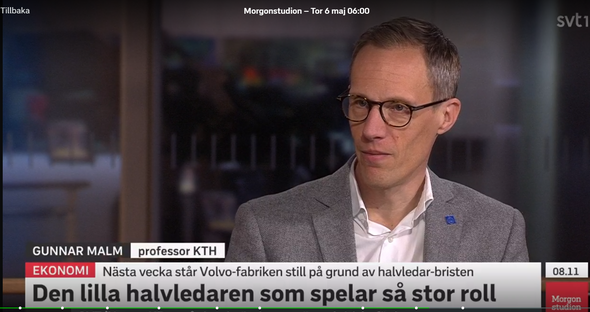
Gunnar Malm is a full-time Professor and Deputy Head of Department at the Royal Institute of Technology (KTH) in the School of Electrical and Computer Engineering. His research focuses on semiconductors and spintronics (nano-electronics), with special emphasis on variability, noise, and fluctuations in electronic components, as well as electronics for extreme environments. He combines experimental work with large-scale computer simulations via KTH's PDC, national SNIC clusters, and Vienna University of Technology's VSC resources. Editor, IEEE Electron Device Letters (2017–present) Technical Program Committee, European Solid-State Device Research Conference (ESSDERC) His pedagogical research (TALE 2022) explores citation practices in thesis writing, and he coordinates multiple semiconductor component courses including Design of Nanosemiconductor Components (IH2657) and Simulation of Semiconductor Components (IH2653) . Malm's Noise and Fluctuations Lab investigates fundamental device physics for sustainable electronics development.