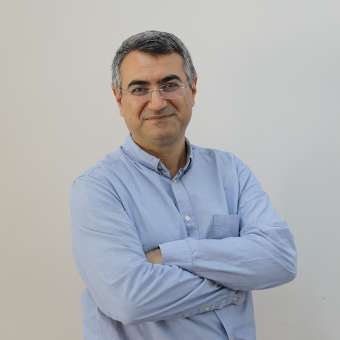
Dr. İsmail Arı is an Assistant Professor in the Computer Science department at Özyeğin University . He holds a PhD from the University of California, Santa Cruz (2004), MS from University of Maryland (2000), and BS in Electrical & Electronics Engineering from Boğaziçi University (1998).
Prof. Cevdet Aykanat is a Professor of Computer Engineering at Bilkent University, Ankara, Turkey. He earned his BS/MS in Electrical Engineering from METU and PhD from Ohio State University as a Fulbright scholar. His research focuses on parallel computing, sparse matrix algorithms, graph partitioning, and high-performance computing for big data. He has been affiliated with Bilkent since 1989 and has held roles like Associate Provost. Education: BSc/MSc (METU Electrical Engineering), PhD (Ohio State University Electrical & Computer Engineering). Research interests include parallel scientific computing, combinatorial optimization, distributed systems, and large-scale data analysis. His work spans over 100 publications in top journals like IEEE Transactions and SIAM, with 5,500 citations and an H-index of 40. Awards: 1996 TUBITAK Investigator Award, 2007 METU Parlar Science Award. He led 6 TUBITAK projects and participated in EU-funded projects like PRACE-1IP to PRACE-6IP. Publications emphasize efficient parallel algorithms for sparse computations, graph partitioning, and distributed systems. His work addresses latency reduction, load balancing, and scalable data processing in HPC environments. Grants: Funded by TUBITAK, Intel SSD, and EU programs. Academic service includes editorial roles at IEEE Transactions on Parallel and Distributed Systems.
Gülay YALÇIN is an Assistant Professor at Abdullah Gul University since 2016. Prior to this, she held a post-doctoral position at the Barcelona Supercomputing Center (BSC) from 2014-2015 and was a researcher there from 2009-2014. She obtained her Ph.D. from Universitat Politècnica de Catalunya in 2014, focusing on Computer Architecture. Her academic background also includes an M.S. from TOBB University (2007) and a B.S. from Hacettepe University (2003), both in Computer Engineering. Education: Ph.D.: Universitat Politècnica de Catalunya, Department of Computer Architecture (2008-2014) M.S.: TOBB University of Economics and Technology, Computer Engineering (2007) B.S.: Hacettepe University, Computer Engineering (2003) Research Interests: Computer Architecture Reliable Computer Design Fault Detection and Recovery Parallel Computer Architectures Hardware Transactional Memory Low-Power Designs Her work emphasizes improving system reliability through innovative fault tolerance mechanisms and energy-efficient computing solutions. Scientific Awards: ParaDIME Project Shortlisted for the 2016 Innovation Radar Prize Advising and Projects: Supervised: Albert Njoroge Kahira (M.S. Candidate) on "Designing Reliable Microarchitectures According to Application Requirements" Project Roles: Researcher in ParaDIME (2012-2015) and Velox (2008-2011)
Deniz Turgay Altılar is a Professor in the Department of Computer Engineering at Istanbul Technical University (ITU), Faculty of Computer and Informatics. He has been an active academic since 1988, progressing from Research Assistant to Associate Professor in 2013 and later achieving the rank of Professor. His work is centered on distributed systems, cloud computing, and computer networks, with expanding interests in AI applications for agriculture and healthcare. Education Bachelor of Science, Control and Computer Engineering, Istanbul Technical University (1984–1988) Master of Science, Computer Engineering, Istanbul Technical University (1988–1992) Research experience at Queen Mary and Westfield College, University of London (1998–2002) His research interests include parallel and distributed systems, cloud computing, secure computation, deep learning, and cybersecurity. He applies these to interdisciplinary domains such as corn yield prediction, radar identification, and medical diagnostics using ECG signals. His recent work emphasizes efficient and secure AI systems. The publication trends show a strong focus on distributed deep learning, straggler mitigation, secure multiparty computation, and hardware-based attack detection. His work bridges theoretical computer science with real-world applications in agriculture, medicine, and national security. Recent articles highlight innovation in lightweight AI models, privacy-preserving computation, and cross-layer system design. Scientific Awards No specific awards are mentioned in the provided text. He actively supervises students and leads major research projects, including those on cache side-channel attacks in multi-tenant clouds, distributed OpenCL platforms, real-time scheduling, and molecular communication in nano-networks. These projects reflect sustained external funding and leadership in cutting-edge computing domains. His research group collaborates across disciplines and institutions, contributing to both national and international scientific communities. Labs and Teams : While not explicitly named, his role as Principal Investigator on multiple projects suggests leadership in a research lab focused on distributed systems, cybersecurity, and applied AI at ITU.
Dr. Didem Unat is an Associate Professor at Koç University, College of Engineering, Department of Computer Engineering . Her research focuses on High Performance Computing (HPC) , GPU Computing , and Compiler Design , with particular emphasis on data locality optimization, multi-GPU communication, and adaptive mesh refinement. She leads the Parallel and Multicore Computing Lab , driving innovations in exascale co-design and heterogeneous system optimization. ACM SIGHPC Emerging Woman Leader in Technical Computing Award (2021) ERC Starting Grant (1.5M EUR) for the SparCity Project (2025) EuroHPC Grant for Extreme Scale Technologies and Applications (2025) 2025 BAGEP Award (Science Academy) Her work bridges Computer Architecture and Machine Learning , addressing challenges in data locality , multi-GPU systems , and performance portability . Recent publications highlight trends in sparse tensor optimization , asynchronous AMR execution , and compiler support for heterogeneous memory . She has developed tools like ComScribe for intra-node GPU communication analysis and ReuseTracker for multicore reuse distance analysis. Dr. Unat’s research is supported by grants from ERC and EuroHPC , reflecting her leadership in exascale technologies and GPU-centric systems . She contributes to the evolution of tiling abstractions , dynamic LLM training , and lightweight communication detection for modern architectures.
Gülay YALÇIN is an Assistant Professor at Abdullah Gul University since 2016. She holds a Ph.D. in Computer Architecture from Universitat Politècnica de Catalunya (2014), an MS in Computer Engineering from TOBB University (2007), and a BS in Computer Engineering from Hacettepe University (2003). Her research focuses on reliable computer design, fault detection, parallel architectures, and low-power systems. She has led projects like ParaDIME (2012-2015) and Velox (2008-2011), advancing energy-efficient computing and transactional memory. Education: Ph.D., Universitat Politècnica de Catalunya, Department of Computer Architecture (2008-2014) M.S., TOBB University of Economics and Technology, Computer Engineering (2007) B.S., Hacettepe University, Computer Engineering (2003) Research Interests: Her work spans fault-tolerant computing, energy-efficient designs, hardware transactional memory, and parallel architectures. She has contributed to error detection techniques leveraging comparators, voltage scaling for reliability, and novel cache designs like Flexicache. Key Projects: ParaDIME (2012-2015): Energy minimization in data centers. Shortlisted for the 2016 Innovation Radar Prize. Velox (2008-2011): Transactional memory for multi-core systems. Reliable Embedded Processors (2007-2008): Fault mitigation in embedded systems. Teaching: She teaches undergraduate courses on 'Exploring Profession' and graduate courses on 'Computer Architecture.' Advising: Currently advising M.S. student Albert Njoroge Kahira on reliable microarchitecture design. Labs/Teams: Active in the Barcelona Supercomputing Center (BSC) during her postdoc (2014-2015) and as a graduate researcher (2009-2014).
Kamer Kaya is an Associate Professor at the Faculty of Engineering and Natural Sciences, Sabancı University. He obtained his PhD in 2009 from the Department of Computer Science and Engineering at İhsan Doğramacı Bilkent University, focusing on Threshold Cryptography. His career spans research roles at CERFACS (France) and Ohio State University, where he worked in the HPC Lab and later as a Research Assistant Professor in the Dept. of Biomedical Informatics. Since 2014, he has been affiliated with Sabancı University and founded Dakik Software Technologies in 2018, focusing on R&D projects in blockchain, machine learning, and high-performance computing (HPC). He is actively involved in Sabancı University's Center of Excellence in Data Analytics and COMPUTE. PhD in Threshold Cryptography from Bilkent University (2009) Postdoctoral research at Ohio State University's HPC Lab Founder of Dakik Software Technologies (2018) His research interests include parallel algorithms , sparse data machine learning , graph algorithms , HPC hardware optimization , and cryptography . He collaborates on projects involving GPUs/IPUs for ML applications, blockchain interoperability, and digital twins for automation. As a team leader, he seeks students skilled in algorithms, data structures, and C/C++ programming.