Michael Haahr is a Doctoral Research Fellow at the Rosseland Centre for Solar Physics, affiliated with the University of Oslo and the Faculty of Mathematics and Natural Sciences. Education: M.Sc. in Computational Physics (University of Oslo, 2019-2021), B.Sc. in Computer Science (2017-2019), and B.Sc. in Physics (2014-2017). His research focuses on computational astrophysics, particularly solar flares and plasma physics, utilizing high-performance computing and simulations. He has developed a PIC-MHD hybrid code in DISPATCH for realistic solar flare modeling. Haahr has participated in international HPC summer schools and workshops on coronal loops, Docker/Singularity, and computational statistics. As a teaching assistant, he has supported courses in astrophysics, discrete mathematics, programming languages, and algorithms at the University of Oslo and Copenhagen. Laboratory & Teams: Rosseland Centre for Solar Physics (University of Oslo).
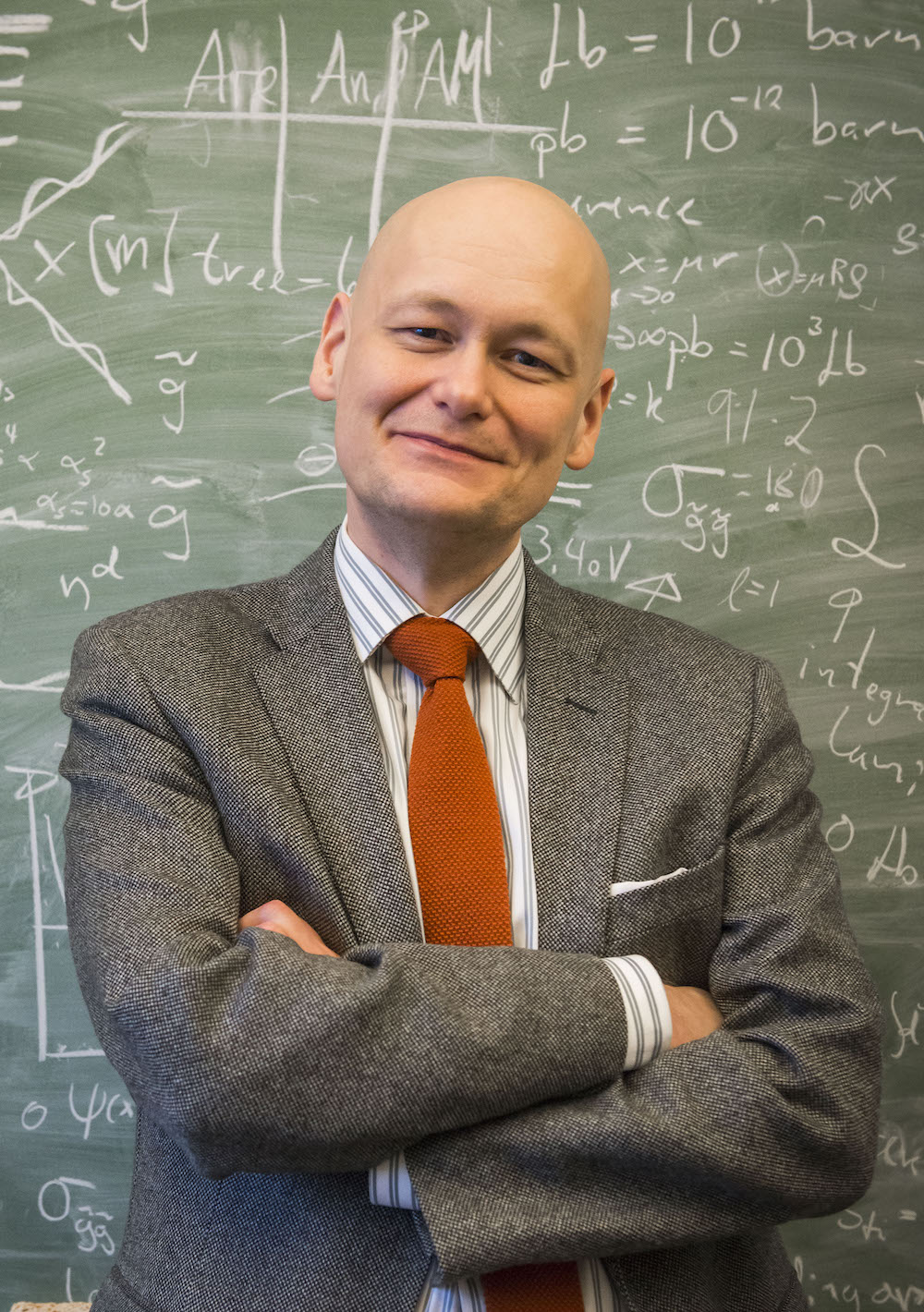
Are Raklev is a Professor at the University of Oslo's Department of Physics. His research focuses on theoretical and computational physics, particularly dark matter, particle physics at CERN's LHC, and applications of machine learning. He holds leadership roles in the GAMBIT Collaboration and its Collider Working Group. Education: PhD (University of Bergen, 2007), Postdoc (University of Cambridge, 2009), and Associate Professor at the University of Oslo (2010-2013) before becoming a full Professor in 2013. His teaching includes classical mechanics and electrodynamics (FYS3120) and supersymmetry (FYS5190/9190). Research Interests: Dark matter detection, Higgs boson studies, software for computational physics, and machine learning techniques like Gaussian processes. He leads projects like GAMBIT (a global inference tool) and PLUMBIN' (to address computational bottlenecks in high-energy physics). Recent publications span superconducting magnet design for colliders, quantum computing error correction, and nuclear isotope production. His work bridges theoretical insights with experimental applications at CERN and other facilities.
Elisavet Kozyri is an Associate Professor at UiT The Arctic University of Norway's Department of Informatics within the Faculty of Science and Technology, where she conducts research in computer security and information flow control. Her office is located in Realfagbygget A232 in Tromsø. Her research focuses on: Information flow properties and enforcement mechanisms Privacy-preserving technologies and GDPR compliance Reactive information flow systems Formal methods for security verification Diversity and inclusion in computer science education She leads the Better Balance in Informatics (BBI) project and participates in the Cyber Security Group (CSG). Her publications demonstrate a consistent focus on information flow control, privacy enforcement, and security formalization, with recent expansion into educational equity research. Analysis shows strong emphasis on: Formal modeling of security properties (60% of publications) Practical implementation of privacy frameworks (25%) Educational initiatives in computer science (15%) Teaching responsibilities include: Advanced Computer Security (2023-2025) Computer Security (2022-2025) Computer Communication (2022) Professional activities include: IEEE Computer Security Foundations Symposium PC member (2021-2026) Deputy Representative to Informatics Europe (2023-present) EUGAIN Management Committee member (2022-2024)
Dolores Modic is a researcher at the Division of Innovation and Entrepreneurship at Nord University. Her primary research interests include technology transfer, intellectual property rights (IPR) management, university-industry collaboration, patent informatics, and circular economy. She has led numerous projects sponsored by funding agencies across Europe, USA, and Asia, serving as a project author, PI, team member, and coordinator. Her work focuses on understanding complex systems in innovation, particularly in circular economy and data-driven IPR management. She contributes to the field through interdisciplinary collaboration and international team coordination. Scientific Awards: JSPS Fellow in Japan (2016-2018) Fulbright Scholar in U.S.A. (2015) She actively participates in projects involving public procurement, patent data, and innovation ecosystems, with recent publications in journals like Environmental Technology & Innovation, IEEE Transactions on Engineering Management, and Research Policy.
Norwegian University of Science and TechnologyNorway
Ernst Gunnar Gran is Associate Professor at the Department of Information Security and Communication Technology at the Norwegian University of Science and Technology (NTNU), where he heads the communication technology discipline. He also holds an adjunct research scientist position at Simula Research Laboratory, where he headed the Cloud department until December 2016. His research spans high performance computing (HPC), HPC interconnection networks, enterprise data centre networks, cloud computing, and data-intensive processing in multi-clouds. He serves as the Scientific Leader of Communication Technologies in the RCN-funded infrastructure project eX3 (Experimental Infrastructure for Exploration of Exascale Computing) and has significant experience with both RCN-funded and EU-funded research projects, including the H2020 project Melodic (Multi-cloud Execution-ware for Large-scale Optimised Data-Intensive Computing). Gran received his M.Sc. and Ph.D. degrees in computer science from the Department of Informatics, University of Oslo, in 2007 and 2014, respectively. Both theses focused on different aspects of resource management in high performance interconnection networks. He previously headed the RCN-funded project ERAC (Efficient and Robust Architecture for Big Data Clouds) and led the design, implementation, and deployment of the multi-homed IP-based research testbed NorNet Core. Gran also has several years of experience as a system administrator and scientific programmer. His research interests center on the intersection of high performance computing and networking, with particular focus on anomaly detection in time series data, HPC interconnection networks, network virtualization, and cloud computing infrastructure. His work demonstrates a consistent evolution from fundamental networking research to applied solutions for modern computing challenges, particularly in IoT security and smart home applications. His recent publications show a strong emphasis on developing lightweight, real-time anomaly detection systems using deep learning techniques. Analysis of his publication trends reveals a clear progression from traditional HPC networking research toward time series anomaly detection applications, particularly for IoT systems. His 15 most recent publications show dual focus areas: approximately 60% concentrate on anomaly detection methods for time series data (particularly for IoT applications), while the remaining 40% maintain his foundational work in HPC networking, virtualization, and cloud infrastructure. This evolution demonstrates his ability to adapt core networking expertise to emerging application domains while maintaining technical depth. While no specific scientific awards are mentioned in the provided text, Gran's leadership roles in significant research projects (eX3, Melodic, ERAC) indicate recognition of his research capabilities within the academic and research funding communities. His position as Scientific Leader of Communication Technologies in the RCN-funded eX3 project further demonstrates his standing in the Norwegian research community. Gran's teaching responsibilities include serving as course coordinator for DCSG1006 Data Communication and Networks, DCSG2001 Interconnected Networks and Network Security, and Networks: Administration, Programming and Security. His research leadership extends to significant grant-funded projects, including the RCN-funded eX3 infrastructure project and the EU H2020 Melodic project. His previous leadership of the ERAC project and the NorNet Core research testbed demonstrates sustained ability to secure and manage substantial research funding. His laboratory and team affiliations include the Department of Information Security and Communication Technology at NTNU, where he heads the communication technology discipline, and Simula Research Laboratory, where he maintains an adjunct position. The NorNet Core research testbed, which he led the development of, represents a significant infrastructure contribution to the networking research community. His current work with the eX3 project suggests ongoing involvement in experimental infrastructure for exascale computing exploration.