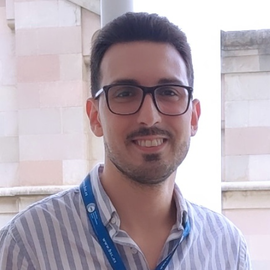
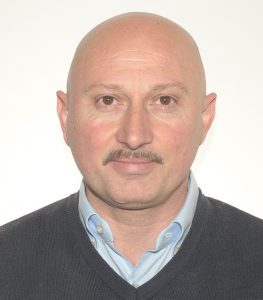
Pierluigi Monaco is an Associate Professor in the Department of Physics at the University of Trieste. He is actively involved in astrophysics, cosmology, and space science research, particularly in galaxy formation studies. His work leverages high-performance computing (HPC) for cosmological simulations and data analysis. Current research activities include participation in the National Centre for HPC, Big Data and Quantum Computing Space-based cosmology with Euclid: the role of High-Performance Computing He serves on the Department's Board and various academic committees, including Boards of Studies and Doctoral Studies Boards for multiple physics programs.
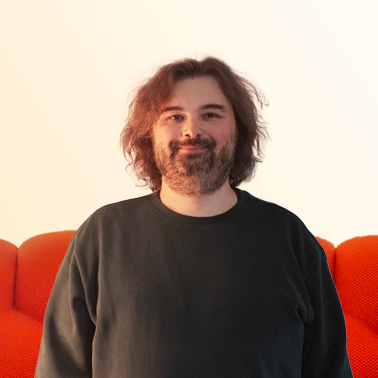
Dr. Alexandro Saro is an Associate Professor in the Department of Physics at the University of Trieste, specializing in Astrophysics, Cosmology and Space Science. He serves as a member of the Department's Board and Boards of Studies for Physics programs (SM20 and SM23), and is actively involved in teaching within the department. His research focuses on galaxy clusters, computational cosmology, and the Sunyaev Zeldovich effect in proto-clusters. Dr. Saro is particularly engaged with the Euclid mission and high-performance computing applications in space-based cosmology. His work contributes to understanding the formation and evolution of the most massive structures in the Universe. Member of Department's Board Member of Joint Board of Studies Lecturer for Physics programs (SM20 and SM23) Dr. Saro serves as Principal Investigator for research projects including 'assegnazione FRA 2022 linea C - assegnazione su richiesta presentata per progetto H2020-SARO-CLUSTERS-19' and is actively involved in the National Centre for HPC, Big Data and Quantum Computing. He also contributes to the 'From ProtoClusters to Clusters in one Gyr' project studying the rapid formation of massive cosmic structures and the 'Stelutis Alpinis' project focused on cosmic discovery from the Carnian mountains.
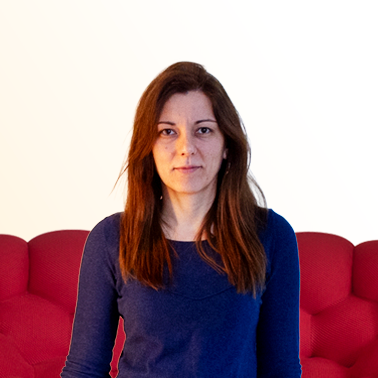
Agata Trovato is a Fixed-term Researcher in the Department of Physics at the University of Trieste, specializing in Experimental Physics of Fundamental Interactions and Applications. She serves as a member of the Department's Board and participates in multiple Boards of Studies including Medical Physics (M203) and Physics programs (SM20, SM23). Her research focuses on experimental approaches to fundamental physics interactions with applications in medical physics and astrophysics. She actively contributes to cutting-edge computational physics research involving high-performance computing infrastructure. Dr. Trovato is currently involved in several major research initiatives including the National Centre for HPC, Big Data and Quantum Computing, where she participates in both primary activities and non-reportable components. She also serves as Scientific Manager for projects involving gravitational waveform reconstructions and high energy astrophysics domain integration. Her work bridges theoretical physics with practical applications, particularly in medical physics contexts, while contributing to Italy's national research infrastructure development in computational physics.
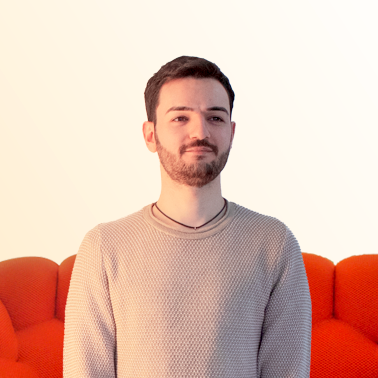
Milena Valentini is a Fixed-term Researcher in the Department of Physics at the University of Trieste, specializing in Astrophysics, Cosmology and Space Science. Her academic roles include: Member of the Department Council Member of Course of Study Recommendations committees for Physics programs SM20 and SM23 Teaching staff member Her research focuses on Astrophysics, Cosmology and Space Science with emphasis on computational applications. Dr. Valentini is actively participating in the National Centre for HPC, Big Data and Quantum Computing research project (2022-2026), a major national initiative funded by the Ministry of University and Research with a total budget exceeding €2.2 million. The research project represents cutting-edge work at the intersection of high-performance computing and astrophysical research, where Dr. Valentini contributes her expertise in space science applications. As a member of the Department Council and Course of Study committees, she plays an important role in shaping the academic direction of physics education at the university. Her institutional activities demonstrate her integration within the Department of Physics, which is recognized as one of the 180 Departments of Excellence for 2023-2027 in Italy.
Roberto Proietti is an Associate Professor at the Department of Electronics and Telecommunications (DET) at Politecnico di Torino. He is a member of the PhotoNext Interdepartmental Center for Applied Photonics and coordinates the Laurea degree program in Electronic and Communications Engineering. His research focuses on optical networks , optical switching , silicon photonics , and quantum networking , with applications in machine learning-driven environmental sensing and smart infrastructure . He has led projects like Performance Tradeoff Studies of Copropagating QKD and Classical Signals in WDM Optical Networks (Scientific Director, 2023-2024) and contributes to SDG Goals 9 (Industry & Innovation) and 11 (Sustainable Cities). He advises PhD students Andrea Rosso and Hasan Awad. His teaching includes Quantum Communications and Networks , Optical Fiber Communications , and Open Optical Networks across multiple degree programs, including Electrical, Communications, and Quantum Engineering. Email: roberto.proietti@polito.it Phone: +39 0110904126 Projects: Quantum Wrapper Networking, Machine Learning for Earthquake Detection
Antonello Filippi is an Associate Professor at the Department of Chemistry and Pharmaceutical Technologies, Sapienza University of Rome. His research focuses on structural and supramolecular chemistry, combining experimental mass spectrometry (IRMPD, IM) with theoretical modeling via high-performance computing (HPC). He also applies GC-MS to characterize food matrices for analytical and biomedical purposes. Graduated with honors in Chemistry from Sapienza University of Rome (1992) Researcher at CNR’s Institute of Nuclear Chemistry (1986–1996) University Researcher (1996–2006) His research projects include structural studies of DNA adducts and non-covalent interactions in supramolecular systems. Recent publications highlight applications in food chemistry, pharmaceutical analysis, and chiral recognition mechanisms. Current teaching activities involve courses in General and Inorganic Chemistry, Analytical Chemistry, and laboratory sessions. He has authored textbooks in general chemistry and stoichiometry.
Ozalp Babaoglu is a Full Professor at the Department of Computer Science and Engineering, University of Bologna. He has held this position since 1987, following a PhD in Computer Science from the University of California, Berkeley in 1981. His research focuses on distributed systems, High-Performance Computing (HPC), fault tolerance, self-organization, and machine learning applications in data-driven autonomics. He has led numerous European research projects like BROADCAST, CABERNET, ADAPT, BISON, and DELIS, contributing to foundational work in biology-inspired distributed algorithms and gossip-based systems. He co-founded the Bertinoro International Center for Informatics (BiCi) in 2001 and the IEEE SASO conference series in 2007. Babaoglu is a Fellow of the ACM (2002) and has received prestigious awards, including the Sakrison Memorial Award (1982) and the USENIX Lifetime Achievement Award (1993). His contributions to BSD Unix and open standards are seminal, including virtual memory extensions during his PhD. Babaoglu has served on editorial boards for ACM Transactions on Autonomous and Adaptive Systems, and previously for ACM Transactions on Computer Systems and Distributed Computing. His recent work addresses HPC fault classification, data-driven resource allocation, and energy-efficient computing in hybrid systems. He actively advises on European projects and explores cognitive paradigms in distributed systems.
Riccardo Cantini is an Assistant Professor (RTDA) at the Department of Computer Science, Modeling, Electronics and Systems Engineering (DIMES), University of Calabria. He holds a European Ph.D. in Information and Communication Technologies (2023) and has been a visiting researcher at the Barcelona Supercomputing Center (BSC-CNS, 2021-2022). His research focuses on deep learning (Large Language Models, sustainable AI) and big social data analysis targeting politically polarized data and high-performance distributed systems. Education: B.Sc. (2016), M.Sc. (2019), and Ph.D. (2023) in Computer Engineering from the University of Calabria. Research interests include: Large Language Models and their ethical deployment Sustainable AI and energy-efficient edge computing Political polarization analysis using social media data Optimization of data-intensive workflows in distributed environments Key projects include the FAIR initiative (Green-Aware AI), eFlows4HPC (HPC workflows), and ASPIDE (Exascale data processing). He has authored/co-authored over 30 publications, including works on bias detection in LLMs and explainable AI in healthcare. Awards: 2024 Top 3 Best PhD Thesis in Big Data & Data Science (CINI), 2022 Editor's Choice article in Big Data and Cognitive Computing . Teaching roles include courses on Business Intelligence, High-Performance Computing, and Operating Systems. He has advised over 40 theses in AI, NLP, and big data. Professional services: Guest Editor for Big Data and Cognitive Computing , Program Chair of Green-Aware AI workshops, and reviewer for top journals/conferences (ICLR, IEEE BigData, etc.).
Robert René Maria Birke is a tenured assistant professor in the Department of Computer Science at the University of Turin, leading research in the Parallel Computing group. His expertise spans virtual resource management, network design, workload characterization, and optimization of AI/big-data applications. Previously, he served as a visiting researcher at IBM Research Zurich and Principal Scientist at ABB Corporate Research, combining industry experience with academic rigor since earning his Ph.D. from Politecnico di Torino in 2009. His educational background includes: Ph.D. in Electronics and Communications Engineering, Politecnico di Torino (2009) Dr. Birke's research centers on systems-level challenges in distributed AI, with current projects investigating federated learning architectures, confidential computing via Trusted Execution Environments, and RISC-V processor optimizations for decentralized machine learning. His work bridges theoretical foundations with practical deployments, particularly in edge computing scenarios and high-performance data synthesis applications. Recent publications reveal growing emphasis on securing generative models against forgery attacks and optimizing tabular data synthesis techniques. Analysis of his 15 most recent publications (2024-2026) shows dominant themes in confidential federated learning (33% of works), RISC-V system optimizations (27%), and generative model security/synthesis (40%). This output spans premier venues including IEEE Transactions, ACM Computing Surveys, and SIGCOMM-affiliated conferences, demonstrating consistent contributions to systems-AI intersection research. Professional recognition includes: IEEE Senior Member While the text confirms extensive collaboration through co-authorships (notably with Marco Aldinucci, Lydia Chen, and Giulio Malenza), no specific student advisees or grant details are provided. His work appears embedded within European initiatives like ICS and EUPilot projects, focusing on compute continuum challenges. Dr. Birke actively contributes to the Parallel Computing group's mission through projects including HPC4AI@UNITO (datacenter digital twins) and Cross-Facility Federated Learning frameworks. His research ecosystem involves multi-institutional teams across Italy, Switzerland, and the EU, with recent talks addressing FLaaS implementations and generative model impacts on system design.
Doriana Medić is an Assistant Professor at the University of Turin's Department of Computer Science, affiliated with the Alpha Research Group for Parallel Computing. Her work bridges formal methods, reversible computing, and distributed systems. Projects: Space Center of Excellence (EC HE, Horizon-EuroHPC-JU), European Pilot (EC H2020 RIA), EUPEX (EC H2020 RIA). Her research explores formal models for concurrent and distributed systems, with recent focus on federated learning, workflow modeling, and HPC applications in astrophysics and machine learning. Publications highlight RISC-V architectures, fault tolerance mechanisms, and hybrid workflows. Selected publications span 2019-2025, emphasizing reversible computing, HPC, and workflow modeling. Key tags include semantics , icsc , streamflow , and riscv . She contributes to the Alpha Research Group at the University of Turin, advancing parallel computing solutions.
Gianluca Mittone is a postdoctoral researcher at the University of Turin's Computer Science Department, affiliated with the Parallel Computing group. His work bridges High-Performance Computing (HPC) and Artificial Intelligence (AI), focusing on Federated Learning (FL) as a privacy-preserving, scalable solution for AI applications. Co-Principal Investigator for FL-as-a-Service platform in TIM Edge & Cloud Continuum IPCEI project Recipient of HPC-Europa3 and EuroPar Foundation awards Research interests center on FL deployment in HPC/cloud environments , including RISC-V hardware exploration for decentralized AI, cross-facility FL workflows, and HPC benchmarking. Publications demonstrate expertise in privacy-preserving AI , edge inference , and medical applications like cardiovascular diagnostics through machine learning. Article analysis reveals integration of HPC systems with emerging AI architectures (including Large Language Models), with subfields spanning confidential FL , drug-target interaction , survival analysis , and RISC-V AI frameworks . Awards highlight recognition in both HPC and FL domains, while collaborations with Telecom Italia and participation in TEXTAROSSA project underscore industry-academia impact. HPC-Europa3 scholarship EuroPar foundation studentship Best PhD Symposium Award (EuroPar 2023) PRAISE Score endorsed by European Society of Cardiology (2023 guidelines)
Dr. Flavio Vella is an Associate Professor at the Department of Information Engineering and Computer Science (DISI) at the University of Trento. He holds roles on the management board of the national HPC laboratory at CINI and the Steering Committee of ICSC’s spoke4. His research focuses on parallel algorithms for emerging computing systems, machine learning systems, and quantum computing, with an emphasis on irregular computation and large-scale graph analysis. He has industrial experience at NVIDIA and Dividiti, and has contributed to EU projects like ARCHYTAS (AI acceleration) and NET4EXA (exascale networking infrastructure). Dr. Vella earned his Ph.D. from Sapienza University of Rome in 2017. His academic journey includes roles at the Free University of Bozen, CNR Italy, and ETH Zurich. He actively serves HPC communities as Artifact co-chair for PPoPP and Computing Frontiers, and as PC member for IPDPS, SC, and EuroPAR. His work has produced over 40 peer-reviewed publications, including Best Paper Awards at SC22/24 and Best PhD Paper at IPDPS17. His research themes include GPU performance optimization, quantum device reliability, and HPC/AI interconnects. Recent work explores tensor networks, physics-constrained neural networks, and exascale system engineering. Projects like ARCHYTAS (EUDF-2023) and NET4EXA (Horizon) highlight his leadership in European HPC initiatives.
Alina Sîrbu is an Associate Professor in the Department of Computer Science and Engineering at the University of Bologna. Her research focuses on machine learning applications in migration studies, high-performance computing (HPC), and social dynamics analysis. She has pioneered interdisciplinary work combining computational methods with public health, genomics, and policy analysis. Key research areas include: Machine learning frameworks for antigen discovery and medical diagnostics Data-driven migration modeling using social media and mobility data Algorithmic bias and opinion dynamics in digital environments Optimization of HPC systems through predictive analytics Recent work highlights include: Development of the Superdiversity Index to measure urban demographic complexity Analysis of climate-induced refugee movements using explainable AI Integration of Twitter/X data to study border-crossing events Her publications span over two decades, with notable contributions to: Computational social science methodologies Healthcare informatics innovations Genomic sequence analysis
Massimo Torquati is an Associate Professor in the Computer Science Department at the University of Pisa. He holds Italian National Scientific Qualifications (ASN) for Full Professor (2023) and Associate Professor (2018) roles in Computer Science and Engineering. His research focuses on high-level tools for parallel programming, autonomic computing, and high-performance data stream processing. He is a member of key organizations like the CINI HPC-KTT National Laboratory, the European HiPEAC Network, and the Parallel Programming Models Group at Pisa. Research Interests: Parallel programming models, distributed systems, concurrency control, and software frameworks like CAPIO and WindFlow. Recent work includes advancements in distributed-memory FastFlow, adaptive streaming, and middleware for scientific workflows. Awards include the ASN qualifications, reflecting his academic standing. He actively contributes to conferences like Euro-Par and workshops on HPC infrastructure. His work emphasizes practical implementations of parallel patterns and scalable computing solutions.
Daniele Marchisio is a Full Professor at the Department of Applied Science and Technology (DISAT) at the Polytechnic University of Turin. He serves as a Member of the Equality Committee and the University Open Access Commission. His academic journey began with a degree in Chemical Engineering from the Polytechnic University of Turin in 1997, followed by a PhD in 2001 from the same institution in collaboration with Iowa State University. His educational background includes: Bachelor's degree in Chemical Engineering (cum laude) from Polytechnic University of Turin (1997) PhD in Chemical Engineering from Polytechnic University of Turin in collaboration with Iowa State University (2001) Professor Marchisio's research focuses on multiscale computational methods for polydisperse particulate and multiphase flows. His work spans several key areas including precipitation and crystallization processes, particle aggregation and dispersion, nanoparticle formation in combustion, bubble columns, gas-liquid stirred reactors, turbulent liquid-liquid dispersions, and fluidized beds. He combines molecular dynamics with continuum modeling to develop innovative approaches in computational fluid dynamics, dissipative particle dynamics, mesoscopic modeling, and population balance methods. His research has significant applications in battery materials production and recycling, pharmaceutical processes, biomethanation, and aqueous phase reforming. His publication record demonstrates strong focus on multiphase systems , crystallization processes , and battery technology . Recent work shows increasing integration of machine learning techniques with traditional computational methods, particularly for parameter identification and optimization in complex chemical processes. His research bridges fundamental computational methods with practical industrial applications across energy, materials, and chemical engineering domains. Professor Marchisio has received several prestigious scientific awards: Most cited paper for Chemical Engineering Science (Elsevier, 2007) Sciencedirect top 25 most downloaded article (Elsevier, 2010) Abilitazione Scientifica Nazionale - prima fascia - 09/D2 (MIUR, Italy, 2014) Highly cited paper for the International Journal of Multiphase Flow (Elsevier, Netherlands, 2016) As an academic advisor, Professor Marchisio has supervised numerous PhD students working on cutting-edge research topics including magnesium hydroxide precipitation, lithium-ion battery modeling, and computational fluid dynamics applications. His research is supported by significant funding from multiple sources including European Union projects (H2020, Horizon Europe), national research programs (PRIN), and industry collaborations. Current major projects include BATCAT (Battery Cell Assembly Twin), NESSF (Non-equilibrium self-assembly of structured fluids), HPC Spoke 7, BIG-MAP, and SEArcularMINE. Professor Marchisio leads the Multiscale Modelling for Materials Science and Process Engineering research group within DISAT. His team specializes in developing integrated computational frameworks that bridge molecular-scale phenomena with continuum-level engineering applications. The group maintains strong collaborations with international institutions including Beijing University of Chemical Technology, CSIRO in Melbourne, and University College London. Their work has direct applications in sustainable engineering, clean energy technologies, and advanced materials development aligned with several UN Sustainable Development Goals.