John R. Steel is a Professor at the University of California, Berkeley, specializing in foundational areas of set theory, mathematical logic, and inner model theory. His research focuses on the interplay between large cardinals, determinacy axioms, and inner model constructions, contributing significantly to the understanding of core model theory, forcing axioms, and the continuum problem. He has delivered plenary lectures and tutorials at major international conferences including the European Set Theory Society meetings, the Association for Symbolic Logic annual meetings, and the Joint Mathematics Meetings. Key topics in his talks include mouse theory, hod analysis, comparison lemmas, and philosophical aspects of Gödel's program. Steel's work bridges technical set-theoretic constructions with foundational questions in mathematics, often addressing implications of determinacy axioms and large cardinal hypotheses in L(R) and beyond. His recent research explores multiverse perspectives, correctness results for extender models, and the consistency strength of AD-related principles.
Prof. Jens Robert Schöndube is a full professor of Business Administration with a focus on Managerial Accounting at Leibniz University Hannover's Institute of Controlling. He holds leadership roles including Executive Director of the Institute and membership in the Faculty Council. Previously, he served as Dean of the Faculty of Economics and Management from 2016 to 2020. His research emphasizes incentive systems, performance measurement, and corporate governance. He earned his doctorate from Magdeburg University in 2006 and held professorships at Tübingen and Magdeburg before joining Hannover in 2013. His work explores agency theory applications in managerial accounting, delegation mechanisms, and board governance. Recent studies address tax audit efficiency, decision-making under pressure, and dynamic agency conflicts. He contributes to journals like European Accounting Review and Management Accounting Research. His academic career spans over 20 years with significant institutional roles and a robust publication record. Research highlights include analyzing board monitoring effectiveness, optimal delegation strategies, and contractual trust dynamics. His studies often bridge theoretical models with practical governance challenges in organizational settings. Despite no listed advisees, his work influences managerial practices in incentive design and performance evaluation systems.
Dr. Matthew Hammerton is an Associate Professor of Philosophy at Singapore Management University (SMU), affiliated with the School of Social Sciences. His work focuses on normative ethics, metaethics, philosophy of happiness, and philosophy of work. He holds a PhD in Philosophy from the Australian National University (2017) and an MPhil in Philosophy from the University of Sydney (2010). His research explores agent-relative value, meaning in life, and the ethical implications of workism. Key contributions include critiques of consequentialism and deontology, analyses of meaning in post-scarcity societies, and examinations of meritocratic paradoxes. He recently authored a monograph on workism, analyzing how work dominates modern identity and meaning. Teaching includes courses like 'Critical Thinking in the Real World' and 'Big Questions (Happiness and Suffering).' His scholarship spans peer-reviewed journals such as Australasian Journal of Philosophy and Journal of Ethics , with recent publications addressing utopianism, moral wisdom, and luck’s role in meaning. Research interests also encompass Buddhist ethics and human development, reflecting his interdisciplinary approach to ethical theory and its societal applications. He currently chairs the Modes of Thinking Basket Coordination at SMU.
Dr. Gareth Arnott is an Associate Professor in the School of Biological Sciences at Queen's University Belfast, affiliated with the Institute for Global Food Security. He is actively involved in research and supervision of PhD students focusing on animal behavior and welfare. Research Interests: Dr. Arnott specializes in animal contest behavior, applying game theory to understand aggression dynamics. His work spans fundamental research (e.g., vertebrate/invertebrate behavior) and applied welfare issues like reducing pig aggression post-regrouping and canine behavioral problems. Key topics include contest behavior, sexual selection, animal personality, and welfare challenges in dairy cows, pigs, and dogs. Recent Research Trends: His 2025 publications emphasize innovative solutions in livestock management (e.g., milking robots, virtual fencing) and ecological impacts (e.g., invasive species). He explores cognition's role in social networks and welfare implications of early-life stress. Awards & Activities: Nominated for Queen's University Belfast's 2017/18 Team of the Year Award. Active in conferences (e.g., Animal Welfare Research Network) and public engagement (e.g., Temple Grandin lectures). Leads projects on pig welfare, rumen pH sensors, and bioscience training partnerships. Grants & Collaborations: Principal Investigator on projects like 'Minimizing Pig Aggression' and co-investigator on rumen sensor development. Collaborates with institutions like Edinburgh University and Howard Farms Limited. Labs & Teams: Engaged in interdisciplinary teams addressing livestock welfare, invasive species, and precision agriculture technologies.
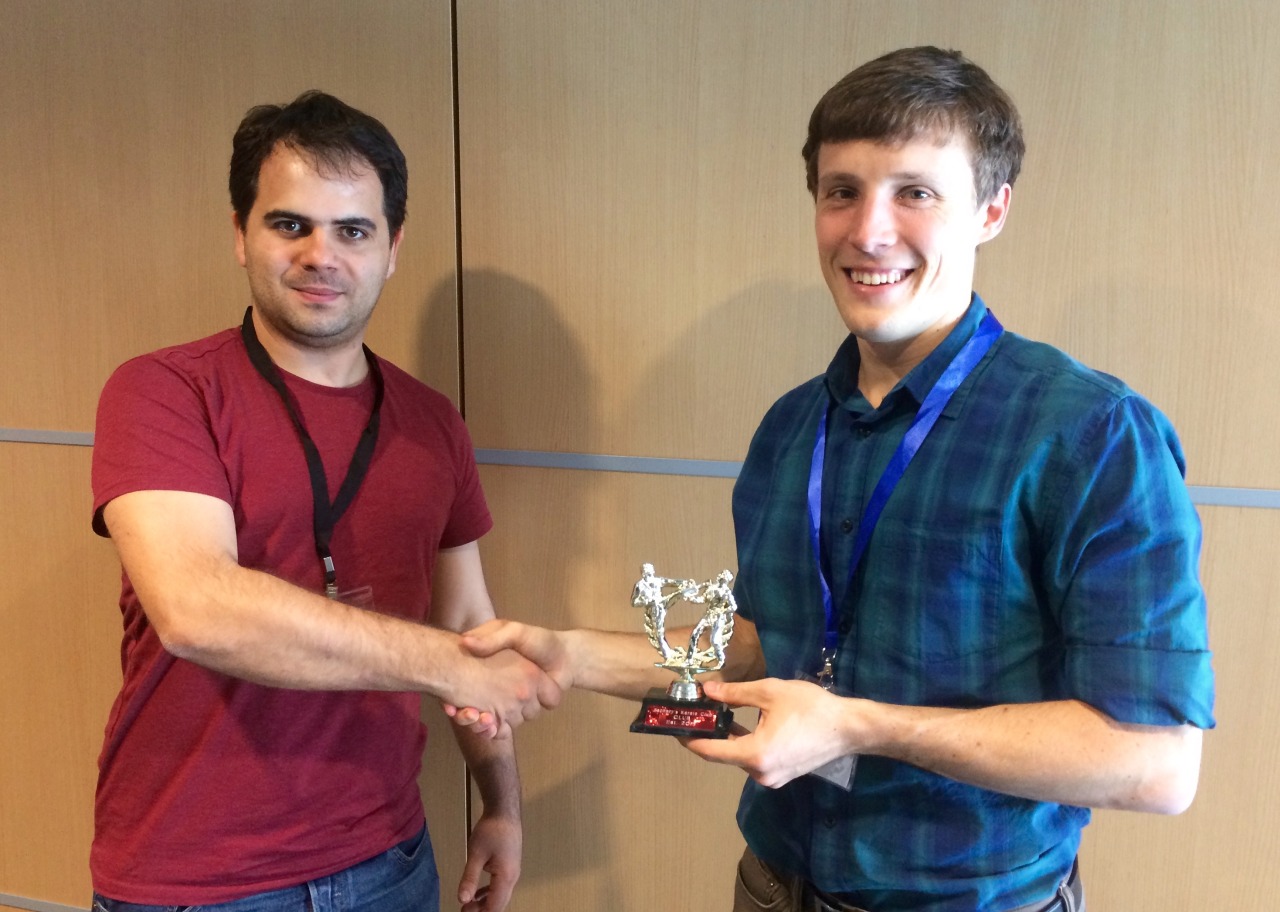
Tiago de Paula Peixoto is a Professor of Complex Systems and Network Science at the Institute of Science and Technology Austria (IT:U), where he leads the Inverse Complexity Lab. He has previously held faculty positions at Central European University (2019–2024) and the University of Bath (2016–2019), and conducted postdoctoral research at the University of Bremen and Technical University of Darmstadt. He holds a PhD in Physics from the University of São Paulo (2008) and a habilitation in Theoretical Physics from the University of Bremen (2017). His research lies at the intersection of statistical physics, computational statistics, information theory, Bayesian inference, and machine learning , with a central focus on inverse problems in network science . His group develops principled mathematical and computational models to infer the local interaction rules of complex systems from observed macroscopic behavior. Key research themes include statistically sound pattern detection in networks, network reconstruction from indirect data, uncertainty quantification, generative modeling of modular hierarchies and latent spaces, and scalable inference algorithms. His recent publications (2020–2025) reflect a consistent focus on advancing the theoretical and algorithmic foundations of network inference. A major theme is the development of Bayesian and information-theoretic frameworks for robust network reconstruction, moving beyond simplistic heuristics like correlation thresholding. He has pioneered methods for posterior sampling to quantify uncertainty and for minimum description length to prevent overfitting. His work also addresses scalability, with algorithms achieving subquadratic time complexity. Applications span diverse domains, including social systems (migration flows), political networks, and biological systems. Erdős–Rényi Prize from the Network Science Society (2019) Alexander von Humboldt Foundation Fellowship (2008) Karate Club Club Prize (6th recipient) Peixoto advises a vibrant group of PhD students and postdoctoral researchers, including Thomas Robiglio, Sebastian Kusch, Martina Contisciani, and Bukyoung Jhun. His former students include Felipe Vaca, Lizhi Zhang, and Silvia Guerrini. He has not received any specific grant mentions in the text, but his group’s sustained activity suggests successful funding. His lab is strongly committed to open science, with most of their methods implemented in the widely used graph-tool library, which is extensively documented and freely available. The lab organizes events like the annual Inverse Complexity Retreat and participates in major conferences such as NetSci and STATPHYS. The group is actively recruiting new PhD candidates and postdocs, indicating ongoing expansion and research momentum.
Ruth Misener is a Professor in the Department of Computing at Imperial College London, where she leads the Computational Optimization Group and holds the BASF/RAEng Research Chair in Data-Driven Optimization (2022–2027). She is affiliated with the Faculty of Engineering and contributes to interdisciplinary research institutes including the Data Science Institute, the Institute for Molecular Science and Engineering, and the Sargent Centre for Process Systems Engineering. Her research lies at the intersection of numerical optimization, operations research, and machine learning, with applications in chemical engineering, bioprocess optimization, energy systems, and industrial scheduling. She develops global optimization algorithms for mixed-integer nonlinear programs (MINLP), focusing on real-world challenges such as heat recovery network design, petrochemical process optimization, and robust bioreactor operation. A key innovation is her work on optimizing over machine learning surrogates, including tree ensembles and neural networks, enabling data-driven decision-making under uncertainty. Her recent publications demonstrate a strong trend toward integrating Bayesian optimization with active learning, explainable AI, and industrial applications, particularly in collaboration with BASF, Royal Mail, and Eli Lilly. She develops and maintains open-source optimization tools such as ROmodel, OMLT, and ENTMOOT, which are publicly available on GitHub. STEM for Britain acceptance Runner-Up Presentation Award at PSE@ResearchDayUK Best Quality Poster to Simon Olofsson 1st Poster Prize at UK/Ireland Annual Meeting of the Society for Industrial & Applied Mathematics (2018) 2nd Poster Prize at Centre for Process Systems Engineering Industrial Consortium Meeting (2017) 1st Poster Prize at 2nd PSE@ResearchDayUK (2017) 2nd Presentation Prize at Department of Computing Research Associate Symposium (2017) Runner-Up for May Hicks Award (via student Natasha Page) Ruth supervises a dynamic research team and has examined and mentored numerous PhD students, including Jean Kossaifi, Robert Walecki, Alexander Thebelt, and Toby Boyne. She leads major research grants, including the BASF/RAEng Research Chair and the IConIC Prosperity Partnership, and collaborates with industry partners to advance continuous manufacturing and data-driven process optimization. Her team actively disseminates work through open-access publications, video presentations, and social media.
Sylvain Schmitz is a Professor of Computer Science at Université Paris Cité, affiliated with the IRIF institute. He leads the Automata and Applications team and contributes to modeling and verification research. Key Research Areas: Logic, Well Quasi Orders, Program Verification, Formal Languages, Database Theory Grants: ANR BraVAS (2017–2022), ANR PRODAQ (2015–2019), ANR ReacHard (2011–2014), ANR AVeriSS (2007–2009) His work focuses on the algorithmic complexity of well-quasi-orders, with applications to vector addition systems, Petri nets, and complexity hierarchies. He has delivered lectures on Algorithmic Aspects of WQO Theory (MPRI), Model-Checking Finite Structures (LMFI), and logic for the agrégation preparation. Recent publications analyze complexity bounds for vector addition systems and lossy counter machines, often leveraging ideal decompositions of well-quasi-orders. His 2024 ICALP paper with Lia Schütze addresses strongly monotone descending chains over ℕᵈ, while 2024 LICS work with Anand et al. explores unboundedness verification. Scientific Awards: IUF junior fellowship (2018–2023) He supervises PhD students Hector Buffière (2024–present), Aliaume Lopez (2019–2023), Anthony Lick (2016–2019), and Simon Halfon (2015–2018). He has served on steering committees for STACS (co-chair) and GT-Verif, and organized conferences like Highlights 2014.
Jakob Grue Simonsen is a Professor and Department Chair at the Department of Computer Science (DIKU), University of Copenhagen. He holds a Dr. Scient., PhD, and MBA. His research focuses on the mathematics of computation, including computability theory, term rewriting, lambda calculus, complexity hierarchies, and symbolic dynamics, with applications in information retrieval and human-computer interaction. His primary research explores infinite computational processes and their finite representations, alongside practical work in neural hashing, fact-checking systems, and quantum language models. Previously, he contributed to constructive mathematics and biocomputing. An analysis of his 15 most recent publications (2015–2022) reveals strong emphasis on: Theoretical computability and game-theoretic models Neural networks for NLP (BERT, semantic hashing) Fact verification and explainable AI methodologies Efficient retrieval algorithms and recommendation systems Awards: RTA 2004 Best Paper Award CHI '13 Honorable Mention CHI '14 Honorable Mention
Dr. Michał Wiechetek serves as an assistant professor in the Department of Social Psychology and Psychology of Religion at the Institute of Psychology, Faculty of Social Sciences, John Paul II Catholic University of Lublin. His academic work bridges social psychology with health and organizational contexts, focusing on biobanking, pandemic impacts, and digital behavioral disorders within Polish society. Research Interests Social Psychology : Analyzes professional prestige hierarchies and social identity dimensions in healthcare and migration contexts Psychology of Religion : Investigates religiosity, miraculous healing beliefs, and meaning in life across medical and clerical populations Health Psychology : Examines illness perception, biobank donation determinants, and quality of life during crises Biobanking Research : Maps psychological barriers to tissue donation and consent quality in medical screenings Internet Addiction : Explores cybersex and gaming addiction through personality traits and gender moderation Organizational Psychology : Develops competency assessment tools like M-Astra for managers and ComTal for teams Publication Trends Wiechetek's output demonstrates consistent interdisciplinary collaboration, primarily in the International Journal of Environmental Research and Public Health (11+ publications). Recent work (2020-2024) emphasizes pandemic-related quality of life and biobanking, while earlier research (2015-2019) established his focus on religiosity-health links and internet addiction. His Polish-French gambling study exemplifies cross-border scholarly partnerships. Scientific Awards No prizes, fellowships, or medals were documented in the source materials. Advising and Grants Thesis Supervision : Oversees diploma theses as indicated by institutional menu navigation Grant Leadership : Served as contractor for National Science Centre projects including Psychoimmunological Transition to Retirement (2011) and Polish-French Gambling Trajectory Study (2020) Method Development : Created M-Astra for managerial competencies and ComTal-Team Member for talent assessment Research Groups No dedicated laboratories or permanent research teams were referenced, though conference organization (e.g., 2018 Polish Society of Social Psychology Congress) indicates collaborative network leadership.
Kelly Dern is a Lecturer in the Department of Advertising, Public Relations and Design at University of Colorado, while also serving as a Senior Product Designer and illustrator at Google. She leads the Video AI team, focusing on inclusive design for Google Workspace products like Meet and Duo, and contributes to design systems across Google Payments and Nest. Beyond Google, she advises Boost Thyroid app and ILLA, and co-founded the Old Girls Club think tank. 14+ years experience in product design Specializes in AI-driven inclusive design Advocate for women in tech Research interests center on inclusive design systems, AI-assisted creativity, and accessible UX for health technology. Her work emphasizes emotional design in wellness apps, ambiguity navigation frameworks, and scalable design processes through Figma variables. Recent publications explore AI productivity, modular type scales, and design under uncertainty. Her articles highlight practical applications in energy simulation, debt management systems, and chronic illness UI. Scientific contributions include: Google Product Excellence Award for Inclusive Design Works Advising & speaking includes teaching with Girls Who Code, advising Boost Thyroid, and keynotes at UXDX, SXC2023, and DesignOps Summit. She advocates for design ethics and cross-functional collaboration. Labs & teams include Google's Video AI team, Nest hardware team, and renewable energy design initiatives. She also mentors through platforms like Medium and LinkedIn, promoting design education and systems thinking.
Dr. Ban Pin Tan is a Mathematics Lecturer at the National University of Singapore (NUS), holding a PhD from NUS awarded in 1997. His research focuses on graph theory and digraph properties, particularly in kings in multipartite digraphs, eccentric digraphs, Roman domination, bondage numbers, and optimal orientations. He has contributed to over 8 peer-reviewed publications since 1995, addressing structural properties of tournaments and multipartite graphs. His work includes foundational studies on dominance hierarchies, 3/4-kings enumeration, and digraph orientation optimizations. Dr. Tan emphasizes teaching methodologies that foster deep conceptual understanding through systematic lecture notes, 'Pause and Think' sessions, and problem-solving exercises. He believes in inspiring students to apply mathematical principles to real-world challenges, aligning with Singapore's knowledge-based economy goals. His pedagogical approach combines rigorous problem sets with frequent quizzes to enhance critical thinking and engagement. His long-term research program includes: (1) studying kings-of-kings in semicomplete multipartite digraphs, (2) analyzing eccentric digraphs of various graph classes, (3) determining optimal orientations for graph families, (4) evaluating Roman domination and bondage numbers, and (5) exploring magic graph properties. Current investigations focus on eccentric digraphs, Roman domination extensions to digraphs, and magic graph characteristics.
David Thomas is an Associate Professor at ESCP Business School's Department of Finance in Paris. His research focuses on corporate finance, cash management, payout policies, and customer-supplier relationships. He holds a PhD from Paris Dauphine University and has taught at both ESCP and Université Paris Dauphine. His work has been published in journals like the Journal of Corporate Finance and European Journal of Finance. Key research contributions include studies on relationship-specific investments, CEO reputation's impact on shareholder voting, and corporate liquidity strategies under customer risk. He has been awarded the Prix de Thèse de la Chancellerie des Universités de Paris for his doctoral work. Teaching responsibilities include Financial Mathematics, Corporate Finance, and Financial Analysis at both undergraduate and master's levels. He actively participates in academic service, including roles on recruitment committees and seminar coordination at ESCP.
Marc-Antoine Weisser is a researcher with a focus on network optimization, algorithm design, and graph theory. His work spans telecommunications, electrical networks, and computational complexity. He has contributed to studies on inter-domain network hierarchies, optical network optimization, and combinatorial problems such as Steiner trees and bin packing. Weisser's research often involves developing polynomial and approximation algorithms for real-world network challenges. Key research areas: Network topology analysis, algorithmic design for resource allocation, and optimization in electrical/optical networks His publications highlight contributions to congestion avoidance mechanisms, optical ring networks, and inter-domain routing architectures. Weisser collaborates frequently with institutions like the University of ... [university name missing in source text].
Tevong You is a Lecturer in Physics at King's College London, affiliated with the Department of Physics and the Faculty of Natural, Mathematical & Engineering Sciences. He holds a PhD from King's College London (2012–2015) and degrees from ETH Zurich and Imperial College London. His research focuses on theoretical particle physics and cosmology, particularly exploring beyond the Standard Model physics, Higgs boson properties, and effective field theory approaches. He has held prior roles including Gonville & Caius College Lecturer (2018–2022) at the University of Cambridge, Junior Research Fellow (2015–2018), and Senior Research Fellow at CERN (2019–2022), alongside the Branco Weiss Society in Science Fellowship (2018–2023). Research Interests: His work investigates particle phenomenology at the intersection of experiment and theory, emphasizing the Standard Model Effective Field Theory (SMEFT) framework. Key areas include Higgs boson properties, dark matter, and theoretical motivations for future colliders. He advocates for advanced collider experiments to probe new physics. Education: PhD in Theoretical Particle Physics, King's College London (2012–2015) Masters, ETH Zurich Undergraduate, Imperial College London Scientific Awards: Branco Weiss Society in Science Fellowship Junior Research Fellow at University of Cambridge Gonville & Caius College Lectureship Labs/Teams: Active in the Theoretical Particle Physics and Cosmology group at King's, focusing on new physics beyond the Standard Model.
Aynur Bulut is an Associate Professor in the Department of Mathematics at Louisiana State University (LSU). Her research focuses on nonlinear partial differential equations (PDEs), particularly in supercritical settings and fluid models. She has made significant contributions to the analysis of dispersive PDEs, including studies on the Navier-Stokes equations, surface quasi-geostrophic (SQG) systems, and nonlinear wave equations. Bulut holds a Ph.D. from The University of Texas at Austin and an M.S. from Bogazici University. Her academic journey includes postdoctoral work with notable mathematicians like Jean Bourgain. She teaches advanced courses such as Theory of Partial Differential Equations (Math 7386) and Multidimensional Calculus (Math 2057) at LSU. Her invited talks span prestigious institutions like MIT, Stanford, and international venues including Turkey’s Bilkent University and Koc University. Research interests emphasize global well-posedness, singularity formation, and probabilistic methods in dispersive equations. Her work often explores thresholds for uniqueness/non-uniqueness (e.g., Onsager threshold) and stability properties in supercritical regimes. Recent studies address convex integration techniques, geometric trapping phenomena, and nonlinear instability in fluid dynamics. Notable collaborations include work with M. Czubak, H. Dong, and S. Palasek. While her publications span over two decades, recent focus areas include SQG equation behavior, hypodissipative Navier-Stokes regularity, and logarithmically energy-supercritical wave equations. Teaching and mentorship are integral to her academic profile at LSU.