

Mirta Galesic is a Professor at the Santa Fe Institute and Resident Faculty at the Complexity Science Hub (CSH) in Vienna, where she co-leads the Collective Minds research group. She is also External Faculty at the Vermont Complex Systems Center, University of Vermont, and an Associate Researcher at the Harding Center for Risk Literacy, University of Potsdam. Her work bridges cognitive science, social psychology, and complexity science to understand how individuals and groups adapt to complex societal challenges. Her research focuses on collective adaptation , belief dynamics , social learning , and opinion formation . She develops empirically grounded computational models to study how cognitive mechanisms interact with social environments to generate complex social phenomena. Her interests include how people perceive and respond to uncertainty, how collectives solve problems, and how network structures evolve in response to changing problems. The 15 most recent publications reveal a strong trend toward integrative, interdisciplinary frameworks. They combine cognitive models with network science and data-driven analysis to explore belief change, social sampling, hate speech dynamics, and collective intelligence. A central theme is the wisdom of the crowd and its limitations, especially in polarized or complex information environments. Her work increasingly applies formal modeling to real-world issues such as election forecasting, science communication, and algorithmic fairness. ERC Advanced Grant (2024), €3 million over 5 years Mirta Galesic has received major research funding, most notably the prestigious ERC Advanced Grant in 2024, which supports her project on collective adaptation. She collaborates extensively across institutions, including the Santa Fe Institute, Max Planck Institute, and University of Potsdam. While no formal students are listed, she leads and mentors researchers within the Collective Minds group at CSH. She has been involved in organizing major events such as NetSci 2023 and CSH Winter Schools, contributing to training and community building in network and complexity sciences. She is a key figure in the Collective Minds research group at the Complexity Science Hub, which investigates how cognitive and social mechanisms give rise to collective behavior. The group uses experimental, survey, and computational methods to study belief dynamics, social influence, and adaptive problem-solving in teams and societies. Her work is highly collaborative, involving interdisciplinary teams from physics, computer science, psychology, and sociology.
جستجوی استاد راهنمای دانشگاهی
برای مسیر پژوهشیتان، استاد راهنما، استاد دانشگاه و پژوهشگر مناسب را پیدا کنید و با آنها ارتباط بگیرید.
نمایش ۳۱-۳۵ از ۳۵ استاد راهنما
اطلاعات پروفایلها از صفحات عمومی دانشگاهها گرفته شده و ممکن است بهروز نباشد.
- Network Science
- Complex Systems
- Statistical Physics
- +۱۳ مورد دیگر
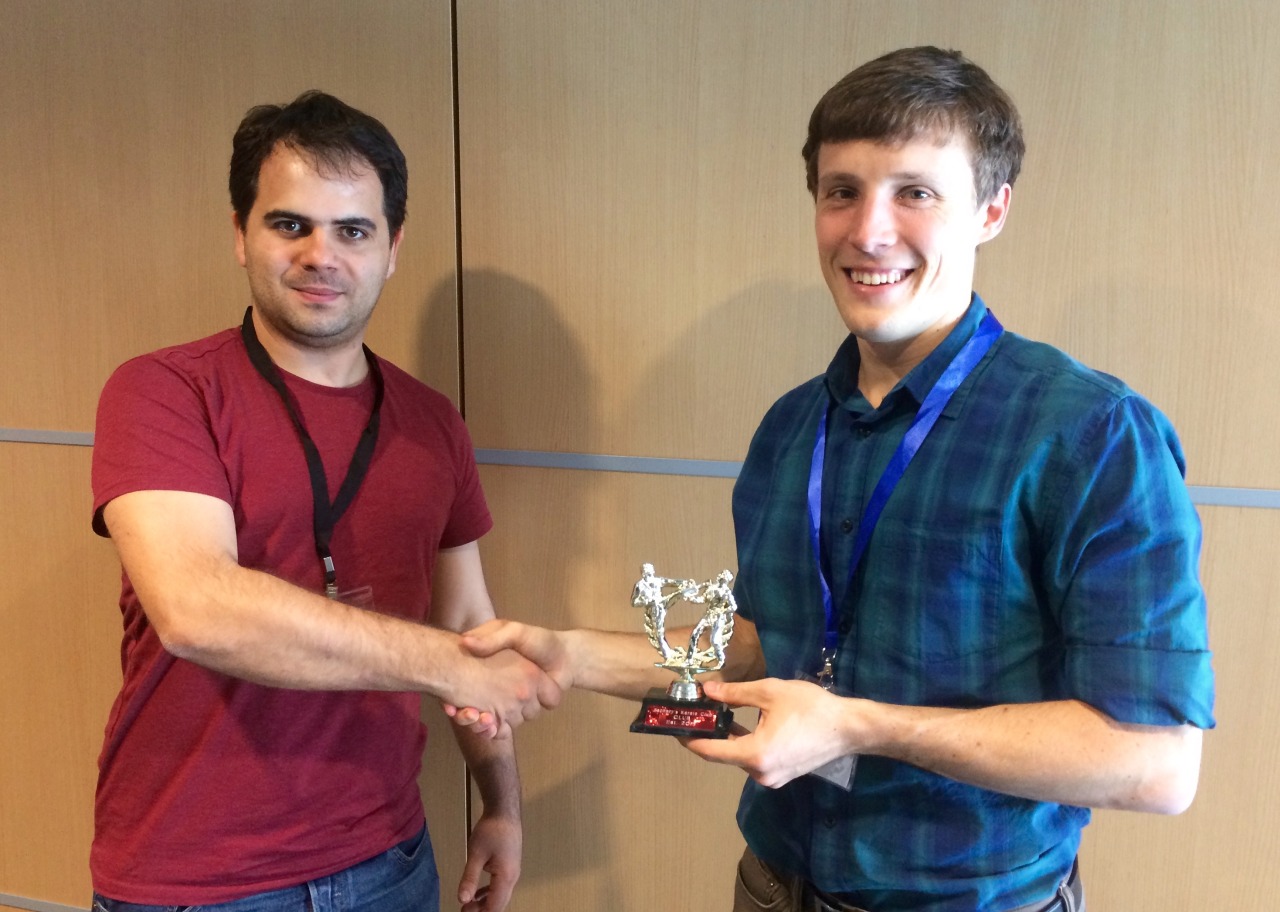
Tiago de Paula Peixoto is a Professor of Complex Systems and Network Science at the Institute of Science and Technology Austria (IT:U), where he leads the Inverse Complexity Lab. He has previously held faculty positions at Central European University (2019–2024) and the University of Bath (2016–2019), and conducted postdoctoral research at the University of Bremen and Technical University of Darmstadt. He holds a PhD in Physics from the University of São Paulo (2008) and a habilitation in Theoretical Physics from the University of Bremen (2017). His research lies at the intersection of statistical physics, computational statistics, information theory, Bayesian inference, and machine learning , with a central focus on inverse problems in network science . His group develops principled mathematical and computational models to infer the local interaction rules of complex systems from observed macroscopic behavior. Key research themes include statistically sound pattern detection in networks, network reconstruction from indirect data, uncertainty quantification, generative modeling of modular hierarchies and latent spaces, and scalable inference algorithms. His recent publications (2020–2025) reflect a consistent focus on advancing the theoretical and algorithmic foundations of network inference. A major theme is the development of Bayesian and information-theoretic frameworks for robust network reconstruction, moving beyond simplistic heuristics like correlation thresholding. He has pioneered methods for posterior sampling to quantify uncertainty and for minimum description length to prevent overfitting. His work also addresses scalability, with algorithms achieving subquadratic time complexity. Applications span diverse domains, including social systems (migration flows), political networks, and biological systems. Erdős–Rényi Prize from the Network Science Society (2019) Alexander von Humboldt Foundation Fellowship (2008) Karate Club Club Prize (6th recipient) Peixoto advises a vibrant group of PhD students and postdoctoral researchers, including Thomas Robiglio, Sebastian Kusch, Martina Contisciani, and Bukyoung Jhun. His former students include Felipe Vaca, Lizhi Zhang, and Silvia Guerrini. He has not received any specific grant mentions in the text, but his group’s sustained activity suggests successful funding. His lab is strongly committed to open science, with most of their methods implemented in the widely used graph-tool library, which is extensively documented and freely available. The lab organizes events like the annual Inverse Complexity Retreat and participates in major conferences such as NetSci and STATPHYS. The group is actively recruiting new PhD candidates and postdocs, indicating ongoing expansion and research momentum.
Michele Cosciaمشاهده پروفایل
دانشیار
- Network Science
- Complex Networks
- Digital Humanities
- +۱۰ مورد دیگر
Michele Coscia is an Associate Professor in the Department of Computer Science at the IT University of Copenhagen (ITU), where he conducts research at the intersection of network science, digital humanities, and data analytics. He leads the NERDS research group and supervises PhD students and postdoctoral researchers working on financial crime detection, archaeological networks, and work environment modeling. PhD in Computer Science, University of Pisa (2012) Former researcher at the Center for International Development (CID), Harvard University (6 years) Visiting researcher at Barabási Lab, Northeastern University His research focuses on developing and applying network science methodologies such as noise-corrected backboning , node attribute analysis , and network variance to study complex systems. His work spans diverse domains including: Archaeology : Inferring social and biological relationships from material culture at Neolithic sites like Çatalhöyük. Cultural Analytics : Mapping Italian music networks, analyzing Wikipedia’s gender bias, and studying ideological polarization on social media. Social Media Dynamics : Investigating meritocracy vs. topocracy, intolerance feedback loops, and information virality on platforms like Reddit and Twitter. Sports Analytics : Analyzing predictability trends in team sports and the impact of economic systems on league competitiveness. His publications appear in high-impact journals such as Science Advances , EPJ Data Science , and Applied Network Science . He is the author of The Atlas for the Aspiring Network Scientist , a comprehensive open-access textbook now in its second edition, which covers graph theory, machine learning on graphs, and statistical foundations of network analysis. Recent trends in his work show a growing emphasis on interdisciplinary applications of network science, particularly in archaeology and cultural studies, often in collaboration with institutions such as Aarhus University and the National Research Center for Work Environment. His research consistently promotes open science, with datasets and code publicly shared. Co-PI on a Villum Synergy project applying network analysis to Roman Empire archaeological data Active contributor to the CUDAN (Cultural Data Analytics) community Developing methods for uncertain and incomplete network data Michele Coscia’s work demonstrates a strong commitment to methodological innovation and real-world impact across the humanities, social sciences, and computational domains.

Frans van der Sluis serves as an Associate Professor in the Department of Communication at the University of Copenhagen, where he conducts interdisciplinary research at the intersection of human cognition and information systems. His work focuses on designing search and filtering technologies that align with human learning processes and curiosity-driven exploration. Education: BSc in Psychology (2006) BSc in Business Information Technology (2006) MSc in Psychology (2008) PhD in Interactive Information Retrieval and Filtering (2013) Van der Sluis investigates how information systems can be optimized to transform raw data into meaningful knowledge through understanding epistemic emotions, user uncertainty, and cognitive processing during information interactions. His methodology frequently incorporates eye-tracking and empirical user studies to measure comprehension, interest, and engagement beyond traditional accuracy metrics. Analysis of his recent publications (2023-2025) reveals a consistent trajectory toward conversational approaches in information quality assessment, with growing applications in sustainability domains like wind energy training networks and ethical consumer behavior. His work bridges theoretical HCI frameworks with practical implementations across diverse contexts from social media to specialized research environments. No scientific awards were documented in the source materials. While specific advising details remain unspecified, his collaborative projects—including the EU-funded Train2Wind initiative for offshore wind power researchers—demonstrate active grant management and cross-institutional leadership. His professional network spans major European universities and industry research centers. Van der Sluis maintains active collaborations with University of Twente, Glasgow University, Leiden University, and industrial partners including Philips' Innovation Lab, reflecting his position at the nexus of academic research and real-world information system design.
Rosa Ellen Lavelle-Hill serves as an Assistant Professor of Social Data Science and Psychology within the Faculty of Social Sciences at the University of Copenhagen since March 2023. Her academic appointments include postdoctoral research at the University of Tübingen (Germany) and the Alan Turing Institute (UK). She holds a PhD in "Big Data Psychology" from the University of Nottingham. PhD: Big Data Psychology, University of Nottingham Postdoc: University of Tübingen, Germany Postdoc: Alan Turing Institute, UK Her research integrates psychological theory with big data and machine learning methodologies to analyze human behavior in social good contexts. Key focus areas include sustainable development, environmental psychology, health applications, and migration studies. She specializes in Explainable AI techniques that challenge and refine existing social science theories through data-driven insights. Her methodological expertise spans longitudinal machine learning, meta-analysis of educational outcomes, and analysis of non-traditional data sources like mobile money records. Recent publications demonstrate consistent application of machine learning to educational psychology (2024-2025), migration risk assessment (2022), and consumer behavior (2020). Her work shows increasing emphasis on ethical AI applications in social science with publications in high-impact journals including Psychological Bulletin , PNAS , and Journal of Educational Psychology . Research collaborations span Tanzania, Germany, and the UK, with particular focus on urban migration risks and educational data science. Her work has been referenced in policy sources and gained significant attention across academic social media platforms including X and Bluesky.