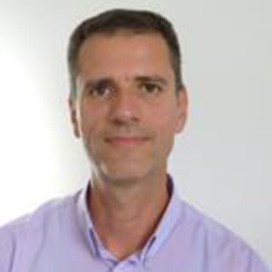
Pedro Petersen Moura Trancoso is a Full Professor at the Department of Computer Engineering , Chalmers University of Technology, Sweden. His research focuses on deep learning accelerators , heterogeneous computing , energy-efficient architectures , and memory system optimization for IoT and edge devices. Key projects: AutoPIM (autonomous vehicle accelerators), VEDLIoT (efficient AIoT), eProcessor (European processor ecosystem), PRIME (PIM systems) Collaborations: European Commission, Swedish Research Council, Swedish Foundation for Strategic Research Research Trends : Hybrid CNN/GPU/FPGA Acceleration On-Chip/Scratchpad Memory Optimization Adaptive Resource Allocation for Energy Efficiency Hardware-Software Co-Design for AIoT Publications demonstrate leadership in deep learning hardware , heterogeneous memory systems , and edge computing architectures . Key journals: IEEE ISPASS, ACM Computing Frontiers, DATE Conference.
Patrick LESERF is an Associate Professor at ESTACA, a French engineering school specializing in transport systems, where he serves as a Teacher-researcher in ESTACA'Lab. Since joining in 2005, he has founded the embedded systems laboratory, developed academic programs including a specialized master's degree in Embedded Lighting Systems (with IOGS, Renault, and PSA), and led research collaborations with CEA-LIST on transport systems reliability using model-based approaches. His research centers on Model-Based Systems Engineering (MBSE) for embedded automotive systems, with expertise in SysML modeling, safety-security co-optimization, and AUTOSAR methodology. Key contributions include architecture optimization for critical systems, real-time communication networks (CAN/LIN/FlexRay), and embedded OS design. Recent work expands into intelligent transportation systems and electric vehicle powertrain optimization. Analysis of his 2023-2024 publications reveals a strategic shift toward AI-integrated solutions: neural architecture search for efficient deep learning models, predictive analytics for urban traffic optimization using Eclipse MOSAIC, and multi-objective optimization of battery/motor systems in electric vehicles. This evolution demonstrates integration of traditional embedded systems engineering with data-driven approaches. Scientific Awards: No major awards documented in source materials. Advising and Grants: Co-supervises PhD candidate Léo Pouy on MBSE for autonomous decision-making systems. Led the European Matelo project (statistical testing for embedded software) during industrial tenure and established ESTACA's joint research team with CEA-LIST. Directs curriculum development for embedded systems education across multiple specialized master's tracks. Labs and Teams: Founded ESTACA'Lab's embedded systems research group in 2005, scaling it to four teacher-researchers. The lab focuses on model engineering, transport communication networks, and software architecture optimization, supported by a 350-hour teaching program covering embedded networks, OS, and microcontrollers. Current activities include steer-by-wire systems and IoV applications.
Zhenya Zang is a researcher specializing in deep learning applications for biomedical optics and hardware-accelerated signal processing, with recent focus on diffuse correlation spectroscopy for medical diagnostics. Education PhD completed January 2025 with thesis: "Towards highly efficient algorithms and hardware architecture design for single-photon signal processing" Research Focus Zang's work bridges computer science and biomedical engineering through: Development of back-propagation-free neural network algorithms Hardware-embedded data processors for real-time imaging Optimization of deep learning architectures for optical diagnostics Extreme learning machine implementations in medical hardware Publication Trends 2025 research demonstrates a clear trajectory toward deployable medical AI systems, emphasizing hardware-software co-design to solve latency challenges in blood flow monitoring. Key innovations include convolutional neural network adaptations for diode array sensors and accuracy-focused detection frameworks. Scientific Awards No awards documented in available records. Grants & Collaboration Researcher on "Smart Hardware-embedded Data Processors for Rapid 3D Ranging & Imaging" (2019-2022), a studentship project led by Principal Investigator D. Li Current work shows no student supervision activity. Research Infrastructure Publications indicate work within embedded hardware development environments for medical imaging, though specific laboratory affiliations remain undocumented.
Thomas Wiemann is a temporary Professor for Autonomous Robotics at Osnabrück University and a researcher at the German Research Center for Artificial Intelligence (DFKI) , group Kooperative und Autonome Systeme . He has been active since 2007, focusing on 3D mapping, SLAM, and semantic interpretation of sensor data for robotics. He received his Dr. rer. nat. in 2013 and his habilitation in 2020. His work is widely recognized, with awards such as the Karman Innovation Award (2007) and the Intevation Free Software Award (2014). Education: Habilitation in Computer Science, Osnabrück University (2020) Doctorate (Dr. rer. nat.) in Computer Science, Osnabrück University (2013) M.Sc. in Physics and Computer Science, Osnabrück University (2007) B.Sc. in Physics and Computer Science, Osnabrück University (2005) Research Focus: Thomas Wiemann's research is centered on autonomous robotics , particularly in 3D mapping , SLAM , and semantic environment understanding . His work includes the automatic generation of polygonal maps from point cloud data, large-scale 3D reconstruction, hyperspectral data integration, and hardware-accelerated SLAM systems using FPGAs and GPUs. He has developed open-source tools like the Las Vegas Reconstruction Toolkit (LVR) and contributed to ROS packages for 3D mapping and navigation. Scientific Awards: Karman Innovation Award (2007) for his master’s thesis Intevation Free Software Award (2014) for his contributions to open-source software Advising & Grants: He has supervised over 60 bachelor’s and master’s theses, primarily in the areas of 3D mapping, SLAM, and robotics systems. His projects include SOILAssist (2019–2021), focusing on sustainable agriculture using robotics, and 3DinOS (2016–2017) for 3D documentation of historical buildings. He has also worked on DFG-funded projects like RoboRithmics . Labs & Teams: He is part of the Knowledge Based Systems Group at Osnabrück University and collaborates with the DFKI Robotics Innovation Center . His lab focuses on advanced 3D perception, semantic mapping, and energy-efficient robotic systems.
Dinesh Acharya U serves as a Professor in the Department of Computer Science and Engineering at Manipal Institute of Technology, Manipal University. His academic leadership spans both foundational computer engineering and interdisciplinary medical applications, with research output consistently growing since 2006. Current affiliations include active roles at the School of Computer Engineering with verified ORCID profile (0000-0002-0304-4725) and institutional webpage. Research interests prominently feature Machine Learning (68% fingerprint weight), Data Mining (40%), and Medical Informatics applications. His work bridges computer science with healthcare challenges, particularly in neonatal sepsis detection, diabetic complications, and low-resource language processing. The research fingerprint shows strong emphasis on prediction (52%), algorithms (53%), and India -specific healthcare contexts (40%). Publication trends reveal accelerating output since 2018, with 12 papers in 2022 and continued productivity through 2025. Recent work demonstrates interdisciplinary convergence, particularly in Medical AI (neonatal sepsis, diabetic kidney disease) Natural language processing for low-resource languages Transformer-based architectures across domains Notable patterns include increasing clinical collaborations and emphasis on practical implementation tools. Professional recognition includes an h-index of 13 with 596 citations across 71 research outputs. Key distinctions: Scopus profile verification ORCID registration Multi-institutional collaborations evident in co-authorship Academic supervision and grant activity cannot be confirmed from available data, though 15+ recent publications suggest active research teams. Current projects appear focused on Medical diagnostic tool development Low-resource language technology Clinical decision support systems with evident laboratory infrastructure supporting computational healthcare research.
Arijit Raychowdhury is a Professor and the Steve W. Chaddick School Chair at Georgia Tech's School of Electrical and Computer Engineering (ECE). He leads the Center for the Co-Design of Cognitive Systems (CoCoSys) and directs the DoD-sponsored SCALE Workforce Development Program in SoC Design. Current affiliations: Georgia Tech (ECE), Integrated Circuits and Systems Research Lab Prior affiliations: Intel Corporation (6 years), Texas Instruments (1.5 years) Research interests focus on low-power circuits, compute-in-memory (CIM) systems, cryogenic electronics, and neuro-symbolic AI. His work bridges circuit design with emerging device technologies and machine learning applications. Scientific contributions include: Over 250 publications and 27 patents Leadership in top conferences (ISSCC, VLSI Symposium, DAC, CICC) Pioneering 3D Gaussian Splatting acceleration, adaptive echo-cancellation networks, and CIM architectures Advancing GaN-based power converters and cryogenic CMOS Awards : IEEE Fellow (2022) SRC Technical Excellence Award (2021) Qualcomm Faculty Award (2021, 2020) IEEE/ACM Innovator under 40 (2018) Intel Young Faculty Award (2015) Dimitris N. Chorafas Award (2007) Leadership : • Director of CoCoSys Center • Site Director for SCALE Program • Distinguished Lecturer, IEEE Solid-State Circuits Society
Tim Fritzmann is a researcher at the Department of Security in Information Technology (Technische Universität München). His work focuses on post-quantum cryptography, lattice-based algorithms, and secure hardware/software co-design for constrained environments like automotive systems and embedded devices. Post-Quantum Cryptography Lattice-Based Cryptography Hardware/Software Co-Design Error-Correcting Codes RISC-V Architecture ASIC Design His recent publications (2018–2022) highlight advancements in fault attacks, side-channel countermeasures, and efficient implementations of lattice-based protocols for IoT, automotive systems, and FPGA-SoC platforms. Key themes include parameter optimization for decryption reliability, masked accelerators, and instruction-set extensions for quantum-resistant algorithms. Research projects involve collaborations with institutions like the University of Leuven and TU München, emphasizing post-quantum security integration into real-world hardware architectures. No explicit awards or student advisement details are listed publicly.
Conrad Foik is a researcher at the Chair of Electronic Design Automation at the Technical University of Munich , working under Prof. Dr.-Ing. Ulf Schlichtmann. His research focuses span analog and digital design automation, processor modeling, and performance simulation. University: Technical University of Munich Department: Electronic Design Automation Research Areas: Processor Description Languages, Software Performance Simulation, Hardware-Software Co-Design His recent work addresses flexible generation of performance simulators, mapping instruction set models to hardware, and RISC-V simulation environments. Publications highlight tools like CorePerfDSL for accurate performance modeling.
Ludovic Apvrille is a Professor at Telecom Paris (Institut Polytechnique de Paris), where he leads research in the Communications and Electronics (Comelec) department and previously headed the LabSoC (Laboratory on System on Chip). His work focuses on embedded systems design , with particular emphasis on safety, security, and formal verification of complex systems including automotive applications, drones, and cyber-physical systems. Research Areas: Embedded Systems, Cybersecurity, Model-Driven Engineering, Formal Verification, AI-assisted Design Key Tools: TTool, SysML-Sec, AVATAR, SMASHUP, DIPLODOCUS His recent publications analyze security vulnerabilities in RISC-V architectures using the gem5 simulator, while his ongoing work explores AI integration in system modeling and unified verification techniques for hardware/software co-designs. He actively supervises research projects in safety-security-performance trade-offs and microarchitectural security , with applications to autonomous vehicles and critical infrastructure systems. Grants & Projects: EVITA project, PEPR-5G HISEC, MoVe4SPS, PEPR-Security ARSENE
Patricia Desgreys is a full professor at Institut Polytechnique de Paris , where she leads the Communication Circuits and Systems (C2S) research team within the Laboratory of Information Processing and Communication (LTCI) . Her work spans analog and mixed-signal (AMS) circuit design, cognitive radio systems, and digitally enhanced mixed-signal architectures for IoT and cyber-physical systems. Agrégation in Applied Physics, École Normale Supérieure de Cachan M.Sc. and Ph.D. in Microelectronics, University of Bordeaux (1995-1999) Her research focuses on AMS circuit design from transistor to architectural levels, including software-defined radio , cognitive radio , and neural-inspired analog-to-feature converters . She has contributed to digital predistortion techniques for power amplifiers, compressive sampling for astrophysical signals, and leadless pacemaker communication channels . Her 150+ publications highlight advancements in wireless systems, biomedical sensors, and 5G infrastructure. Recent work (2024) explores AI-driven analog design and 75 years of circuits innovation in IEEE Transactions. She has graduated 16 PhD students and co-authored the book Digitally Enhanced Mixed Signal Systems (IET, 2019). Her leadership includes Technical Program Chair roles at IEEE PRIME (2019), ICECS (2016), and NEWCAS (2012-2013), plus editorial work for IEEE TCAS-II special issues (2018-2019). She directs the ICS Master’s program (Institut Polytechnique de Paris/Paris-Saclay University) and teaches advanced electronics at SJTU-ParisTech in Shanghai . Her patents include signal sampling circuits and power amplifier linearization techniques.
Ulrich Kühne is a Lecturer at Télécom Paris , affiliated with the Secure and Safe Hardware (SSH) team and the Information Processing and Communication Laboratory (LTCI) . His research focuses on embedded systems security and formal methods for security guarantees. Research Interests: Embedded systems security, formal verification of protection schemes, and mitigation of hardware/software attacks. Publications: His work spans moving target defense for connected cars, side-channel attack mitigation in neural networks, and hardware-assisted security mechanisms. Labs & Teams: Active in LTCI and SSH, focusing on hardware-software co-design for security.
Lazaros Papadopoulos serves as an Assistant Professor in the Department of Electrical and Computer Engineering at Democritus University of Thrace since May 2024, focusing on computational resource management for embedded and high-performance systems. His work bridges hardware-software co-design with energy-efficient computing paradigms. His academic credentials include: Bachelor's in Electrical and Computer Engineering from Democritus University of Thrace (2005) Master's degree from the same institution (2008) PhD from the National Technical University of Athens (2016) Research centers on optimizing computing infrastructure through real-time resource management, heterogeneous memory architectures, and AI workload acceleration. His investigations target energy-performance tradeoffs in GPU systems, persistent memory integration, and edge-device neural network deployment, with direct applications in sustainable computing and high-performance data processing. Publication analysis (2018-2022) reveals consistent focus on heterogeneous system optimization, particularly energy-aware GPU acceleration frameworks, memory management for DRAM/NVM hybrids, and efficient CNN implementations for edge devices. Key thematic threads include sustainable computing practices, hardware-aware AI deployment, and memory hierarchy innovations. Scientific recognition includes: Two Best Paper Awards Research leadership spans major EU initiatives: Work Package Coordinator for LAGO (Horizon Europe, 2022-2024) and PRAETORIAN (H2020, 2022-2024); Technical Coordinator for EXA2PRO (H2020, 2018-2021); and Work Package Coordinator roles in SDK4ED (H2020, 2018-2020) and EXCESS (H2020, 2013-2016). These projects address embedded systems security, exascale programming models, and energy-efficient computing toolchains. He operates within the Computer Architecture and High Performance Systems laboratory, directing research on computational resource orchestration for next-generation heterogeneous platforms.
Prof. Dr.-Ing. Martin Buchholz is the Head of Electrical Engineering at Saarland University of Applied Sciences . He leads the RI-ComET research group and oversees the High Frequency Laboratory and Optical Communications Laboratory . His work focuses on high-frequency systems, wireless communication, and embedded design. Contact: martin.buchholz@htwsaar.de Location: Room 2302, Goebenstraße 40, Saarbrücken Research Highlights: Development of innovative RFID systems and TPMS (Tire Pressure Monitoring Systems). Advancements in antenna design , software-defined radio , and radio field propagation . Focus on contactless energy transfer , embedded systems , and real-time FPGA implementations . Collaboration with partners like IKU Systems & Services and Stürmer Freizeittechnik for high-altitude balloon projects ( htw saar stratos ). Academic Contributions: Co-authored 15+ publications on RFID , OFDM systems , and DVB-H receivers (1999–2014). Key journals/conferences: IEEE Transactions on Consumer Electronics , ISSCC , Wireless Congress Munich . Students & Team: Dipl.-Ing. Joachim Hauck , M.Sc. Andreas Becker , M.Sc. Christian Schmidt , and B. Eng. Tina Müller are listed as team members. Projects include Mission I–VI of the stratosphere balloon program, with test flights from 2014 to 2019. Labs & Facilities: High Frequency Laboratory and Optical Communications Laboratory at Saarland University of Applied Sciences. Technical center for EMC measurements and antenna testing.
Chao Qian, M.Sc., is a researcher and PhD student at the Department of Embedded Systems, University of Duisburg-Essen, since April 2020. He holds a bachelor's degree in Electrical Engineering from the University of Electronic Science and Technology of China (2015) and a master's degree in Embedded Systems from the University of Duisburg-Essen (2020). His research focuses on enabling artificial intelligence (AI) in reconfigurable hardware like FPGAs for energy-efficient and high-performance embedded systems. He investigates methods to deploy pre-trained neural networks on FPGAs, targeting traditionally resource-constrained embedded systems. Recent publications highlight his work on Configuration-aware FPGA power management Quantized transformers for time-series forecasting Soft sensor design for fluid flow estimation LSTM acceleration on embedded FPGAs In projects like "KI-Sprung: LUTNet" and "Elastic AI", he contributes to adaptive machine learning in pervasive computing. Contact: Email: chao.qian@uni-due.de Phone: +49 203 379 2390 Address: Bismarckstr. 90 (BC), Room BC 104, Duisburg
Christopher Ringhofer serves as a Researcher and PhD candidate at the Intelligent Embedded Systems department within the Faculty of Engineering and Computer Science at the University of Duisburg-Essen since April 2020. His work focuses on developing energy-efficient AI solutions for embedded platforms with current projects funded by the German Federal Ministry of Education and Research. He earned his BSc in Applied Informatics (2017) and MSc in Distributed Dependable Systems (2020) from the same institution, following three years of industry experience in IoT development at ithinx GmbH. His doctoral research centers on automated neural architecture search for signal processing on constrained devices. Ringhofer's research explores evolutionary algorithms for constructing latency-optimized neural networks targeting microcontrollers and embedded FPGAs, with primary applications in digital audio processing for studio/live environments. His work bridges hardware constraints with deep learning requirements through techniques like precomputed convolutional layers and hardware-aware NAS. He actively contributes to academic instruction through the Bachelor's course 'Embedded Systems' and specialized student projects on 'AI-based Neurosignal Processing', maintaining consistent teaching involvement since Winter Semester 2020/21. Current research projects include 'TransfAIr: Transfer Approaches for Artificial Intelligence in Industry' (since May 2024) and previous work on 'LUTNet' and 'KI-LiveS' initiatives. His technical contributions focus on the IoT Garage infrastructure and Elastic AI ecosystem development for pervasive computing environments.