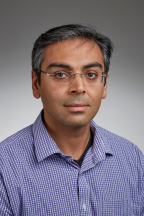
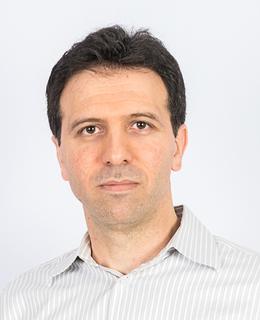
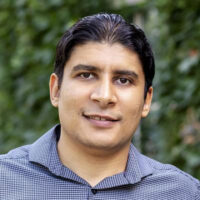
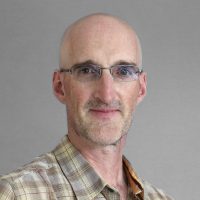
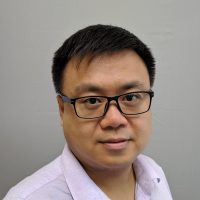
Dr. Hiren Patel is a Professor in the Department of Electrical and Computer Engineering at the University of Waterloo. He holds a Doctorate in Computer Engineering from Virginia Tech and previously worked as a postdoctoral fellow at UC Berkeley under Edward A. Lee. His research focuses on real-time embedded systems, computer architecture, machine learning hardware, and cybersecurity. He teaches courses like ECE 150 (Programming), ECE 320/429 (Computer Architecture), and ECE 327 (Digital Systems). Research Interests: Cyber-physical systems and hybrid architectures Hardware/software co-design methodologies Predictable cache coherence protocols IoT and edge computing systems Security in embedded and real-time systems Recent work emphasizes cache coherence solutions for safety-critical systems and GPU acceleration strategies. His publications address challenges in multicore predictability, FPGA bandwidth optimization, and autonomous robotics orchestration. No specific awards are listed, though his extensive publication record indicates significant contributions to embedded systems research. He currently oversees graduate student applications focusing on his core research areas.
Natalie Enright Jerger is a Professor in the Department of Electrical and Computer Engineering at the University of Toronto's Faculty of Applied Science and Engineering. She holds the Canada Research Chair in Computer Architecture and serves as Director of the Division of Engineering Science (2023-2028). Previously, she was the Percy Edward Hart Professor (2016-2019). She received her B.S. in Computer Engineering from Purdue University (2002), and M.S./Ph.D. in Electrical Engineering from University of Wisconsin-Madison (2004/2008). Her research focuses on: Multi/many-core architectures and on-chip networks Cache coherence protocols and memory hierarchy optimization Approximate computing and sustainable systems Intermittent computing for energy-harvesting devices Hardware acceleration for machine learning Her publications demonstrate strong emphasis on networks-on-chip (NoC) innovations, including routing algorithms, deadlock handling, power-efficient designs, and topology optimizations. Recent work expands into approximate computing, mobile architectures, and ML-driven hardware design. Major Awards: Fellow of Engineering Institute of Canada (2023) McLean Senior Fellow (2019) IEEE Micro Top Picks (2016) ACM/IEEE Microarchitecture Hall of Fame (2015) Sloan Research Fellowship (2015) Canada Research Chair (current) Distinguished Scientist, ACM Fellow, IEEE She leads the NEJ research group and collaborates with industry partners including Intel, AMD, Qualcomm, and IBM. Her work is funded by NSERC, CFI, and industrial grants. She co-chaired ASPLOS 2023 and HPCA 2014, and actively promotes diversity through WICARCH and ACM initiatives.
René Jr Landry is a full Professor in the Department of Electrical Engineering at École de technologie supérieure (ETS), Université du Québec, specializing in Global Navigation Satellite Systems (GNSS), avionics, and wireless communication technologies. His academic journey includes a B.Ing. from Polytechnique Montréal, M.Sc. from University of Surrey (UK), and Ph.D. from SupAréo in Toulouse. He maintains active research leadership through two key laboratories: LASSENA (Laboratory of Space Technologies, Embedded Systems, Navigation and Avionics) and LACIME (Communications and Microelectronic Integration Laboratory). His research spans critical aerospace navigation domains including GNSS signal processing, inertial navigation systems, software-defined radio for avionics, radio frequency interference mitigation, and indoor positioning technologies. Landry's work addresses real-world challenges in satellite navigation robustness, precision positioning in urban/denied environments, and next-generation avionic system security. His current projects focus on blockchain-enhanced IoT security, AI-driven GNSS disruption analysis, and adaptive RF front-ends for multi-band avionics applications. Analysis of his recent publications reveals strong emphasis on resilient positioning systems through multi-constellation integration (particularly Iridium-NEXT), blockchain applications for navigation security, and explainable AI techniques for GNSS signal quality assessment. His work increasingly bridges traditional navigation engineering with cutting-edge security and machine learning paradigms. 2014 Prix d'excellence du c.a. pour les services à la collectivité Landry has supervised over 100 graduate students across doctoral, master's, and research projects since 2005, with current supervision extending through Summer 2025. His research funding supports multiple industry partnerships focused on avionics certification, software-defined radio implementations, and next-generation navigation systems. The LASSENA laboratory under his leadership develops certified avionic products from open-source SDR platforms and advances multi-sensor fusion techniques for challenging navigation environments. His research infrastructure includes specialized facilities for GNSS signal simulation, avionics hardware testing, and multi-sensor integration. Current work emphasizes flight-tested validation of RF front-end technologies, blockchain-secured navigation data, and real-time interference mitigation systems for aviation applications.
Arrvindh Shriraman is an Associate Professor and Program Director of Software Systems at Simon Fraser University's School of Computing Science in Surrey. His research focuses on energy-efficient software, multicore memory systems, and optimizing hardware/software interfaces for parallel programming. He holds a Ph.D. (2010) and M.S. (2006) in Computer Science from the University of Rochester, and a B.Eng. (2004) from the University of Madras. He teaches courses on parallel programming and energy-conscious software design. His research interests include synchronization mechanisms for domain-specific architectures, cache optimization, and FPGA-based acceleration. He has contributed to frameworks like Mu-grind for HLS-generated RTL instrumentation and TAPAS for parallel accelerator generation. Notable projects include RANGE-BLOCKS for synchronization in domain-specific systems and TapeFlow for gradient computation in neural networks. His work emphasizes real-time verification of autonomous systems and safety-critical trajectory planning for underwater vehicles. Shriraman collaborates closely with the Tangent Lab, exploring cutting-edge solutions in hardware-software co-design and embedded systems. His teaching and research bridge theoretical computer science with applied engineering challenges, addressing scalability, efficiency, and safety in modern computing systems.
Majid Ghaderi is a Professor in the Department of Computer Science at the University of Calgary, Faculty of Science. His expertise spans network algorithms, secure communication, and machine learning applications in network control. He holds a Ph.D. in Computer Science from the University of Waterloo (2006), and M.Sc. and B.Sc. degrees in Software Engineering from Sharif University of Technology (2001 and 1999). Education: Ph.D. Computer Science, University of Waterloo, 2006 M.Sc. Software Engineering, Sharif University of Technology, 2001 B.Sc. Software Engineering, Sharif University of Technology, 1999 Research Interests: Dr. Ghaderi focuses on optimizing network algorithms, securing communication in distributed systems, and leveraging machine learning for network control. His work addresses challenges such as secure wireless protocols, SDN-based network management, and efficient resource allocation in data centers. He explores proactive traffic scheduling and anomaly detection in critical infrastructures like industrial control systems and vehicular networks. Publications Trends: His recent work emphasizes covert communication in heterogeneous networks, adaptive federated learning in edge environments, and low-overhead diagnostic systems for cloud networks. He also investigates cybersecurity defenses against hardware vulnerabilities and dynamic threat landscapes. Awards: Best in-session Presentation Award, IEEE INFOCOM 2018 Municipal Excellence Award, Government of Alberta 2018 Faculty of Science Excellence in Teaching Award 2012 Advising & Grants: While no specific advisees are listed, his research has been supported by grants focusing on network security, edge computing, and IoT applications. He teaches CPSC 441 (Computer Networks) and maintains an active lab focused on network systems and cybersecurity. Labs & Teams: His research group collaborates on projects involving software-defined networks, vehicular communication, and industrial IoT security. The team develops open-source tools for network monitoring and anomaly detection.
Dr. Mohamed Hassan is an Assistant Professor in the Department of Electrical & Computer Engineering at McMaster University. His research focuses on Cyber-Physical Systems-on-Chip (iCPSoCs) , emphasizing design, analysis, and deployment for critical domains like Unmanned Aerial Vehicles (UAVs), Autonomous Cars, and healthcare systems. Key research areas include hardware/software codesign, real-time systems, embedded systems, and security. He teaches courses such as COMPENG 4DM4 (Computer Architecture) and COMPENG 4DS4 (Embedded Systems) . His work bridges foundational theories (e.g., scheduling, AI) with infrastructure-level innovations (e.g., compilers, memory systems). The Fanos Research Lab he leads explores interdisciplinary solutions for efficient CPS-on-Chip, addressing challenges in multicore predictability, memory latency, and edge computing. Recent contributions include frameworks for explainable memory-centric workloads and techniques to accelerate TinyML inference. Dr. Hassan serves on Technical Program Committees for conferences like RTAS and OSPERT, highlighting his role in advancing real-time embedded systems research.
Paul Van Oorschot is a Professor at the School of Computer Science, Carleton University. He has held the Canada Research Chair in Authentication and Computer Security from 2002 to 2023. His expertise spans authentication, applied cryptography, and network security. He co-authored the seminal Handbook of Applied Cryptography and led the NSERC Internetworked Systems Security Network (2008–2013). His research focuses on enhancing security in systems, software, and web authentication, including methods to augment passwords with geolocation and device recognition. He holds a Ph.D. from the University of Waterloo and was awarded the J.W. Graham Medal (2000) and Fellowship in the Royal Society of Canada (2011). Education: Ph.D. in Computer Science from the University of Waterloo (1988) His research interests include authentication systems, public-key infrastructure, smartphone security, and usability challenges in security design. He has contributed to frameworks like OWL for password-based key exchange and SLV for server location verification. His work addresses both technical and human factors in securing modern computing environments. Key contributions include analysis of TLS interception, memory safety in programming languages, and evaluating IoT security best practices. He has published extensively on topics ranging from side-channel attacks to cryptographic protocol vulnerabilities. Awards: J.W. Graham Medal in Computing and Innovation (2000), Fellow of the Royal Society of Canada (2011) His academic leadership includes roles in shaping cybersecurity education and policy, emphasizing the need for rigorous scientific approaches in security research. His research group, the Carleton Computer Security Lab (CCSL), drives interdisciplinary projects in software security and system administration tools.
Stephen Brown is a Professor at the University of Toronto within the Department of Electrical and Computer Engineering under the Faculty of Applied Science and Engineering. He earned his B.A.Sc and M.A.Sc in Electrical Engineering from the University of Toronto and New Brunswick, respectively, and a Ph.D. in Electrical Engineering from the University of Toronto (1992). His career spans over two decades in academia and industry collaboration. Education : B.A.Sc, University of New Brunswick M.A.Sc, University of Toronto Ph.D, University of Toronto Professor Brown’s research focuses on field-programmable gate arrays (FPGAs) , CAD algorithms , and computer architecture , with applications in machine learning and high-level synthesis . He is a principal investigator in the LegUp project , an open-source high-level synthesis framework that bridges software and hardware design. His work also extends to optimizing FPGA interconnect delays, physical synthesis, and logic block architectures. Key trends in his publications include advancements in high-level synthesis tools, FPGA architecture evaluation, and timing-driven design methodologies. His contributions often intersect with design automation , resource sharing , and embedded systems . Scientific Awards : NSERC 1992 Doctoral Prize Hart Professorship for Innovation in Teaching (2017) Multiple teaching excellence awards Best Paper Award at ICCAD 1990 Best Paper Award nomination at Canadian Conference on VLSI (1989) As Director of the FPGA University Program at Intel Corporation, he leads industry-academia initiatives. His teaching portfolio includes courses like ECE253 (Digital Logic) and ECE1733F (Switching Theory).
Lianying Zhao is an Associate Professor in the School of Computer Science at Carleton University and serves as a Director of the Carleton Computer Security Lab (CCSL). His research focuses on low-level platform security, including hardware, firmware, hypervisor, and operating systems, with an emphasis on trusted computing, authentication, privacy preservation, and security metrics. He leads the CCSL research group, collaborating with interdisciplinary teams to address critical security challenges in IoT, cloud systems, and web applications. Education: Not explicitly listed in provided texts. Roles: CCSL Director, Research Supervisor, and Graduate Program Advisor. Dr. Zhao’s work spans hardware security improvements, firmware vulnerability analysis, and user-centric security metrics. Recent research highlights include studies on router configuration habits, tracker detection in web browsers, and CVSS score discrepancies. He has supervised numerous graduate students in cybersecurity domains, contributing to over 30 peer-reviewed publications since 2013. His lab affiliations include CCSL and CISL, where he collaborates on projects such as secure deletion frameworks, TLS validation vulnerabilities, and hybrid decision-making models for cloud security. Current research also explores cross-regional login throttling mechanisms and AI-driven vulnerability detection in embedded systems.
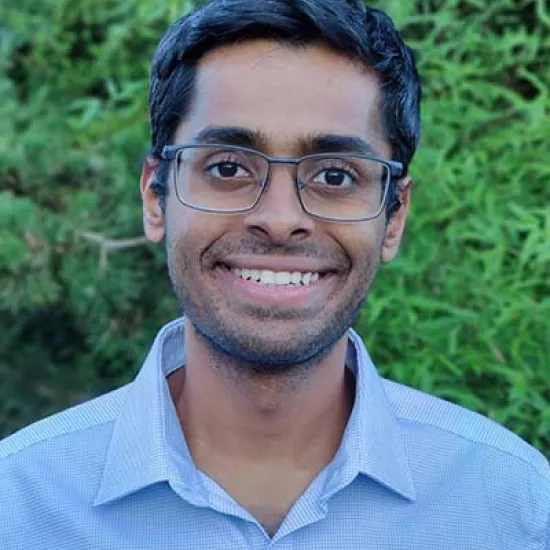
Gururaj Saileshwar is an Assistant Professor in the Department of Computer Science at the University of Toronto, within the Mathematical and Computational Sciences school. His research focuses on securing computing hardware and systems, with a focus on microarchitectural security (cache side-channels, Rowhammer attacks), system security (memory safety), and security for machine learning systems. Education: PhD in Computer Science from Georgia Institute of Technology (2019), advised by Prof. Moinuddin Qureshi. B.Tech and M.Tech from Indian Institute of Technology Bombay (India). Prior to UofT, he was with NVIDIA Research. Research interests include developing new attacks, defenses, and tools for automated security analysis. His work has received multiple awards including the IEEE Top Pick in Hardware and Embedded Security, HPCA Best Paper Award, and IEEE HOST Best PhD Dissertation Award. He teaches courses on secure computer systems and hardware security, including CSC427 (Computer Security) and a topics course on secure computer systems. His lab focuses on hardware-software co-design solutions for security and reliability challenges in modern computing systems. Labs/Teams: Leads the Secure Hardware Systems Lab at UofT, collaborating on Rowhammer mitigation, cache attack defenses, and machine learning security. Grants: Active funding from NSF, industry partnerships with NVIDIA, and other hardware security initiatives. Advising: Currently recruiting PhD students interested in hardware security, system security, and machine learning systems security.
Dr. Alexandra Fedorova is a Professor in the Department of Electrical and Computer Engineering at the University of British Columbia (UBC), with an Associate Member role in the Computer Science department. She leads the Systopia systems research group, focusing on system software design, memory/storage management, and accelerator-centric computing. Her work emphasizes performance optimization, energy efficiency, and hardware-software co-design. She holds a PhD from Harvard University (2006), where she researched operating system scheduling under Margo Seltzer. Prior to UBC, she was an Associate Professor at Simon Fraser University (2006–2015). Fedorova is a recipient of the Alfred P. Sloan Research Fellowship and the Anita Borg Early Career Award. She consults for MongoDB's storage engine team and collaborates with industry on storage and performance challenges. Her research spans tools like Non-sequitur for program trace visualization, studies on storage-class memory (e.g., Optane), and frameworks for GPU acceleration. Recent efforts include Sunstone (spatial accelerator scheduling) and ExtMem (application-aware memory management). Her work bridges low-level systems with high-performance computing needs. Key contributions include optimizing NUMA systems, improving storage engine performance, and exploring processing-in-memory architectures. Fedorova’s projects often involve open-source collaboration, reflected in her GitHub repositories such as vividperf and perf-logging , which support performance analysis tools.
Dr. Kenneth Kent is a Professor in the Department of Computer Science at the University of New Brunswick (UNB), where he has served for 14 years. He is the Director of the Information Technology Centre (ITC) and heads the Reconfigurable Computing Group. He also serves as Director of the IBM Centre for Advanced Studies - Atlantic and holds an Honorary Professorship at Hochschule Bonn-Rhein-Sieg. His research focuses on hardware/software co-design, reconfigurable computing, virtual machines, and embedded systems. Dr. Kent earned his PhD and Master of Science in Computer Science from the University of Victoria. His work has led to over 100 refereed publications and the supervision of 70+ graduate students. He co-founded WEnTech Solutions Inc., a software firm addressing waste-to-energy optimization. His awards include the IBM Faculty Fellow of the Year and Project of the Year (as Principal Investigator) for contributions to the J9 Java Virtual Machine. His articles span FPGA acceleration, compiler optimization, cloud storage security, and IoT intrusion detection. Recent work emphasizes energy-efficient Node.js systems and advancements in CAD tools like VTR 9 for FPGA architecture. Dr. Kent’s advising and grants include leading the IBM CAS Atlantic and directing industry-academia collaborations. He has pioneered technologies such as the Eclipse OpenJ9 JVM and the CephArmor storage interface, balancing academic research with commercial innovation. He leads the Reconfigurable Computing Group at UNB and collaborates with the Institute for Visual Computing in Germany. His research bridges theoretical computing and practical applications, with a focus on scalable systems and embedded technologies.
Shawki M. Areibi is a Professor and Area Head of Engineering Systems and Computing in the School of Engineering at the University of Guelph. His research focuses on VLSI Physical Design Automation, Reconfigurable Computing Systems, and Hardware/Software Co-design for Embedded Systems. He leads efforts in developing advanced algorithms for CAD tools, FPGA design, and machine learning applications. His work addresses challenges in VLSI layout optimization, parallel processing, and embedded systems design. Affiliations: AI Affiliated Faculty, Area Heads, Computer Engineering, Engineering Systems and Computing Research. Research Interests: VLSI Circuit Layout, Reconfigurable Computing, Machine Learning, and FPGA-based Accelerators. His research integrates meta-heuristics like Genetic Algorithms and Tabu Search to solve complex optimization problems. He has contributed to hardware acceleration frameworks for machine learning algorithms and embedded systems, with applications in domains like signal processing and data mining. His recent work includes congestion-estimation models for modern FPGAs and analytic placement tools for ultra-scale architectures. Publications span VLSI design, reconfigurable computing, and machine learning, emphasizing algorithmic innovation and hardware-software co-design. His students have explored topics ranging from FPGA placement to domain adaptation in remote sensing. Grants and Advising: Advises graduate and undergraduate students on projects involving FPGA acceleration, machine learning, and embedded systems. His labs focus on developing next-generation CAD tools and hardware accelerators.
Prof. Mohammed Khalid is a Professor in the Department of Electrical and Computer Engineering at the University of Windsor. He specializes in FPGA-based systems, network-on-chip architectures, and hardware acceleration for signal processing applications. His leadership roles include serving on the executive committee of IEEE Canada. His research focuses on optimizing cryptographic hardware, automotive embedded systems, and efficient algorithm implementations on FPGAs. Key contributions include advancements in PUF-based security mechanisms, high-speed elliptic curve processors, and FPGA-accelerated machine learning algorithms. He has led projects in automotive radar systems and AUTOSAR configuration tools. His work emphasizes practical applications of hardware-software co-design principles. Research Highlights : Development of novel FPGA architectures for real-time signal processing Innovative approaches to resource-efficient cryptographic hardware Pioneering work on hybrid NoC architectures for multi-FPGA systems Awards : IEEE Windsor Section Award (2019) for group leadership Best Student Paper Award (2024) for supervised research by Mohit Sharma Prof. Khalid's 150+ publications span FPGA design methodologies, adaptive signal processing, and embedded systems security. His research group collaborates with industry partners to advance automotive electronics and IoT applications.
James R. Green is a Professor in the Department of Systems and Computer Engineering at Carleton University , where he has been a faculty member since 2005. He holds a PhD from Queen's University and is a licensed Professional Engineer (P.Eng.) and Senior Member of IEEE. His work integrates machine learning, biomedical informatics, and high-performance computing. His educational background includes: B.A.Sc. in Systems Design Engineering, University of Waterloo (1998) M.Sc.(Eng.), Queen's University (2000) PhD, Queen's University (2005) Dr. Green's research focuses on machine learning challenges in biomedical informatics , particularly class imbalance and rare event prediction. Key areas include protein structure, function, and interaction prediction; microRNA detection in unique species; non-contact neonatal monitoring; and accelerating scientific computing via parallel architectures like the Cell BE processor. His lab has developed several widely used bioinformatics tools such as PIPE, ProtDCal, and PCI-SUMO. His recent publications reflect a strong trend in computational biology and machine learning , with applications in proteomics, genomics, and medical diagnostics. He has published over 100 peer-reviewed papers and secured funding from NSERC, CIHR, CFI, ORF, OCE, MITACS, and IBM. Scientific and teaching recognitions include: Three teaching awards NSERC Best Project Award (twice: 2006-2007 and 2007-2008) Multiple student projects resulting in conference papers (e.g., CMBEC) He has supervised numerous undergraduate capstone projects in areas such as assistive technologies, robotic systems, and bioinformatics. His teaching portfolio includes courses in Pattern Classification, Machine Learning, Computer Architecture, and Biomedical Engineering. He leads an active research group that bridges computer engineering and life sciences, fostering interdisciplinary collaboration. Lab and research team initiatives include: Development of open-access web servers for protein analysis Collaborations with biologists and clinicians Integration of hardware and software for medical applications