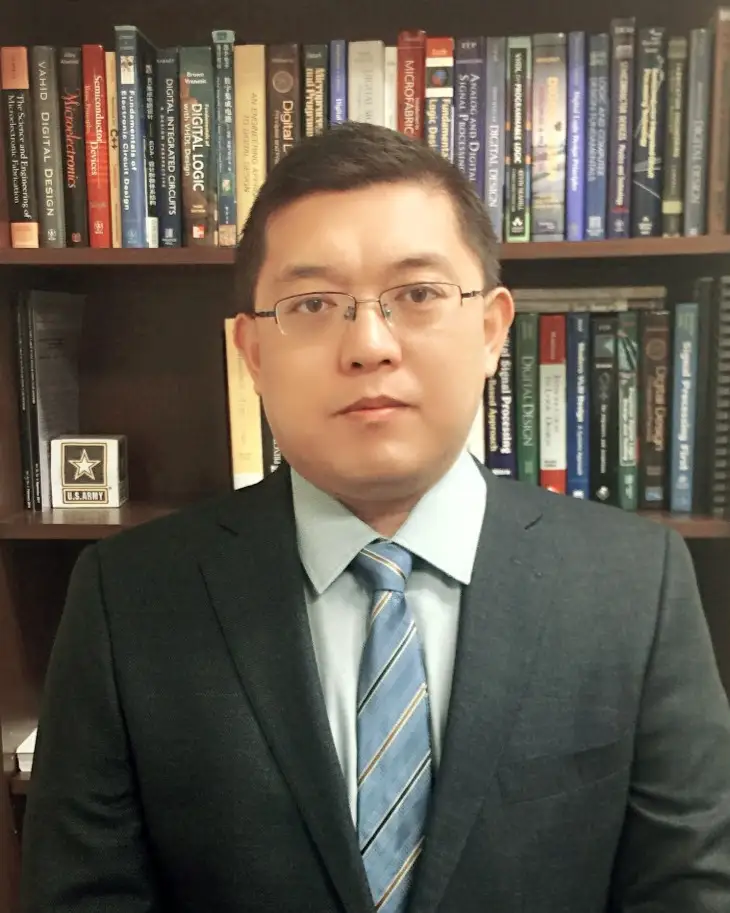
Jinhui Wang is a Professor in the Department of Electrical and Computer Engineering at the University of South Alabama's College of Engineering. His research focuses on cutting-edge technologies in Artificial Intelligence , VLSI Circuits , and Neuromorphic Computing . Education: Postdoctoral work in VLSI Design at University of Rochester, NY, USA; Ph.D. and B.S. in Electrical Engineering from Beijing University of Technology and Hebei University, China. His work addresses 3D IC Design , Emerging Memory Systems , and Cooling Techniques for Electronic Devices , with recent publications emphasizing privacy-preserving AI hardware and intelligent memory architectures for mobile and embedded systems. Collaborative projects span applications in Wireless Sensor Networks , IoT , and UAV Electronic Subsystems .
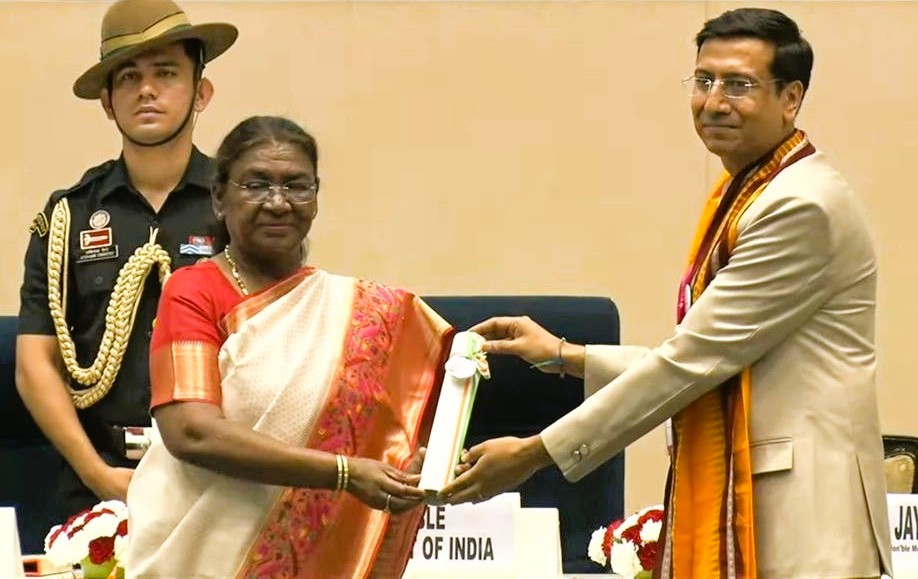
Prof. Kapil Ahuja is a Full Professor in the Department of Computer Science & Engineering at the Indian Institute of Technology Indore (IIT Indore), where he heads the Mathematics of Data Science and Simulation (MODSS) research lab. After completing dual Master's degrees and a Ph.D. from Virginia Tech (USA) followed by postdoctoral work at the Max Planck Institute in Germany, he has held visiting positions at UT Austin, IMT Atlantique, Sandia National Labs, TU Dresden, and TU Braunschweig. His administrative roles include founding Dean of International Affairs and former Head of Computer Science & Engineering at IIT Indore. Education: Ph.D. in Mathematics, Virginia Tech (2011) M.S. in Mathematics, Virginia Tech (2009) M.S. in Computer Science, Virginia Tech (2007) B.Tech. in Mechanical Engineering, IIT (BHU) Varanasi (2001) Research Focus: Prof. Ahuja's work bridges theoretical advances with real-world applications, emphasizing machine learning algorithms for plant/cancer studies, game-theoretic poverty reduction models, exascale climate modeling solvers, and drone trajectory optimization. His interdisciplinary approach integrates numerical linear algebra with network science to solve complex systems problems across healthcare, agriculture, and climate science, supported by 4.85 Crores INR in external funding. Publication Trends: Recent work demonstrates growing emphasis on AI-driven optimization for physical systems (drones, climate models) and biomedical applications (cancer classification). His publications increasingly feature cross-disciplinary collaborations between computer science, biology, and economics, with notable contributions in explainable AI for healthcare and resource allocation algorithms for social networks. Scientific Recognition: National Teacher's Award (2024) from the President of India Five-time recipient of IIT Indore's Best Teacher Award (2013-2023) Best Poster Award at International Workshop on Game Theory & Networks (2019) Steeneck Graduate Research Fellowship (Virginia Tech, 2011) Multiple SIAM travel awards for international conferences Mentorship & Service: Prof. Ahuja has graduated 5 Ph.D. and 4 M.S. (Research) students while mentoring 75 B.Tech. projects. He serves as Associate Editor for Applied Intelligence Journal (Springer Nature) and Knowledge and Information Systems, organizes international conferences, and reviews for 35+ academic sources. His administrative leadership significantly expanded IIT Indore's global partnerships through the Research Park initiative. Research Infrastructure: The MODSS lab maintains active collaborations with Oak Ridge National Lab, Sandia National Labs, and European institutions. Current projects include AI-optimized drone swarms for agricultural monitoring and game-theoretic models for poverty intervention, utilizing high-performance computing resources for large-scale simulations.
Martha A. Kim is an Associate Professor in the Department of Computer Science at Columbia University's School of Engineering and Applied Science. She serves as a Member of the Data Science Institute, Center Co-Chair of the Center for Computing Systems for Data-Driven Science, and Chair of the Computer Engineering Program. Professor Kim's research focuses on computer architecture with particular emphasis on the hardware-software interface. Her work develops tools and designs that help computer systems operate efficiently and intuitively, including database accelerators for energy-efficient queries, techniques for optimizing parallel software to better utilize hardware resources, and improving the versatility of specialized hardware accelerators. She leads the ARCADE Lab where she conducts research in computer architecture, parallel programming, compilers, and low-power computing. Her publication record shows consistent output at top-tier conferences including ASPLOS, MICRO, MEMOCODE, ISLPED, DAC, DaMoN, CC, and CGO, with recent work spanning video transcoding in the cloud, pipelined dataflow circuits, thermal monitoring, and database acceleration. Professor Kim has received several prestigious awards: 2013 Rodriguez Family Award 2015 Edward and Carole Kim Faculty Involvement Award 2013 NSF CAREER award 2016 Anita Borg Early Career Award She currently advises three doctoral students (Martha Barker, Thomas Repetti, and Andrea Lottarini) and has previously graduated PhD students Melanie Kambadur (2016) and Lisa Wu (2014). Her research is supported by C-FAR, DARPA, Google, Intel, and NSF. Professor Kim teaches Fundamentals of Computer Systems, Computer Architecture, and Principles and Practice of Parallel Programming courses at Columbia University. The ARCADE Lab provides opportunities for students to work on cutting-edge research in hardware-software interface optimization, with applications in energy efficiency, database acceleration, and parallel computing systems.
Sudip Misra is a Professor in the Department of Computer Science and Engineering at the Indian Institute of Technology Kharagpur, West Bengal, India. With an extensive publication record of 168 publications and over 1,142 citations, he has established himself as a leading researcher in networking and sensor systems. His work spans multiple domains within computer science and engineering, with a particular focus on practical applications of theoretical concepts. Dr. Misra's research interests encompass Wireless Sensor Networks, Internet of Things (IoT), Mobile Networks, Routing Protocols, Network Security, Energy Efficiency, Underwater Sensor Networks, UAV Networks, and Machine Learning applications for networking. His work demonstrates a consistent focus on solving real-world problems through innovative networking solutions, particularly in resource-constrained environments. He has made significant contributions to security protocols, energy management, and connectivity solutions across various network paradigms. Analysis of his recent publications reveals a strong trend toward practical applications of networking technologies, with increasing focus on IoT security, vehicular networks, underwater communication systems, and UAV-enabled networks. His work shows evolution from fundamental networking protocols to more complex, application-specific solutions addressing contemporary challenges in smart transportation, precision agriculture, and secure cloud-based IoT services. Dr. Misra has mentored numerous students and researchers, as evidenced by his extensive co-authorship record. His collaborative work spans multiple institutions across India and internationally, demonstrating strong research leadership and networking capabilities. His research has been supported by various funding mechanisms, though specific grants are not detailed in the available information. His laboratory or research group appears to focus on sensor networks, IoT systems, and related communication technologies, with particular emphasis on security, energy efficiency, and practical deployment scenarios. The research output suggests a well-established team working on cutting-edge networking challenges with real-world applicability.
Syed Asad Alam is a Post-Doctoral Research Fellow at the School of Computer Science and Statistics, Trinity College Dublin, The University of Dublin, Ireland, specializing in optimization and efficient implementation of digital systems for signal processing and communication algorithms. Education: Bachelors in Computer and Information Systems Engineering, N.E.D. University of Engineering and Technology, Karachi, Pakistan M.Sc. in Electrical Engineering (System-on-Chip Design), Linköping University, Sweden PhD in Electrical Engineering (Computer Engineering/Electronics Systems), Linköping University, Sweden His research integrates Machine Learning with Embedded Systems through novel approaches to Quantization and Logarithmic Number Systems , targeting efficient Neural Networks implementation on FPGAs and ASICs . This work builds on extensive industry experience with multimedia processors, communication devices, and SOC bus design, including specialized projects on filters, wireless systems, frequency multipliers, and DSP processors. His 2020 LCTES publication on non-base-2 logarithmic systems exemplifies his focus on numerical representation efficiency for resource-constrained embedded applications, reflecting broader trends in hardware-aware machine learning optimization. No scientific awards or grant information was documented in the source material. He has collaborated with multiple industry teams on FPGA-based design and Integrated Circuit Development across startup environments, though specific advising roles or student supervision were not indicated.