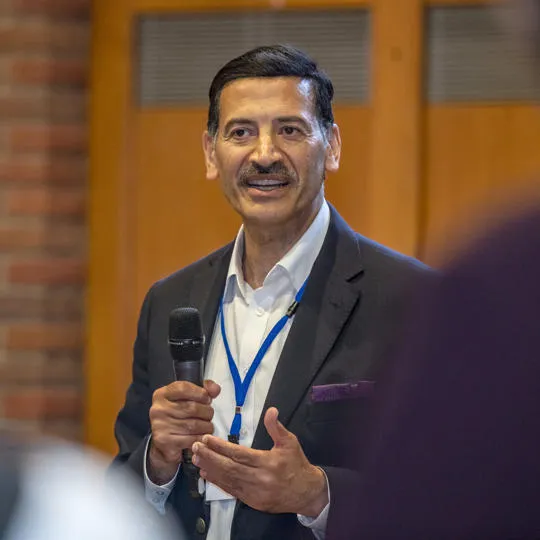
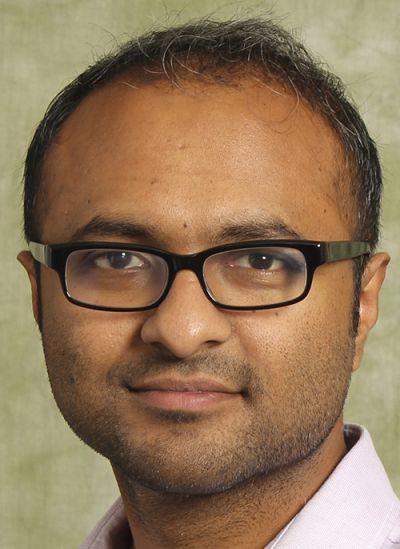
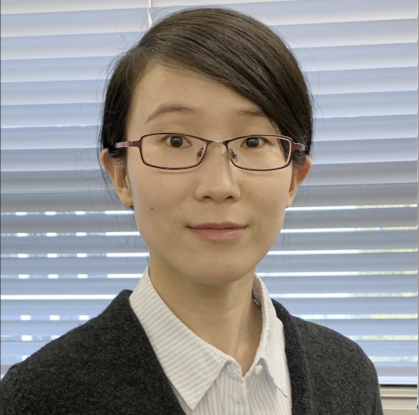
Professor Sir Bashir M. Al-Hashimi is Vice President (Research & Innovation) at King’s College London and co-Director of the King's Institute for Artificial Intelligence. A renowned computer engineer, his research focuses on energy-constrained computing, semiconductor chips, and battery-free systems enabling IoT technologies. Significant contributions include founding the Arm-ECS industry-academia center, leading large-scale interdisciplinary research programs, and publishing over 350 technical papers. Honors include knighthood (2025), CBE (2018), and fellowships in Royal Society, IEEE, and Royal Academy of Engineering.
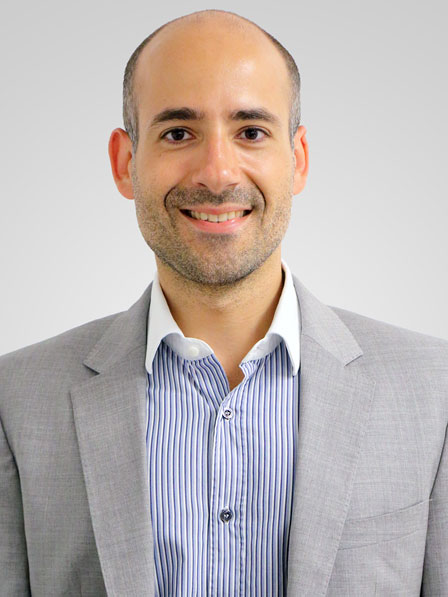
Matteo Rinaldi is a Professor in the Department of Electrical and Computer Engineering at Northeastern University's College of Engineering and serves as Director of the Institute for NanoSystems Innovation. His work focuses on advanced micro/nanoelectromechanical systems (M/NEMS) for sensing and communication applications. Ph.D. in Electrical and Systems Engineering, University of Pennsylvania (2010) M.Sc. and B.S. in Electronic Engineering, University of Rome Tor Vergata (2007, 2004) Research Interests: Rinaldi's research spans fundamental and applied aspects of piezoelectric nanomaterials, with emphasis on Aluminum Nitride (AlN) and Scandium Aluminum Nitride (ScAlN) based NEMS Plasmonically enhanced infrared and chemical sensors Low-power reconfigurable radio communication systems Integration of MEMS/NEMS with electronics Nanomaterials for harsh environments Publications & Research Trends: Rinaldi's recent work explores high-frequency resonators, infrared detection systems, and zero-power sensing technologies. Key trends include plasmonics for energy-efficient devices, ScAlN integration for improved performance, and machine learning applications in nanoscale device design. Scientific Recognition: 2025 IEEE IFCS Walter G. Cady Award 2024 Northeastern Global Network Accelerator Award Optica Fellow IEEE Sensors Council Early Career Award DARPA Young Faculty Award NSF CAREER Award Advising & Funding: Rinaldi advises graduate researchers like Antea Risso. His lab secures major grants from DARPA, NSF, DOE, and the Bill & Melinda Gates Foundation, focusing on next-generation sensing technologies and 6G communication systems. Research Infrastructure: Leads the Northeastern Sensors & Nano Systems Laboratory (NS&NS Lab) and co-directs the bicoastal Institute for NanoSystems Innovation with Boston and Oakland campuses, advancing nanoscale semiconductor technologies.
Simha Sethumadhavan is a Professor of Computer Science at Columbia University and an Alfred P. Sloan Research Fellow. His research focuses on computer architecture and security, particularly on securing hardware first and systematically hardening systems stacks. Hardware Security Microarchitectural Side Channels Memory Safety Analog Accelerators His recent work explores mechanism design for security, memory safety, reliability co-design, and cloud security. Publications span journals like Communications of the ACM and conferences including IEEE Security and Privacy, CCS, ISCA, and MICRO. Distinguished Paper Awards IEEE Micro Top Picks Best Student Paper Awards Best of CAL 2016 He advises PhD students such as Adam Hastings, Evgeny Manzhosov, and Miguel Arroyo, and has taught courses like Computer Architecture (CSEE 4824) and Hardware Security (COMS 6424). He has served on editorial boards and program committees for ISCA, IEEE Security and Privacy, and MICRO.
Andreas Andreou is a Professor of Electrical and Computer Engineering at Johns Hopkins University (JHU), with secondary appointments in Computer Science and the Whitaker Biomedical Engineering Institute. He co-founded the JHU Center for Language and Speech Processing (CLSP) and co-directs the Andreou Lab, focusing on brain-inspired microsystems, neuromorphic engineering, and biomedical sensors. His research spans CMOS-based neuromorphic processors, event-based vision systems, and wearable health monitoring devices like the StethoVest. Key contributions include silicon retinas, polarization-sensitive imagers, and algorithms for pattern analysis. Research Interests: Neuromorphic Computing: Designing energy-efficient brain-inspired chips using 3D CMOS, FETs, and memristive technologies. Biomedical Microsystems: Wearable acoustic sensors for cardiac monitoring and vestibular prosthetics. AI Hardware: Neuromorphic accelerators for edge computing, leveraging LLMs for automated circuit design. Notable Achievements: IEEE Fellow (since 2020) Recipient of the 3rd Best Paper Award at IEEE BioCAS 2018 $2M DARPA grant for bio-inspired event cameras Labs/Teams: The Andreou Lab collaborates with the Kavli Neuroscience Discovery Institute and NSF-funded neuromorphic projects. Ongoing work includes neuromorphic Ising machines, LLM-driven chip design, and quantum sensing for medical applications.
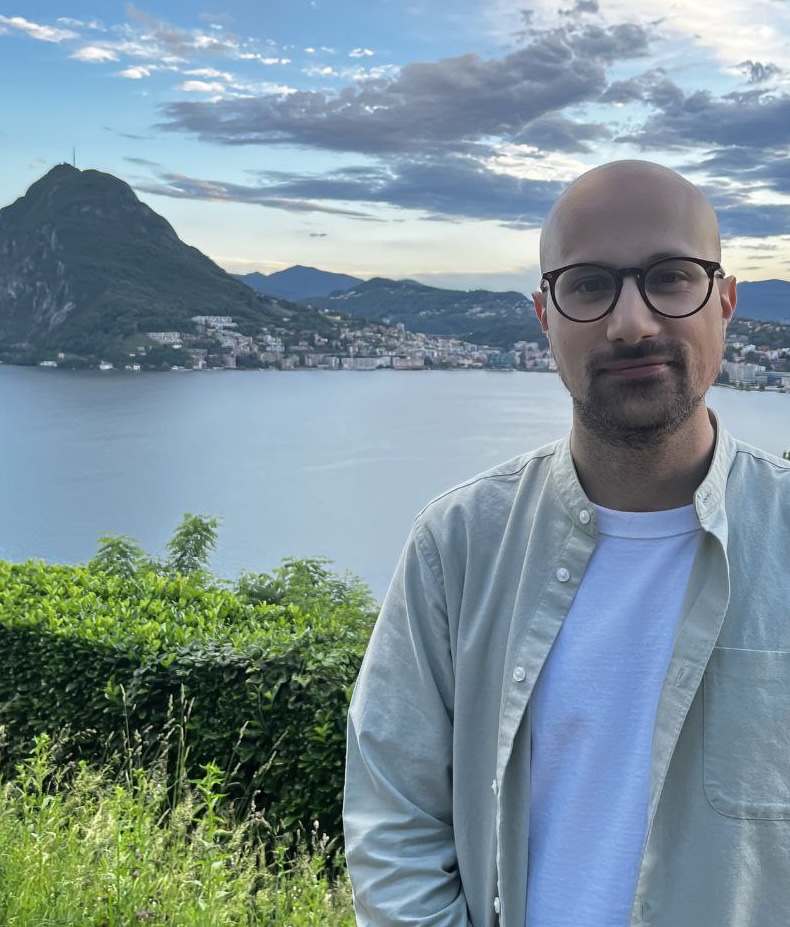
Andrea Cini is a postdoc researcher affiliated with the Graph Machine Learning Group and the Dalle Molle Institute for Artificial Intelligence (IDSIA USI-SUPSI) at the University of Lugano (USI). He also holds a position as a SNSF postdoc fellow at the University of Oxford under Prof. Michael Bronstein, focusing on machine learning for time series forecasting and graph processing. His research integrates graph deep learning methodologies with spatiotemporal dynamics, emphasizing applications in healthcare, energy systems, and intelligent systems. Education: PhD in Computer Science and Engineering (USI, 2020), supervised by Prof. Cesare Alippi MSc and BSc in Computer Science and Engineering (Politecnico di Milano) Visiting researcher at Imperial College London (Prof. Danilo Mandic) Research interests span graph neural networks , time series forecasting , and spatiotemporal data processing . His work has introduced influential methods such as the Torch Spatiotemporal library, and has been recognized with a best paper award. Recent publications emphasize applications in relational conformal prediction, hierarchical forecasting, and energy grid optimization. Awards include the Best Paper Award for contributions to graph-based forecasting methodologies. Current projects are funded by the Swiss National Science Foundation, exploring graph-based reinforcement learning and spatiotemporal modeling at the University of Oxford. Collaborations include affiliations with the Northernmost Graph Machine Learning group at UiT the Arctic University of Norway. His research bridges theoretical advancements and industrial applications in fields like healthcare dynamics prediction and smart grid optimization.
Bruno Ehrler is a Professor at the University of Groningen (honorary) and Group Leader of the Hybrid Solar Cells Group at AMOLF in Amsterdam since 2014. His research focuses on perovskite materials science, including fundamental studies and device applications like solar cells. He holds significant grants (ERC Starting, NWO Vidi) and is a WIN Rising Star award recipient. He previously worked at the University of Cambridge, where he earned his PhD in Physics under Prof. Neil Greenham. His expertise spans optoelectronics, quantum dots, and singlet fission photovoltaics. Ehrler contributes to national energy initiatives and serves on advisory boards for the Dutch Chemistry Council and nanoGe conferences. Education: PhD in Physics, University of Cambridge (2009–2012) MSci in Physics, University of London (Queen Mary College, 2005–2009) Studies at RWTH Aachen and University of London Research Interests: Perovskite materials, solar cell efficiency, ion migration dynamics, photonic materials, and sustainable energy technologies. His work bridges fundamental material science with applied device engineering, addressing challenges in scalability, stability, and energy conversion efficiency. Grants & Awards: ERC Starting Grant (2020): Artificial synapses from halide perovskites NWO Vidi Grant (2017): Metal halide perovskites WIN Rising Star Award (2018) Advising & Labs: Leads the Hybrid Solar Cells Group at AMOLF, focusing on perovskite innovation. Collaborates on national energy projects like the Netherlands Energy Research Alliance (NERA). Active in mentoring early-career researchers through advisory roles and grant programs.
Kento Sato is a researcher specializing in High-Performance Computing (HPC), with a focus on checkpointing systems, data compression, and parallel computing optimization. His work addresses challenges in fault tolerance, algorithmic efficiency, and resource management in large-scale computing environments. Collaborating with institutions like the Joint-Laboratory of Extreme Scale Computing, he explores trade-offs between compression efficiency and hardware costs, as well as automatic variable identification for checkpointing. His contributions span theoretical advancements and practical implementations, with notable publications in venues such as SC, IPDPS, and the International Journal of High Performance Computing Applications. Key Research Themes: Checkpointing protocols, lossy compression for scientific data, HPC workflow optimization. Long-term Collaboration: Regular co-authorship with experts like Satoshi Matsuoka and Martin Schulz. Publications consistently highlight innovations in fault tolerance mechanisms, adaptive hardware design, and scalable algorithms for machine learning and distributed systems.
Keith Ulmer is an Associate Professor in the Department of Physics at the University of Colorado Boulder. His research focuses on experimental particle physics, particularly using the CMS experiment at CERN's LHC. He leads projects for the CMS Global Track Trigger and US-CMS Trigger/DAQ upgrades. His work includes searches for physics beyond the Standard Model, such as supersymmetry and dark matter, and detector R&D leveraging FPGA-based machine learning. Education: Ph.D. in Physics (2007, University of Colorado Boulder), B.A. from Amherst College. Awards include the 2024 LPC Distinguished Researcher, CU Teaching Excellence, and CERN Scientific Associate roles. Research interests span high-energy collider physics, detector innovation, and advanced computing. He advises graduate students and collaborates internationally on SUSY searches, trigger system upgrades, and Higgs physics. Notable contributions include the first observation of B_s→μμ decay and leadership in CMS Phase-2 upgrades.
Adnan Siraj Rakin is an Assistant Professor at Binghamton University's School of Computing. He holds a PhD and MS in Computer Engineering from Arizona State University (2022 and 2021) and a BS in Electrical and Electronic Engineering from Bangladesh University of Engineering and Technology (2016). His research focuses on AI security, including adversarial attacks on deep learning systems, model stealing, and hardware vulnerabilities. Notable contributions include defenses against bit-flip attacks, weight duplication frameworks, and RowHammer exploits. Research Interests: Adversarial Attacks (Input/Weight/Model Stealing) Deep Learning Security Hardware Vulnerabilities (e.g., FPGA/DRAM) Robust Neural Network Design Publications highlight advancements in detecting and mitigating adversarial perturbations, with work featured in CVPR, ICCV, and IEEE Security & Privacy. His recent efforts address LLM vulnerabilities and edge computing efficiency. He received the 2022-2023 Educator of the Year award from Binghamton's CS department. Current projects include developing full-stack obfuscation frameworks, secure domain adaptation, and exploring adversarial impacts on robotics systems.
Davide Mottin is an Associate Professor at the Department of Computer Science, Aarhus University. His primary research focuses on graph theory, machine learning, and data mining, with significant contributions to knowledge graphs, algorithm design, and interdisciplinary applications in drug discovery and material science. He holds a leadership role in large international conferences such as CIKM 2024 as a Program Chair. His research explores scalable graph algorithms (e.g., subgraph matching, alignment), robust knowledge graph cleaning, and leveraging large language models for scientific tasks. Mottin has pioneered work on spectral methods for graph analysis (e.g., NetLSD, VERSE embeddings) and developed frameworks for interactive data exploration (e.g., X2Q, MetaExp systems). Key contributions include FUGAL for graph alignment and Ucode for community detection Active in reproducibility efforts, as seen in retraction notices and algorithmic redesigns Focus on practical applications in drug discovery via evolution-based models (EvolMPNN) He has authored over 60 peer-reviewed publications and holds grants supporting interdisciplinary research at the intersection of computer science and life sciences. Mottin is affiliated with the university's AI and data science initiatives, contributing to both theoretical advancements and real-world system implementations.
Grace Li Zhang is an Assistant Professor (Tenure Track) in Hardware for Artificial Intelligence at TU Darmstadt since 2022. Previously, she served as Group Leader on Heterogeneous Computing at TU Munich (2018–2022) and earned her Dr.-Ing. in Electrical and Computer Engineering (summa cum laude) from TU Munich (2014–2018). Her research focuses on AI hardware-software co-design, including hardware accelerators for AI algorithms, neuromorphic computing, and emerging memory technologies like RRAM and FeFET. She explores circuit design methodologies, explainability of AI systems, and energy-efficient architectures. Recent work emphasizes leveraging large language models (LLMs) for automated hardware design, verification, and code generation. Her projects address challenges in optical neural networks, in-memory computing, and robustness against hardware non-idealities. Zhang’s contributions span 60+ peer-reviewed articles, with a strong focus on practical implementations for real-world applications. She leads the TU Darmstadt Hardware for AI group, collaborating with industry partners on next-generation computing systems. Her work bridges theoretical innovations with tangible hardware solutions, targeting efficiency, scalability, and security in AI infrastructure.
Evi Zouganeli is a Professor at the Department of Mechanical, Electrical and Chemical Engineering, Faculty of Technology, Art and Design, Oslo Metropolitan University (OsloMet). She leads the Automation, Robotics, and Intelligent Systems (ARIS) research group and serves as a board member of the Norwegian Artificial Intelligence Society (NAIS). Her work bridges academic research and industrial applications in intelligent systems. Research Focus: Zouganeli specializes in Machine Learning and Computer Vision applications for Cognitive Robotics, with emphasis on assistive technologies, smart cities, and smart industry. Her research explores neuromorphic computing, sensor network optimization, and multi-modal AI integration. Publications Trends: Recent works focus on AI-enabled robotics, sensor placement optimization in smart homes, and neuromorphic reservoir networks. Earlier contributions include European collaborative research in photonic technologies and broadband networks. Additional Contributions: She actively participates in public discourse about AI implementation challenges and Norway’s AI development potential, engaging with industry leaders and policymakers.
Professor Tughrul Arslan holds the Chair of Integrated Electronic Systems at the School of Engineering, University of Edinburgh . He leads the Embedded Wireless and Wearable Sensor Systems (EWireless) Group and co-founded sensewhere Ltd. and Sofant Technologies . His research spans reconfigurable architectures, low-power wireless systems, and biomedical RF sensing. Academic Background: BEng and PhD in Electronics Professional Affiliations: Senior Member IEEE, Fellow IET, Chartered Engineer His work focuses on smart wearable devices , indoor positioning systems , and AI-driven healthcare monitoring . Recent publications emphasize microwave imaging for dementia detection , edge AI accelerators , and non-invasive tremor monitoring . Key contributions include patented technologies like the Reconfigurable Instruction Cell Architecture (RICA) . Award-winning academic, he has supervised over 40 PhD students and authored 400+ peer-reviewed papers. His external roles include Chief Technology Officer at sensewhere , driving commercialization of indoor navigation solutions.
Luciano Lavagno is a prominent academic in computer science and engineering, specializing in asynchronous circuit design, logic synthesis, and embedded systems. He has collaborated extensively with researchers like Alberto Sangiovanni-Vincentelli, Joaquim Cortadella, and Alex Yakovlev. Key contributions: Hazard-free asynchronous circuits, STG manipulation, FPGA synthesis frameworks Research focus: Formal verification, design methodologies, hardware-software co-design His publications from 1991–2025 demonstrate sustained innovation in asynchronous control logic, embedded system validation, and machine learning hardware acceleration. Notable works include SIS (sequential synthesis) and Petrify (asynchronous controller tool). While his 2018 DiracDeltaNet work extended into neural network optimization, his core expertise remains rooted in formal methods for circuit design.
João Pedro Matos-Carvalho is an Assistant Professor at Lusófona University in Lisbon, affiliated with the School of Engineering and the Department of Electrical and Computer Engineering. He is also an Integrated Member of the Center of Technology and Systems (CTS) at UNINOVA and COPELABS, Lusófona University, contributing to interdisciplinary research in robotics and intelligent systems. Ph.D. in Electrical and Computer Engineering, FCT NOVA (2021) M.Sc. (Hons.) in Electrical and Computer Engineering, FCT NOVA (2017) His research focuses on aerial robotics, machine learning, remote sensing, and sensor networks, with applications in UAV navigation, precision agriculture, environmental monitoring, and embedded AI. He has made significant contributions to GPS-denied navigation, multispectral imaging, and AI-driven signal processing. The recent publications reflect a strong trend in integrating deep learning with real-world engineering systems, particularly in UAV autonomy, IoT, and human-centric applications like fall detection and online learning analysis. His work spans algorithm design, software development, and practical deployment in complex environments. Best Paper Award at IEEE Conference (2018) Distinguished Paper Award by LASIGE at FCUL (2021) Best Poster Presentation Award at International Complex Systems and Their Applications Conference (2023) He has secured the competitive Scientific Employment Stimulus (CEEC) grant from FCT and has advised or collaborated on multiple research projects. He has guest-edited special issues in journals such as Drones and Frotiers in Computer Science , and serves as a reviewer for leading scientific journals. He leads the development of open-source tools like AutoNAV and Raster Forge, supporting simulation and geospatial analysis. He is actively involved in research teams at CTS-UNINOVA and COPELABS, focusing on intelligent systems, aerial robotics, and data fusion. His lab work emphasizes practical UAV platforms, sensor integration, and AI deployment in real-time systems.