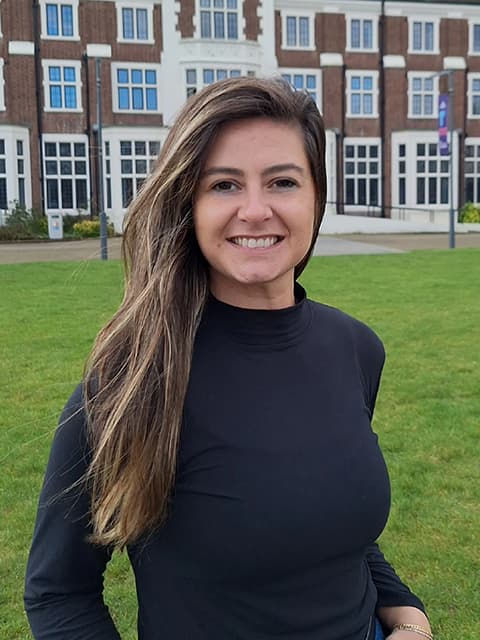
Sabrina Furtado is a Lecturer in Sport Management and Dean’s Associate Fellow at Loughborough University’s School of Sport, Exercise and Health Sciences. She holds a BSc, MSc, and PhD. Previously, she taught at the Federal University of Paraná and State University of Santa Catarina in Brazil, focusing on sport management, sports law, and entrepreneurship in the sports sector. Her research focuses on sports governance, strategic planning, and policy development in public and private sports entities. Key areas include Olympic and Paralympic federations, sports financing, and the impact of media representation on disability inclusion. She contributes to the Sport, Business and Society and Lifestyle for Health and Wellbeing research groups, as well as the Inteligência Esportiva Research Institute . Recent work analyzes governance structures in Santa Catarina municipalities, business intelligence applications in sports management, and modernization processes in Brazilian Olympic federations. Her publications span topics like Paralympic organizational roles, media stigma in disability sports reporting, and funding mechanisms for sports initiatives. No scientific awards are mentioned. Sabrina advises master’s students on sport management and policy but no grant details are provided. Her current projects aim to strengthen sports policies and enhance stakeholders’ engagement in the sport system.
Gareth Hall is a Senior Lecturer in Psychology at Aberystwyth University's Department of Psychology, where he has been an established member since the department's founding in 2007. He holds a PhD from Glamorgan University and is a Chartered Member of the British Psychological Society (BPS) and a Fellow of the Higher Education Academy (FHEA). His academic career includes significant administrative roles such as Examinations Officer (2007-2014, 2016), Senior Tutor (2014), and Acting Director of Admissions and Recruitment (2009, 2011). Dr. Hall's research focuses on social psychology with particular expertise in social identity theory applied to real-world contexts. His work spans sport psychology, examining sport for development programs, intergroup behavior in fandom, and well-being in physical culture communities like CrossFit. He has pioneered research testing laboratory theories in real-world settings, challenging traditional experimental paradigms through creative methodologies that incorporate digital technologies and interdisciplinary approaches. His publication record shows consistent output since 2006, with significant contributions in 2019-2023 focusing on sport psychology applications in Brazil, forensic psychology, and educational technology. His work demonstrates a clear trajectory toward interdisciplinary collaboration, particularly in sport for development contexts and the application of social identity theory to complex social issues. Scientific Awards and Recognition: Teaching and Learning Improvement Award from Aberystwyth University (2011) Active editorial roles including for Frontiers in Sports and Active Living (2021) and Bulletin of Latin American Research (2019) Dr. Hall has secured research funding from prestigious organizations including the Economic and Social Research Council (2018) and British Council (2015). His external engagements include committee membership with the British Psychological Society's Undergraduate Education Committee (2015-present), AQU Catalunya (2022-2023), and visiting researcher positions at the University of Padua (2017-2018). His work contributes to multiple UN Sustainable Development Goals, particularly those related to social development and inclusion.
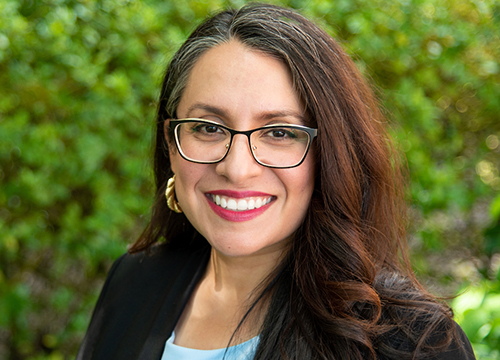
Katherine C. Rodela is an Associate Professor and Interim Chair in the Department of Educational Leadership and Sport Management at Washington State University Vancouver, part of the College of Education, Sport, and Human Sciences. She is a community-engaged scholar committed to advancing equity and justice in education through research, teaching, and outreach. Her educational background includes a Ph.D. from Stanford University’s Graduate School of Education and a BA in Philosophy and History from Seattle University. She is a former Fulbright Scholar with research experience in civic engagement in Peru. Dr. Rodela's research focuses on leadership for equity and social justice, particularly the leadership of Latinx communities, parents, and educators. Her work explores how leaders of color navigate equity initiatives, how marginalized families advocate for justice, and how educational leadership can be redefined to include youth, parents, and community members. She uses qualitative methods, especially LatCrit counterstorytelling, to center the voices of those often excluded from leadership narratives. Her recent publications reflect a strong trend in examining Latinx leadership pathways, community cultural wealth, gender and LGBTQ+ inclusion, and activism in conservative educational settings. These works are published in leading journals such as Educational Administration Quarterly , Peabody Journal of Education , and Teachers College Record . George Brain and Gay Selby Faculty Award in Educational Leadership Fulbright Scholar She actively mentors future educational leaders and collaborates with community partners such as the SW Washington Latino Parent Leadership Institute. Her research includes longitudinal studies on Latinx parent leadership and equity leadership during politically divisive times. She has also contributed to special issues and conceptual frameworks that challenge traditional notions of educational leadership and advocate for more inclusive, justice-centered models.
David Imhoof is Professor of History at Susquehanna University and serves as the NCAA Division III Faculty Athletic Representative. He has twice chaired the History Department (2006-2015, 2020-2023) and directed the Global Opportunities (GO) Austria study abroad program since 2010. His research focuses on cultural and political history in 20th-century Germany with particular emphasis on Göttingen between the World Wars. Education : Ph.D. in History from the University of Texas at Austin, B.A. in History and Liberal Arts from Trinity University. Imhoof's research explores how cultural practices like sports, music festivals, and film shaped political integration in Weimar and Nazi Germany. His current projects include a biography of a Nazi mayor and a history of Germany's 20th-century recording industry. He has published extensively on topics ranging from the Total Work of Art concept to sound studies in German contexts. His recent publications form trends in cultural history, media studies, and political integration analysis. These works examine how music, sports, and film served as vectors for both traditional values and ideological transformation during Germany's turbulent 20th century. Scientific Awards : Multiple Susquehanna Research Grants, DAAD Fellowship, Nachtegall Junior Scholar Award, and Presidential Scholar at Trinity University. Imhoof advises senior theses and independent study projects. He has led assessment reforms in Susquehanna's history department and coordinated over $3,500 in donor campaigns. As director of GO Austria, he develops international curricula and faculty training programs. He co-founded Susquehanna's Holocaust-Genocide Studies Group (2000-2014) and leads a rock band Faculty Lounge with fellow professors. His service includes NCAA representation, university strategic planning, and organizing academic events ranging from opera performances to Holocaust survivor talks.
Matthew Holmes is a Lecturer in Management at the University of York's School for Business and Society, where he leads the MSc International Business Management program. His research employs sociological frameworks to analyze sport-for-development initiatives in Zambia, particularly focusing on poverty alleviation and UN Sustainable Development Goals. Methodologically, he uses participatory approaches and interdisciplinary theory. His publications critically examine power structures in international development, with recent work applying postcolonial theory to decolonize research methods. Articles emphasize socio-economic inequality, community agency, and gender equity in least developed countries.
Ramón Spaaij is a Professor in the College of Sport, Health and Engineering at Victoria University and holds a Professorial Chair in Sociology of Sport at the University of Amsterdam. He leads the Sport in Society Research Program at IHES and was previously a Senior Research Fellow at La Trobe University, where he served as Deputy Director of the La Trobe Refugee Research Centre. His educational background includes an MA from Leiden University and a PhD from the University of Amsterdam. Spaaij’s research centers on social cohesion, conflict, and social change through two primary lenses: the sociology of sport and the sociology of terrorism. He investigates how sport influences diversity, inclusion, and community belonging, particularly through initiatives like sport for development and youth engagement. Simultaneously, he conducts internationally recognized research on violent extremism, with a focus on lone wolf terrorism, radicalization pathways, and counterterrorism strategies. His recent publications reveal a strong interdisciplinary focus, bridging sociology, criminology, and sport studies. The articles demonstrate recurring themes in both sport-related social dynamics and terrorism studies, with consistent attention to identity, exclusion, and structural violence. He frequently collaborates with scholars across disciplines and countries, contributing to handbooks, journals, and policy-oriented research. Victorian Department of Health and Human Services (2015): Sport integrity analysis DST Group – VU Industry Postdoctoral Research Fellowship (2015–2018): Online/offline radicalization Australian Research Council Linkage Project (2014–2017): Managing diversity in junior sport Youth & Identity Grant, Utrecht University (2013–2015): Youth violence in football National Institute of Justice, USA (2012–2015): Lone wolf terrorism prevention He has completed supervision of 5 Honours, 11 Masters, and 1 PhD student, and currently mentors 5 PhD, 4 Master’s, 1 Honours student, and 2 postdoctoral fellows. He is affiliated with several professional associations including the International Sociological Association and the Australian Sociological Association. Spaaij is also a frequent contributor to international media on topics related to sport and extremism.
Dr Martin Toms is Associate Professor of Global Sport Education & Coaching and Head of Global Engagement at the School of Sport, Exercise and Rehabilitation Sciences, University of Birmingham. He is an expert in youth sport, talent identification and development, and sport education from international and socio-cultural perspectives, with extensive collaborations in India and with the PGA of GB&I. Education: BA (Hons) Sport Science and English Literature, University of Surrey, 1993 MPhil Youth Sport & Education, University of Brighton, 1997 Cert Ed (Post-Secondary Education), University of Plymouth, 2000 PhD Youth Sport Talent & Developmental Socialisation, Loughborough University, 2005 Dr Toms' research focuses on youth sport in international contexts—especially India—talent development, socio-cultural dimensions, grassroots sport, and sport education programs. His work emphasizes cultural and cross-cultural understanding in sport systems. He has edited key texts such as the Routledge Handbook of Golf Science and Sports Science in India: Practice and Perspective , and his recent publications reflect a strong trend in athlete development pathways, talent systems, and critical analyses of sport policy and practice globally. Scientific Awards and Recognition: Fellow of the Higher Education Academy (FHEA) Dr Toms actively supervises doctoral and postgraduate students on topics including talent identification in Indian sport, elite cricket development, and professional journeys in golf. He has secured research funding and consultancy projects in China and Europe and is an adjunct Professor at the University of Regina, Canada. He plays a key role in transnational education and has served as Emeritus Editor-in-Chief of the International Journal of Golf Science and co-editor of the European Journal for Sport & Society . He is also a board member of the World Scientific Congress of Golf. Labs and Research Teams: While not tied to a specific lab, Dr Toms leads global engagement initiatives and collaborates with international institutions and research networks focused on sport development, talent systems, and educational reform in sport.
Dr Paul Widdop is a Professor in Sport Business at Manchester Metropolitan University's Business School. He holds a PhD from the University of Manchester and is a core member of Edinburgh University's Academy of Sport. His research focuses on the economic networks and geopolitical dimensions of sport, employing social network analysis to explore relational dynamics in consumption and production. Widdop has authored 11 books including 'The Business of the FIFA World Cup' and 'Handbook of Football Business and Management', alongside over 40 peer-reviewed articles. Education: PhD in Social Change & Statistics (University of Manchester), MSc in Social Research Methods & Statistics (University of Manchester). Research Interests: Geopolitical economy of sport, social network analysis methodologies, sport policy, fan culture, and global sport networks. He examines intersections between economics, politics, and sociology in sport contexts. Professional Affiliations: Reviews Editor for the Journal of Consumer Culture, Mitchell Centre member (University of Manchester), co-founder/Chair of the Football Collective research community. He actively engages in policy briefs addressing sport's societal impact, including responses to the pandemic's effects on grassroots football. Awards: None explicitly listed, though his editorial roles and research contributions highlight professional recognition. Advising/Grants: No specific grants listed, but his prolific publications and policy engagement indicate active research collaboration. Advises through academic mentorship in sport business and management. Labs/Teams: Leads the Football Collective, a vibrant academic network studying football's socio-economic impacts. Collaborates with institutions like the Mitchell Centre for Social Network Analysis.
Marco Williams is a Professor in the Department of Radio/Television/Film at Northwestern University's School of Communication, where he leverages documentary filmmaking to explore critical intersections of race, history, and justice in America. An acclaimed director with over three decades of impactful work, his films serve as vital educational resources and catalysts for national dialogue on social issues. His academic foundation includes: MFA in Afro-American Studies, UCLA MFA in Producer’s Program, UCLA BA in Visual and Environmental Studies, Harvard University Williams' research centers on documentary as a tool for social change, with primary focus on African American historical narratives, civil rights legacies, and systemic inequities. His cinema verite approach combines rigorous scholarship with compelling storytelling to illuminate underrepresented perspectives and challenge dominant historical narratives. This methodology has established him as a leading voice in visual anthropology and critical race studies within media production. His filmography reveals consistent thematic evolution toward deeper examinations of institutional racism and resilience, with recent works expanding into educational equity and cultural memory. Williams' films frequently bridge academic research and public engagement through PBS broadcasts, film festival circuits, and community screenings that spark participatory dialogue. His extensive honors include: Emmy Award for Freedom Summer George Foster Peabody Award for Two Towns of Jasper Alfred I duPont Silver Baton Guggenheim Fellowship Lehman Brady Visiting Professorship at Duke/UNC National Association of Black Journalists Award Pan African Film Festival Awards Williams maintains significant academic influence through his professorship at Northwestern and previous role at NYU's Tisch School of the Arts, where he shaped emerging filmmakers' approaches to ethical storytelling and social documentation.
Andrew Jones is an Assistant Professor (Research) at the Research Centre for Business in Society (CBiS) at Coventry University. His research focuses on sustainable transport, accessibility, transport policy, and their economic impacts. He holds a PhD from the University of Wolverhampton (2014), examining Foreign Direct Investment in the English Premier League. Prior to CBiS, he evaluated the ERDF-funded KEEN programme. His work spans projects for ESPON, DEFRA, and Coventry City Council, addressing sustainable transport solutions and rural connectivity challenges. He has published in journals like Transportation Research Part A and Journal of Rural Studies, and contributes to teaching cases on post-pandemic transport recovery. His vision emphasizes inclusive, net-zero transport systems addressing accessibility gaps. Education: PhD in Business Management (University of Wolverhampton, 2014) MA in International Business BA in Business Management Research Interests: Sustainable Transport & Electric Vehicles Transport Policy & Economic Development Urban-Rural Connectivity Social & Economic Impacts of Transport Knowledge Transfer in Sport Management His recent work explores stakeholder engagement in transport innovation, post-pandemic mobility trends, and policy frameworks for decarbonization. He collaborates with EU projects like KEYSTONE to enhance transport ecosystems. Key outputs include analyses of EV adoption barriers, rural electrification trials, and Olympic legacies. Consultancy & Activities: Transport Policy Advisor for UK Government Departments Co-Investigator on 10+ research projects (2014–2025) Guest Lecturer in Sustainable Supply Chains Labs & Collaborations: Active in CBiS, collaborating with institutions across Europe on transport sustainability and regional development. His work aligns with UN SDGs 7 (Clean Energy), 9 (Industry/Infrastructure), 11 (Sustainable Cities), and 13 (Climate Action).
Dr Daniel Kilvington is a Senior Lecturer and Course Director in Media and Cultural Studies at Leeds Beckett University. He is a leading expert on race, racism, and anti-racism in sports and new media, with a focus on British South Asian exclusion in English football. Key affiliations: Leeds Beckett University, Zesh Rehman Foundation (Trustee), West Riding County FA Inclusion and Advisory Group. Collaborations include the English Premier League, Kick It Out, FARE, and ECB. Research interests: His work examines online harms in sports, institutional racism in football, anti-racist pedagogy in coaching, and structural inequalities affecting British South Asians in football. He has authored five books and co-founded the Sport and Discrimination Conference series. Articles trends: His recent publications highlight social media as a new frontier for racism, the need for institutional accountability, and the role of education in combating discrimination. Themes include British South Asian football communities, digital hate speech, and grassroots reform. Grants: He has secured funding from the Arts and Humanities Research Council (AHRC) and the British Academy for research on inclusive sports environments. Initiatives: Created the Creating and Developing Coaches program to address exclusion in football coaching. Media presence: Regularly featured in Sky Sports News, BBC Radio 5 Live, and The Guardian.
Dr. Konstantin Aal is a researcher at the Department of Business Informatics and New Media within the Faculty of Information Systems and New Media at the University of Siegen, Germany. Having joined the university in 2012 after completing his studies in Business Informatics there, Dr. Aal has established himself as a prominent researcher at the intersection of technology, social activism, and human-computer interaction. Dr. Aal's educational background is rooted in Business Informatics at the University of Siegen, where he also completed his major dissertation on the social platform come_NET and its use by children as part of the come_IN project. His academic journey reflects a consistent focus on the social implications of technology. His research interests span several critical areas in contemporary socio-technical studies. Dr. Aal investigates how social media platforms are used in political conflicts and activism, particularly in the Middle East and North Africa region, with specific attention to the Palestinian-Israeli conflict and content moderation practices. He also explores human-technology interaction in contexts of aging and dementia care, human-wildlife conflict, and the digital transformation of rural communities. His work consistently emphasizes participatory design approaches, ethical considerations in technology development, and the importance of cultural sensitivity in global technology deployments. Dr. Aal's publication record shows a strong trajectory of impactful research, with particular emphasis on understanding how marginalized communities appropriate technology for their needs. His recent work on the "PlurAIverse" concept expands design paradigms for artificial intelligence to be more inclusive and culturally sensitive, while his ethnographic work in conflict zones reveals critical insights about digital activism under surveillance. Member of the research team for iStoppFalls (fall prevention for elderly) Contributor to multiple EU-funded projects on digital inclusion and socio-informatics Active participant in the Socio-Informatics research program at the University of Siegen Dr. Aal's work bridges theoretical insights with practical applications, often developing technologies in close collaboration with community stakeholders. His approach emphasizes "grounded design" - developing technological solutions that emerge from deep understanding of local practices and needs.
Dr. Jamie Sommer is an Associate Professor in the Department of Sociology & Interdisciplinary Social Sciences at the University of South Florida's College of Arts and Sciences. Her research focuses on how institutional structures, governance, and external factors like multinational corporations and NGOs influence environmental and development outcomes. She holds a Ph.D. from SUNY Stony Brook (2018) and has conducted extensive cross-national studies on forest loss, corruption, and climate policy. Education: Ph.D., State University of New York at Stony Brook, 2018 Her work examines state capacity's role in environmental health, with recent projects analyzing how global trade, governance quality, and gendered resource rights affect forest ecosystems. She collaborates with UN agencies to evaluate climate adaptation programs in developing nations. Key themes in her research include: Environmental governance and policy effectiveness Ecologically unequal exchange Corruption's environmental impacts Gender and environmental citizenship Her 15 most recent articles (2023–2025) reveal a focus on cross-national analyses of forest loss drivers, including tax policies, NGO interventions, and transnational corporate practices. She critiques how global systems perpetuate environmental inequities while advocating for governance reforms to protect ecosystems and marginalized communities. Collaborations include the UNFCCC Gender Division and transnational advocacy networks in Asia. No advising or grant details are explicitly stated in the provided materials.
S. Alexander Haslam is a Professor of Social and Organizational Psychology and Laureate Fellow at the University of Queensland's School of Psychology, where he maintains an active research program with over 300 peer-reviewed articles and 15 authored or edited books. He currently serves as Associate Editor of The Leadership Quarterly and previously held the Chief Editor role for the European Journal of Social Psychology . His work bridges academia and real-world application through interventions like Groups 4 Health and More Than Sport, targeting mental health via social identity principles. Haslam's research centers on social identity theory and group processes across organizational, health, and social contexts. He examines how shared identities influence leadership, mental health outcomes, and collective resilience, with key applications in workplace stress, athletic performance, retirement transitions, and emergency response interoperability. His social identity model of leadership challenges traditional views by emphasizing group-based influence, while interventions such as social identity mapping directly address loneliness through community identification. The 2025 articles reveal three dominant trends: (1) mental health applications in high-stress occupations (construction, emergency services), (2) identity leadership in sports across cultures, and (3) organizational identity in crisis scenarios. Methodologically, they feature randomized controlled trials, longitudinal designs, and cross-national collaborations—particularly in Japan and Europe—validating the social identity approach for loneliness reduction, team performance, and ethical behavior. Common threads include psychological safety, group membership multiplicity, and intervention scalability. Scientific awards include Distinguished Contribution to Psychological Science from both the Australian Psychological Society and British Psychological Society, plus his 2022 appointment as a Member of the Order of Australia for 'significant service to higher education, particularly psychology, through research and mentoring.' While specific grant details are absent, his work is embedded in major collaborative projects like the Global Identity Leadership Development Project and pandemic response studies. He mentors researchers globally, with his leadership evident in large-scale cross-cultural teams (e.g., 25+ co-authors on Capitol attack analysis). Policy impact is demonstrated through advisory roles in social prescribing and mental health frameworks. Haslam co-leads the Groups 4 Health intervention team and develops tools including the Identity Leadership Inventory–Youth (ILI-Y) and Visual Identity Leadership Scale (VILS). His research group collaborates across sports, clinical, and emergency domains, with ongoing projects on psychedelic therapy, retirement transitions, and AI-human interaction. The BBC Prison Study remains a foundational reference for his organizational identity work.
Fiona Catherine Chambers is a Full Professor of Education at University College Cork (UCC), Ireland, with over 30 years of transformative experience in the field. She is an internationally recognized leader at the intersection of sport, education, and innovation. Her leadership roles include President of AIESEP, Vice-President of CEREPS, UNESCO CIGEPS Observer, and Expert Advisor for UNESCO's Global Observatory for Gender Equality in Sport. In March 2025, she was awarded the status of Honorary Network Member of Network 18 Research in Sport Pedagogy by the European Educational Research Association Council. Professor Chambers' research spans three key areas: sport, innovation, and education, with a particular focus on research for social impact. Her work encompasses sport pedagogy, physical education, design thinking, digital wellbeing, motor competence, and physical literacy. She has pioneered numerous initiatives including StrategicDesign@UCC (founded in 2020), the Master of Arts and Postgraduate Diploma in Innovation through Design Thinking, the Global Design Challenge for Sport and Physical Activity, AIESEPConnect, Made2Move, and All Island All Active. Her publications reveal a consistent focus on wellbeing, physical activity, and innovative pedagogical approaches in education. Her research portfolio demonstrates a strong emphasis on addressing complex societal challenges through transdisciplinary methodologies, particularly human-centered design thinking. Professor Chambers has secured millions in funding for her projects from various sources including the Higher Education Authority, ERASMUS, and Horizon Europe. Her work bridges theory and practice, empowering individuals across sectors to tackle societal challenges through innovative thinking and collaborative action. Honorary Network Member of Network 18 Research in Sport Pedagogy (awarded March 2025) 2023 inaugural Women in Business in Sport award Consistently recognized among the 50 most influential women in Irish sport Professor Chambers has secured substantial research funding for numerous projects, including the PGDip Innovation Through Design Thinking (€1,440,000 from HEA), Spring 3.0 (€75,000 from ERASMUS), and Icehearts Europe (€252,807 from Horizon Europe). As a two-time TEDx speaker, she has demonstrated the powerful impact of combining strategic leadership with passionate advocacy. Her expertise is sought globally, reflected in Visiting Professor appointments across four international institutions and ongoing consultancy work with universities, sporting organizations, and global businesses. Through StrategicDesign@UCC and initiatives like Made2Move and the Global Design Challenge, Professor Chambers has created platforms that bring together academics, practitioners, and students to address complex challenges in sport, physical activity, and education. Her transdisciplinary approach has fostered collaborations across multiple sectors and institutions, both nationally and internationally, creating a vibrant ecosystem for innovation and research in education and sport.