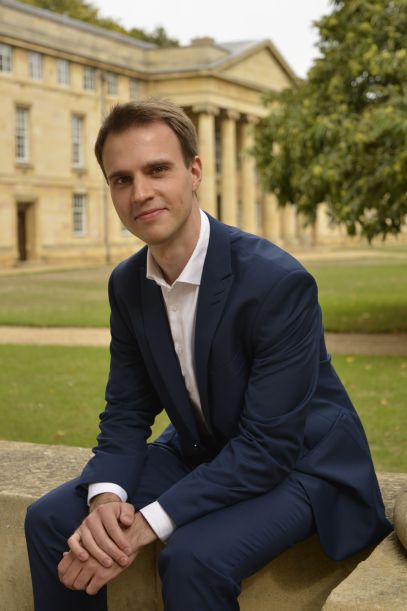
Dmitrij Szamozvancev serves as a Fellow in Computer Science and Technology at Downing College and a Postdoctoral Researcher in the Department of Computer Science at the University of Cambridge. He holds the academic rank of Associate Professor and acts as Director of Studies for IB Computer Science students, overseeing undergraduate supervision in theoretical computer science courses. Education: MEng degree (institution not specified) His research centers on abstract mathematical methods for programming language theory, specializing in formal syntax representation for computer verification and metaprogramming. He investigates foundational models in proof assistants and functional languages, with particular expertise in reactivity, partial evaluation, and reflective programming systems. This work bridges theoretical computer science with practical language implementation challenges. Analysis of his 2017-2022 publications reveals consistent focus on mathematical structures in language design, particularly category theory applications in reactive GUI systems and syntax formalization. His work demonstrates strong interdisciplinary connections between type theory, metaprogramming, and domain-specific language engineering. Szamozvancev's teaching philosophy emphasizes abstract pattern recognition across mathematics and computer science. As Director of Studies, he mentors IB Computer Science students with a focus on theoretical foundations, aiming to reduce cognitive load through unifying conceptual frameworks in complex technical domains.
Małgorzata Plechawska-Wójcik is an Assistant Professor at the Lublin University of Technology, affiliated with the Faculty of Electrical Engineering and Computer Science and the Department of Computer Science. Her research focuses on bioinformatics, software engineering, GUI usability, and interdisciplinary applications of machine learning in healthcare and neurology. She leads or contributes to projects such as the T1DCoach diabetes management application and the Integrated Development Programme of the university. Her work spans comparative analyses of programming frameworks, database systems, and game engines, emphasizing performance optimization and usability. Education details are not explicitly listed, but her academic role indicates advanced qualifications in engineering and computer science. Current projects include collaborations with ANMC, Moodle, and Eduroam initiatives, alongside research into schizophrenia detection via retinal measures and EEG analysis. Research interests include: Bioinformatics : Leveraging machine learning for medical diagnosis (e.g., schizophrenia detection via optical coherence tomography and neural networks). Software Engineering : Comparative studies of frameworks (React.js, Solid.js), scripting languages (JavaScript, Kotlin), and database mapping tools (NuGet). Human-Computer Interaction : Evaluating GUI usability in e-commerce, streaming services, and serious games for education and healthcare. Publications highlight trends in: Machine learning applications in neuroscience and healthcare. Performance benchmarking of web, mobile, and game development tools. Comparative analyses of frameworks and architectures (e.g., Spring vs Laravel, Godot scripting languages). Notably, she has been honored with the Merit Medal for the City of Lublin alongside colleagues from the Computer Science Department. Her advising and grant involvement include project management tools, serious games for first aid training, and environmental monitoring systems using Arduino platforms. Key labs and initiatives include collaborations with the Katedra Informatyki (Computer Science Department) on projects like LubGame Conference and the Moodle integration for educational tools. Her work bridges theoretical computer science with practical applications in healthcare, education, and industry.
Gianvito Urgese is an Associate Professor at the Interuniversity Department of Territorial Sciences, Planning and Policies (DIST) at Politecnico di Torino, where he is also a member of the EDA research group and the SmartData@PoliTO Big Data and Data Science Laboratory. His academic and research activities are deeply integrated into the Department of Control and Computer Engineering (DAUIN), reflecting his interdisciplinary focus on computer engineering and data science. His research spans artificial intelligence, bioinformatics, neuromorphic computing, edge computing, embedded systems, and Industry 4.0. He investigates optimized task-specific algorithms, designs heterogeneous software-hardware architectures for bioinformatics acceleration, and develops computational paradigms for neuromorphic platforms. His work also extends to digital lifecycle management in Industry 4.0, aligning with Sustainable Development Goals 9, 11, and 12. His recent publications reveal a strong trend in neuromorphic computing and quantum-inspired optimization, with contributions to benchmarking frameworks (NeuroBench), neuron-based encoding tools (WiN-GUI), and quantum annealing methods. These works are published in high-impact journals such as Nature Communications , IEEE Transactions on Emerging Topics in Computing , and Science Translational Medicine , indicating a multidisciplinary and high-impact research profile. Urgese is actively involved in supervising PhD students and teaching graduate-level courses such as Neuromorphic Computing and Engineering, Applied AI and Machine Learning, and System-on-Chip Architecture. He serves on doctoral colleges and course committees, demonstrating leadership in academic governance. Scientific and Research Leadership: Principal Investigator (Scientific Manager) in multiple commercial research projects on data analytics, fog computing, and firmware design (2019–2025). Supervision of PhD research on neuromorphic systems, bioinformatics algorithms, and AIoT solutions. Active contributor to European-funded initiatives in neuromorphic and Industry 4.0 domains. He collaborates with multidisciplinary teams, including researchers at the Candiolo Cancer Institute and participants in the Telluride Neuromorphic Cognition Engineering workshop, highlighting the collaborative and applied nature of his work.
Yue Jiang is an incoming Assistant Professor at the University of Utah (Fall 2025) and is currently finishing her Ph.D. at Aalto University and the Finnish Center for Artificial Intelligence (FCAI). Her research focuses on human-centered technologies in HCI, computer vision, and deep learning, particularly in computational user interface understanding, eye tracking, and adaptive GUI layouts. She has held visiting roles at Carnegie Mellon University (CMU) and collaborated with institutions in Canada and the UK. She serves on program committees for CHI, VL/HCC, and IUI, and has organized computational UI workshops at CHI conferences. Education: Ph.D. in Intelligent Systems (Aalto University & FCAI, 2025) Visiting Ph.D. Student (CMU, 2024) M.Sc. in Computer Science (University of Maryland, 2020) B.Sc. in Computer Science (University of Toronto, 2018) Research Interests: Yue explores computational representations of UIs, human behavior modeling via eye tracking and motion capture, and adaptive interfaces. Her work bridges HCI, computer vision, and machine learning to enhance human capabilities through AI-driven systems. Awards: Meta Research PhD Fellowship (2023–2025) Heidelberg Laureate Forum Young Researcher (2024) Google Europe Students with Disabilities Scholarship (2022) Advising & Grants: Yue mentors students in areas like multimodal generative AI and seeks researchers for her group. She has received grants from FCAI, Adobe Research, and the National Science Foundation. Labs & Collaborations: Active in the Computational Behavior Lab (Aalto) and BIG Lab (CMU), she collaborates on projects like OR-Constraints for adaptive GUIs and graph-based UI modeling.
Mark Grechanik is an Associate Professor in the Department of Computer Science at the University of Illinois Chicago, affiliated with the College of Engineering. With a Ph.D. in Computer Science from the University of Texas at Austin (2006), he has over 30 years of experience as a software consultant for startups and Fortune 500 companies. His research focuses on software systems, security, and quality assurance, with a strong emphasis on automated testing, cloud computing, and data privacy. Ph.D., The University of Texas at Austin, 2006 His work addresses critical challenges in software testing, including integration testing automation (ASSIST project), database deadlock prevention, GUI test script analysis, and cloud elasticity optimization. He has developed techniques leveraging static/dynamic analysis, machine learning, and accessibility technologies to improve test efficiency and fault detection. Grechanik’s research has been recognized with best paper awards at SEKE 2019 and ICST 2009. He has secured funding from the NSF and Microsoft, and his innovations are commercialized through 37 patents. His publications span top venues like ICSE, ICST, ASE, and journals such as Empirical Software Engineering and IEEE Transactions on Software Engineering. He has served as General Chair of ICST 2016, member-at-large of the ACM SigSoft committee for nine years, and on editorial boards including Springer’s Empirical Software Engineering Journal. Grechanik is a senior member of ACM and IEEE.
Dr Yanlong Zhang is a Senior Lecturer at Manchester Metropolitan University. He holds a PhD in Software Engineering and a PGCE in Higher Education, complemented by industry experience as an Assistant Engineer, Engineer, and Teaching Assistant. His research focuses on web engineering, including web measurement, security, and games design, with particular attention to software metrics and user interface design. Teaching responsibilities include undergraduate modules on web design and development, computer systems, game design, and human-computer interaction, as well as postgraduate courses in information systems. His work explores GUI generation using GANs, structural similarity in source code, and navigability metrics for websites. Research outputs span topics like melanoma classification via image similarity and quality analysis of software architectures. His publications demonstrate expertise in both theoretical frameworks (e.g., HASARD model) and applied systems (e.g., MEIC design). Office hours are Monday 10-11, 1-2, and Thursday 10-11. Proficient in English, Chinese, and basic Japanese/German, Dr Zhang contributes to education and industry through his roles as a Fellow and teaching-focused academic. His work bridges software engineering principles with practical web development challenges.
Irena Yulkova Avdjieva is an Assistant Professor at the Faculty of Mathematics and Informatics, Sofia University St. Kliment Ohridski, specializing in Information Technologies. Her research focuses on interdisciplinary methods at the intersection of computational biology, phylogenetics, and big data analysis. Key Research Areas: Phylogenetic tree visualization, gene duplication dynamics, and functional annotation of plant genomes Projects: Lead research on data analysis techniques for big sequencing datasets (contract DFNI-102/7, 2014) Expertise: Combines evolutionary biology with advanced computational approaches Her publications (2012-2016) demonstrate expertise in phylogenetic analysis tools, gene duplication patterns in grasses, and parallel computing methods for genomics. She contributes to developing bioinformatics solutions like PhyloEdit for evolutionary data visualization. Current work emphasizes knowledge discovery in biological datasets through computational frameworks and algorithm optimization for next-generation sequencing applications.
Mohammad Ali Darvish is a Senior Lecturer in the Department of Computer Science at Johns Hopkins University , specializing in software engineering , software testing , and computer science education . He has held teaching positions since at least 2006 and currently works from Malone Hall in Baltimore, Maryland. Education PhD in Computer Science (2015), Iowa State University MSc in Software Engineering (2010), Chalmers University of Technology, Sweden His research focuses on improving software testing methodologies , particularly for graphical user interfaces , and developing automated testing frameworks . He also contributes to computer science education reform , most notably through the Gateway Computing curriculum for engineering majors. Recent publications demonstrate expertise in: GUI Testing (2014-2015) Health Informatics (2011) Software Verification (2010) AI Research Frameworks (2006) Contact: darvish@jhu.edu | Department Website | Google Scholar
Kyle Boyd is a Lecturer in Interaction Design at the Belfast School of Art within Ulster University. Based at the Belfast campus, he contributes to the Art and Design Research group. PhD in Computer Science (Ulster University, 2014) MA in Multidisciplinary Design (Ulster University, 2009) BSc (Hons) in Interactive Multimedia Design (Ulster University, 2007) His research focuses on Interaction Design , User Experience , and Digital Health , with particular emphasis on: Usability engineering for aging populations Trust analysis in mental health chatbots Sustainable design practices aligned with UN SDGs Co-creation methodologies in health technology Recent publications reveal a strong focus on chatbot usability , dementia care applications , and temporal bias in UX measurement . His work bridges Human-Computer Interaction with healthcare innovation through projects funded by: InvestNI InterTrade Ireland European Union programs ESPRC Interreg Notable achievements include: 2024: Outstanding Interdisciplinary Research Team Award 2025: Senior Fellowship in Higher Education Academy 2018: Fellowship in Higher Education Academy He actively contributes to academic service as: External Examiner (University of Limerick, ongoing since 2025) Conference organizer (15th Irish HCI Symposium, 2022) Industry consultant (UX evaluation of business simulation interfaces)
João Coelho Garcia serves as an Assistant Professor at Instituto Superior Técnico, University of Lisbon, and is affiliated with the Distributed Systems Group at INESC ID Lisbon. His academic responsibilities include teaching courses in Mobile and Ubiquitous Computing, Distributed Systems, and Operating Systems, Virtualization and Cloud Computing for the 2025/2026 academic year. Dr. Garcia's research spans distributed systems, cloud computing, and operating systems with specialized focus on consistency models, fault tolerance mechanisms, and privacy preservation in distributed environments. His work addresses critical challenges in serverless computing architectures, error reporting systems, and resource elasticity for cloud-native applications. The interdisciplinary nature of his research extends into public health and economics through studies on labor supply impacts from congenital disabilities and childcare policy effectiveness. Analysis of his recent publications reveals dominant trends in distributed systems consistency (particularly causal and cross-service models), privacy-enhanced fault replication, and predictive elasticity for cloud workloads. His research bridges theoretical distributed systems concepts with practical applications in serverless functions, error reporting systems, and cloud resource management while maintaining interdisciplinary connections to socioeconomic studies. As a core member of INESC ID Lisbon's Distributed Systems Group, Dr. Garcia contributes to advanced research in distributed computing infrastructure. The group maintains strong industry collaborations and focuses on developing next-generation solutions for consistency, fault tolerance, and privacy in modern distributed applications through both theoretical frameworks and practical system implementations.
Atif Memon is a Professor in the Department of Computer Science at the University of Maryland, College Park (UMCP), where he has been a faculty member since 2001, progressing from Assistant Professor to Associate Professor and finally to Professor in 2015. He is also a Professor at the Institute for Advanced Computer Studies at UMCP. Dr. Memon founded and heads the Event Driven Software Lab (EDSL), where his research focuses on design, development, quality assurance, and maintenance of event-driven software applications. Dr. Memon received his Ph.D. in Computer Science from the University of Pittsburgh in 2001, with a dissertation titled "A Comprehensive Framework for Testing Graphical User Interfaces." His advisors were Martha Pollack and Mary Lou Soffa. Prior to his Ph.D., he earned an M.S. in Computer Science from King Fahd University of Petroleum and Minerals in Saudi Arabia (1995) and a B.C.S. in Computer Science from the University of Karachi (1991). Dr. Memon's research primarily focuses on software testing, particularly for event-driven systems. He is renowned for designing and developing GUITAR, a model-based GUI testing framework that operates on Android, iPhone, Java Swing, .NET, Java SWT, and web systems. His work extends to Community Event-based Testing (COMET), a community infrastructure for event-based testing researchers. His research interests include: Automated GUI and mobile application testing Model-based software testing techniques Event-driven software quality assurance Testing methodologies for emerging technologies Test automation and script maintenance Flaky tests and test reliability Dr. Memon's recent publications demonstrate a strong focus on practical applications of software testing, particularly in mobile environments. His work bridges theoretical testing concepts with real-world implementation challenges, with significant contributions to GUI test automation, mobile application testing, and test script maintenance. The trend in his recent work shows increasing emphasis on mobile platforms, security testing, and addressing the challenges of flaky tests in continuous integration environments. His research spans both academic innovation and practical industry applications, as evidenced by his collaborations with companies like Google, Apple, and others. Among his notable achievements, Dr. Memon received the Best Paper Award at SECURWARE 2014 for his work on "N-Gram Based User Behavioral Model for Continuous User Authentication" and a retrospective award for the most influential paper among the papers of 2003 Working Conference on Reverse Engineering. Dr. Memon currently advises six PhD students at Maryland on various aspects of testing event-driven software systems, and so far six students have completed their doctoral thesis work under his guidance. His research has been supported by significant funding from agencies including DARPA, NSF, NIH, and NSA for projects such as "Vetting Android Applications for Security Using Graphical User Interface Logic," "COMET - Community Event-based Testing," "Algorithms and Software for the Assembly of Metagenomic Data," and "Research in Science and Public Policy for the U.S. National Security Agency." As the founder and head of the Event Driven Software Lab (EDSL), Dr. Memon leads a team focused on advancing the state of the art in testing event-driven software applications. The lab has developed several influential tools and frameworks, most notably GUITAR, which has been widely adopted in both academic and industrial settings. Dr. Memon has also been instrumental in developing community infrastructure for testing researchers through COMET, enabling uniformity in experimentation and benchmarking in event-driven software testing.
Jon Freach is an Associate Professor of Practice in the School of Design and Creative Technologies at The University of Texas at Austin, co-leading the Undergraduate Curriculum. He also serves as Head of Undergraduate Programs and is affiliated with the Center for Integrated Design. Education: Bachelor of Fine Arts in Graphic Design from SUNY Fredonia (1990), Certificate in User-Centered Design from UCLA (2005). Research focuses on civic design, urban systems, and human-centered solutions for healthcare, transit, and municipal services. His work emphasizes design thinking in public sector innovation, including projects with Bloomberg Philanthropies in cities like Lincoln, Durham, Tulsa, and New Orleans. Publications span design methodologies and civic innovation, appearing in Fast Company, The Atlantic, and Interactions Magazine. His patented innovations include wayfinding systems and GUI frameworks. Awards : Two SEGD Honor Awards for wayfinding and transit design projects Advising/Grants: Collaborates with global cities via Bloomberg-Harvard programs. Previously led design research at frog, a global design agency (2008-2018). Founded Austin Center for Design. Labs/Teams: Active in the Center for Integrated Design, blending design, technology, and policy for urban challenges.
Teresa Zigh is a Teaching Associate Professor at Stevens Institute of Technology, affiliated with the Charles V. Schaefer, Jr. School of Engineering and Science and the Department of Systems and Enterprises. She holds a PhD (1997) in Computational Linguistics, an MS (1985) in Management Science, and a BE (1978) in Chemical Engineering, all from Stevens. Her research focuses on systems dynamics, network analysis, gravitation, and stochastic processes. She has extensive industry experience, including roles at Combustion Engineering, Computer Sciences Corporation, and Computershare, where she managed large-scale financial document generation systems. Education: PhD: Computational Linguistics (Stevens Institute of Technology, 1997) MS: Management Science (Stevens Institute of Technology, 1985) BE: Chemical Engineering (Stevens Institute of Technology, 1978) Her research interests span statistics, modeling & simulation, genetic algorithms, and linguistics. Notable publications include contributions to defense acquisition systems analysis, gaming simulation for CONOPS development, and nonlinear dimensionality reduction in image processing. She actively participates in professional societies like the Systems Dynamics Society and INFORMS.
Ana Paiva is an Associate Professor at the Faculty of Engineering of the University of Porto (FEUP), where she has worked since 1999. She is also a researcher at INESC TEC's Software Engineering Group and actively contributes to the international software testing community through projects like PBGT (Pattern-Based GUI Testing) and AMBER iTest. Her roles include directing the Master in Software Engineering program at FEUP and serving in leadership capacities for conferences such as ICST and QUATIC. PhD in Electrical and Computer Engineering (2007), University of Porto Habilitation in Computer Science (2018), University of Porto MSc in Electrical and Computer Engineering (1997), University of Porto Degree in Systems and Informatics Engineering (1995), University of Minho Her research focuses on model-based GUI testing , software testing automation , and pattern-driven validation techniques . She has pioneered approaches for Android testing (iMPAcT tool), reverse engineering of GUIs (ReGUI), and multidimensional test coverage analysis (PARADIGM-COV). Current projects include PBGT (National Science Foundation funded) and TOCE (Testing Online Collaborative Editing). The 15 most recent publications reveal sustained contributions to mobile application testing (2019-2017), pattern-based testing methodologies (2017-2014), and formal GUI analysis (2013-2008). Key tools developed include PETTool, iLearnTest educational framework, and UML2Spec# translation system. She leads the Software Engineering Group at INESC TEC and manages research lab I122 (FEUP). Professional service includes ISTQB working groups, QUATIC conference leadership, and editorial contributions to journals like STVR and Software Quality Journal.
Wen-Chin Chen is a Professor at National Taiwan University in the Department of Computer Science and Information Engineering. With a PhD in Computer Science from Brown University (1984), his expertise spans algorithms , multimedia systems , and quantum computing . Previously at GTE Laboratories (1984–1987), he has taught foundational courses such as Algorithms , Mathematical Analysis of Algorithms , and Quantum Algorithms . Education: BS in Mathematics, National Taiwan University (1976) PhD in Computer Science, Brown University (1984) His research integrates design and analysis of algorithms with applications in multimedia synchronization and quantum computing . Publications reflect deep engagement with data structures , combinatorics , and real-time system design , including work on audio-video synchronization models , heap-ordered trees , and genetic algorithm optimization . Recent projects involve quantum algorithms (e.g., Shor's, Grover's) and linear algebra for geometric and matrix operations, indicating ongoing contributions to theoretical computer science and applied mathematics .