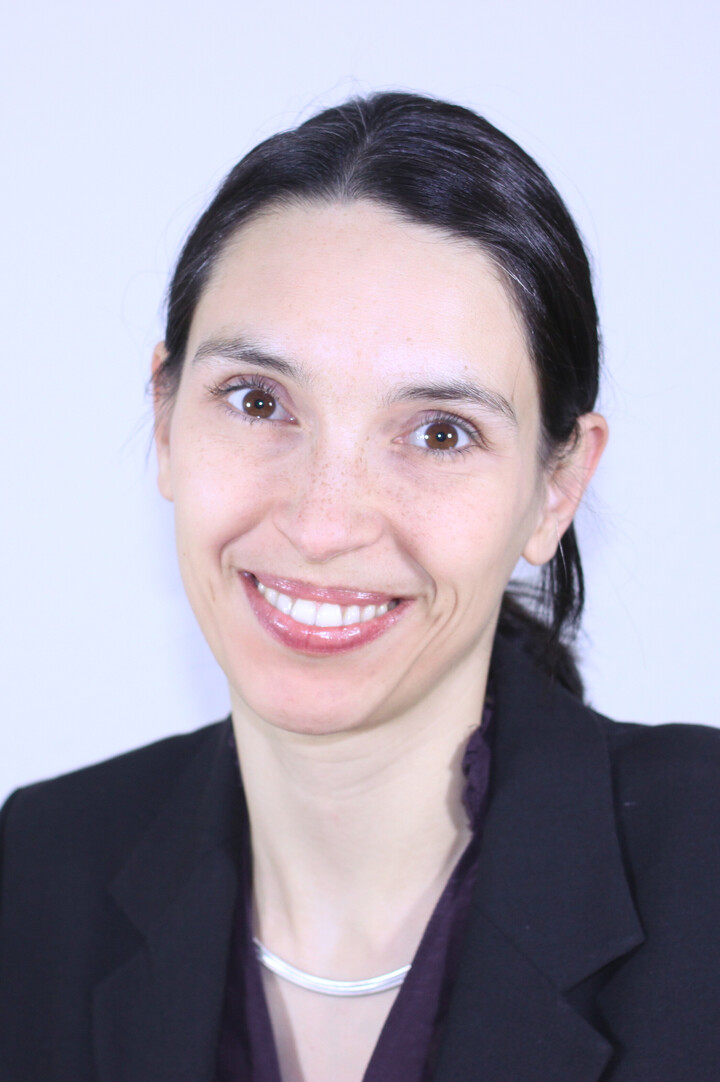
Anastasia Ailamaki is a Professor at the Swiss Federal Institute of Technology in Lausanne (EPFL), renowned for her work in database systems and data management . Her research focuses on optimizing query processing for modern hardware, particularly GPUs and heterogeneous systems, and advancing cloud data analytics with serverless architectures like PixelDB . She has co-authored influential frameworks for adaptive query optimization , hardware-conscious database engines , and model-relational data management . Key research areas: GPU acceleration , HTAP , query approximation , spatial data processing , and cloud-native databases . Recent work emphasizes cross-task optimizations in distributed environments, efficient sampling , and context-aware joins integrating vector embeddings. In 2023, she contributed to adaptive recursive query optimization and speculative K-means clustering, while 2024 publications addressed proportional caching (HPCache) and model-relational systems . Her collaborations span institutions such as MIT, Microsoft, and ETH Zurich, with publications in top venues like SIGMOD , VLDB , and ICDE .
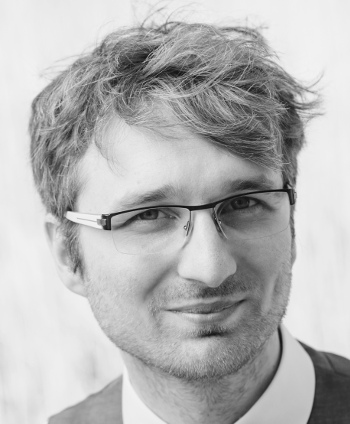
Anna Levina is an Assistant Professor for Computational Neuroscience at the University of Tübingen , affiliated with the Department of Computer Science under the Faculty of Science. Her research focuses on the self-organization of neuronal activity, critical dynamics in neural networks, and the excitation/inhibition balance in cortical circuits. Current positions: Assistant Professor (since 2018), Group Leader (2017-2018), Equality Officer (Computer Science) Previous roles: IST Fellow (2015-2017), Associated Researcher (2011-2015), Postdoc/PI (2011-2015), Postdoc (2008-2011) Her research integrates mathematical modeling , statistical physics , and computational neuroscience to study criticality phenomena, neural avalanches, and adaptive network dynamics. Key interests include: Self-organized criticality in neural systems Excitation/Inhibition balance mechanisms Network topology and dynamics Timescale analysis in neural processing Stochastic modeling of neural activity Recent publications reveal trends in understanding critical dynamics across biological and artificial networks, with applications to memory systems, sensorimotor integration, and disease modeling. She has received recognition as an IST Fellow .
Prof. Margret Keuper is a Professor of Machine Learning at the University of Mannheim's School of Business Informatics and Mathematics, leading the Data and Web Science Group. She is also affiliated with the Max-Planck-Institute for Informatics and ELLIS (fellow since 2024). Her research focuses on robust deep learning, neural architecture search, and computer vision tasks like motion segmentation and adversarial defense. She holds a PhD from the University of Freiburg and previously held positions at the University of Siegen and the University of Mannheim. Her work spans projects funded by DFG and BMBF, including Climate Visions for social media analysis and TrackOpt for motion tracking. She teaches courses on computer vision, generative models, and reinforcement learning. She actively serves on program committees for top conferences like CVPR, ECCV, and NeurIPS, and is an associate editor for IEEE TPAMI and JAIR. Education: PhD in Computer Science from University of Freiburg (advisor: Thomas Brox) Research Projects: Learning to Sense (DFG), Climate Visions (BMBF), TrackOpt (BMBF) Key Roles: Head of Mannheim Master in Data Science Examination Board, Member of MSc Business Informatics Board Her research emphasizes robustness in AI systems, with contributions to adversarial attacks, domain generalization, and efficient solvers for large-scale problems. She advises over 15 PhD students across academic and industry partnerships.
Michael Schaub is a tenure-track Assistant Professor in the Department of Computer Science at RWTH Aachen University, specializing in Computational Network Science. His research focuses on analyzing complex systems through network and graph models, integrating dynamical systems, control theory, and machine learning. He leads the Computational Network Science group, advancing methodologies for higher-order network models like simplicial complexes and hypergraphs. Schaub holds a PhD from Imperial College London and has held postdoctoral positions at MIT and Oxford. He is an ERC Starting Grant recipient (2022) and a Marie Curie Fellow, recognized for contributions to network dynamics and topological data analysis. Education: PhD in Mathematics, Imperial College London (2011-2015) MSc in Biomedical Engineering, Imperial College London (2010) BSc in Electrical Engineering, ETH Zurich (2007-2010) Research Interests: Schaub’s work spans interdisciplinary applications of network science, including biological systems, social networks, and technical infrastructures. Key areas include: Higher-order network models (hypergraphs, simplicial complexes) Graph signal processing and dynamics on networks Community detection and dynamical systems analysis Topological data analysis and machine learning Grants & Awards: ERC Starting Grant (2022): HIGH-HOPeS project Marie Skłodowska-Curie Fellowship (2017-2019) Junior Fellow, German Informatics Society (GI) Member of Junges Kolleg (North Rhine-Westphalia Academy) Labs & Teams: Leads the Computational Network Science Lab at RWTH Aachen, collaborating internationally on projects like the ELLIS Society and the European Laboratory for Learning and Intelligent Systems (ELLIS). Active in organizing workshops (e.g., Toponets, SIAM MDS).
Günter Rote is a Professor in the Department of Computer Science at Freie Universität Berlin, specifically within the Theoretical Computer Science group (Arbeitsgruppe Theoretische Informatik). He holds a formal academic title of Professor Dr. and is affiliated with the Faculty of Mathematics and Computer Science. His research focuses on theoretical computer science, computational geometry, algorithms, and discrete mathematics. Key research interests include geometric algorithms, optimization problems (e.g., shortest paths, traveling salesman problems), and algorithm design for parallel computing systems. His work spans topics such as systolic arrays, convex hulls, and combinatorial optimization. Rote’s contributions include foundational studies on computational geometry problems, algorithmic complexity, and practical applications in energy equity and infrastructure design. Publications highlight contributions to solving extremal equations, polygon transformations, and the quadratic assignment problem. He has been active in academic leadership, mentoring students, and contributing to computational science communities. His email is rote@inf.fu-berlin.de, and his office is located at Takustraße 9 in Berlin.
Prof. Dr.-Ing. Eric Sax is a Professor of Electronic Systems Engineering and Management at the Karlsruhe Institute of Technology (KIT), serving as Dean of the Department of Electrical Engineering and Information Technology (ETIT). He leads the Institut für Technik der Informationsverarbeitung (ITIV) and directs the Forschungszentrum Informatik ESS division . As Program Director of the Electronic Systems Engineering & Management (ESEM) master's program at the HECTOR School, he focuses on integrating academic and professional education. His research spans automotive systems engineering , self-learning functions , cybersecurity , and data-driven validation . Key themes include over-the-air updates, scenario-based testing, and the synergy between machine learning and automotive systems. His work addresses challenges in autonomous driving validation, software-defined mobility, and cyber-physical system security. Prof. Sax's contributions include frameworks for automotive software partitioning, cloud-enabled vehicle architectures, and methodologies for quantifying data quality impacts on perception systems. He actively collaborates with industry partners to bridge academic research with industrial application. His recent projects include OptiCAM (cloud/edge function offloading), Drive4C (autonomous driving benchmarking), and UNCOVER (data-driven security monitoring). He holds leadership roles in both KIT and the HECTOR School's technology business programs.
Marco Caccamo is a Professor at the Technical University of Munich (TUM) , holding the Chair of Cyber-Physical Systems in Production Engineering within the Faculty of Mechanical Engineering. He is also a Principal Investigator and Professor at the Department of Computer Science, with courtesy appointments in Electrical and Computer Engineering, Coordinated Science Lab (CSL), and Aerospace Engineering at the University of Illinois at Urbana-Champaign (UIUC). His research spans Embedded Systems , Real-Time Systems , and Cyber-Physical Systems (CPS) , focusing on resource management, reinforcement learning architectures, and 6D pose recognition for robotics. University of Pisa (B.Sc., 1997) Scuola Superiore Sant'Anna (Ph.D., 2002) Research highlights include predictable resource management on heterogeneous platforms, security frameworks for AI-based controllers , and UAV testbed development . His work integrates deep learning and real-time constraints in industrial applications like avionics, farming, and automotive systems. His 15 most recent publications emphasize cache optimization , memory bandwidth regulation , and reinforcement learning for CPS , with a focus on multi-core processors and DNN inference . Awards include the IEEE Fellow (2018), Alexander von Humboldt Professorship (2018), and multiple Best Paper Awards at RTSS, RTNS, and RTAS. NSF CAREER Award (2003) IEEE Fellow (2018) Alexander von Humboldt Professorship (2018) Best Paper Awards (RTSS 2024, RTNS 2023, ECRTS 2019) He has advised numerous Ph.D. students and postdocs, with a track record in UAV development and industrial collaborations . His lab, the Real-Time and Embedded System Laboratory , focuses on real-time OS and predictable computing .
Amol Deshpande is a Professor in the Department of Electrical Engineering and Computer Sciences at the University of California, Berkeley, College of Engineering. With over 160 publications spanning from 2000 to 2025, his research has significantly impacted the database systems community. His work bridges theoretical foundations with practical systems, evidenced by numerous publications in top-tier venues including SIGMOD, VLDB, and ICDE. Professor Deshpande's research focuses on database systems, with particular expertise in graph databases, data management, probabilistic databases, query optimization, and data provenance. His work addresses fundamental challenges in managing complex data, including efficient graph analytics, dataset versioning, streaming data processing, and privacy-preserving data management. Recent research directions include entity-relationship abstractions beyond traditional relations, standalone catalog engines for large data systems, and graph theoretical approaches to dataset versioning. His publication trends show a consistent focus on evolving database technologies, with early work on probabilistic databases and query optimization, transitioning to graph analytics and data provenance, and more recently addressing modern challenges in data cataloging, privacy-first data management, and serverless stream processing. His research spans both theoretical contributions (e.g., approximation algorithms for stochastic optimization) and practical systems building (e.g., RStore, TreeCat). Professor Deshpande has mentored numerous PhD students who have become active researchers in the database community, including Hui Miao, Souvik Bhattacherjee, and Konstantinos Xirogiannopoulos. His collaborative work spans across institutions, with frequent collaborations with researchers from MIT, University of Maryland, and other leading institutions. His research has been supported by major funding agencies and has influenced both academic research and industry practices in data management. The evolution of his work reflects the changing landscape of data management, from traditional relational systems to modern graph and streaming data challenges.
Ignasi Sau Valls is a Directeur de Recherche (DR2) at CNRS, affiliated with the LIRMM laboratory at Université de Montpellier, France. He is a member of the AlGCo team, focusing on algorithms for graphs and combinatorics. His academic background includes dual degrees in Mathematics and Telecommunications Engineering from UPC (Barcelona), a PhD in joint supervision between UPC and Projet Mascotte (Sophia Antipolis), and a postdoctoral position at the Technion (Israel). He has been with CNRS since 2010 and was promoted to his current role in October 2024. He also served as a Visiting Professor at UFC (Brazil) from 2016–2017. His research interests lie primarily in Graph Theory and Parameterized Complexity , with a focus on structural graph properties, kernelization, and algorithm design. He has made significant contributions to problems involving minor-closed graph classes, treewidth, and graph modification. His work bridges theoretical foundations with algorithmic applications, particularly in discrete optimization and network problems. The recent articles highlight a strong trend in parameterized algorithms, especially for graph modification, kernelization, and structural graph problems. Topics such as hitting minors, dynamic programming on tree decompositions, and edge contractions reflect a deep engagement with structural parameterizations and fixed-parameter tractability. His publications frequently appear in top-tier journals like SIAM Journal on Computing, Journal of Combinatorial Theory, and Algorithmica, as well as major conferences such as ICALP, SODA, and IPEC. Best paper award of Track C of ICALP'10 Best student paper award of WG'09 Ignasi Sau has been a principal investigator of the ANR JCJC project ELIT (ANR-20-CE48-0008-01), funded with 169k€ from 2021 to 2026. He serves as an editor for DMTCS and Information and Computation , and has held significant organizational roles, including PC member of numerous conferences (MFCS, WG, IPEC, COCOON) and as co-chair and main organizer of WG 2019, ICGT 2022, and JCALM 2023. He has delivered invited courses at international schools in France, Argentina, and Brazil. He is actively involved in the research community through editorial duties, conference organization, and collaborative research. His lab affiliation is the AlGCo team at LIRMM, a leading group in algorithmic graph theory and combinatorics.
Nuno Santos is an Associate Professor in the Department of Computer Science and Engineering at Instituto Superior Técnico (IST), University of Lisbon, and a senior researcher at INESC-ID Lisbon. He leads the SysSec team, focusing on systems security and privacy. His research spans secure enclaves, network security, and censorship-resistant systems. Education: Ph.D. in Computer Science (2013) from Max Planck Institute for Software Systems (MPI-SWS) in affiliation with Saarland University. Visiting research stints at Vrije Universiteit Amsterdam (2018) and Technical University of Munich (2024). Research Interests: Systems security, privacy, trusted execution environments (TEEs), network security, censorship resistance, AI security, and secure cloud computing. He has pioneered work on mitigating vulnerabilities in TrustZone-based TEEs and enhancing confidential computing. Publications: Over 30+ peer-reviewed articles in top-tier venues like S&P, USENIX Security, CCS, and NDSS. Recent trends focus on AI-driven security (e.g., automated exploit generation, prompt-to-SQL injections) and confidential computing (e.g., AMD SEV-SNP analysis). Awards: IST Outstanding Teaching Award (2019/2020), 2024 Prémio Científico Universidade de Lisboa/Caixa Geral de Depósitos. Advising & Grants: Supervised MSc theses in areas like AI-powered vishing attacks and confidential VMs. Active in conference organization (e.g., USENIX Security’25 Vice Chair, IEEE EuroSP’26 Co-Chair). Labs/Teams: Leads the SysSec team at INESC-ID Lisbon, collaborating on projects like AnyTEE (TEE framework) and FlowLens (network security tool).
Professor Asaf Shapira is a faculty member in the Department of Theoretical Mathematics at Tel Aviv University's School of Mathematical Sciences. He has been actively contributing to combinatorics and graph theory research for over a decade, with numerous publications in top journals including Journal of the ACM, Advances in Mathematics, and Geometric and Functional Analysis. Professor Shapira's research focuses on extremal combinatorics, graph theory, and property testing. His work explores fundamental questions in Ramsey theory, hypergraph theory, and probabilistic methods in combinatorics. He has made significant contributions to the study of graph regularity, removal lemmas, and extremal problems in dense and sparse graphs. His recent publications demonstrate a consistent focus on theoretical aspects of combinatorics with connections to theoretical computer science. A notable trend is his work on developing polynomial bounds for various combinatorial theorems and exploring connections between combinatorial structures and computational complexity. His research often bridges pure mathematics with theoretical computer science applications. Professor Shapira teaches advanced courses at Tel Aviv University including Extremal Graph Theory, Basic Combinatorics, and seminars on specialized topics in combinatorics. His teaching spans undergraduate and graduate levels, reflecting his commitment to educating the next generation of mathematicians.
Martin Grohe is a Professor at the School of Logic and Theory of Discrete Systems , part of the Department of Computer Science at RWTH Aachen University . His research spans Algorithms and Complexity , Logic , Database Theory , Graph Theory , and Machine Learning , with a focus on integrating logical frameworks into computational models. His recent work explores graph neural networks , Weisfeiler-Leman algorithms , and parameterized complexity , as seen in publications on isomorphism testing , database repairing , and probabilistic query evaluation . While no specific scientific awards are mentioned, his contributions to graph theory and machine learning are widely recognized through numerous peer-reviewed publications.
Kai Leonhard is an Adjunct Professor at the Chair of Technical Thermodynamics , RWTH Aachen University. His research focuses on computational chemistry, thermodynamics, and molecular modeling, particularly in solvent design and reactive chemical processes. Department: Chair of Technical Thermodynamics Email: kai.leonhard@ltt.rwth-aachen.de Prof. Leonhard's work integrates quantum chemistry with computer-aided molecular and process design (CAMD/CAPD), emphasizing solvation thermodynamics, reaction kinetics, and machine learning applications. His projects span biofuel combustion, microgel synthesis, and sustainable solvent development. Recent publications highlight advancements in COSMO-RS-based solvent screening, reaction network exploration via ChemTraYzer-TAD, and multi-fidelity modeling for partition coefficients. He employs machine learning to enhance predictive thermodynamic models and optimize chemical processes.
Prof. Dr. Matthias Weidlich is a faculty member at Humboldt University of Berlin within the Institute of Computer Science under the Faculty of Mathematics and Natural Sciences . His research focuses on Process Mining , Complex Event Processing , and Data Privacy with applications in Business Process Management and Scientific Workflows . Research Interests: Business Process Management and Process Mining Complex Event Processing and Stream Data Analysis Data Privacy and Security in Process Systems Scientific Workflow Systems and User Behavior Heterogeneous Network Embeddings Algorithm Design and Optimization Recent Publications (2023-2025) demonstrate expertise in: Efficient stream processing techniques Privacy-preserving process mining frameworks Scientific workflow analysis tools Graph neural network applications Multi-modal data integration Adaptive querying systems Contact: Office: Unter den Linden 6, 10099 Berlin Phone: 030 2093-41277 Email: matthias.weidlich@hu-berlin.de Web: hu.berlin/data
Dani S. Bassett is the J. Peter Skirkanich Professor at the University of Pennsylvania with primary appointment in the Department of Bioengineering (School of Engineering and Applied Science) and secondary appointments in Physics & Astronomy, Electrical & Systems Engineering, Neurology, and Psychiatry. They serve as an external professor at the Santa Fe Institute and lead a research group focused on complex systems and network science. B.S. in Physics, Penn State University (2004) Ph.D. in Physics, University of Cambridge as Churchill Scholar and NIH Health Sciences Scholar (2009) Postdoctoral position at UC Santa Barbara and Junior Research Fellow at Sage Center for the Study of the Mind Their research integrates complex systems science, statistical mechanics, and applied mathematics to study network dynamics in physical and biological systems. Key areas include brain connectivity mechanisms, cognitive processes, neurological disease modeling, granular matter physics, and collective human curiosity. Bassett employs advanced methodologies including algebraic topology, network control theory, and multilayer network analysis to investigate how network architecture influences system function across diverse domains. Recent publications reveal a strong trend toward interdisciplinary network science applications, particularly in modeling human curiosity through Wikipedia navigation patterns and analyzing brain network reconfiguration during cognitive development. Their work bridges physics, neuroscience, and behavioral science with emphasis on topological network properties and dynamical processes. American Psychological Association's Rising Star (2012) MacArthur Fellow Genius Grant (2014) Lagrange Prize in Complex Systems Science (2017) Erdos-Renyi Prize in Network Science (2018) American Physical Society Fellow (2021) Web of Science Highly Cited Researcher (3 consecutive years) Bassett's research is supported by major agencies including NSF, NIH, DoD, ONR, and private foundations (MacArthur, Sloan, Paul Allen). Their lab actively recruits students from physics, engineering, neuroscience, and computer science backgrounds, emphasizing diversity in academic perspectives. Current projects include the 'Curious Minds' initiative exploring collective knowledge building and network-based models of neurological disorders. Bassett co-authored the MIT Press book 'Curious Minds: The Power of Connection' with philosopher Perry Zurn.