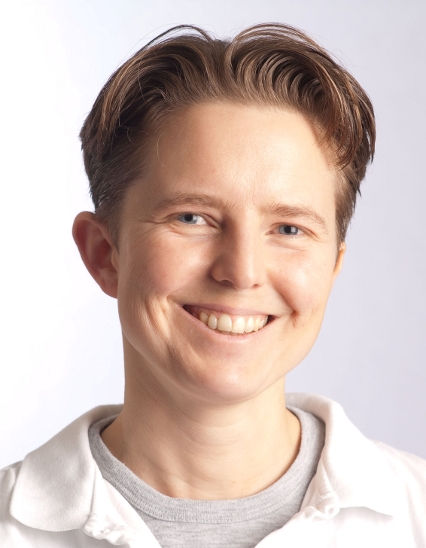
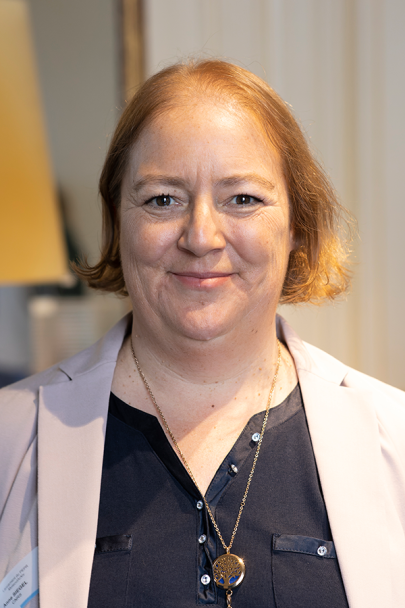
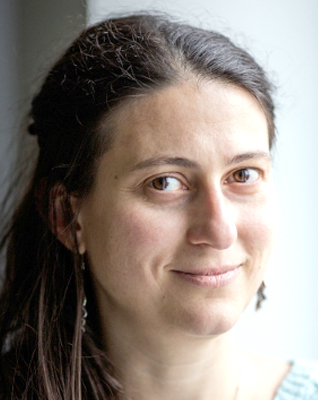
Danai Symeonidou is a Researcher (CR) at INRAE in Montpellier since 2015, working in the GAMMA team. She holds a PhD from University Paris Sud (2014) and a joint Greek-French Master's degree from the University of Crete and University Paris Sud. Her research focuses on Semantic Web technologies, key discovery in knowledge bases, rule mining, and descriptive analytics. She has conducted postdoctoral research at Telecom ParisTech and was a visiting researcher at the Insight Centre for Data Analytics in University College Cork, Ireland. Education includes a Bachelor's degree from the University of Macedonia (2009), followed by advanced studies in France. She has extensive teaching experience across multiple institutions, including courses on Discrete Mathematics, Relational Databases, UML, Algorithms, and Semantic Web topics. Her work emphasizes scalable solutions for data linking and key discovery, with contributions to RDF data analysis, knowledge base optimization, and agrifood chain modeling. She has published widely in top venues such as ISWC, K-Cap, and EKAW, focusing on theoretical foundations and practical applications of semantic web technologies.
Khadija Bousselmi Ep ARFAOUI is a Lecturer at Savoie Mont Blanc University and a researcher at the LISTIC laboratory. She holds a PhD in Computer Science from the University of Tunis El Manar and completed a postdoctoral fellowship at LAMSADE, Paris Dauphine. Her research focuses on optimizing data-intensive systems, including cloud-based workflow scheduling, Big Data architecture, and energy-efficient CNN design. She teaches modules like Optimization Methods, Networks, and Graph Theory at the IUT Annecy campus. PhD: Approche scalable pour l’ordonnancement des workflows scientifiques dans un environnement Cloud , 2017 Postdoc: Multi-Objective Cloud Workflow Scheduling , 2019-2020 (LAMSADE) Research Interests: Parallel computing, distributed systems, machine learning applications in data warehousing and disaster prediction, and green computing strategies. Notable contributions include frameworks like DR-SWDF for dynamic workflow deployment and decision support systems for Big Data pipelines. Recent work emphasizes ML in healthcare (speech disorder diagnosis) and environmental analytics (avalanche forecasting).
Sébastien MONNET is a Professor at the University of Savoie Mont Blanc since 2016, affiliated with Polytech Annecy-Chambéry and the LISTIC laboratory (deputy director). Previously, he was an Associate Professor at Sorbonne University (2007–2016) and held roles at Inria. His HDR (2015) focuses on data replication in large-scale distributed systems. Education: PhD and HDR in Computer Science Research Interests: Focuses on distributed systems, fault tolerance, data replication protocols, cloud computing, and simulation methodologies. Recent work includes federated learning energy estimation, semantic integration in smart systems, and optimization of distributed architectures. Key Projects: ANR RainbowFS (2016–2020): Geo-replicated database optimization AAP USMB DEDICATED (2019–2020): Distributed AI and smart home systems ARMADA (2013–2015): Chile-France collaboration on cloud reliability Advising & Grants: Supervised 12+ PhD/Master students Co-PI in CNRS-Araucaria (2015–2017) and Maimonide (2014–2015) projects Labs/Teams: Deputy director of LISTIC, leading the ReGaRD theme (Resilient and Adaptive Distributed Systems).
Nicole Schweikardt is a full Professor at the Department of Computer Science, Humboldt-Universität zu Berlin, since 2014. She previously held positions at Goethe-Universität Frankfurt (W2/W3 Professor for Theory of Complex Systems, 2007-2014) and served as Junior-Professor for Logic and Database Theory at HU Berlin (2005-2007). Her research focuses on logic in computer science, particularly database theory and complexity theory. Key contributions include algorithmic meta-theorems for bounded degree structures, efficient query evaluation techniques, and analysis of first-order logic extensions with counting quantifiers. She explores query languages' expressivity, document spanners, and locality properties in logic. Recent work (2025) covers event stream query discovery, color refinement for relational structures, and learning aggregate queries via first-order logic. Earlier studies (2018-2022) address FO+MOD queries under updates, Hanf normal forms, and enumeration algorithms over sparse graphs. GI-Dissertationspreis (2002) Emmy-Noether Fellowship (2005) Heinz Maier-Leibnitz-Prize (2007) Teaching Award (2015) She has supervised 6 PhD theses and contributed to database conferences (PODS, ICDT, LICS) as PC member and workshop organizer. Her affiliations include DFG Fachkollegium Informatik (since 2024) and editorial boards of Acta Informatica and ACM SIGLOG Education Committee.
Arnaud Durand is a Professor at Paris-Diderot University's Faculty of Mathematics since 2005. He currently serves as Director of the Mathematics Department (UFR de mathématiques) and has held several leadership roles including Pole Manager (2006-2010), Deputy Director (2010-2014), and Co-Director (2014-2017) of the GDR IM - Mathematical Computer Science research group. He previously headed the Master's program in Mathematical Logic and Foundations of Computer Science (2007-2013) and the Logic research team (2014-2017), and was instrumental in establishing the university's Mathematics and Computer Science double degree program (2009-2016). Education includes: Ph.D. from University of Caen (1994-1996) Postdoctoral research at University of Pisa (1997-1998) His research bridges mathematics and computer science, focusing on: Structural complexity : Counting and enumeration problems Descriptive complexity : Logical characterization of complexity classes Database theory : Query evaluation and tractability Finite model theory : Logical aspects of finite structures Graph/hypergraph theory : Algorithmic and structural properties Recent publications demonstrate a strong emphasis on computational complexity, logical methods in computer science, and database theory, with frequent exploration of counting problems, team semantics, and conjunctive query evaluation. Research consistently intersects theoretical computer science, mathematical logic, and discrete mathematics. Student Advising : Has supervised doctoral candidates including: David Duris (2006-2009) Yann Strozecki (2007-2010) Nicolas de Rugy-Altherre (2011-2015, co-supervised) Florent Capelli (2013-2016) Alexandre Vigny (current, co-supervised)
Daniel Le Berre is a Professor at the Faculty of Sciences Jean Perrin within the University of Artois . His academic journey includes undergraduate and graduate studies at the University of Western Brittany (UBO), Brest, and a doctoral thesis on propositional logic at Paul Sabatier University, Toulouse III. He transitioned from a Research Assistant at the University of Newcastle, Australia (2000-2001) to a Lecturer at Jean Perrin Faculty since 2001, becoming a University Professor in 2013 . Education Undergraduate & Graduate: University of Western Brittany (UBO), Brest Doctorate: Paul Sabatier University, Toulouse III (thesis: "Around SAT: the calculation of P-restricted implicants, algorithms and applications" , defended 2000-01-12) His research focuses on Artificial Intelligence and Propositional Logic , particularly in SAT, MAXSAT, Pseudo-Boolean Optimization, QBF, Non-monotonic reasoning, and Modal logics. He also explores constraint solvers in software engineering . His recent work trends include: SAT-based CEGAR methods for Hamiltonian cycle problems Pseudo-Boolean optimization proof logging Research software policy (CODE beyond FAIR, University of Artois Forges analysis) Compressed UNSAT CDCL trees with caching Daniel contributes to academic governance as a member of the Scientific Council of the INS2I Institute (CSI INS2I) and the editorial board of the Journal on Satisfiability, Boolean Modeling and Computation (JSAT) . He has supervised notable doctoral students including Romain Wallon (2017-2020) and Valentin Montmirail (2015-2018). His lab CRIL-CNRS UMR 8188 serves as a hub for his research.
Ladjel Bellatreche is a Full Professor of Data Engineering at the National Engineering School for Mechanics and Aerotechnics (ENSMA) in Poitiers, France, where he has been a faculty member since September 2010. He leads the Data and Model Engineering Team at the Laboratory of Computer Science and Automatic Control for Systems (LIAS) . His educational background includes an Engineering degree in Computer Science obtained in 1992 from the Department of Computer Science at Sidi Bel Abbès, Algeria. He later held positions as Assistant and Associate Professor at the University of Poitiers, France, and served as a Visiting Professor at the University of Québec in Outaouais, Canada, and a Visiting Researcher at Purdue University and Hong Kong University of Science and Technology. His research interests span a wide range of topics in data engineering, including semantic data integration , ontology-based database design , big data and cloud computing , green computing , and database deployment . He has made significant contributions to the design and optimization of data warehouses, particularly in the context of large-scale and distributed systems. Bellatreche has an extensive publication record, including over 60 journal articles and numerous conference proceedings. His recent work focuses on scalable RDF query processing, green query optimization, and leveraging linked open data for enhancing traditional data warehouses. He has also co-authored several books and book chapters on data warehousing and big data analytics. He actively participates in the research community by serving as a reviewer for top-tier journals such as IEEE TKDE and DKE , and as an editorial board member for various international journals. He has organized and co-organized numerous conferences and workshops, including DAWAK , DASFAA , and MEDI , and has served on the program committees of over 40 international conferences. Bellatreche is deeply involved in promoting research in Africa and Asia, where he co-supervises several PhD and Master's students and organizes conferences and workshops to foster collaboration and knowledge exchange.
Cédric EICHLER is a Lecturer at INSA Centre Val de Loire , affiliated with the LIFO (Laboratoire d'Informatique Fondamentale d'Orléans) research lab. His work focuses on Data Privacy , Semantic Graph Databases , and Graph Rewriting techniques to enhance confidentiality in heterogeneous systems. His research explores Differential Privacy for RDF graphs, semantic data sanitization , and privacy-preserving data transformations . Recent publications analyze privacy operators , membership inference attacks on large language models, and secure geo-distributed graph processing using synthetic graphs. Key collaborations include Benjamin NGUYEN, Sara TAKI, and Adrien BOIRET. Cédric contributes to frameworks for multi-scale software architectures and industrial IoT security , emphasizing formal methods and privacy-by-design principles. His affiliations span projects like SENDUP and GIRAFON , addressing privacy in semantic networks and k-core computation . No scientific awards are explicitly mentioned in the provided data.
Benjamin NGUYEN is a University Professor at the National Institute of Applied Sciences Centre Val de Loire, where he leads the PETSCRAFT project team within the LIFO research laboratory. His work focuses on cutting-edge privacy research with a particular emphasis on data anonymization, semantic graph databases, and privacy-enhancing technologies for modern data systems. Professor NGUYEN's research spans several critical areas in data privacy including database anonymization techniques, privacy metrics for semantic graphs, and energy consumption analysis for telework privacy. His work bridges theoretical computer science with practical applications in real-world systems, particularly focusing on how to maintain data utility while ensuring strong privacy guarantees. Recent research explores innovative approaches to privacy boundary detection in telework environments and novel methods for processing sensitive data across distributed systems. Analysis of his recent publications reveals a strong focus on practical privacy solutions for contemporary challenges. His work consistently addresses the tension between data utility and privacy protection, with particular attention to semantic graph databases, RDF systems, and energy consumption patterns in telework environments. The TELESAFE project represents a significant strand of his current research, developing methods to detect private/work boundary crossings in energy consumption data. As leader of the PETSCRAFT project team, Professor NGUYEN directs research on Privacy-Enhancing Technologies with practical applications. His team develops innovative solutions for data collection with minimization principles, informed consent mechanisms, and full data accuracy preservation. The group's work spans both theoretical foundations and practical implementations of privacy-preserving systems.
Caroline Brosse is a Lecturer at the University of Orléans, affiliated with the LIFO laboratory and the GAMoC research team since 2024. Her research focuses on graph theory, particularly enumeration algorithms for structures in graphs such as induced subgraphs, minimal completions, and deletions, with additional work on digraphs and location problems. Education : PhD in Computer Science (2019–2023) at LIMOS, Université Clermont Auvergne, supervised by Vincent Limouzy, Aurélie Lagoutte, and Lucas Pastor Research : Enumeration algorithms, graph theory, digraphs, directed graph problems Teaching : Undergraduate courses in graph theory, databases, programming (C/Python), mathematical writing (LaTeX/git) Her publications reflect trends in algorithmic graph theory, including reconfiguration graphs, combinatorial games on graphs, and structural enumeration. She actively participates in scientific outreach through workshops and public engagement initiatives like Terra Numerica and Maison des Mathématiques et de l'Informatique.
Frédéric Flouvat is a Full Professor in computer science and data scientist at Aix-Marseille Institute of Technology , conducting research at the Computer Science and Systems Laboratory (LIS - UMR 7020) . As co-leader of the Data Centric AI (DCAI) team in the Data Science department, he focuses on data-centric AI, pattern mining, and spatio-temporal data analysis. His interdisciplinary work spans environmental monitoring, urban dynamics, and educational data mining. His research emphasizes Representation learning in Agent-Based Models Innovative approaches to data-centric AI Expert model integration for pattern discovery Spatio-temporal pattern extraction from complex data Applications to soil erosion, urban growth, and educational outcomes Scientific recognition includes INFORSID 2005 Young Researcher Best Paper Prize Best paper award at EGC'13 He has coordinated pedagogical projects like Development of the FabLab spirit and supervised numerous students across institutions including University of New Caledonia, Grenoble, Paris, Lyon, and Brest. Current research projects include SITI (ANR-funded urban dynamics study) and Descol IA (Carnot Star Institute health benefits research).
Aurélie Leborgne is a Lecturer in Computer Science at the University of Strasbourg's ICube laboratory, affiliated with the Department of Computer Science at IUT. She completed her PhD in Computer Science at INSA Lyon (2016), a Master's at the University of Caen (2012), and a University Diploma in Higher Education Pedagogy at Strasbourg (2022). Her research spans two domains: 1) Computer Science focusing on spatio-temporal graph modeling, pattern mining, and applications in medical imaging/environmental monitoring; and 2) Pedagogy investigating emotional awareness, collaborative learning, and teaching methodologies. She leads significant research projects including the ANR JCJC-funded MoS-T (2021-2025) on spatio-temporal pattern mining and METEC-Graphe (2019-2022) on spatio-temporal data modeling. She currently advises PhD candidates Assaad O. Zeghina and Romain Perrin, and has supervised three Master's students. Her teaching portfolio includes programming (C#, Java, C++), web technologies, AI, databases, and professional development courses at IUT. Research responsibilities include leading ANR projects and serving on laboratory councils. Teaching leadership includes implementing reflective practices across the department (2021-2023) and coordinating internships (2017-2018).
Anne Siegel is a CNRS Research Director based at IRISA (Institute for Research in Computer Science and Random Systems), affiliated with the University of Rennes and CNRS. She currently serves as a Scientific Officer at CNRS Informatics (INS2I), overseeing the transversal mission for gender equality, having previously served as Deputy Scientific Director from 2021 to 2025. Her research focuses on the intersection of computer science and biology, particularly in developing symbolic methods for knowledge representation and integration to analyze large-scale biological systems. Former student of ENS Lyon Associate professor of mathematics Doctor of mathematics from the University of Aix-Marseille (2000) Joined CNRS in 2002 Research Director position since 2010 Anne Siegel's research spans the interface between computer science and biology, with particular emphasis on symbolic approaches to knowledge representation and integration for analyzing large-scale biological networks. Her early work focused on mathematics-computer science interfaces through the study of symbolic dynamic systems. She then transitioned to biology-computer science interfaces, developing methods to analyze metabolic networks of organisms including macro-algae. Her current research contributes to various scientific projects focusing on methods for modeling the metabolism of organisms in interaction with their microbiota. She has made significant contributions to bioinformatics, systems biology, and computational modeling of biological processes. Her publication record demonstrates a strong focus on developing computational methods for biological network analysis, particularly in metabolic modeling and logical signaling networks. The research trends show a consistent pattern of interdisciplinary work combining mathematical rigor with biological applications, with a recent emphasis on microbial communities, metabolic modeling, and the development of computational tools for systems biology. Her work often involves collaborations across multiple institutions and countries, reflecting the interdisciplinary nature of her research. Best paper award (CMSB 2012) Active involvement in gender equality initiatives in science Anne Siegel has supervised numerous PhD students and researchers throughout her career, with a particular focus on interdisciplinary projects at the interface of computer science and biology. Her leadership roles have included creating and leading the Dyliss team (bioinformatics, systems biology) within IRISA laboratory (2012-2019), and serving as head of the 'Data and Knowledge Management' department (2019-2021). She has been actively involved in multiple research projects funded by institutions including ANR, Inria, and CNRS, with focus areas spanning from algal metabolism to plant microbiomes and fermented products. She has been instrumental in establishing and leading the Dyliss team at IRISA, which focuses on bioinformatics and systems biology. Her leadership extends to national committees including the CNRS National Committee and the Inria Evaluation Committee. She has also played a key role in gender equality initiatives within CNRS Informatics, contributing to the creation of the transversal parity-equality mission.
Iovka Boneva serves as an Associate Professor at the University of Lille, affiliated with the LINKS research team within the CRIStAL laboratory (UMR 9189, jointly operated by University of Lille, CNRS, and Centrale Lille). Her office is located in Room B215 at Inria Bâtiment B, Haute Borne, with contact number 03 59 35 87 20. Her research centers on advanced data management systems, specifically: Schemas and constraints for RDF data Data exchange across heterogeneous formats Security integration in data exchange protocols Streaming evaluation of tree and graph queries Dr. Boneva has supervised two doctoral theses: José Martin Lozano Aparicio (defended December 14, 2020) on 'Data exchange from relational databases to RDF with target schemas and constraints' Momar Sakho (defended July 24, 2020) on 'Logical queries on hyperstreams' She actively contributes to the LINKS team at CRIStAL, focusing on theoretical and applied challenges in next-generation data systems within the University of Lille's research ecosystem.
Ladjel Bellatreche is a Full Professor of Data Engineering at ISAE-ENSMA (National Engineering School for Mechanics and Aerotechnics) in Poitiers, France, where he has served as faculty since September 2010. He leads the Data and Model Engineering Team within the Laboratory of Computer Science and Automatic Control for Systems (LIAS). Prior to his current position, he spent eight years as Assistant and then Associate Professor at Poitiers University. His academic journey includes visiting positions at the University of Québec en Outaouais (Canada), Purdue University (USA), and Hong Kong University of Science and Technology (China). Professor Bellatreche's research focuses on Semantic Data Integration, Ontology-based Database Design, Life Cycle of Extremely Large Database Design, Big Data & Cloud Computing, Green Computing, and Database Deployment. His work bridges theoretical foundations with practical applications in data management systems, particularly addressing challenges in scalability, efficiency, and semantic enrichment of data repositories. His research has evolved from traditional data warehousing to encompass modern big data analytics and energy-efficient database systems. Analysis of his recent publications reveals a strong trend toward addressing the challenges of big data management through innovative approaches in semantic integration, graph-based query optimization, and green computing. His research shows consistent focus on data warehousing evolution, with increasing emphasis on semantic technologies, RDF data processing, and energy efficiency in query processing. The work demonstrates progression from traditional database design to contemporary challenges in data science and advanced analytics. Professor Bellatreche actively contributes to the academic community through editorial roles, including serving as an Editorial Board Member for the International Journal of Reasoning-based Intelligent Systems and Subject Area Editor for the Scalable Computing Journal. He has organized numerous international conferences and workshops including DAWAK, DOLAP, and MEDI, and has served on program committees for over forty international conferences. He is deeply involved in research mentorship and international collaboration, particularly in Africa and Asia, where he co-supervises students and organizes academic events such as ICT-EurAsia and CIIA. His work extends to promoting research capacity building in developing regions through academic partnerships and collaborative projects. As leader of the Data and Model Engineering Team at LIAS laboratory, Professor Bellatreche oversees research initiatives focused on advanced data management systems. His team works on cutting-edge problems in database design, optimization, and integration, with particular expertise in semantic data warehousing, big data analytics, and green computing approaches for database systems.