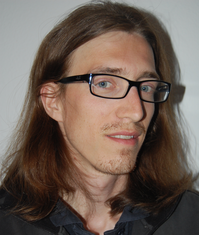
Dr. He Xu is a Visiting Professor in the Department of Engineering Science at the University of Oxford, with a focus on Biomaterials , Tissue Engineering , and Biomechanics . She previously worked at Shanghai Normal University, rising from lecturer (2014) to associate professor (2018) and full professor (2024). Education: BEng in Materials Science and Engineering (China University of Geosciences), DPhil in Biomedical Engineering (Shanghai Jiao Tong University, 2014) Her research explores: Biomaterials : Smart hydrogels, piezoelectric systems, and nanogenerators for therapeutic applications. Tissue Engineering : Innovations in intervertebral disc and tendon regeneration. Drug Delivery : Targeted activation, nitric oxide therapy, and bioelectronic systems. Her publications span 2021–2025 , combining Biomaterials , Nanotechnology , and Medical Imaging to address challenges in Diabetes , Cancer , and Cardiovascular Disease . Key collaborations include the 3DMed Interreg 2 Seas Consortium and work on rapid Covid-19 testing .
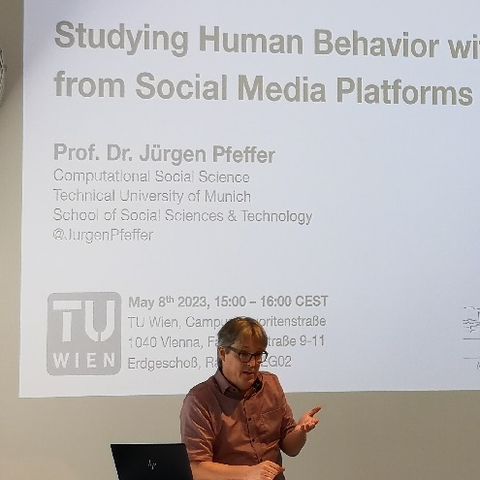
Jürgen Pfeffer is a Professor of Computational Social Science & Big Data at the Technical University of Munich's School of Social Sciences and Technology, with an additional appointment as Adjunct Professor at Carnegie Mellon University's Institute for Software Research. His interdisciplinary work bridges computer science and social science with a focus on analyzing large-scale socio-technical systems. His research expertise spans computational social science, network analysis, and big data methodologies. Pfeffer's work examines methodological, algorithmic, and theoretical challenges in analyzing dynamic social systems, with current projects focusing on modeling and detecting negative dynamics from social media, particularly online firestorms and hate speech against politically active women. His research combines network science approaches with computational methods to understand complex social phenomena. Pfeffer's publication record demonstrates significant contributions to the field since his 2010 doctorate, with high-impact papers in journals like Science and EPJ Data Science. His work on social media analysis, particularly the influential 2014 Science paper 'Social Media for Large Studies of Behavior' co-authored with Derek Ruths, has shaped methodological approaches in the field. His research shows consistent evolution from foundational network analysis to contemporary applications in political discourse, hate speech detection, and multi-layer network analysis. Hennig, M., Brandes, U., Pfeffer, J., & Mergel, I. (2012). Studying Social Networks. A Guide to Empirical Research Ruths, D., & Pfeffer, J. (2014). Social Media for Large Studies of Behavior Pfeffer, J., Morstatter, F., & Mayer, K. (2018). Tampering with Twitter's Sample API As an advisor and collaborator, Pfeffer has worked extensively with researchers including Raji Ghawi, Mirco Schönfeld, Momin Malik, and Kathleen Carley. His work demonstrates strong connections between theoretical network science and practical applications in social media analysis. His current research continues to address pressing issues in online discourse, with recent work focusing on hate speech classification, lexical change in negative word-of-mouth, and polarization dynamics in social media environments. Pfeffer leads the Pfeffer Lab, which focuses on developing methodological approaches for analyzing complex social systems through computational methods. His work has implications for understanding political legitimacy, social influence, and community dynamics in both online and offline contexts.
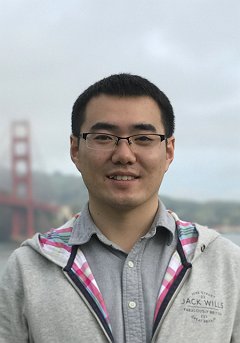
Yuhong Nan is an Associate Professor in the School of Software Engineering at Sun Yat-sen University, China, specializing in software security and privacy leakage analysis for emerging platforms including IoT, mobile systems, and blockchain. Previously a Post-doctoral Research Associate at Purdue University under Prof. Dongyan Xu, she builds practical security tools to detect and mitigate vulnerabilities in real-world systems. Dr. Nan earned her PhD from Fudan University in 2018 supervised by Prof. Min Yang. Her academic journey spans rigorous research in security engineering with emphasis on empirical validation and tool development for complex platform ecosystems. Her research program focuses on uncovering systemic security flaws through innovative analysis techniques. Key contributions include vulnerability detection in smart contracts (e.g., state dependencies, reentrancy), privacy leakage analysis in mobile/IoT ecosystems, and countermeasures against deceptive UI patterns. She employs hybrid approaches combining static/dynamic analysis, machine learning, and large-scale empirical studies to develop deployable security solutions. Analysis of her 15 most recent publications (2023-2025) reveals dominant themes in blockchain security (60%), particularly smart contract/DApp vulnerabilities, with significant work in mobile privacy (30%) and cross-platform threats (10%). Her methodology consistently leverages fine-grained static analysis, semantic enrichment, and feedback-driven fuzzing, yielding tools like SmartAxe and Midas that have influenced industry practices. Dr. Nan actively mentors graduate researchers with 17 advisees including Tencent-employed graduates, and serves as a trusted reviewer for premier journals (IEEE TDSC, TMC, TOPS) and conference committees (ASIACCS, ICICS). Her leadership in security communities bridges academic research with practical defense mechanisms. At Sun Yat-sen University, she directs a high-output research group that collaborates with industry partners to address evolving threats in decentralized systems, maintaining her position among top publishing authors in USENIX Security, CCS, and NDSS venues through rigorous technical innovation.
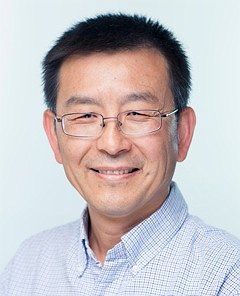
Jingling Xue is a Scientia Professor at the School of Computer Science and Engineering at the University of New South Wales (UNSW) in Sydney, Australia. As an IEEE Fellow of the Computer Society, he leads the Programming Languages and Compilers research group, focusing on practical applications of compiler optimization and program analysis techniques. His work bridges theoretical foundations with real-world software systems, particularly in developing open-source tools for large-scale program analysis. Professor Xue received his B.Eng and M.Eng degrees from Tsinghua University in 1984 and 1987, respectively, followed by a PhD from the University of Edinburgh in 1992. His academic journey has established him as a leading figure in programming languages and compiler technology. Xue's research spans programming languages, compiler technology, and program analysis with emphasis on practical relevance. His current projects include compiler techniques for improving parallelism and locality, pointer/alias analysis for million-line-scale programs, and static/dynamic analysis for detecting bugs and security vulnerabilities in real-world applications like web browsers and Android apps. His group actively develops open-source tools to support scientific replicability and reproducibility in these areas. His recent publications demonstrate a strong focus on applying program analysis techniques to modern challenges including AI compilers, homomorphic encryption, security vulnerability detection, and graph processing systems. The work shows evolution from traditional compiler optimization to addressing emerging domains like privacy-preserving computation and deep learning systems while maintaining rigorous theoretical foundations. Scientific Awards: Best Paper Award at CGO'13 Best Paper Award at CGO'16 Distinguished Paper Award at ECOOP'16 Distinguished Paper Award at ICSE'18 Distinguished Paper Award at ISSTA'19 Distinguished Paper Award at ASE'19 Distinguished Artifact Award at ISSTA'23 Best Artifact Award at FSE'23 Distinguished Paper Award at ASE'23 Test-of-Time Award at CGO'21 Professor Xue has successfully supervised 30 PhD students to completion, many of whom now work as professors or researchers in academia and industry. He has served as Program Chair for major conferences including LCTES'13, CC'18, CGO'20, and General Chair for LCTES'20. His group currently focuses on memory safety in Rust, smart contract analysis, AI compilers, compilation for privacy-preserving computation, and adversarial attacks in deep learning. The Programming Languages and Compilers group maintains strong connections with industry partners, translating theoretical advances into practical tools for real-world software development challenges. Their work on pointer analysis, memory safety, and compiler optimizations continues to influence both academic research and industrial practice.
Giovanni Colavizza holds a dual academic appointment as Professor in the Department of Communication at the University of Copenhagen and Associate Professor at the University of Bologna (since November 2023). His research bridges information science, digital humanities, and open science practices. His primary research areas include: Quantitative analysis of open research practices (data/code/preprint sharing) and citation impact Wikipedia's role in scientific knowledge dissemination and news source reliability assessment Digital tools for humanities including knowledge graphs and NLP applications for historical archives Recent publications (2024-2025) reveal strong interdisciplinary trends, combining scientometrics with natural language processing to analyze scientific communication patterns and colonial archival materials. His work appears in leading venues including PLoS ONE, Scientometrics, and IEEE Journal of Biomedical and Health Informatics, demonstrating methodological innovation across information science and humanities domains.
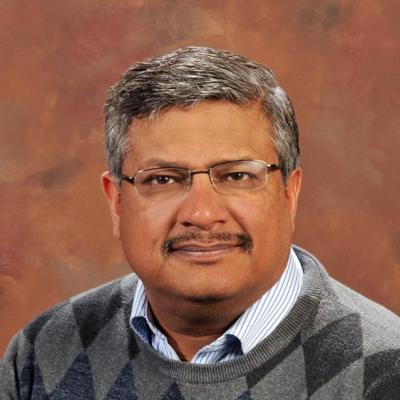
Gagan Agrawal is the UGA Foundation Professorship in Computing and a Professor at the School of Computing, University of Georgia. He serves as Director of the School and is affiliated with the Franklin College of Arts & Sciences. Agrawal holds a PhD and MS in Computer Science from the University of Maryland (1994-1996). His research focuses on high-performance computing, parallel algorithms, compiler optimization for deep learning, GPU acceleration, and interdisciplinary applications in health informatics. Notable contributions include frameworks like ForensiBlock (blockchain for data forensics) and DELITE (tensorized instruction compilation). Agrawal has secured over $2.5M in NSF grants for projects addressing extreme-scale computing challenges. Recent grants include: SHF: Small: Memory Hierarchy Optimizations Meet Transformers (MITTEN) ($600K, 2024-2027) DELITE compilation system for deep learning models ($600K, 2023-2026) Publications span parallel computing methodologies, cybersecurity frameworks, and health outcomes analysis. His work on social determinants of health in cancer survival has been systematically reviewed in top-tier medical journals. Agrawal leads UGA's computing initiatives, emphasizing interdisciplinary research and student mentorship in HPC and AI domains.
Michalis Mountantonakis is a Postdoctoral Researcher at FORTH and Laboratory Teaching Staff in the Department of Computer Science at the University of Crete, Greece. He holds a PhD (2020), MSc (2016), and BSc (2014) in Computer Science from the University of Crete, all with top grades. His research focuses on Large-Scale Semantic Data Integration, Linked Open Data, and Semantic Web technologies, with over 45 publications in top venues like ACM VLDB, ISWC, and ECML. He has been awarded the prestigious SWSA Distinguished Dissertation Award (2020) and the Maria Michael Manasaki Fellowship (2020). His work includes tools like LODsyndesis and LODChain, addressing challenges in knowledge graph connectivity and validation of AI-generated content. Education: PhD in Computer Science (2016-2020), University of Crete (Excellent GPA 9.74/10) MSc in Computer Science (2014-2016), University of Crete (Excellent GPA 9.87/10) BSc in Computer Science (2010-2014), University of Crete (2nd in class with GPA 8.42/10) Research Interests: His work bridges semantic web technologies with modern AI challenges, emphasizing large-scale data integration, knowledge graph applications, and validation frameworks. He has contributed to cultural heritage informatics, machine learning-augmented semantic systems, and cross-lingual NLP solutions. Recent trends include leveraging LLMs for query generation and semantic enrichment while ensuring factual accuracy through knowledge graph-driven validation. Key Achievements: Developed LODsyndesis, a global-scale semantic integration service Pioneered real-time validation of ChatGPT responses using RDF knowledge graphs Won Best Paper Award (ISWC 2022) for entity enrichment techniques Recipient of Stelios Orphanoudakis Undergraduate Fellowship (2013-2014) Participated in Roche Continents 2019 (top 100 European science students) Grants & Labs: His research has been supported by GSRT/HFRI. He collaborates with FORTH-ICS and leads projects in EU-funded initiatives like iMarine and BlueBridge. Current work focuses on governance models for ontologies, interoperable thesaurus creation (e.g., FoodEx2), and semantic analytics for cultural heritage datasets.
Xiaoli Fern is an Associate Professor in the School of Electrical Engineering and Computer Science at Oregon State University. She holds a Ph.D. in Computer Engineering from Purdue University (2005) and dual degrees (B.S. and M.S.) in Automation and Computer Science from Shanghai Jiao Tong University (2000). Her research focuses on applied machine learning , graph learning , and explainability in AI systems , with applications in microbiome analysis , ecological monitoring , and human-computer interaction . Research Expertise: Unsupervised learning, clustering, correlation analysis, outlier detection, and scientific data mining. Collaborations: Active involvement in the IGERT Ecosystem Informatics program and interdisciplinary projects with ecologists, roboticists, and biologists. Awards: 2011 NSF CAREER Award for early-career excellence in research. Her recent work includes applying deep learning to microbiome data and developing interactive systems that bridge theory with real-world applications in biology and materials science. She mentors students across all academic levels and emphasizes the importance of collaborative, real-world problem-solving in her research lab.
Enrico Franconi is a tenured full Professor in the Faculty of Engineering at the Free University of Bozen-Bolzano, Italy. He is the founder and director of the KRDB Research Centre for Knowledge-based Artificial Intelligence, established in 2002. His research focuses on applying database, AI, and semantic technologies to address challenges in information systems design, data integration, and big data analysis. He holds leadership roles including former Vice-Rector for Research (2005-2006) and director of the European Masters Program in Computational Logic (2004-2019). His academic contributions span Description Logics, knowledge representation, and ontology engineering, with a strong emphasis on theoretical foundations and practical applications. He has led numerous EU-funded projects, including ONTORULE and SeWAsIE, and contributed to international conferences as a program committee member and keynote speaker. His work bridges theory and practice, aiming to translate foundational results into real-world solutions. He is a prolific author with an h-index of 42 and has mentored researchers in areas like semantic web technologies and conceptual modeling. Key achievements include advancing ontology-driven data integration, developing tools like ICOM for conceptual modeling, and contributing to standards for semantic web languages. He is affiliated with the Computational Logic community and actively participates in international research networks such as CAIRNE. His research has been recognized through ANVUR evaluations ranking his department among Italy’s top computer science faculties.
Dr. Vladimir Vlassov is a full Professor in Computer Systems at the Division of Software and Computer Systems (SCS) , Department of Computer Science (CS) , School of Electrical Engineering and Computer Science (EECS) , KTH Royal Institute of Technology , Stockholm, Sweden. He leads the AVA project in ALEC2, an AI-powered system for mental health care. He is a member of the Distributed Computing research group (DC@KTH) . Education & Roles: Holds a PhD and is a member of ACM and IEEE. Previously visited MIT (1998) and UMass Amherst (2004). Teaches courses on Data Mining , Distributed Systems , and Concurrent Programming . Research Interests: Focus on scalable AI, Cloud computing, distributed systems, and NLP for mental health. Projects include ExtremeEarth (Copernicus data analytics) and EMJD-DC (distributed computing PhD program). Grants & Projects: Principal Investigator in ALEC2 (adaptive mental health care) and ExtremeEarth (EU H2020). Led EU projects like ENCORE (manycore systems) and PaPP (embedded systems). Labs & Teams: Directs the Distributed Computing group, contributing to Hopsworks (machine learning feature store) and Maggy (hyperparameter optimization).
Olaf Hartig is a Senior Associate Professor at Linköping University's Department of Computer and Information Science (IDA), affiliated with the Database and Information Techniques (ADIT) division. He is also an Amazon Scholar collaborating with the Neptune graph database team. His research focuses on data management, semantic web technologies, graph databases, and distributed data systems. Hartig holds a PhD from Humboldt-Universität zu Berlin and is a Docent at Linköping University. He has received numerous awards, including the SWSA Distinguished Dissertation Award and eight best paper awards, and was selected as a Wallenberg Academy Fellow in 2024. Education: PhD in Computer Science (Humboldt-Universität zu Berlin), Docent (Linköping University). Research interests span query processing for Linked Data, federated systems, RDF and GraphQL semantics, and knowledge graph construction. He leads research groups in Database and Web Information Systems and Semantic Web Technologies at IDA. Key achievements include pioneering traversal-based query execution, developing Triple Pattern Fragments, and contributions to standards like RDF* and SPARQL*. His work has been recognized through grants, patents (e.g., on graph acceleration techniques), and leadership roles in conferences like ISWC and ESWC. Teaching: Course leader for database technology courses (TDDD12, TDDD37) and advanced topics like big data analytics and bioinformatics databases. Active in curriculum design and interdisciplinary education. Labs/Teams: Database and Web Information Systems Group, Semantic Web Research Group, Sports Analytics Group (IDA) Grants: Wallenberg Academy Fellowship, Swedish Research Council funding
Xiuyuan Cheng is an Associate Professor of Mathematics at Duke University, affiliated with the Trinity College of Arts & Sciences. Her expertise lies in applied analysis, focusing on developing theoretical and computational techniques for high-dimensional data analysis, signal processing, and machine learning. She holds a Ph.D. from Princeton University (2013). Her research emphasizes graph-based methods, kernel techniques, and deep learning applications in manifold data analysis. Notable contributions include work on graph Laplacian convergence, optimal transport for single-cell data, and rotation-equivariant neural networks. She has received grants from the National Science Foundation, including a CAREER award (2023–2028) for learning graph diffusion from high-dimensional data. Recent publications explore topics such as bi-stochastic graph normalization, neural tangent kernels, and adversarial defense using basis transformations. Teaching includes advanced courses like Measure and Integration and High-Dimensional Data Analysis. She collaborates extensively in interdisciplinary projects, integrating mathematical theory with computational tools for real-world applications.
George Dasoulas is a Postdoctoral Researcher at Harvard University's Department of Biomedical Informatics, affiliated with the Zitnik Lab. He holds a PhD in Computer Science from École polytechnique in Paris, France, and previously worked at Huawei Technologies France. His research focuses on graph machine learning, particularly in biomedical applications and telecommunications, with contributions to graph neural networks (GNNs), attention mechanisms, and topological deep learning. Education: Ph.D., Computer Science (DaSciM group, LIX, École polytechnique); Diploma in Electrical & Computer Engineering (National Technical University of Athens). His work includes developing Lipschitz-normalized attention layers, parametrized graph shift operators, and modularity-aware graph autoencoders. He has been recognized with the 2022 Wojcicki and Troper Fellowship from Harvard's Data Science Initiative. Key Research Themes: Graph Representation Learning, Topological Neural Networks, Equivariant Learning, Multimodal Learning Applications: Biomedical Informatics, Telecommunications, Sustainable AI His articles emphasize scalable GNN architectures, graph-based unlearning strategies, and multimodal protein phenotyping. He has contributed to open-source projects like LipschitzNorm and PGSO, and actively publishes in top conferences (ICML, ICLR, NeurIPS).
Bernd Sturmfels is a leading mathematician serving as Director of the Max Planck Institute for Mathematics in the Sciences in Leipzig since 2017. He is also Professor Emeritus of Mathematics, Statistics, and Computer Science at the University of California, Berkeley, and holds honorary professorships at the Technical University of Berlin and the University of Leipzig. His research bridges pure and applied mathematics, with foundational contributions to algebraic geometry, combinatorics, and computational biology. Education: Sturmfels earned dual Ph.D. degrees in 1987 from the University of Washington and Technische Universität Darmstadt, followed by an honorary doctorate from Goethe University Frankfurt in 2015 and additional honorary doctorates from the University of Bern (2023) and the University of Chicago (2024). Research Interests: His work spans algebraic geometry , combinatorics , commutative algebra , algebraic statistics , convex optimization , and computational biology . He explores deep connections between abstract algebraic structures and practical applications in statistics, optimization, and the life sciences. Publications and Trends: With over 300 research articles and 11 books, his recent work (2022–2025) focuses on advanced topics like Grassmannian geometry, tropical implicitization, quantum chemistry applications, and algebraic statistics. His research increasingly integrates computational methods with theoretical insights, addressing problems in machine learning, phylogenetics, and optimization. Awards and Honors: Sturmfels has received numerous prestigious awards, including: George David Birkhoff Prize in Applied Mathematics (2018) SIAM von Neumann Lecturership (2010) Humboldt Senior Research Prize (2007–2008) David and Lucile Packard Fellowship (1992–1997) Fellowships of the AMS and SIAM Membership in the Berlin-Brandenburg Academy of Sciences and Humanities Mentoring and Grants: He has supervised 60 doctoral students and numerous postdocs, with many securing positions at leading institutions. His mentoring philosophy emphasizes diversity and excellence, as highlighted in his Notices of the AMS article. Funding sources include the NSF, DARPA, and the German National Science Foundation (DFG). Labs and Teams: At the Max Planck Institute, he leads the Nonlinear Algebra group, fostering interdisciplinary collaboration between mathematics and the sciences. His team focuses on developing algebraic methods for data analysis, optimization, and theoretical physics.
Benjamin Suger is a researcher in the Department of Computer Science at the University of Freiburg, affiliated with the Autonomous Intelligent Systems group within the Faculty of Engineering. His work centers on robotics and intelligent systems, particularly in autonomous navigation and environment modeling. Diploma in Mathematics, University of Freiburg (2003–2011) PhD Student, Autonomous Intelligent Systems Group, University of Freiburg (2011–2017) His research interests include traversability analysis, SLAM, 3D modeling, and mobile robotics. He applies machine learning and computer vision techniques to enable robust robot navigation in complex and dynamic environments. His work often integrates sensor data from 3D lidar and visual systems to improve perception and localization. The recent publications highlight a strong focus on long-term autonomy, outdoor navigation, and memory-efficient SLAM algorithms. Key themes include handling perceptual changes, terrain adaptability, and integration of open geospatial data like OpenStreetMap. His work bridges theoretical algorithm development with real-world robotic applications. Scientific recognition includes being a finalist for the Best Conference Paper Award. This reflects the impact and quality of his contributions to the robotics community. Best Conference Paper Award Finalist Benjamin Suger has contributed significantly to research projects such as LifeNav and has served as a teaching assistant for the Introduction to Mobile Robotics course. While no direct advising of students is listed, his collaborative work with prominent researchers like Wolfram Burgard indicates active participation in a larger academic and research team. He has not received external grant mentions in the provided text. He is part of the Autonomous Intelligent Systems lab at the University of Freiburg, a leading group in robotics research, where he contributes to advancing the state of the art in autonomous navigation and environmental understanding for mobile robots.