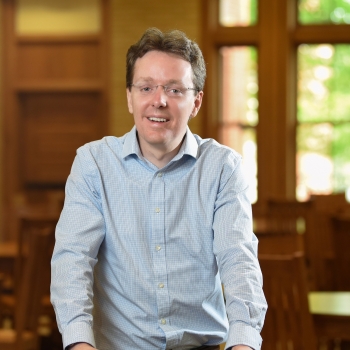
Jennifer Nordstrom is a Professor in the Department of Mathematics and Computer Science at Linfield University. She holds office in Taylor Hall 205 and can be reached at 503-883-2654 or via email at jnordstrom@linfield.edu and jfirkins@linfield.edu. Her research spans multiple areas of mathematics including algebra, combinatorics, noncommutative ring theory, and Leavitt path algebras. Nordstrom has also made significant contributions at the intersection of mathematics and culture, particularly through game theory applications in popular media. She maintains active research programs in combinatorial game theory and graph theory. Her recent publications demonstrate a diverse research portfolio, ranging from specialized algebraic structures to accessible explorations of game theory in film and literature. This dual focus on theoretical mathematics and practical applications reflects her commitment to making mathematical concepts relevant to broader audiences. Nordstrom is deeply involved in educational innovation through open textbook initiatives. She has developed several open-source educational materials including Introduction to Game Theory: a Discovery Approach and Discrete Mathematics: an Active Approach to Mathematical Reasoning , all available through her website and the PreTeXt-Runstone Open-Source Ecosystem (PROSE). She mentors undergraduate research in combinatorial game theory and graph theory and currently runs the Math PLUS Program, which pairs Linfield University students with middle schoolers from Yamhill-Carlton Intermediate School to work on mathematics-focused science fair projects.
Chuck Lundon is Professor and Department Chair in the Department of Mathematics at Linfield University, renowned for pioneering unconventional study abroad programs that integrate mathematics with cultural history across Russia, Germany, Switzerland, China, Japan, and Australia. His international teaching methodology follows historical mathematical legacies like Euler's work and explores connections between Chinese mathematics and Japanese wasan/sangaku. Dr. Lundon's academic credentials include: B.A. in Mathematics and Music from Lewis & Clark College M.S. in Mathematics from University of Illinois at Urbana-Champaign Ph.D. in Mathematics from Arizona State University His research centers on graph theory and combinatorics, specializing in competitive graph coloring algorithms developed through extensive undergraduate collaboration. With over 30 student co-authors across NSF-funded REU-RET programs (2008-2017), his work bridges theoretical mathematics with accessible educational frameworks for emerging researchers. Publications spanning 2004-2020 reveal consistent innovation in graph coloring games, with recent contributions including foundational texts for undergraduate research and analyses of k-degenerate graphs, tree structures, and higher-dimensional combinatorial paths. His work demonstrates evolving sophistication in modeling competitive coloring scenarios while maintaining educational applicability. Though no specific scientific awards are documented, Dr. Lundon's sustained NSF funding for undergraduate research initiatives highlights the significance of his scholarly contributions. He has mentored more than 30 undergraduate researchers through co-authored publications and NSF REU-RET programs, while collaborating internationally with scholars like Dr. Michael Crosser (Australia astronomy projects, Crisscrossing Science podcast) and Dr. Christopher Keaveney (China-Japan mathematics history studies). These partnerships create interdisciplinary learning environments connecting abstract mathematics to real-world scientific discovery. Dr. Lundon's educational philosophy, shaped by his own three undergraduate study abroad experiences (USSR, UK, China), manifests in immersive programs that contextualize mathematical concepts within global cultural frameworks, culminating in planned 2023 Australia courses examining Nobel-winning astronomical research.
Peter R. W. McNamara is a Professor of Mathematics in the Department of Mathematics & Statistics at Bucknell University in central Pennsylvania. He received his Ph.D. from MIT in 2003 under the supervision of Richard Stanley, following undergraduate studies at Trinity College Dublin. His academic career includes postdoctoral positions at LaCIM (Université du Québec à Montréal), Instituto Superior Técnico in Lisbon, and visiting positions at MIT, UC Berkeley, and Trinity College Dublin. Ph.D.: MIT (2003), Advisor: Richard Stanley B.A.: Trinity College Dublin McNamara's research focuses on combinatorics, particularly algebraic and order-theoretic aspects. His work centers on symmetric and quasisymmetric functions, P-partitions, edge labellings of posets, and bijective combinatorics. He has made significant contributions to understanding positivity and equality questions in symmetric function theory and the combinatorial topology of partially ordered sets. His recent publications demonstrate continued productivity in algebraic combinatorics, with a focus on quasisymmetric functions, P-partitions, and the structure of various posets. The publications show a consistent research trajectory with increasing collaboration and sophisticated applications of combinatorial methods to algebraic structures. Presidential Award for Teaching Excellence (2025) Simons Foundation Collaboration Grant (2012-2018) Charles W. and Jennifer C. Johnson Prize (2003) MIT Presidential Fellowship (1999-2000) McNamara has successfully mentored numerous undergraduate researchers, including several honors thesis students who have gone on to pursue doctoral studies. His teaching portfolio at Bucknell is extensive, covering courses from calculus to advanced combinatorics and algebra. He has also been actively involved in university service, chairing multiple departmental and university committees, and organizing academic conferences including sessions at the American Mathematical Society meetings. His professional activities include extensive conference organization, editorial reviewing for major combinatorics journals, and participation in the Mathematical Olympiad community.
Rogers Mathew is an Associate Professor in the Department of Computer Science and Engineering at Indian Institute of Technology Hyderabad. His research focuses on graph theory, combinatorics, and theoretical computer science, with applications in algorithm design and discrete mathematics. Ph.D. from Indian Institute of Science, Bengaluru Postdoctoral experience at University of Haifa (Israel) and Dalhousie University (Canada) His research interests include: Graph theory and combinatorics Algorithm design for discrete structures Extremal set theory and linear algebra methods Probabilistic and polynomial techniques in theoretical computer science Recent publications span topics in graph theory, combinatorics, and algorithm analysis, with keywords including computer science, mathematics, and theoretical computer science. His work often bridges discrete mathematics with computational complexity. Scientific awards include: VATAT Postdoctoral Fellowship AARMS Postdoctoral Fellowship Rogers Mathew has supervised doctoral students such as Tapas Kumar Mishra, Atrayee Majumder, Seshikanth Varma, and Shiwali. He has taught courses in computational complexity theory, advanced graph theory, combinatorics, and data structures.
Bojka Milicic is a cultural anthropologist and Associate Professor (Lecturer) in the Department of Anthropology at the University of Utah, where she has held academic appointments since 1992. A native of Croatia, she studied ethnology and indology at the University of Zagreb before earning her MA (1986) and PhD (1992) in Anthropology from the University of Utah. Her career progression includes roles as Adjunct Assistant Professor (1992–2001), Assistant Professor (Lecturer) (2001–2005), and her current position since 2005. Her research spans multiple continents, with fieldwork in Croatia, India, and Peru. Primary interests include kinship systems, gender studies, cognitive anthropology, and the application of formal models (graph theory, network analysis) to anthropological questions. She investigates symbolic systems—such as body symbolism, color classifications, and cosmological structures—while exploring language origins and literary theory. Milicic's publications reflect sustained engagement with kinship theory, symbolic analysis, and cross-cultural methodologies, emphasizing graph-theoretic approaches and cognitive frameworks across Mediterranean, Andean, and Polynesian contexts. Recent works continue this trajectory with studies on ritual kinship in Peru (2024) and formal kinship modeling (2019). She teaches courses including Mediterranean Cultures , Peoples of Europe , and Symbolic Anthropology , demonstrating alignment with her research expertise in European and Mediterranean societies. No laboratory affiliations, grants, or advising relationships are documented.
Antar Bandyopadhyay is a Professor at the Theoretical Statistics and Mathematics Division of the Indian Statistical Institute (ISI), currently serving as Head of the Delhi Centre (May 01, 2023 - present). He has previously served as Professor-in-Charge of the Theoretical Statistics and Mathematics Division (September 18, 2020 - September 17, 2022). His academic journey includes a Ph.D. in Statistics from the University of California, Berkeley (2003), postdoctoral studies at the Institute for Mathematics and Its Applications (University of Minnesota) and Chalmers University of Technology (Sweden). Professor Bandyopadhyay's research focuses on theoretical and applied probability, with emphasis on discrete problems arising from combinatorics, statistical physics, and computer science. His specific interests include random graphs, probability on trees, combinatorial optimization, recursive distributional equations, branching random walks, percolation theory, interacting particle systems, Markov chains, random walks in random environments, and urn models. His work demonstrates a strong connection between theoretical developments and applications in various scientific domains. Analysis of his recent publications reveals a consistent focus on probability theory with particular emphasis on urn models, branching random walks, and random processes on graphs and trees. His research shows a progression from foundational work on recursive distributional equations to more complex applications in network theory and statistical physics. The publications demonstrate significant contributions to theoretical probability with practical implications in fields such as epidemiology, combinatorial optimization, and stochastic geometry. Outstanding Graduate Student Instructor Award from UC Berkeley (2002) Teaching Effectiveness Award from UC Berkeley (2002) Professor Bandyopadhyay has supervised multiple Ph.D. students including Deborshi Das (expected 2026), Partha Pratim Ghosh (2022), Gursharn Kaur (2018), Debleena Thacker (2015), and Farkhondeh Sajadi (2013). He has also guided M.Stat. dissertation students including Somak Laha (2021-2022) and Subhabrata Sen (2012-2013). His collaborative work spans numerous institutions including UC Berkeley, Chalmers University, and various Indian Statistical Institute centers.
Siya BAO is an Assistant Professor at Waseda University's Faculty of Science and Engineering, focusing on quantum computing applications in combinatorial optimization and geospatial information processing. Currently affiliated with the Green Computing Systems Research Organization, her work bridges theoretical computer science with practical implementations in travel planning, indoor localization, and financial forecasting. Key research interests include: Quantum Computing Geospatial Information Processing Text Mining Based on 15 recent publications, her research trajectory demonstrates: Quantum annealing solutions for multi-day trip planning Machine learning applications in financial time series analysis Advancements in smartphone-based pedestrian dead reckoning Innovations in QUBO model formulation for constrained optimization Scientific recognition includes: DICOMO 2023 Outstanding Paper Award IEEE ICSC 2020 Best Student Opponent 2017 Telecommunications Advancement Foundation Travel Aid Research activities span: Principal investigator for JSPS-funded geospatial optimization projects (2021-2024, 2024-2027) Contributing author to Springer's 'Machine Learning for Indoor Localization and Navigation' (2023) Extensive conference presentation history including IPSJ-ONE 2024 invited talk on quantum computing applications
Igor Balla is a Strauch Postdoctoral Fellow at the Simons Laufer Mathematical Sciences Institute (SLMath) in Berkeley, where he participates in a research program on extremal combinatorics. He holds a PhD in Mathematics from ETH Zürich, advised by Benny Sudakov, and earned prior degrees from New York University (Master’s) and Carnegie Mellon University (Bachelor’s). He has held postdoctoral positions at Tel Aviv University, the Hebrew University of Jerusalem, and Masaryk University. PhD : Mathematics, ETH Zürich Master’s : New York University Bachelor’s : Carnegie Mellon University His research lies at the intersection of combinatorics and linear algebra, focusing on extremal problems with connections to geometry, theoretical computer science, probability, and quantum physics. Key themes include equiangular lines, orthonormal representations, spectral graph theory, and extremal set systems such as union-closed families. His work often combines algebraic methods with combinatorial reasoning to solve long-standing open problems. The recent articles highlight a strong trend in equiangular lines, spectral extremal combinatorics, and the application of linear algebra to graph theory and coding. His work on extension complexity and the MaxCut problem bridges discrete mathematics and optimization. The recurring use of eigenvalues, matrix projections, and vector representations underscores a unified methodological framework across his publications. Strauch Postdoctoral Fellow Igor Balla has taught as a lecturer in Graph Theory and Advanced Combinatorics at Masaryk University and served as a teaching assistant at ETH Zürich and Carnegie Mellon University across courses in graph theory, algebra, and number theory. He has not been mentioned in connection with any specific grants, but his postdoctoral fellowship indicates competitive research support. His frequent invited talks at institutions like Princeton, MIT, Harvard, and ICERM reflect active engagement in the global combinatorics community. He is affiliated with the research program in extremal combinatorics at SLMath, a leading institute in mathematical sciences. His collaborations span institutions including ETH Zürich, Tel Aviv University, and the Hebrew University, indicating a strong, collaborative research network. His recent work with prominent mathematicians like Benny Sudakov, Po-Shen Loh, and Noga Alon further emphasizes his integration into elite research circles.
Frederick Manners is an Associate Professor in the Department of Mathematics at the University of California, San Diego (UCSD), a position he has held since 2019. Prior to this, he was a Szegő Assistant Professor at Stanford University from 2016 to 2019, and he earned his D.Phil. from the University of Oxford in 2016 under the supervision of Professor Ben Green. Current Affiliation: Associate Professor, Department of Mathematics, University of California, San Diego Previous Positions: Szegő Assistant Professor, Stanford University (2016–2019); D.Phil. Student, University of Oxford (2012–2016) Education: D.Phil., University of Oxford His primary research interests are in Additive Combinatorics and closely related fields. His work extensively covers combinatorics (especially probabilistic and extremal), number theory (especially analytic), probability and statistics, ergodic theory, topological dynamics, aspects of theoretical computer science, and analysis with a focus on Fourier methods. A central theme in his recent research is higher-order Fourier analysis, also known as the inverse theory of the Gowers norms, and its applications to problems like Freiman's theorem and the polynomial Freiman–Ruzsa conjecture. An analysis of his 15 most recent publications reveals a deep and consistent focus on the structural properties of sets in additive combinatorics. His work frequently involves proving inverse theorems for Gowers norms, developing the theory of nilspaces, and tackling long-standing conjectures such as the Hall–Paige conjecture and Tomescu's graph coloring conjecture. His research employs sophisticated tools from harmonic analysis, ergodic theory, and probability to derive quantitative bounds and establish the underlying algebraic structure of combinatorial objects. Key Research Areas: Additive Combinatorics, Higher Order Fourier Analysis, Gowers Norms, Ergodic Theory, Extremal Combinatorics, Probabilistic Methods Scientific Awards and Recognitions: Szegő Assistant Professor, Stanford University Frederick Manners is an active educator at UCSD, teaching a variety of undergraduate and graduate courses in mathematics, including calculus, linear algebra, and mathematical logic. His teaching portfolio indicates a strong commitment to pedagogy. While specific details about student advising and research grants are not provided in the text, his prolific publication record and prestigious prior position suggest he is involved in guiding students and securing research funding. He has collaborated with leading mathematicians such as Ben Green, Terence Tao, Timothy Gowers, and Sean Eberhard. His work on the structure theory of nilspaces represents a significant collaborative effort. Laboratories and Research Teams: While no formal lab is mentioned, his extensive list of publications with co-authors like Yonatan Gutman, Péter Varjú, Sean Eberhard, and Rudi Mrazović indicates he is a key member of a vibrant research team focused on additive combinatorics and its interactions with other fields.
Yann Strozecki is an Associate Professor (Maître de Conférences HDR) at the University of Versailles Saint-Quentin, where he is based in the DAVID Laboratory and leads the ALMOST research team focused on algorithms and stochastic models. He is currently on a part-time assignment at LIGM, Gustave Eiffel University, and has previously held positions at LIP6 (RO team), Paris-Sud University (ALGO team), and completed a postdoctoral fellowship at the University of Toronto's Theory Group. He earned his PhD from Paris Diderot (Paris 7) under Arnaud Durand. His research lies at the intersection of theoretical computer science and discrete mathematics, with core interests in: Enumeration complexity, especially delay and space constraints Algorithmic game theory, particularly simple stochastic games (SSGs) Graph and matroid algorithms Cheminformatics and molecular structure generation Sparse polynomials and algebraic complexity Analysis of his recent publications reveals a strong trend in developing efficient enumeration algorithms with provable delay and space bounds, advancing the theoretical foundations of output-sensitive computation. He also contributes to practical algorithms for Cloud RAN scheduling and cheminformatics, often combining theoretical rigor with real-world applications. His work on geometric amortization and strategy improvement in SSGs demonstrates innovation in algorithm design. Notable scientific contributions include: Generic strategy improvement methods for SSGs Polynomial-delay enumeration via closure operations Efficient deterministic scheduling for low-latency networks Tools for molecular cage generation in chemistry Yann Strozecki actively supervises PhD and master’s students, including Noé Demange, Maël Guiraud, and Xavier Badin de Montjoye. He co-organizes the ALMOST team seminar and has advised numerous interns in algorithmics and game theory. His research has been supported through collaborations with Nokia Bell Labs (CIFRE thesis) and interdisciplinary projects in cheminformatics and networking.
Michał Pilipczuk is an Associate Professor at the Institute of Informatics, Faculty of Mathematics, Informatics and Mechanics, University of Warsaw. His research focuses on parameterized algorithms , structural graph theory , and logic in computer science , with significant contributions to algorithm design for sparse and planar graphs. Current affiliation: University of Warsaw Research areas: Parameterized Complexity, Graph Structure, Algorithmic Logic Grant leadership: ERC Starting Grant (CUTACOMBS), NCN SONATA BIS (PI) Recent work explores quasi-polynomial algorithms for induced subgraphs in H-free graphs, geometric independent set approximation , and kernelization techniques for nowhere dense graph classes. He co-authored the definitive textbook Parameterized Algorithms (Springer 2015). Contact: michal.pilipczuk@mimuw.edu.pl
Prasad Raghavendra is a Professor in the Electrical Engineering and Computer Sciences (EECS) Department at the University of California, Berkeley. His research focuses on theoretical computer science, particularly in optimization, complexity theory, approximation algorithms, hardness of approximation, and statistics. He is affiliated with the Center for the Theoretical Foundations of Learning, Inference, Information, Intelligence, Mathematics and Microeconomics at Berkeley (CLIMB) and the Simons Institute for the Theory of Computing (SITC). PhD in Computer Science and Engineering, University of Washington, Seattle (2009) M.S. in Computer Science and Engineering, University of Washington, Seattle (2007) B.S. in Computer Science, Indian Institute of Technology, Madras, India (2005) Raghavendra's research spans theoretical computer science with a focus on optimization, complexity theory, approximation algorithms, and the hardness of approximation problems. He has made significant contributions to understanding Constraint Satisfaction Problems (CSPs), Sum-of-Squares SDP hierarchies, and their applications in high-dimensional statistics. His work bridges theoretical computer science with statistical inference, exploring computational-statistical gaps and developing efficient algorithms for problems in robust statistics, community detection, and tensor decomposition. Raghavendra's recent publications demonstrate a clear trajectory toward the intersection of theoretical computer science and high-dimensional statistics. His work increasingly focuses on Sum-of-Squares SDP hierarchies for statistical problems, robust algorithms for planted models, community detection in stochastic block models, and heavy-tailed statistics. The publications show a progression from foundational work on CSPs and approximation algorithms toward applications in machine learning and statistical inference, with particular attention to computational barriers and optimal algorithms in high-dimensional settings. Michael and Sheila Held Prize (2018) Okawa Research Grant (2015) NSF Faculty Early Career Development Award (CAREER) (2013) Sloan Research Fellow (2012) Raghavendra has advised numerous PhD students who have gone on to positions at institutions like Stanford Statistics, Google Research, and academic positions. His current and past students include David X. Wu, Sidhanth Mohanty, Tarun Kathuria, and others. His research has been supported by multiple grants including an NSF CAREER award and Okawa Research Grant, focusing on theoretical foundations of learning, inference, and computational complexity. He regularly teaches advanced courses including CS 270 (Combinatorial Algorithms and Data Structures), CS 294 (Constraint Satisfaction Problems), and CS 294 (Efficient Algorithms and Computational Complexity in Statistics). Raghavendra is affiliated with the Center for the Theoretical Foundations of Learning, Inference, Information, Intelligence, Mathematics and Microeconomics at Berkeley (CLIMB) and the Simons Institute for the Theory of Computing. His work often involves collaborations with researchers in theoretical computer science, statistics, and mathematics at Berkeley and beyond. His research group focuses on developing theoretical foundations for high-dimensional statistical problems and exploring computational barriers in inference tasks.
Professor Andrew Thomason is a faculty member at the University of Cambridge within the Department of Pure Mathematics and Mathematical Statistics . Holding the title of Professor of Combinatorial Mathematics , his research focuses on Combinatorics , Graph Theory , and Algorithms . His work spans extremal graph theory, hypergraph containers, and hereditary properties. Notable contributions include studies on graph minors, edge colorings, and spectral analysis of networks. Recent research trends highlight his exploration of multipartite hypergraph colorings, saturated matrices, and structural analysis of networks using weighted spectral distribution.
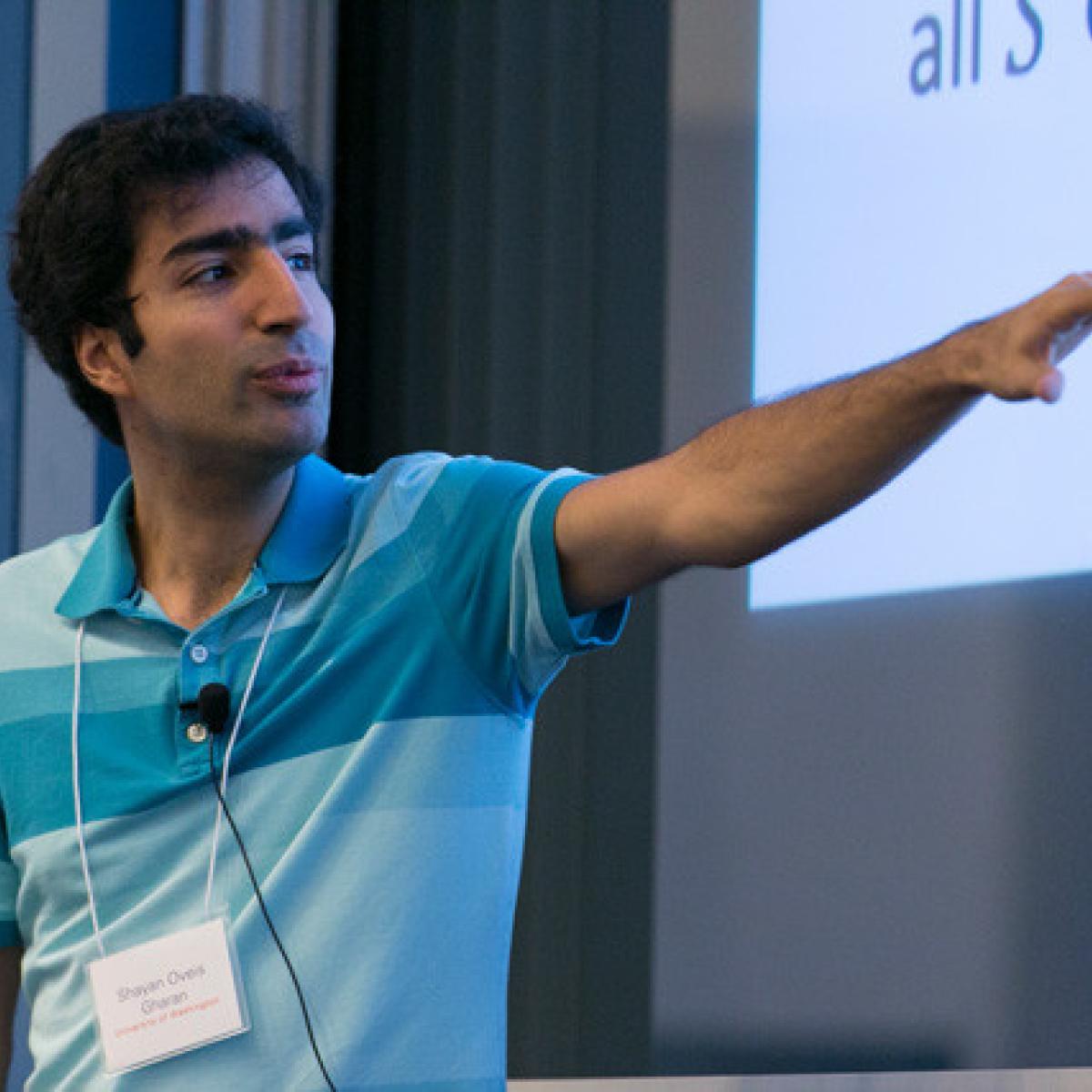
Shayan Oveis Gharan is a Professor in the University of Washington 's Computer Science and Engineering department. His work bridges algorithm design, applied probability, and spectral graph theory, with a focus on leveraging Markov Chains and polynomial paradigms in approximation algorithms. Education: PhD in Computer Science from Stanford University (2013) Research interests span theoretical computer science, combinatorics, and optimization. He explores how algebraic techniques, particularly log-concave and hyperbolic polynomials, can enhance spectral graph theory and counting/sampling algorithms. His studies on the Traveling Salesman Problem and matroid theory have redefined approximation bounds. Recent publications highlight advancements in trickle-down theorems, polynomial paradigms for graph sparsification, and high-dimensional random walks. These works intersect with fields like machine learning and computational complexity. Scientific awards include the 2025 Michael and Sheila Held Prize, 2022 Simons Investigator Award, and 2016 NSF Career Award. His students, such as Nathan Klein and Kuikui Liu, have transitioned to academic and industry roles.
Lecturer in Mathematics at Lancaster University, Sean Prendiville specializes in additive combinatorics and analytic number theory. His work bridges discrete Fourier analysis with problems in Ramsey theory and partition regularity. Institution: Lancaster University Academic Rank: Lecturer Research Interests: Additive combinatorics Analytic number theory Fourier analysis in number theory Nonlinear Diophantine equations Partition regularity Arithmetic Ramsey theory Publication Trends: Recent works (2024-2023) focus on quantitative bounds for nonlinear Roth-type configurations, multidimensional extensions, and Fourier uniformity in Sidon sets. Earlier contributions span polynomial Szemerédi theorems, matrix progressions, and mean value estimates in Weyl sums. Academic Activities: Co-organizer of the Webinar in Additive Combinatorics during the pandemic, editorial board member of the Proceedings of the Royal Society of Edinburgh Section A: Mathematics , and contributor to lecture notes on Fourier analysis in combinatorics and Ramsey theory.