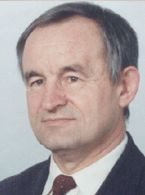
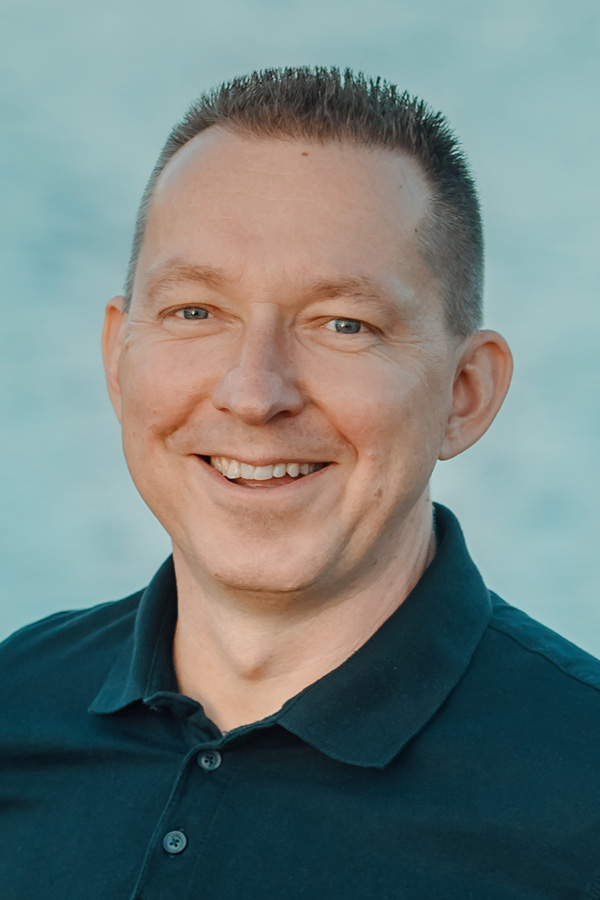
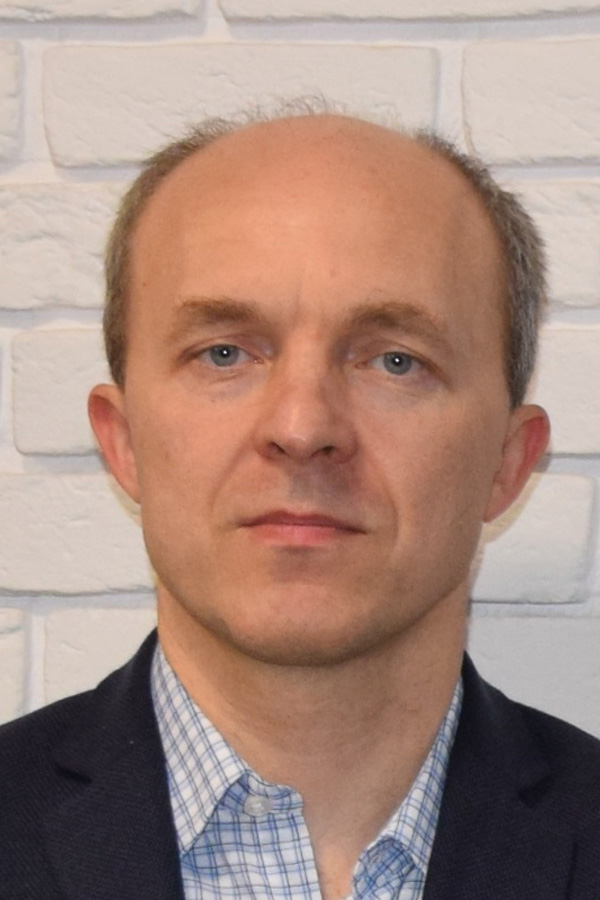
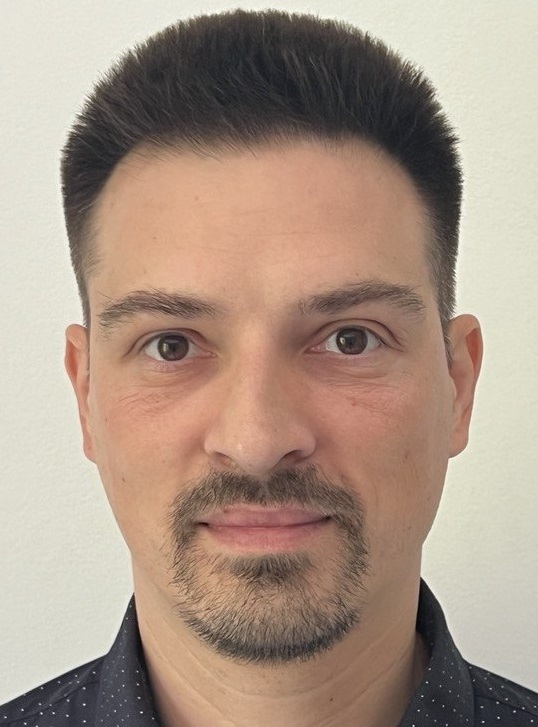
Sebastian Ernst is a Lecturer at the Department of Applied Informatics, Faculty of Electrical Engineering, Automatics, Computer Science and Biomedical Engineering, AGH University of Science and Technology in Kraków. His research focuses on Computer Science , Artificial Intelligence , and Smart Cities , with a strong emphasis on Geographic Information Systems (GIS) and Energy Efficiency in urban environments. University: AGH University of Science and Technology Faculty: Electrical Engineering, Automatics, Computer Science and Biomedical Engineering Department: Applied Informatics Position: Lecturer Contact: ernst@agh.edu.pl Office: C-2, 4th floor, room 424 Phone: +48 12 617 51 95 His recent publications highlight trends in Graph-Based Modeling , Smart Lighting Systems , and Robust Algorithm Design for urban infrastructure. He explores Pairwise Comparisons , GIS Applications , and Energy Conservation through computational methods.
Krystian Jobczyk is a Professor at the Department of Applied Informatics , Faculty of Electrical Engineering, Automatics, Computer Science and Biomedical Engineering , AGH University of Science and Technology in Kraków. His research focuses on fuzzy logic, temporal logic, and their applications in knowledge engineering, artificial intelligence, and business process modeling. He is affiliated with the Disciplinary Council for Technical Information Technology and Telecommunications at AGH. Research Interests : Fuzzy logic systems and their categorial interpretations Temporal logic frameworks (e.g., Halpern-Shoham logic) for digital circuits and planning Process mining and business process modeling Philosophical and model-theoretic aspects of logic Publications highlight his work on fuzzy-temporal integrations, multi-agent systems, and logic-based verification methods. Key trends include applications of fuzzy integral logic, convolution-based approaches, and interdisciplinary bridges between logic and computer science. Contact : jobczyk@agh.edu.pl | krystian_jobczyk@op.pl | +48 12 617 50 64 | Room 319, Building C-2, 3rd floor.
Leszek Kotulski is a Professor at the Department of Applied Informatics, Faculty of Electrical Engineering, Automatics, Computer Science and Biomedical Engineering at AGH University of Science and Technology in Kraków. His office is located in building C-2, 4th floor, room 425, with contact number +48 12 617 51 93 and email kotulski@agh.edu.pl. He serves on the Disciplinary Council for Technical Information Technology and Telecommunications. Professor Kotulski's research focuses on graph-based computational methods applied to smart city infrastructure, particularly in energy-efficient street lighting systems and IoT networks. His work integrates graph transformations, multi-agent systems, and spatial data processing to optimize urban infrastructure. He has developed innovative approaches for digital twin generation, lighting system modernization, and energy conservation in urban environments. His research bridges computer science with practical urban engineering challenges, creating solutions that improve both efficiency and sustainability of city infrastructure. Analysis of his recent publications reveals a clear research trajectory focused on applying graph theory to urban infrastructure challenges, with a particular emphasis on lighting systems. His work demonstrates increasing sophistication in integrating IoT networks with graph-based computational models, evolving from basic lighting control systems to comprehensive smart city solutions involving digital twins and distributed network configurations. The interdisciplinary nature of his research connects computer science, electrical engineering, and urban planning, with consistent contributions to both theoretical frameworks and practical implementations. Professor Kotulski has made significant contributions to the field through his development of graph-based methods for optimizing public lighting systems, energy conservation in smart cities, and spatial data processing techniques. His work on reactive power compensation algorithms for street lighting and graph-based approaches to lighting retrofit projects demonstrates practical applications of his theoretical research. His research activities include leadership in the GRADIS (Graph-based Distributed Adaptive Design) project and contributions to the Alvis modeling language for embedded systems. He has developed multi-agent systems supporting automated photometric computations and large-scale lighting design, creating frameworks that enable more efficient urban infrastructure planning and management.
Konrad Kułakowski is a Professor at the Department of Applied Informatics within the Faculty of Electrical Engineering, Automatics, Computer Science and Biomedical Engineering at AGH University of Science and Technology in Kraków. His research spans multiple domains including decision support systems, operations research, and robotics, with a focus on pairwise comparisons methods and their applications in optimization problems and automated systems. Affiliation: AGH University of Science and Technology School: Faculty of Electrical Engineering, Automatics, Computer Science and Biomedical Engineering Department: Applied Informatics His research interests center on improving accuracy and resilience in pairwise comparisons methods, detecting manipulation in decision-making processes, and optimizing path planning for automated guided vehicles (AGVs) in constrained environments. His work bridges theoretical advancements in decision analysis with practical applications in robotics, real-time systems, and biomedical engineering. Key trends in his recent publications include: Advancements in heuristic algorithms for pairwise comparisons matrices Applications of Monte Carlo simulations for method validation Path planning optimization for AGVs in irregular layouts Detection of manipulation in peer assessment frameworks Resilient aggregation techniques for secure judgments in AHP
Jacek Bojarski is a Professor at the University of Zielona Góra's Institute of Mathematics, with office location in Room 503 A-29. His academic work bridges theoretical mathematics with practical applications across multiple scientific domains. Research Profile Professor Bojarski's research spans several interconnected mathematical disciplines: Theory of operators on locally convex and Banach spaces, including integral representations and spectral theory Nonlinear analysis focusing on iterative methods, fixed point problems, and Volterra-type integral equations Game theory applications to stochastic, multigenerational, and large-scale decision systems Graph theory with emphasis on coloring problems and combinatorial structures Nonlinear wave propagation including Korteweg-de Vries equation extensions Iterative Gaussian and Archimedes-Borchardt algorithms for mean determination His work demonstrates strong connections between abstract mathematical theory and real-world applications in sustainable energy, industrial processes, and scientific modeling. Teaching and Applications Professor Bojarski teaches statistical analyses, econometrics, modeling of random phenomena, and programming with R and Python. His research is conducted through the Center for Applications of Mathematics and Computer Science (OZMI), which promotes interdisciplinary collaboration on practical problems using advanced mathematical methods. This center develops optimization techniques for sustainable energy, healthy society initiatives, and industrial processes through specialized software modeling.
Dr. Marta Borowiecka-Olszewska is a researcher at the Institute of Mathematics at the University of Zielona Góra, Poland. She contributes to interdisciplinary research through the Center for Applications of Mathematics and Computer Science (OZMI), focusing on sustainable energy, healthcare, and industrial optimization. Her academic work spans graph theory, operator theory, and nonlinear analysis, with applications in mathematics, computer science, and econometrics. Research Focus: Her research includes hereditary properties in graphs, spectral theory of operators, fixed-point theorems in uniformly convex spaces, and preference models using graded/interval relations. Teaching: She teaches courses in probability theory, time series analysis, and combinatorial foundations of computer science, including Erasmus and international collaborations with Chongqing Normal University. Projects: Participates in the EU-funded "Modern teaching and practical cooperation with entrepreneurs" development program (POWR.03.05.0-00-00-Z014/18). Her work also involves iterative methods for Gaussian algorithms, mean invariance, and Volterra-type integral equations in nonlinear analysis.
Sebastian Czerwiński is a faculty member at the University of Zielona Góra's Institute of Mathematics. He holds a doctoral degree and maintains an active research profile across theoretical and applied mathematics. His research interests include: Additive and combinatorial number theory Diophantine approximations and graph coloring Probabilistic methods and Ramsey Theory Multivariate linear models and stochastic equations Nonlinear wave propagation and Fourier series approximation Fixed point problems and combinatorial geometry Dr. Czerwiński teaches linear algebra, mathematical analysis, number theory, cryptography, and algorithmic methods while also delivering popular science lectures for school students. His work connects theoretical mathematics with practical applications through the Center for Applications of Mathematics and Computer Science (OZMI), focusing on sustainable energy, healthy society, and industrial processes. His research on iterative Gaussian algorithms and nonlinear analysis contributes to both pure mathematics and real-world problem solving across multiple disciplines.
Anna Fiedorowicz is a faculty member at the University of Zielona Góra , affiliated with the Institute of Mathematics and the Department of Mathematics and Natural Sciences . She specializes in graph theory , focusing on problems such as coloring, domination, and centrality indicators in graphs and networks. Teaching Activities: Database systems 1 Database 1 Database 2 Databases in web applications Basics of database system management and security Graph algorithms Research Interests: Graph coloring and domination problems Graph games Centrality indicators in graphs and networks
Mateusz Kubiak is a researcher at the Institute of Mathematics of the University of Zielona Góra , focusing on advanced mathematical theories and their applications. His work spans functional analysis, approximation theory, and algorithmic methods. Teaching: Machine learning models, mathematical analysis, and remedial mathematics courses. Research: Investigates iterative methods for fixed point problems, Fourier series convergence, operator theory on locally convex spaces, and graph theory coloring models. Key Collaborations: Participates in EU-funded projects like the Widza Education Development Operational Programme , emphasizing modern teaching techniques and industry partnerships.
Janusz Matkowski is a Professor at the University of Zielona Góra, affiliated with the Department of NŚP (Exact and Natural Sciences). His work spans functional analysis, operator theory, and applied mathematics. Research focuses on functional equations, fixed point theory, and operator theory on locally convex spaces. He investigates graph theory, game theory, and combinatorial geometry for mathematical modeling of complex systems. His applied research involves stochastic equations, multivariate linear models, and approximation theory using Fourier series. He contributes to interdisciplinary projects in sustainable energy, industrial optimization, and decision support systems.
Prof. Maciej Niedziela is a faculty member at the Institute of Mathematics , University of Zielona Góra, Poland. His academic work spans mathematical modeling, nonlinear wave propagation, stochastic equations, combinatorial geometry, and approximation theory. He actively engages in teaching numerical methods, mathematical modeling, differential equations, and programming (R, Python). Research Interests: Nonlinear wave equations (e.g., Korteweg-de Vries, Gardner, Boussinesq equations) Stochastic inclusions and multivalued equations Fourier series summability and approximation theory Applications of computer science in secure data transmission and software development Iterative algorithms (Gaussian, Archimedes-Borchardt) and fixed-point problems Combinatorial geometry and partitioning problems Teaching: He specializes in numerical methods, mathematical modeling, and data mining, while also contributing to computer science education. Contact: Email - m.niedziela@im.uz.zgora.pl
Joachim Syga is a researcher at the Institute of Mathematics, University of Zielona Góra, Poland. He holds a doctoral degree and is actively involved in both teaching and research activities within the mathematics department. His research spans multiple advanced mathematical domains: Existence and properties of multivalued stochastic integrals and inclusions Operator theory on locally convex spaces including integral representations and spectral theory Combinatorial geometry focusing on n-dimensional Euclidean space partitions and polyhedral decompositions Graph theory with emphasis on various coloring models Mathematical means theory and iterative Gaussian algorithms Fixed point problems and convergence conditions Nonlinear wave propagation related to Korteweg-de Vries equations Dr. Syga teaches a comprehensive range of mathematics courses including mathematical analysis (1, 2, 3), ordinary and partial differential equations, financial engineering, control theory, operational research, mathematical modeling, insurance mathematics, and actuarial methods. He also conducts popular science lectures and workshops for primary and secondary school students through the Center for Applications of Mathematics and Computer Science (OZMI), which promotes interdisciplinary collaboration in solving practical industry and business problems using advanced mathematical methods.
Rafał Zalas is a researcher at the Department of Computer Science Applications at the University of Zielona Góra. His work spans diverse mathematical and computational domains, including iterative methods for fixed point problems , approximation theory using Fourier series , combinatorial geometry , and multivalued stochastic equations . His research focuses on convergence conditions for non-expanding operators, summability of Fourier series, and combinatorial properties of geometric partitions. He also explores applications in economics, social sciences, and computer science education, particularly through open-source tools. At the Institute, he teaches operational research and mathematical analysis . His projects include EU-funded initiatives like Modern teaching and practical cooperation with entrepreneurs .
Michał Bartyś, PhD Eng., is an Associate Professor at the Institute of Automatic Control and Robotics, Faculty of Mechatronics, Warsaw University of Technology. His research focuses on automation, robotics, and industrial process monitoring, with a specialization in control systems, fault detection, and real-time diagnostics. Science discipline: Automation, Electronics, Electrical Engineering, and Space Technologies (AEEEST) Expertise: Fault detection, actuator dynamics, fuzzy logic applications Projects: 3 funded initiatives Patents: 6 inventions His recent work examines electro-pneumatic actuator dynamics, fault diagnosis robustness, and energy-efficient robotic operations. He employs graph theory and hybrid inference methods to enhance diagnostic systems. Scientific output includes publications on Modbus vulnerabilities, image fusion for real-time monitoring, and decentralized industrial diagnostics. He has promoted 143 theses and supervises ongoing research in mechatronic systems and industrial safety. Contact: michal.bartys@pw.edu.pl
Krzysztof Malarz is affiliated with the AGH University of Science and Technology in Kraków, Poland. He is an active academic researcher with a focus on interdisciplinary studies bridging computational physics , nanomedicine , and social dynamics . Research Interests : His work spans opinion formation models (social impact theory, Heider balance), nanomaterials for biomedical applications (anticancer agents, fluorescent probes), and percolation theory in complex networks. Publication Trends : Recent articles emphasize computational modeling of social systems, bioinspired nanomaterials , and serotonin receptor ligands with antiproliferative properties. Collaborations : Frequent co-authors include M. Wołoszyn (computational physics), A. Mrozek-Wilczkiewicz (chemistry), and T. Kuliakowski (materials science).