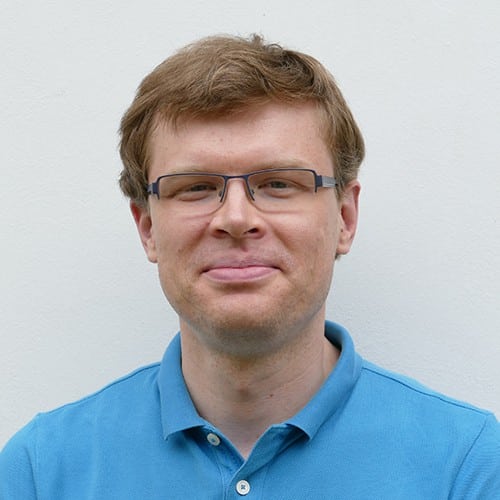
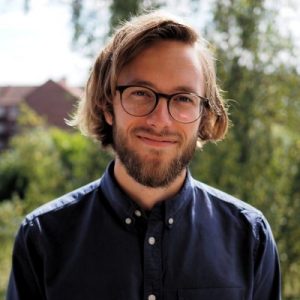
Søren Eilers is a Professor at the Department of Mathematical Sciences , University of Copenhagen. His research focuses on Operator Algebras , particularly the classification of C*-algebras related to discrete and low-dimensional structures. He is a member of the FNU network 'Automorphisms and Invariants for Operator Algebras' and advocates for experimental mathematics using computational methods in pure mathematics. Education: MS in Mathematics and Computer Science, University of Copenhagen (1993) PhD in Mathematics, University of Copenhagen (1995) Research Interests: Operator Algebras K-theory Symbolic Dynamics Discrete Mathematics Experimental Mathematics Recent Publications (2016-2024) demonstrate expertise in graph C*-algebras , symbolic dynamics , and computational approaches to pure mathematics, with key collaborations in Denmark, Japan, Canada, and the U.S. Scientific Leadership: President, Danish Mathematical Society (2006-2008) Principal Investigator, Villum Fonden (2012-2016) Main Organizer, Mittag-Leffler Institute Program (2016) Advisory Roles: Supervised 28 master's theses and mentored 9 PhD students/postdocs (2003-2022) across institutions in Denmark, Canada, Japan, and the U.S.
Martin Aumüller is a Lecturer in Theoretical Computer Science Algorithms at the IT University of Copenhagen . He serves as Head of Education and Master of Software Design , focusing on algorithm engineering, differential privacy, and similarity search. Research interests include: Algorithm engineering for high-dimensional data Locality-sensitive hashing and nearest neighbor search Privacy-preserving machine learning Fairness in approximate search algorithms Benchmarking and evaluation of similarity search tools Publications trends highlight his work on approximate nearest neighbor search , privacy-preserving techniques , clustering algorithms , and scalable outlier detection in high-dimensional spaces. His recent projects (2024-2025) focus on fairness, differential privacy, and efficient indexing. Grants and projects : DIREC (2020-2025): Digital Research Centre Denmark (Innovation Fund Denmark) DIREC: Bias and Benefit of Approximate Nearest Neighbor Search (2022-2025): Principal Investigator (Innovation Fund Denmark) BARC (2017-2024): Basic Algorithms Research Copenhagen (Villum Fonden) SSS (2014-2019): Scalable Similarity Search (European Commission)
Tuukka Ruotsalo serves as Associate Professor in the Machine Learning Section at the Department of Computer Science, University of Copenhagen. His research bridges human cognition with computational systems through brain-computer interfaces and physiological computing. As Academy Research Fellow at University of Helsinki (2019-2024), he maintained dual institutional affiliations while leading cutting-edge work in neuro-linguistic modeling and affective relevance. His research focuses on brain-computer interfaces for information retrieval , where he pioneers methods to decode cognitive states from neural signals to improve search systems. Key areas include affective relevance modeling that integrates emotional states into search algorithms, and neuro-linguistic reconstruction that translates brain activity into language. His work on fairness-relevance tradeoffs in recommender systems established Pareto frontier evaluation frameworks now widely adopted in ethical AI research. Recent publications demonstrate how physiological signals like EEG and galvanic skin response can create more adaptive human-information interaction systems. Ruotsalo's scientific recognition includes the prestigious Academy Research Fellow position. His publications in IEEE Transactions on Human-Machine Systems , Journal of the Association for Information Science and Technology , and Communications Biology reveal growing interdisciplinary impact. His advising spans cognitive neuroscience and machine learning students, with notable collaborations across the SCIENCE AI Centre. Current projects include the TreeSense initiative for remote sensing of global tree resources and development of quantum-inspired neural architectures. His lab leverages the department's powerful compute cluster for large-scale physiological data analysis.
Arijit Khan is an Associate Professor in the Department of Computer Science at Aalborg University, Denmark. He leads the Data Engineering, Science and Systems group and is affiliated with the Technical Faculty of IT and Design. His research focuses on Graph Neural Networks , Blockchain , Data Management , and AI interpretability . He is the Principal Investigator (PI) of a major project on Data Management, Fundamental Algorithms, and Machine Learning for Emerging Problems in Large Networks (2022–2027). Research Interests : Graph Data Management & Machine Learning Blockchain Transaction Analysis Large Language Model + Knowledge Graph Synergies Healthcare AI (e.g., ICU glucose prediction) Explainable AI for Graph Neural Networks Research Trends : His publications emphasize neuro-symbolic systems , uncertain graph analysis , and AI-driven blockchain insights . Recent work bridges large language models with knowledge graphs and explores GPU performance optimization via shader code analysis. Awards & Grants : No explicit awards listed, but his active research grants include a 5-year project on large network analysis with interdisciplinary applications in life and health sciences. Funding emphasizes algorithmic innovation and data science integration. Labs/Teams : Head of the Data Engineering, Science and Systems research group, focusing on AI for societal impact ('AI for the People') and scalable graph data systems. Collaborations span blockchain analytics, healthcare informatics, and GPU architecture design.
Mauricio Bustamante is an Assistant Professor at the Niels Bohr Institute , University of Copenhagen, specializing in theoretical high-energy astrophysics, astroparticle physics, and neutrino phenomenology. His research bridges cosmic phenomena with fundamental particle physics, focusing on ultra-high-energy neutrinos, cosmic rays, gamma-ray bursts, and new physics beyond the Standard Model. PhD in Physics (2012-2014) M.Sc. in Physics (2007-2010) B.Sc. in Physics (2001-2006) His work explores neutrino oscillations, self-interactions, and decay in extreme astrophysical environments. He contributes to major international collaborations like GRAND (Giant Radio Array for Neutrino Detection) and IceCube-Gen2, developing simulation pipelines and forecasting detection methods for EeV-scale neutrinos. Recent publications highlight energy-dependent flavor transitions, Lorentz invariance testing, and constraints on long-range neutrino interactions via DUNE and T2HK experiments. He actively participates in peer review for journals such as Physical Review D , Physical Review Letters , and Astrophysical Journal , and has attended conferences like TeV Particle Astrophysics (2017). His research emphasizes detector design, cosmic ray reconstruction via graph neural networks, and multi-messenger astronomy.
Kasper Green Larsen is a Professor in the Department of Computer Science at Aarhus University. His research focuses on theoretical computer science, machine learning, algorithms, and data structures. He has made significant contributions to boosting algorithms, PAC learning theory, and computational geometry. His work often bridges algorithm design with complexity theory, addressing challenges in optimization, memory efficiency, and lower bounds analysis. Key research areas include: Algorithmic Learning Theory (e.g., boosting, bagging, and PAC learners) Data Structure Design (e.g., invertible Bloom tables, succinct representations) Computational Complexity (e.g., lower bounds for dynamic and oblivious algorithms) Geometric Algorithms (e.g., hierarchical searching, range queries) Recent publications emphasize foundational advancements in learning theory (e.g., optimal weak-to-strong learning) and data efficiency (e.g., memory-reduced Bloom filters). His work frequently appears in top conferences like IJCAI, ICALP, and SODA, reflecting rigorous theoretical contributions with practical implications.
Teresa Anna Steiner serves as an Assistant Professor in the Department of Mathematics and Computer Science at the University of Southern Denmark, specializing in algorithmic research with emphasis on privacy-preserving computational methods and theoretical computer science. Her research centers on differential privacy mechanisms, where she investigates trade-offs between data utility and privacy guarantees through rigorous analysis of noise injection techniques like Laplace and Gaussian distributions. She extends this work to dynamic graph databases requiring real-time privacy protections and develops novel text indexing approaches for regular expression pattern matching, contributing to foundational advancements in algorithm design for sensitive data environments. Recent 2025 publications reveal a cohesive research trajectory focused on practical implementations of differential privacy across diverse data structures, with particular attention to variance optimization in noise mechanisms, edge-level privacy in evolving graphs, and efficient indexing for textual pattern recognition. These works collectively address critical challenges in balancing computational efficiency with robust privacy guarantees in modern data systems. No scientific awards were documented in the available information. Details regarding student advising or research grant funding were not specified in the provided materials.
Christian Kühn is a Professor of Multiscale and Stochastic Dynamics at the Technical University of Munich (TUM), affiliated with the TUM School of Computation, Information and Technology. He has been an External Faculty member at the Complexity Science Hub Vienna since 2017, reflecting his interdisciplinary engagement in complex systems research. His academic background includes a BSc in Mathematics from Jacobs University Bremen (2005), an M.A.St. from the University of Cambridge (2006), and a PhD in Applied Mathematics from Cornell University (2010). He held postdoctoral positions at the Max Planck Institute for the Physics of Complex Systems in Dresden and the Vienna University of Technology, where he also served as an APART-Fellow and Leibniz Fellow. Christian Kühn's research lies at the intersection of differential equations, dynamical systems, and mathematical modeling. He focuses on multiscale problems, the impact of noise and uncertainty in deterministic and stochastic systems, and adaptive networks. Central phenomena of interest include bifurcations, pattern formation, and scaling laws. His work bridges theoretical developments with applications in epidemiology, neuroscience, and complex network dynamics. His recent publications (2021–2024) reflect a strong trend in analyzing nonlinear and stochastic dynamics on networks, with applications ranging from epidemic modeling to synchronization and critical transitions. Key themes include explosive phenomena, adaptive network behavior, moment closure methods, and non-Markovian systems, demonstrating a consistent focus on foundational aspects of dynamical systems with practical relevance. Notable scientific awards include: Richard-von-Mises Prize, GAMM (2017) Lichtenberg Professorship, VolkswagenStiftung (2016) Best Paper Award, TU Vienna (2014) Leibniz Fellow, Oberwolfach (2013) APART-Fellow, Austrian Academy of Sciences (2012) While specific details about advised students are not provided, his role as a full professor and active researcher suggests involvement in mentoring graduate students and postdoctoral researchers. His work has been supported by prestigious grants such as the Lichtenberg Professorship. He leads research in multiscale and stochastic dynamics, contributing to both theoretical advances and interdisciplinary applications. Kühn is part of vibrant research environments at TUM and the Complexity Science Hub Vienna, collaborating with leading scientists in network science, applied mathematics, and complex systems. His work continues to advance the understanding of critical transitions and nonlinear behavior in high-dimensional and stochastic systems.
Katja Hose is a Professor in the Department of Computer Science at Aalborg University's Technical Faculty of IT and Design. Her research focuses on Data, Knowledge and Web Engineering with specializations in AI for the People and Artificial Intelligence and Machine Learning. She maintains an active research profile with numerous publications and projects. Department of Computer Science Technical Faculty of IT and Design Aalborg University Research areas: Query Processing, Semantic Web, Linked Data, Knowledge Graphs Professor Hose's research interests center on knowledge representation, semantic web technologies, and AI applications. Her work spans from theoretical database systems to practical applications in healthcare, environmental assessment, and microbial data analysis. She has made significant contributions to knowledge graphs, large language models, and semantic search technologies, with particular emphasis on addressing hallucinations in AI systems and improving table search in semantic data lakes. Her recent publications demonstrate a strong trend toward integrating knowledge graphs with large language models, developing evaluation frameworks for AI hallucinations, and applying data science to diverse domains including healthcare and environmental sustainability. Her research bridges theoretical computer science with practical applications that address real-world challenges. NLP4KGC Best Paper Award (2023) ESWC 2023 Best Demo Award (2023) 2020 AMiner AI 2000 Most Influential Scholars AIME 2020 Best Paper Nomination (2020) ESWC 2019 Best Demo Award Nomination (2019) Professor Hose leads multiple significant research projects including ARISTOTLE (AI for clinical risk assessment), DarkScience (microbial data analysis), and the Poul Due Jensen Professorate in Big Data and AI. She has supervised numerous PhD students and collaborates extensively across disciplines, particularly in healthcare applications of AI and environmental assessment technologies. Her research has attracted substantial funding from sources like Villum Fonden and Danish E-infrastructure Cooperation. She is actively involved in several interdisciplinary research teams, including collaborations with microbiologists on microbial dark matter projects and with environmental scientists on digital environmental assessment systems. Her work on the ARISTOTLE project demonstrates strong connections between AI research and clinical applications, while her DarkScience project bridges computer science with microbiology.
Maria Sinziiana Astefanoaei is an Assistant Professor at the IT University of Copenhagen , affiliated with the Data, Systems, and Robotics department. Her research focuses on spatiotemporal data analysis, urban computing, and graph algorithms using machine learning techniques. Research Interests: Spatial data analysis, Time series data processing, Large-scale visualizations, Machine learning, Human mobility modeling, and Embeddings. Projects: Principal Investigator for CCAI: Towards greener last-mile operations (2022-2023), contributing to cargo-bike logistics optimization, and Co-Investigator for the Pilot Hub project (2020-2022) funded by the Danish Agency for Research and Education. Publications: 2021 conference paper at CIKM '21 on spatiotemporal signal processing frameworks with neural machine learning models. Her work intersects computer science , urban logistics , and environmental sustainability , with applications in smart city technologies and multi-modal transportation systems.
Alvaro Torralba is an Associate Professor in the Department of Computer Science at Aalborg University, Denmark, affiliated with the Technical Faculty of IT and Design. His research focuses on symbolic search, heuristic functions, and planning algorithms within artificial intelligence and machine learning. Notable projects include the ConAn initiative exploring contrastive analysis for state-space exploration. He has contributed extensively to classical planning, probabilistic planning, and automated planning competitions, earning awards such as the First Prize in the Agile Track of the 10th International Planning Competition (IPC’23). His work often bridges theoretical advancements with practical applications, including game-based network update synthesis and believable non-player character development. Research outputs include over 60 publications since 2011, with a focus on optimizing search algorithms and enhancing planning efficiency through techniques like operator-potential heuristics and bidirectional search strategies. His scientific contributions span algorithmic innovation, verification methodologies, and large-scale abstraction evaluation. Collaborations and datasets include foundational work on PDDL generators and pattern databases, with open-access resources available via Zenodo. As a program committee member and award-winning researcher, Torralba actively contributes to advancing the frontiers of AI planning and decision-making systems.
Luisa Siniscalchi is an Assistant Professor (tenure track) in the Department of Applied Mathematics and Computer Science at the Technical University of Denmark (DTU), affiliated with the Cybersecurity Engineering Center and the Center for Quantum Technologies. Her research lies at the intersection of cryptography, cybersecurity, and theoretical computer science. Her research interests focus on secure multiparty computation (MPC) , zero-knowledge proofs , non-malleable and deniable protocols , post-quantum cryptography , and cryptographic primitives . She investigates foundational aspects of secure computation under minimal assumptions, aiming to achieve optimal round complexity and strong security guarantees in both synchronous and asynchronous settings. The recent publications highlight a consistent trend in designing efficient, secure, and practical cryptographic protocols, particularly in MPC and deniable authentication. Her work often appears in top-tier venues such as EUROCRYPT, CRYPTO, and TCC, demonstrating strong theoretical rigor and innovation. Key themes include black-box constructions, post-quantum security, and privacy-preserving mechanisms. Scientific Awards: No awards listed in the provided text. Luisa Siniscalchi is actively supervising PhD students in cutting-edge projects related to proactive post-quantum cryptography, long-term security of protocols, and dynamic graph algorithms. She collaborates with principal investigators such as Claudio Orlandi, Ivan Damgård, and Carsten Baum, indicating integration into major research initiatives at DTU. While specific grants are not detailed, her involvement in multi-year PhD projects suggests active grant funding. Labs and Research Groups: Cybersecurity Engineering Center, DTU Center for Quantum Technologies, DTU Active research in cryptographic protocols and algorithms
Martin Skovgaard Andersen is an Associate Professor in the Department of Applied Mathematics and Computer Science at the Technical University of Denmark (DTU), where he specializes in Scientific Computing. His research integrates numerical methods, optimization, and machine learning to solve complex computational problems in engineering and data science. Education: Ph.D., University of California, Los Angeles (2006–2011) M.Sc., Aalborg Universitet (2001–2006) Postdoc, Linköping University, Sweden (2011–2012) His research interests include optimization (particularly conic and stochastic programming), numerical algorithms, signal processing, system identification, and fast solvers for integral equations. He works extensively on matrix analysis, regularization, and low-rank approximations, contributing to both theoretical and applied advancements in computational mathematics. The recent publications highlight a strong trend in developing efficient numerical algorithms for large-scale optimization and solving integral equations. His work emphasizes preconditioning, matrix truncation, and Bayesian inversion, with applications in electromagnetics, structural health monitoring, and network identification. There is a consistent focus on improving computational efficiency and scalability of solvers. Scientific Awards: No specific awards mentioned in the provided text. Andersen actively supervises PhD students and leads multiple research projects, including those on non-symmetric conic optimization, data-sparse models, and fast direct solvers. He is the Principal Investigator (PI) on projects related to physics-informed structural health assessment. His collaborative network spans Denmark and international institutions, particularly in computational mathematics and engineering. Labs and Research Teams: He is affiliated with the Scientific Computing section at DTU, which focuses on high-performance computing, numerical algorithms, and mathematical modeling. His work is embedded in a collaborative environment involving researchers in optimization, control theory, and computational electromagnetics.
Professor Zhe Chen is a distinguished academic at Aalborg University's Faculty of Engineering and Science, where he leads research in Electric Power Systems and Microgrids within the Intelligent Energy Systems and Flexible Markets department. With an extensive publication record spanning over two decades and more than 1,200 publications, he has established himself as a leading expert in power engineering and renewable energy systems. Professor Chen's research focuses on Wind Turbine Engineering, Power Engineering, Control Strategy, Wind Power Engineering, Energy Engineering, and Reinforcement Learning. His work bridges theoretical advancements with practical applications in smart grid technology and microgrid systems. His research interests center around developing innovative solutions for renewable energy integration, power system stability, and efficient energy management. His recent publications demonstrate a strong trend toward integrating artificial intelligence with traditional power engineering, particularly in applying deep reinforcement learning to power system control, state estimation with noisy data, and optimization of power electronic converters. His work shows increasing focus on carbon emissions optimization, thermal management in power electronics, and the application of advanced neural network architectures to energy systems. MPCE 2023 Best Paper Award for research on reinforcement learning applications in electric vehicles MPCE 2022 Best Paper Award for distribution network optimization MPCE 2021 Best Paper Award for reinforcement learning in energy systems WATAB Best Paper Award 2005 for offshore wind farm research IEEE Fellow recognition for contributions to power electronics and renewable energy systems Professor Chen has supervised 27 PhD students throughout his career, demonstrating his commitment to academic mentorship. His current research is supported by significant grants including the Erasmus+ funded S3SF project (Smart Energy Solutions for a Sustainable Future) and multiple projects focused on machine learning-based stability analysis for multi-energy systems. His collaborative work spans numerous international partnerships, with recent projects involving researchers from China, Europe, and other global institutions. Professor Chen leads a research team focused on intelligent energy systems, working on advanced control strategies for microgrids, power quality analysis, and the integration of renewable energy sources into existing power infrastructure. His team is particularly known for innovative approaches to wind power integration and DC microgrid technologies.
Jonas L. Juul is an Assistant Professor in the Computer Science Department at the IT University of Copenhagen . With a background in network science and complex systems, he employs statistical methods, mathematical modeling, and computer simulations to study social networks, spreading processes, and human behavior. Focus areas include: information diffusion in social networks Disease spread mitigation in human populations Interdisciplinary collaboration with medical doctors, economists, and computer scientists Recent research highlights include improving statistical models for pandemic forecasting through the InForM project funded by the Novo Nordisk Foundation , and groundbreaking work on contact tracing optimization and information cascade dynamics. Notable recognitions: 2025 H.C. Ørsted Research Talent Prize 2024 Novo Nordisk Foundation Data Science Emerging Investigator Grant 2025 Young Academy membership He has contributed to mathematical modeling efforts during Denmark's COVID-19 reopening in 2020 and maintains active collaborations with institutions including Cornell University , Technical University of Denmark , and Niels Bohr Institute .